Travel Blog; July 18 to July 22 2012
One thing I forgot to mention in my previous blog, was the strange sight of a small tractor driving back and forth along the inter-tidal zone of beach at St Bees. At first we thought that maybe it was scraping up debris (syringe needles, plastic bags and the like), and then we thought that perhaps it had a permit to harvest sand-dwelling shell fish. In the end, we had to ask, and were told that he had a radiation detector fitted to the front, and he made daily checks of the beach for nuclear radiation that may have escaped from the local nuclear power station. Our informant was keen to point out that so far, no radiation had been discovered, and that the beach was perfectly safe. In witness to this safety, and despite the rain, there was a family of two adults and two small children (the only people other than the radiation detection man on the beach) building a sand castle.
Wednesday July 18 dawned as a very cloudy day. It was market day in Ambleside, so we went before breakfast to have a look. There were three stalls—fruit and veg; cakes; and one other that was so tented up because of the imminent rain, that we did not discover what it was actually selling. The fruit and veg stall certainly had fresh-looking produce, so we asked whether it was from local famers. The vegies mostly were, but the cherries were from Turkey, the plums from Spain, the oranges from South Africa, the asparagus from Peru and the apples from New Zealand. The cake stall had locally produced cakes, made of course from mostly imported ingredients. We bought some Eccles cakes, which were really just like I remembered them to be, and which I have never found in or around Melbourne. A truly international famer’s market!
Anyway, we left Ambleside straight after breakfast, and headed, in the rain, for Windermere and the road over the Kirkstone Pass. This road is the highest in the whole of England, and is spectacular—if you can get a glimpse of the valleys on either side through the rain and the mist!. Then on the Keswick and the M6 for bonnie Scotland. Flashing roadside display boards warned of the likelihood of heavy rain, and at times it really was. At other times the sun shone, and we enjoyed watching baby ducks and geese basking in the sun beside the lake at the Annandale Motorway services point as we had our morning coffee . But the rain started again, and we went through quite a number of minor floods on the way to St Andrews and our destination of Easter Kincaple. On arriving at the drive of the guest house, we were confronted by what looked like a moat with the drawbridge up—but it was nothing more than a huge puddle, some 50M long and the entire width of the lane. We managed to get through it without too much difficulty, but later we learned that several roads along which we had travelled earlier were by this time fully closed by floodwater.
The guest house is a very tastefully restored and furbished farm house, run by James and Lucy Cuthill, who are very good friends of Ann’s brother John. The farm has been owned by the Cuthill family since 1898, and is still very much a working farm, as well as the guest house. We were taken into St Andrews by James, to catch up with brother John, who had already booked a table for dinner at his favourite restaurant, The Dolls Hose. James insisted on dropping us off at the restaurant, and on collecting us later, so that we could really enjoy the hospitality! It was good to catch up with John, who we had not seen for about 5 years. He has now grown a beard, and looked very distinguished, if somewhat frailer than when we last met.
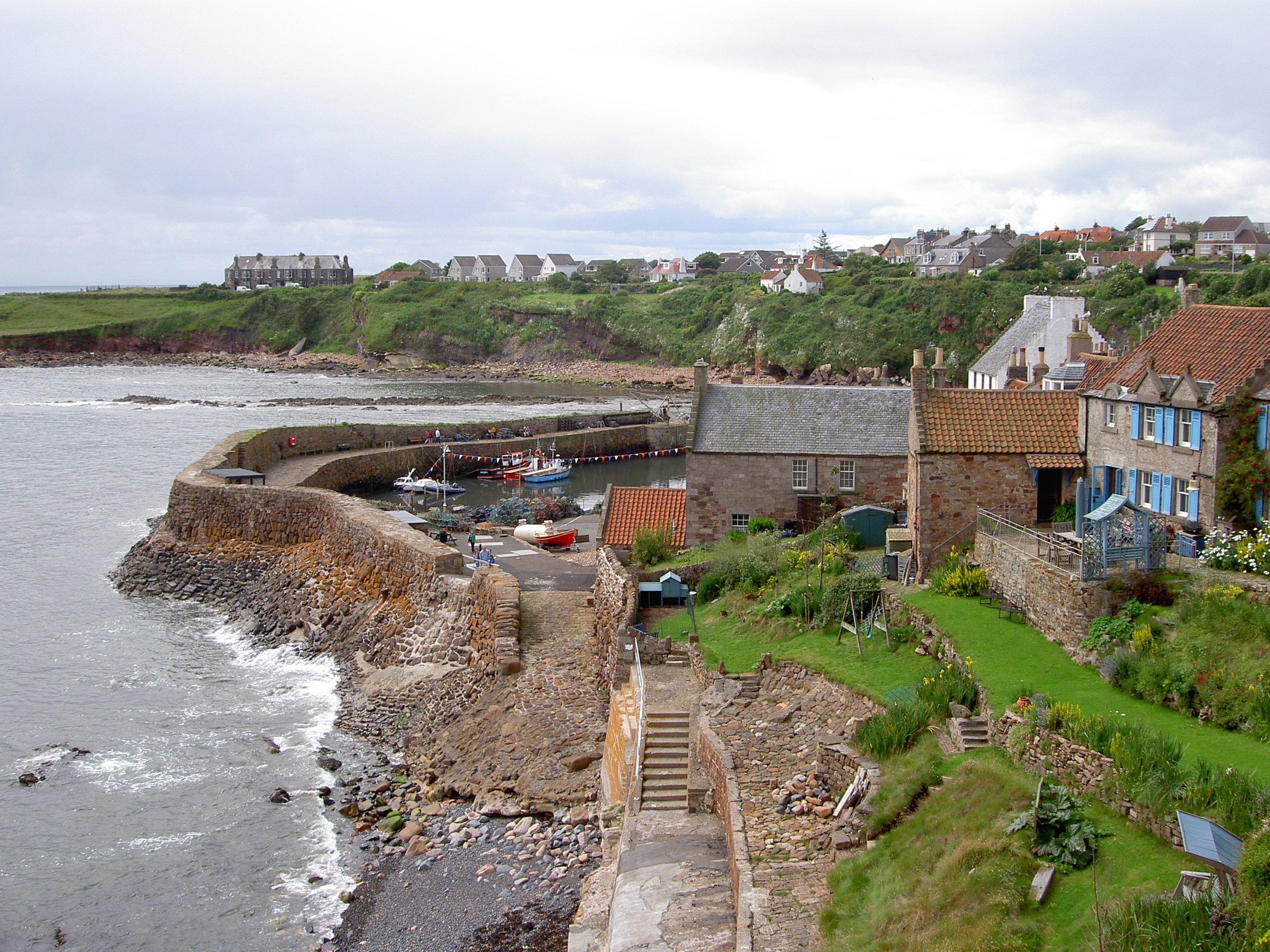
The following day, we went with John around the fishing villages of the EastNeuk, starting at Crail, passing through Anstruther (excellent fish and chips), Pittenweem, Sellardyke and St Monans. They are mostly tiny harbours, except Anstruther which is quite large; and Crail is perhaps the most picturesque. Crail claims to have the most photographed and painted harbour in Britain, and of course we had to add another photograph to boost the statistics. On this trip around the coast, we had a little rain, but nothing to worry about. Golf courses are everywhere, with several new courses developed recently. They all looked to be in very good condition, but several had a great deal of ‘casual water, from which one would get a free drop, if one could find somewhere dry enough to drop! Dinner this evening comprised all the food we had bought for our picnics, but which had not been eaten as the weather had been too inclement.
The following day was really one of eating and drinking with a variety of people, including our niece Gill, our nephew David, David’s partner Wendy, and of course John. Gill prepared a lovely meal and it was a great evening, sitting beside a roaring coal fire (first time for over 40 years). Who would had thought of the need for a coal fire in the middle of July!
On our final day in St Andrews, I was compelled to make a pilgrimage to The Old Course, and took the opportunity to walk to the Swilcan Burn. The fairway was glorious to walk on, and it was very difficult to tell where the fairway ended and the green began. Then it was farewells again, and we drove south to Rob and Sal’s just outside Leeds.
 Slingsby's Miscellany