We spent our last night in Strasbourg, Ann to view a spectacular fireworks and laser light show on the river, and me to sit on the balcony with a glass of local wine whilst I finished the Strasbourg blog—which I hope you have read by now.
Today (Wednesday) we said our farewells to Nicole and headed south toward Colmar, some 100k from Strasbourg. The weather was again very ‘summery’, and it was all very pleasant. We passed several vineyards, and noticed that the vines were double-trellised in the Scot-Henry fashion popular in Australian vineyards—and quite unlike the more traditional single trellising in, for example, Burgundy. The other thing we remarked on was that since leaving Normandy in the very west of France, and driving to Strasbourg in the very east of France, the major crop by far has been corn (maize). This is now grown for animal feed, for corn oil, and for ‘biogas’ (probably ethanol) for fuel. Apparently it is much more beneficial for the farmers, in terms of profits, but is distorting the whole food production chain, leading to shortages of some foodstuffs which now have to be imported.
The route took us largely on the route we had taken to Obernai, along the edge of the Vosges mountains. We could see many intact, and even more ruined, fortifications and castles, stemming from centuries of conflict between France and Germany, and were tempted to make detours to visit some. But in light of our propensity to get lost, we decided to stay to the pre-planned route.
After by-passing Colmar, we went to Neuf Brisach—a magnificently preserved fortified town built by Vauban, from scratch, starting in 1699. From the air it is a perfect octagon, surrounded by three lines of fortified embankments and ditches.
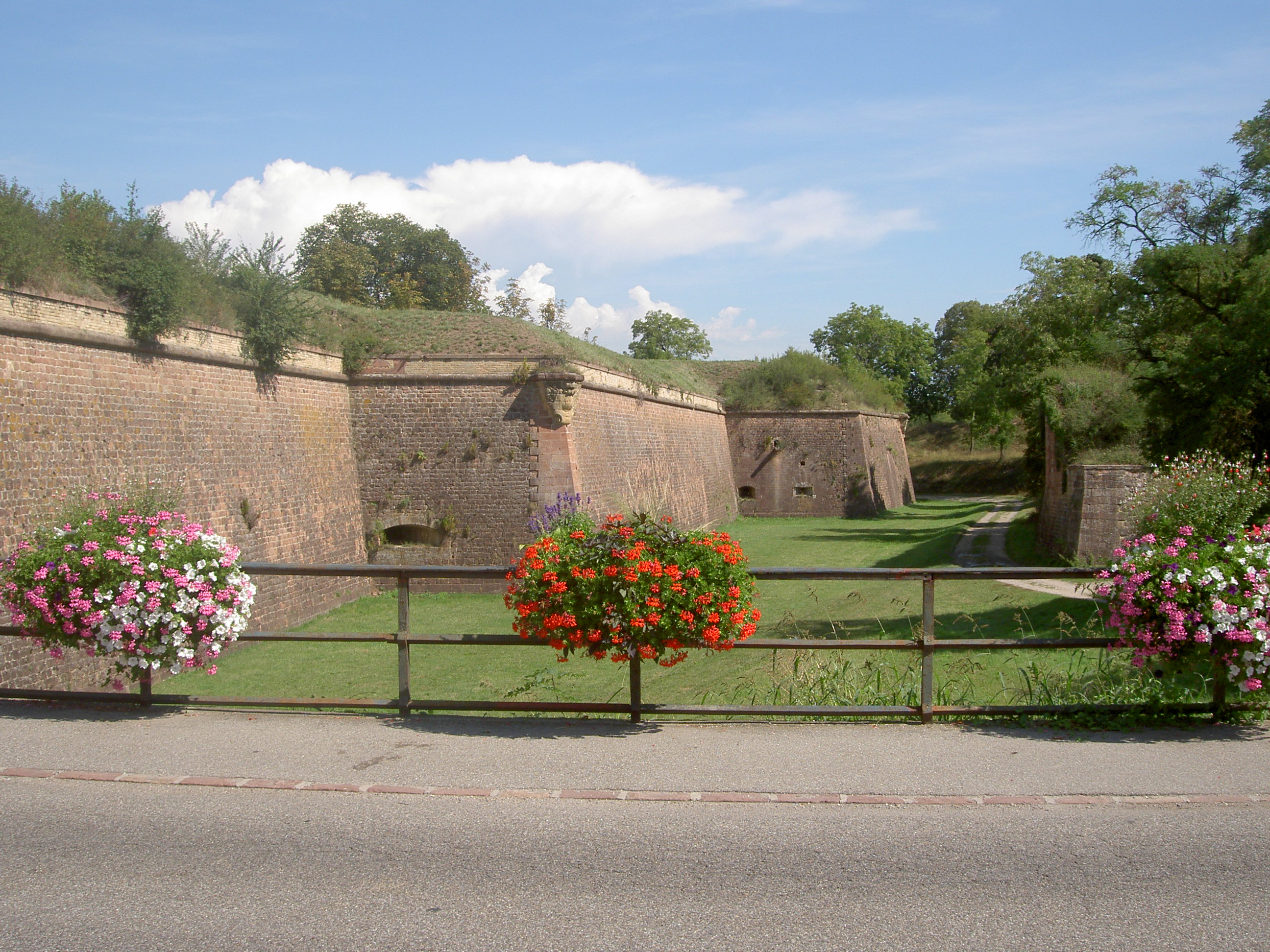
Unfortunately my photographs do not do it justice, and I have no scanner to be able to include the aerial-view postcard we bought. So you will have to take my word for it!. Anyway, it is described as being Vauban’s most complete work, and it served for centuries afterwards as a model for military architecture. So who was this chap Vauban? Vauban was born in 1633, and entered the service of King Louis X1V in 1653. He optimised the defensive system, drew plans for fortified sites and assured the protection of cities in times of siege. At the age of 34, he oversaw all of the kingdom’s defences, drew its territorial limits and developed a network of fortifications. He was also interested in peace and progress through human endeavour, and supported technological development. There are currently 12 major Vauban sites around France included in the World Heritage List of sites of cultural and historic significance, and many others, equally important, but for various reasons are not on the list.
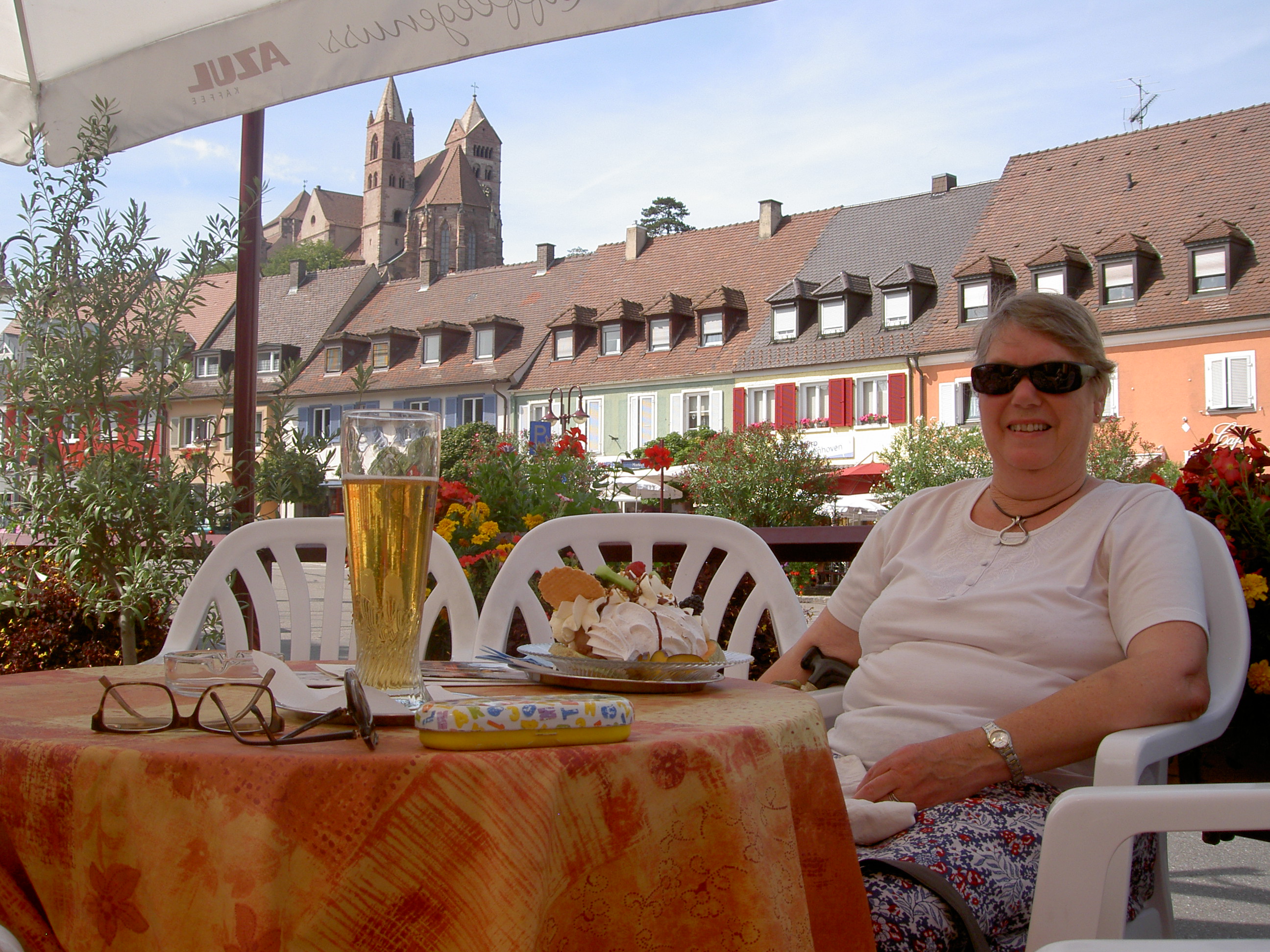
After a final French beer at Neuf Brisach, (necessary to maintain body fluid levels) we crossed the Rhine into Germany, and had our first beer on German soil. Or rather, I had a beer; Ann had a disgustingly large “ice meringue”, which she had difficulty in finishing because it was so large..
Then our navigational troubles started big-time. We had managed to get lost before in France, (I think I may have mentioned this before), but this time we had absolutely no idea where we were, and the unusual German signs with strange looking place names, made life very difficult! We drove a long way one way, then turned round and came back, and finally, after an hour or so, ended up just beside the Freiburg University Hospital. We decided it was a good place to phone our friend from, and she kindly offered to drive to the hospital so that we could follow her home!. There is no way we would have found it by ourselves. But arrived, we were made very welcome—another beer to restore our calm, and a good catch-up chat before an excellent dinner of very traditional Baden ham.
Our plans for the rest of our two full-day visit to Freiburg did not include the use of a car, but trams into the city centre, and a train trip into the nearby Black Forest to the resort town of Titisee.
After an early morning walk to the nearby bakery for fresh bread, and consuming much of it along with some ham and cheese for breakfast, we set off for the tram trip into the city. The German trams here are very similar to those we saw in Strasbourg, but squarer, and perhaps more masculine-looking. But they were comfortable, clean, and well patronised. The centre of Freiburg is a pedestrian precinct of streets and laneways paved with fairly small (about egg-sized) pebbles from the Rhine River, and very attractive. Another, and unique, feature of the central streets and alleys is that they all have a small stream, some 30cm wide and perhaps 10cm deep running along one side. The water is clear, and is diverted from the river Dreisam. It has a very efficient cooling effect in the hot summer—not that we needed it as it rained most of the time we were there.
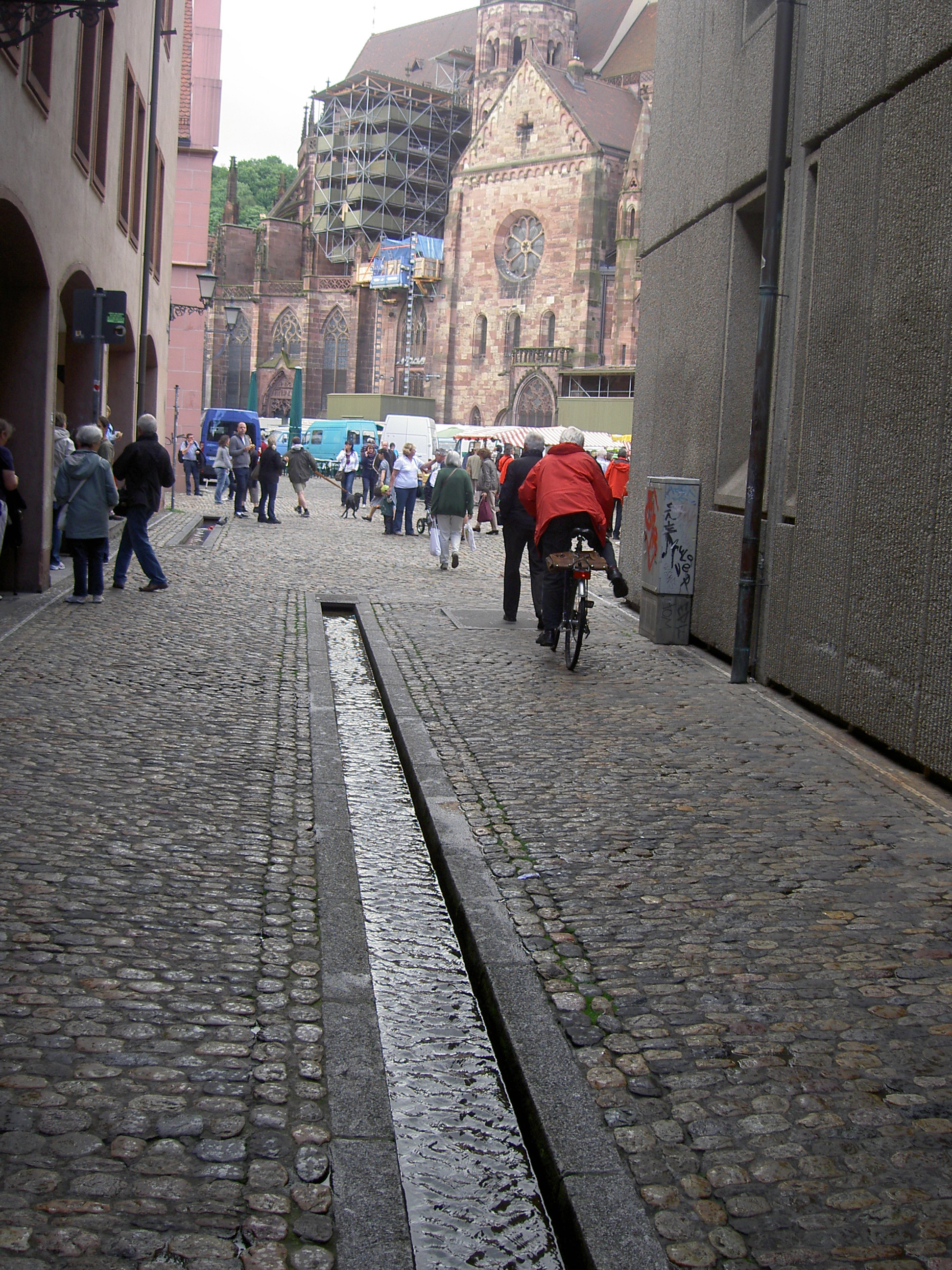
We wandered around the streets, not heading anywhere in particular, but taking in all the sights and different smells of foods as we passed innumerable restaurants and cafes. A visit to the Cathedral, with the second-highest spire in Germany, was very impressive, even though we could not see the stained glass at its best on such a dreary day. And then lunch— a typical German sort of hamburger with potatoes and sautéed vegetables, helped down with some local beer.
Then we took the train for the 35 minute ride way up into the Black Forest to Titisee. The climb was pretty steep, through a very narrow gorge, (The Devil’s Valley) and to our destination 859M above sea level. Titisee is a popular all-year resort, being a ski centre in winter, and health-giving fresh air in the summer. Sometimes the winters are cold enough for the lake to freeze sufficiently to permit ice skating. It would be a very pretty town in the sun—and was not too bad even in the rain! Every building was either a hotel, a restaurant/bar, or a souvenir shop, many of which had very large collections of cuckoo clocks (for which the region is famous) for sale along with other traditional bits and pieces. Most had very attractive hanging basket and widow boxes of red geraniums. Here we met another friend and Dickensian, Helmut, for another beer and slice of Black Forest gateau, in a café overlooking the large glacial lake that gives the town its name. Then it was back down the mountain, and home for dinner, finished off with a glass of traditional Honig-Schnäpsle. (honey schnapps)
(I appear to have miss-filed some photos, so will post this now, and try to find them for a future blog)
Friday was much a repeat of Thursday, but with a more extensive walk around the town centre, visits to museums and art galleries, and no trip up the mountains. One museum visit was interesting in that the rather officious woman on duty did not take her eyes off us for a moment. She briskly ordered us to deposit our bags in a locker, and as we were closely studying a plan of old Freiburg looking for the Vauban fortifications, she ordered us not to stand too close, and not to touch it. We then went down to a basement level, and must have taken too long to cover the blind-spot between two security cameras, as she came to one of the landings and stood and watched to make sure we were not up to any mischief! It was quite unnerving, and I believe she would have made an excellent gestapo officer! Apart from that little experience, Freiburg is a lovely town, even in the rain—very clean, very quiet, bustling with activity and well worth a couple of days—-even if the language is incomprehensible!.
Saturday morning we left for Dijon, and I would like to be able to say that we found our way out without a mistake. We did manage to get away from our friends place OK, and to the filling station to get fuel, and then to the autobahn with no trouble. But then due entirely to the woefully inadequate and ambiguous signage, we found ourselves heading north instead of south, and had to go about 20k until we could get off and change direction. Then, a bit later, we missed the exit we wanted and had to go further south than was necessary before we could cross the Rhine back into France. But eventually we did, and we travelled cross country staying on green roads rather than freeways, to the old town of Belfort. Without sounding like a broken record, I have to say that this is another wonderfully preserved town protected by even more massive Vauban defences that we had seen hitherto. On past visits to France we have always tended to visit older ruined castles, the beautifully romantic chateaux, abbeys, and so on, but this Vauban stuff, far from being romantic and picturesque, is massive, masculine, and absolutely fantastic! Quite why we have never taken an interest before, I’m not sure. But this trip it has really sucked us in!
After Belfort, we continued along the Doubes Valley toward Besançon, and have now put up in a very French hotel in the small, ancient town of Baume-les-Dames for the next three days. The next blog will tell you all about that part of France.
 Slingsby's Miscellany