The train to Paris left on time, as one would expect, and it was rather nice to watch the countryside slip by without having to concentrate on driving. Arrived at the Gare St Lazare, it was a simple taxi ride to the Hotel Studia on Boulevarde St Germain. Simple for us, of course, no quite so for the Taxi driver. Cars, busses, cycles, both motor and pedal, seem to behave like the same poles of hundreds of magnets—that is to say they came very close, at reasonable speeds without ever coming into contact. It was an entertainment in itself being driven in Paris. Unfortunately the taxi meter keeps ticking, even when stuck behind a bus that has become jammed between some road works and a lamp-post, so the trip was a little more expensive than it might have been.
Hotel Studia has lost none of the shabbiness that we remembered. The room we had on the third floor was spotless, the linen equally clean, and the bed very comfortable. The carpet on the floor was threadbare, as was the stair-carpet, and the lift was perhaps even slower than 5 years ago. But it has made some progress toward modernity in that one could pay using Visa card, and there was free WiFi—but only in the reception area, not in the rooms.
For dinner Saturday night, we went to a little place nearby that we had been to on a previous trip. The food was good, and very simple, but a bit more pricey than before and therefore not quite such good value. Monsieur le Patron was still there, as unsmiling as ever, but no sign of Madame, his wife.
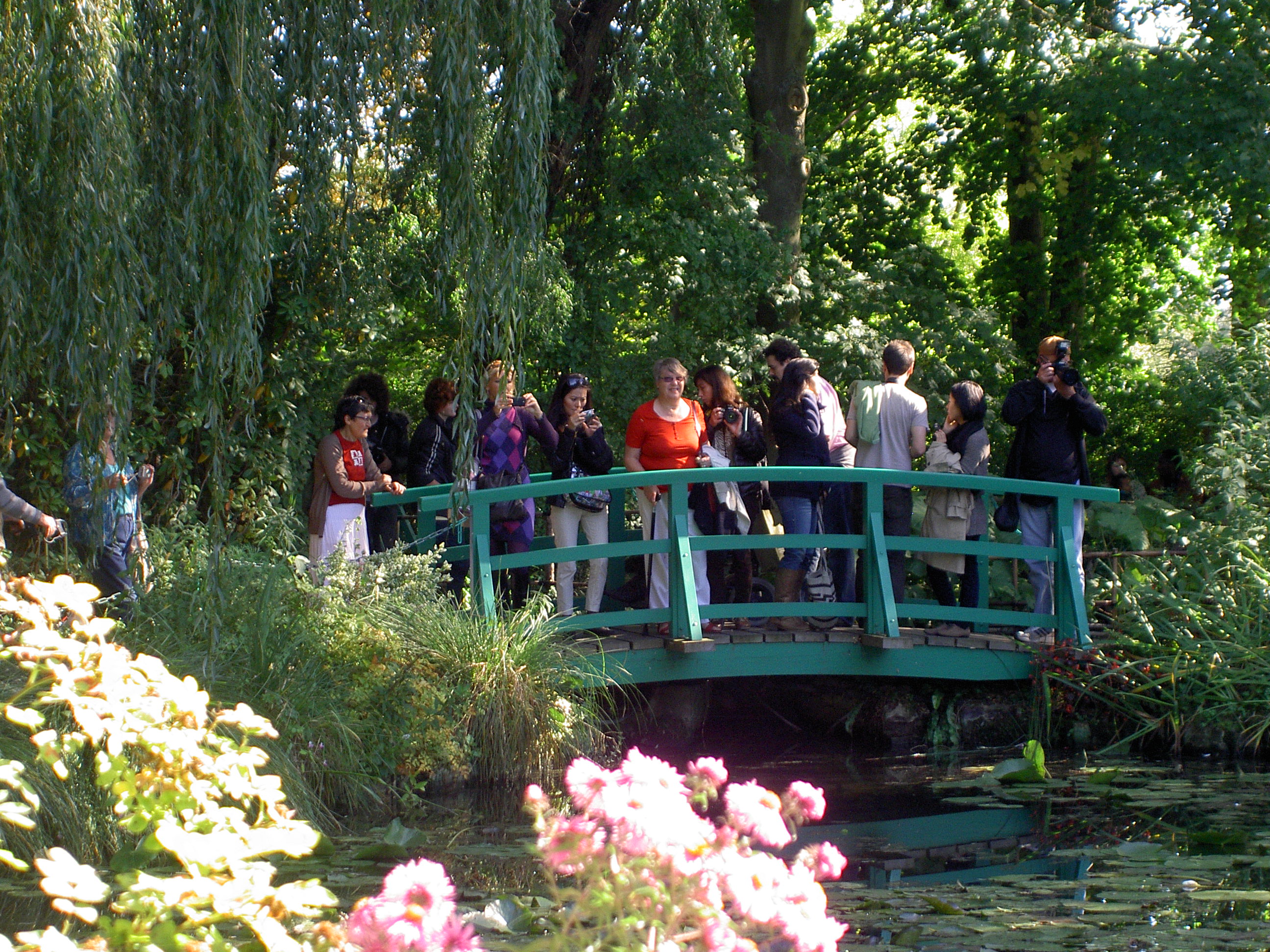
Sunday dawned very pleasantly so we decided on a bus trip to Monet’s place at Giverney. There were eight in the minibus, of which 5 were Australian and three from the US. The minibus reached speeds of 150k on the autoroute, so the journey was not too long. It was lucky that when Monet bought his house, there was plenty of spare ground around it for car parking, but I doubt that he gave that much thought at the time. There were loads of people, but fortunately, being a bus trip, we were allowed in through a side entrance, as the normal queue was over 100m long when we arrived. There was a sort of one-way route through the “Japanese” gardens, over the famous bridge (not the original, however) over the end of the waterlily ponds. Progress was slow, as every small party wanted to take photo of each member standing on the bridge, but it gave plenty of time to see all the garden at leisure.
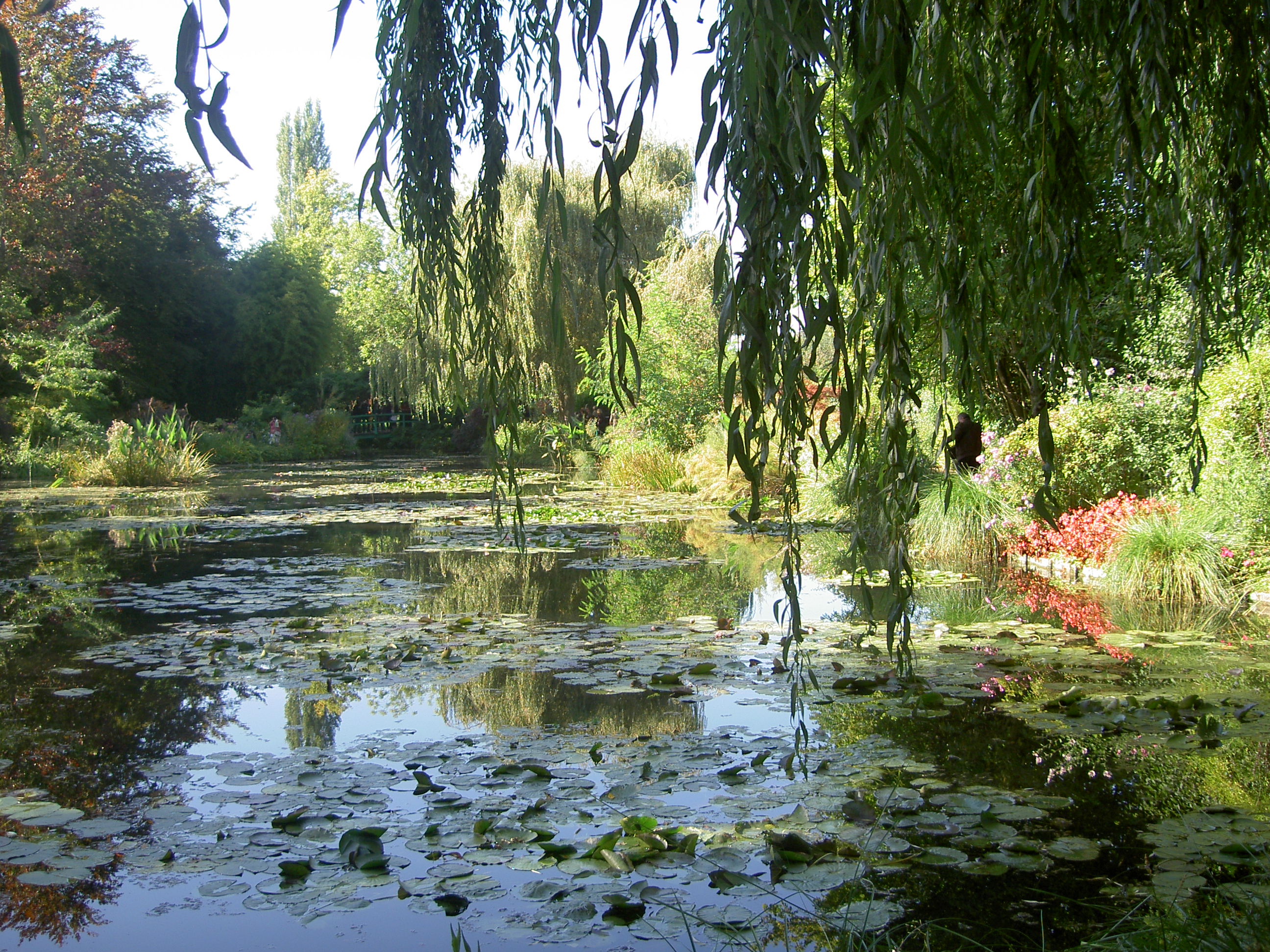
To reach the other garden and the house, the authorities have built an underpass under what would be a pretty busy road, and so that is the direction we took. This part of the gardens has an enormous range of plants, so there is always a mass of colour, and as the sun was shining, we were seeing it at its best.
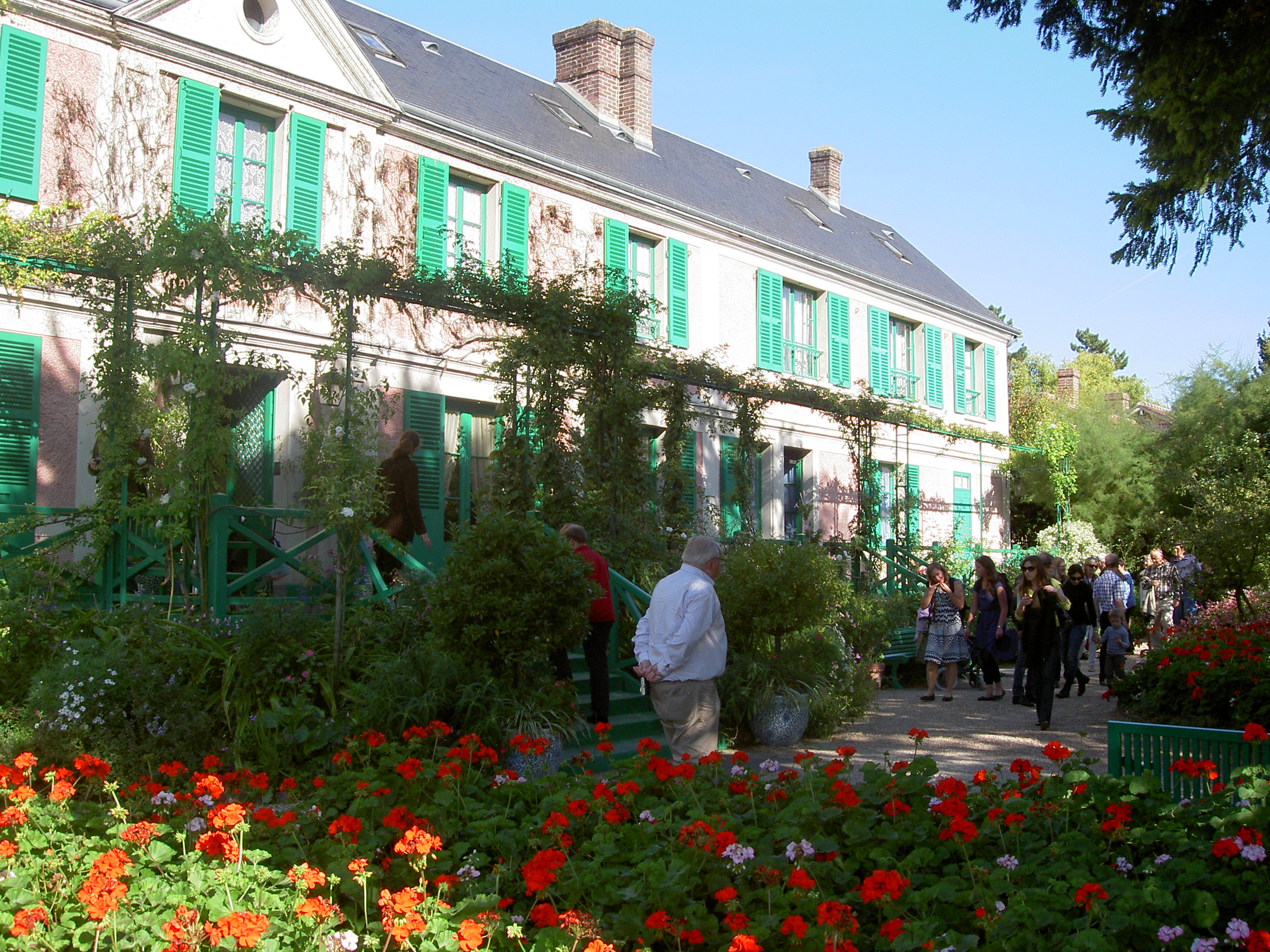
Mind you, not being much of a gardener myself, I would be hard pressed to name even one of them. The house itself is also interesting. One room, Monet’s studio, has been set up as it was at one stage during Monet’s life there, from photographic records. There are about 60 “Monet” paintings around the walls, just as there were back then. Except these are not Monet originals. The last Monet to be auctioned sold for 53million Euros, so the guide told us. 60 paintings at 50 mil each would be about 3 billion, and would require an enormous security effort to protect them. So these are all copies; but in all probability 99.9999% of the visitors would not be able to tell the difference! The art world is a funny business. These copies are pretty worthless, but to the non-expert, indistinguishable from the real thing. When Monet first started exhibiting his ‘impressionist’ paintings, he could not give them away. By the time of his death he was able to live comfortably, but now, I wonder what he would think if he knew how much people paid for his work. Even in the souvenir shop, people queued to by a whole range of trinkets with reproductions of his paintings on.
The return trip to Paris was very quick for the first half, but as it has been such a great day weatherwise, it seemed that half the population had been out, and were now returning home! The second half, from the point of view of distance, took nearly an hour longer than the first half. But get back we did, and made another poor choice of restaurant for dinner!
Monday morning was again very nice, so we caught the ordinary service (number 69) bus to Père Lachaise Cemetery, wherein lie the remains of thousands of people, some of whom are very well-known. It was for the well-known people that we looked, including Oscar Wilde, Edith Piaf, the writer Collette, the painters Delacroix and David. The cemetery is vast, and quite hilly. Not only that, the mausoleums, most of which resembled brick or stone telephone boxes at slightly tottering angles, were packed in with very little room to squeeze between them.
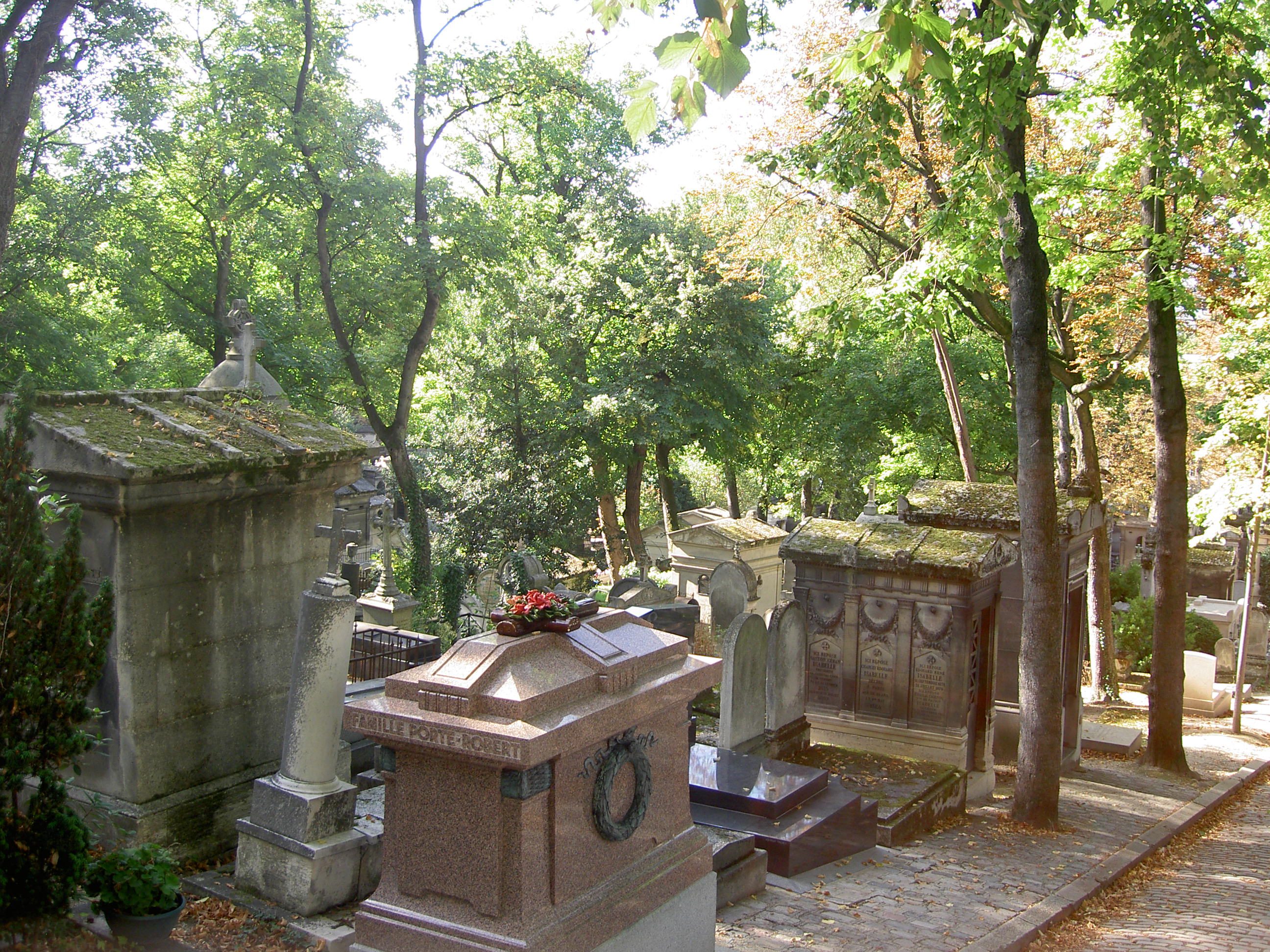
We picked up a map at the office, but failed to find anyone other than Edith Piaf and Oscar Wilde. The former was fairly easy to locate once we were within about 100m, because the remnants of the Piaf Fan Club were gathered in a cluster, singing “Milord”, rather flat and discordantly! Oscar was also easy, once we were within 100m because it is the only tomb in the whole cemetery to have been defaced—both by loyal admirers, and by his detractors. So bad has it become, that the authorities have enclosed the tomb in a very large Perspex box, which has also been so defaced as to render the tomb invisible; and around the box is a large fence, over which people obviously climb. It is such a pity.
After visiting the cemetery, we returned to central Paris by the number 69 bus, and went to an exhibition of works by French designers in the Hotel de Ville. The building itself is worth a visit, and the exhibition was also very good, The companies involved were very old established firms, some dating back several hundred years, such as the Lagiole knife manufacturer, and as well as their old traditional designs, the major focus was on works by their current designers. To be honest, I preferred some of the traditional designs, but it was interesting to see the newer pieces.
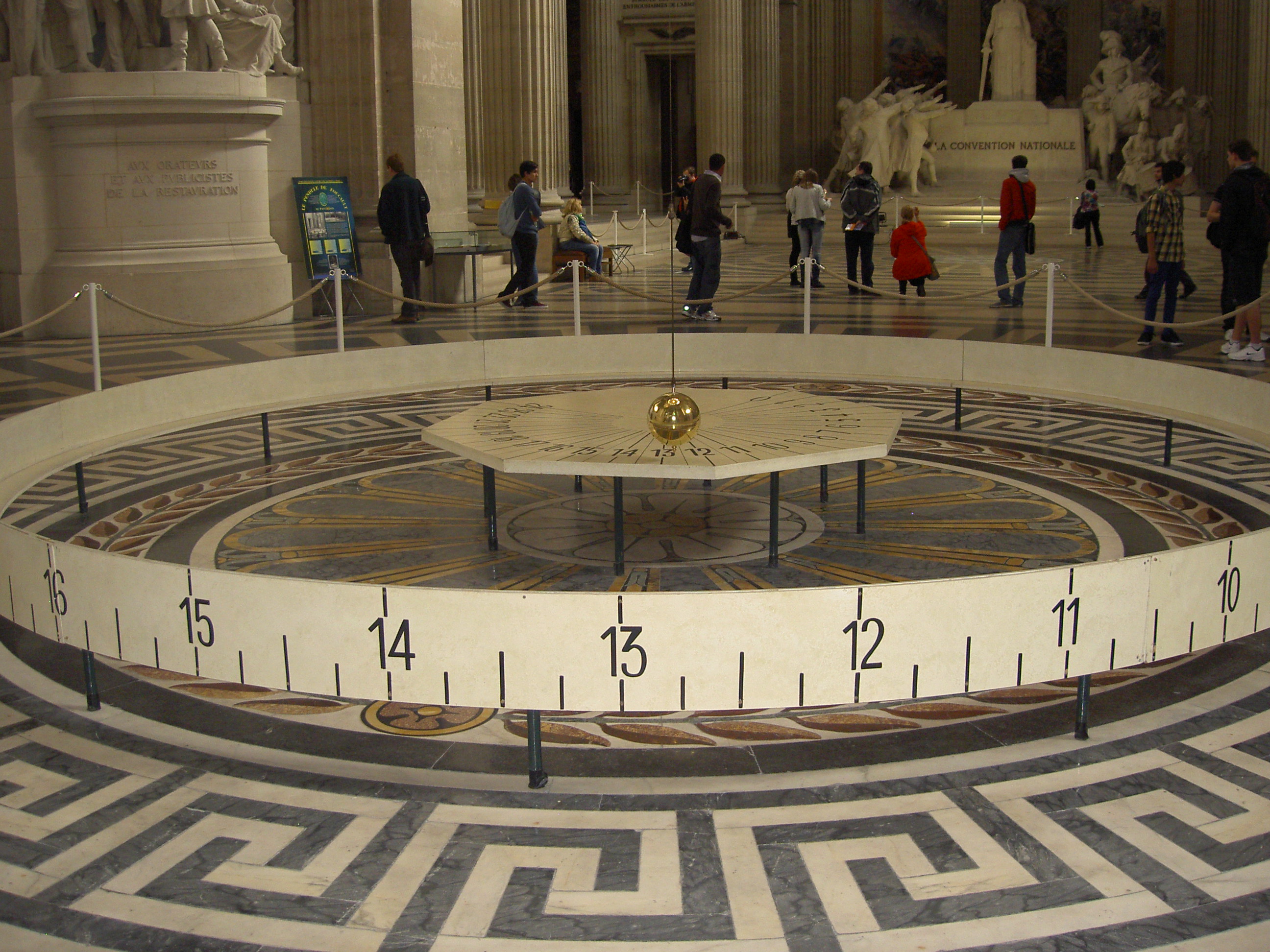
Tuesday morning we spent at the Panthèon, close by the Sorbonne University. Originally conceived in the 18th century as a fitting place for the remains of St Geneviève, (the Patron Saint of Paris), it has been used as a church, and more recently, as the final resting place for men and women of importance to France. For example, Victor Hugo and Madame Curie are there, along with Rousseau and Voltaire.
The main dome is where Foucault first demonstrated the rotation of the earth with his pendulum, and the pendulum is still there, although recently fitted with a shiny new ball. The paintings on the walls depict the life of St Geneviève, and other heroic deeds. It is very worth-while to spend a couple of hours there.
Following our visit, we had an excellent lunch in a restaurant at which we had dined on our previous trip to Paris, and this time we were not disappointed! When Baron Von Haussmann reconstructed Paris in the 19th century, some little corners escaped his bull-dozers, and this restaurant, dating from the 16th century is in one of them. Another area to escape the “Genie with the Lamp” was the ‘Latin Quarter’ in the vicinity of the Sorbonne. This is now a very popular restaurant area, with excellent little restaurants providing very good food at very reasonable prices.
The afternoon was spent in a local launderette—all very exciting! And we went to the Latin Quarter for dinner, followed by a Chopin recital in a very old church .The pianist was very good indeed, but the acoustic properties of the old church were such that there was far too much reverberation, so the music sounded a bit ‘muddy’.
On our last morning, we visited the Museum of the Middle Ages, housed in the Palace of the Bishops of Cluny, just along the Boulevard St Germaine from the hotel. Once again, the building itself is amazing and very worth a visit, having escaped Haussmann’s handiwork; and the exhibition of art, mostly religious, from the middle ages is excellent. The tapestries, including the Lady and the Unicorn, are extremely well preserved, and the other pieces of art, both large and small, are very well presented.
After a final Parisian lunch, we collected our luggage and took, what was for Paris, a very sedate taxi tide to the Gare du Nord for the Eurostar.
 Slingsby's Miscellany