Are we getting The Truth, The Whole Truth, and Nothing but The Truth?
The title of this essay is based on the guiding principles of our justice system. When presenting evidence in court, we are required to swear under some sort of oath, that we shall do just that. However, when it comes to evidence on the thorny subject of climate change, those principles are jettisoned in favour of ideological barrow-pushing by all sides of the debate. I am not a ‘climate scientist’, nor am I a ‘climate sceptic’, but I have had a thorough grounding in chemical, physical and biological sciences. For much of my early adult life I conducted research myself, and later, although I discontinued my career in research, I still worked very closely with many others who were actively involved in research. My background in a life of science has taught me to question what I read and hear, especially when there is so much apparently conflicting information. I have found, over the last few years, it has become increasingly difficult to determine who, if any, are right, and who are not. In this essay I shall identify such facts as I am able to in order to find out who is telling “The Truth, The Whole Truth, and Nothing but The Truth”, and who is not.
Here are four ‘truths’ that I am happy to believe and am prepared to accept.
- Atmospheric carbon dioxide levels are rising.
- Global temperatures are rising
- Polar ice caps and other glaciers are melting
- Sea levels are rising.
What I am not so certain about is the relationship between them, and that relationship therefore must be questioned. Do we have some chickens and eggs in this list?
Those most vocal, and those who are currently getting most air-time on radio and TV, and thus becoming more influential, seem to be pushing the line that there is a cause/effect relationship in the order in which I have listed the events. They are saying that the increasing CO2 levels are causing the increased temperatures, which in turn are causing the ice to melt, and hence increase the sea level. They are also saying that very soon it will reach a ‘tipping point’ from which there is no return, and catastrophic consequences will surely follow. They say we are already seeing glimpses of what is to come in the way of more severe floods and droughts, forest fires etc.Before we look for answers to the question of cause and effect, it is helpful I think, to first have a look at the earth itself, and then have a detailed look at the history of the climate for the last 18,000 years. To go back any further would be a waste of time, as it is 3 billion years or so of repeated cycles of warming and cooling, but not adding to our ability to predict what happens from now on!
As I understand it, the planet came into existence some 4.5 billion years ago, plus or minus a week or so, and probably on a Thursday afternoon. It is a roughly spherical ball of various materials, with a mass of something of the order of 6 X 1024 kg, or about 6,000 trillion tons. Much of it is covered by water, and the solid parts comprise an outer shell of loosely fitting slabs called tectonic plates, which slide about a bit on a core of less solid stuff, pushing up new mountain ranges as they bump into each other. It has a circumference at the equator of about 40,000km, and it revolves on a somewhat wobbly axis, once every 24 hours. That gives a speed of the order of 1,660 km/h at the equator, slightly in excess of the speed of sound (1,253km/h), and which is sufficient to cause the sphere to bulge in the equatorial region. In addition to that, the earth travels around the sun, a distance of some 940 million km at a speed of 11,000 km/h in an elliptical orbit, with enormous stresses as the curvature increases and decreases. The sun around which earth revolves is also an extremely dynamic ball of energy, with its own variations, all of which have their impact felt on earth. To add to these stresses, the moon pulls at it, continuously sloshing billions of tons of water about all over the planet. And then there are terrestrial volcanoes having various disruptive effects as the mood takes their fancy. Put simply, the earth might appear to be a solid, stable place to live, but it has to put up with an awful lot of stress, and it is totally unsurprising that its climate changes over millions of years with alternating hot and cold periods with varying durations and widely different extremes. And that is what has been noted and recorded. With all the possible sets of conditions and stresses, it is not possible to state with any precision exactly what causes these climatic conditions to change, or how long and frequent those changes may be. Suffice to say, the only thing constant is the change!
Now, a more detailed look at the last 18,000 years. We will pick up the story when the last of the major arctic ice sheets had already started receding and had shrunk to about as far south as London, give or take a mile or so. Quite what the change was that caused this shrinking we need not be too concerned about but whatever it was, it is absolutely guaranteed that it was not the burning of fossil fuels by Homo sapiens! It probably had a lot to do with the sun, and/or terrestrial volcanic activity. The ice sheet continued to shrink as the ice melted, but initially the temperature did not rise. So here is an experiment you can do for yourselves. Put a couple of kilos of ice in a bucket with a couple of bottles of beer, or if you prefer, champagne, and leave it for an hour or so. You will find that the drink gets cold, and the ice begins to melt, but stick a thermometer in and you will find the water in the bucket is still at 0o C. Take out one bottle, remove the cap and enjoy an icy cold drink whilst leaving the other bottle in the bucket with the rest of the ice melting in the sun. The temperature of the water in the bucket remains at zero degrees until all of the ice has melted, and only then does it begin to rise. But once it starts to rise, it does so very quickly and within a very short time, the second bottle is too warm to be enjoyed. The reason is very simple. It takes 80 calories of energy to melt one gram of ice at 0o C to one gram of water at 0oC, but only one calorie is needed to warm up the one gram of water by one degree. So, the 2 kilos of ice will require 2000 X 80, = 160,000 calories to melt to water at zero, but only another 2000 x 10 = 20,000 calories to warm it up to 10o C. So, scale that up by factors of many millions and it is pretty obvious that a huge amount of extra energy would be required to melt ice caps well before there is excess energy to start warming the planet.
But of course, eventually that point is reached. As the ice cap shrinks the albedo effect (ie the reflection of incident energy away from the surface and back into space) decreases, so more energy is available to be absorbed. And further, as the ice shrinks, the land previously buried under the ice is exposed, and being much darker in colour than the ice, does absorb the energy more readily. Once that point is reached, then the temperature will increase. The next step in the sequence you will have noticed with your warm beer! Not only is it warm, but it also probably fizzed all over the table as soon as you opened it, and certainly became ‘flat’ very quickly. This is because the solubility of gases, including CO2, is inversely proportional to the temperature. As the temperature rises, so the CO2 is displaced and enters the atmosphere. Thus, the increase in CO2 follows after the temperature rise, rather than causing it.
So let us put the list into the new order:-
- Polar ice caps and other glaciers are melting
- Global temperatures are rising
- Atmospheric carbon dioxide levels are rising.
- Sea levels are rising.
Pretty much the opposite of the conventional narrative, and all we have done is to replace one too simplistic scenario with another, equally simplistic, but at least with a thinking based on very well-established principles of physics.
A very quick word about sea level rise. Certainly, melting ice will contribute to the sea level, but ONLY if it is land-based ice. Floating sea ice and icebergs are already 100% included in the sea level of the time, and do not add a single millimetre when they melt. But the other factor that will increase the sea level is the thermal coefficient of expansion. For every degree that the sea warms, it will expand in accordance with the coefficient, and given the huge volume of sea water, even a small increase in temperature would be significant.
Now back to CO2 levels. Once the ice has melted and the land warms up, there will be a return of plant growth, which, of course, demands the photosynthesis of carbohydrates, a process by which CO2 is removed from the atmosphere. So on the one hand we have increasing CO2 thanks to the warming of the oceans, but on the other we have the removal of CO2 by the new plant life. So these factors will both have to be taken into account by those trying to tell us what is really happening.
Now we have seen the basics of what happens with climate change, even if we are not yet sure why, how or when each of the observed effects occur, let us pick up the story of the last 18,000 years.
Without any help or hindrance from Homo sapiens the arctic ice sheet continued to recede until about 1,000 years ago, in other words, for some 17,000 years until about 1,000 AD. By that time, the southern end of Greenland had become exposed from under the ice, and had become, as its name implies, a green and pleasant land. So green and pleasant that it attracted Vikings who came across in their boats from Scandinavia and established a colony there. They took with them some cows and lived very happily farming the land and drinking the milk for about 300 years. This was “the Medieval Warm Period”. The colony grew to about 3000 people, but the climate changed again, and at about 1,400 AD the “Little Ice Age” began, and the Vikings had to leave Greenland as it once again became a major ice sheet. This “Little Ice Age” with an average global temperature change of about 0.5 of a degree C lower than the preceding “Medieval warm Period” lasted until about 1,850, bringing us nicely to the Industrial Era, coinciding with the increased use of fossil fuels, starting in the early 19th century, and on-going.
So much for the “Truth”, but what about “The Whole Truth”?
- Burning fossil fuels adds CO2 to the atmosphere
- Increasing temperature adds CO2 to the atmosphere (due to decreased solubility in water)
- Increased temperature leads to better plant growth, which takes CO2 out of the atmosphere
- Better plant growth provides more food, and supports a growing population of Homo sapiens
- More humans consume more food, and therefore put more CO2 back into the atmosphere
The net consequences of ALL of these truths need to be considered before simply blaming fossil fuels for the problems yet to come!
So whilst as we have seen CO2 concentrations do appear to be associated with temperature increases, and one can see why it is believed that there is a direct causal relationship, with CO2 being the culprit, there are other factors which are never spoken about, but which must be taken into account.
Let us have a look at the growth since 1800, of the global population of Homo sapiens. In 1800 the global population was just about 1.0 billion, and Thomas Robert Malthus (1766-1834) had already theorised that populations grow geometrically whilst food production grew arithmetically. Within 200 years, by 2,000, it had grown to just shy of 8.0 billion, a geometric progression of doubling every 70 years or so. If that growth continues exponentially unabated, by 2070, a couple of decades beyond the date for which we have set the “net-zero target” for carbon emissions, the population will be of the order of 16 billion. Even if the increase is linear, the population will still have reached 10 or so billion.
The following graph shows very clearly how much more significant and dramatic the increase in population is, compared to the increase in temperature and CO2. But this never gets mentioned at all, despite it being by far the biggest elephant in the room!
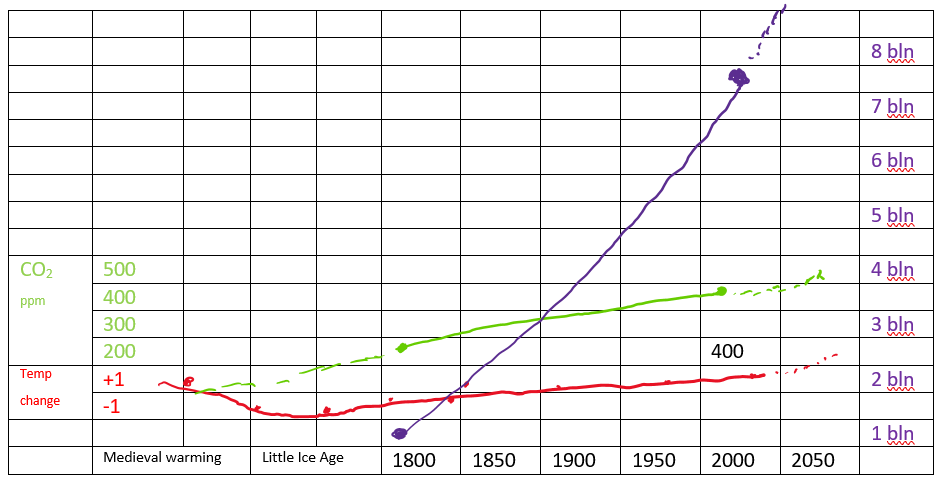
Population, billion (purple) temperature change +/- oC (red) Carbon Dioxide parts/million (green)
Dotted lines are projections.
Now here is another truth that is never mentioned! It is essential to understand that every single morsel of food that passes your lips, and the lips of your loved-ones, and of every single one of those billions of mouths, comes directly from the CO2 in the atmosphere! It has been the very fact of the increased emissions, and the increased temperature since 1800 that has enabled the population to grow as it has done for the last 200 years. Now today the activists and their acolytes are demanding a reduction in CO2. If such a step is brought about too quickly, the catastrophic famine and consequential starvation will result in a human death toll never seen before on the planet. If you believe that increasing atmospheric CO2 increases the temperature, you must also believe that decreasing that CO2 will lead to a decrease in temperature. That decrease in temperature will also enable the sea to absorb more CO2, leading to a greater decrease in global temperature. The decrease in CO2 and the decreased temperatures will combine to cause very significant decreases in the global production of food, leading to the mass starvation events just referred to. Thus, the effect of reduced CO2 and the consequential reduction of temperature will be far, far worse than the increase of one further degree currently predicted by 2050. In order to feed the ever-increasing population, we will need MORE, NOT LESS CO2 in the atmosphere.
It has been estimated that the production of one calorie of food carbohydrate consumes 5 to 6 calories of energy. Some calories come from the sun, and power the photosynthesis. The remaining calories are used in tilling the land, planting and then harvesting the crop, processing and transporting the food to where it is required, and in the manufacture and distribution of fertilisers to ensure maximum crop yields. All of that extra energy has to be generated somehow, and the most effective way is the use of fossil fuels, not least because that will also provide the additional CO2 that will be required as a substrate for the synthesis of carbohydrate food. We cannot allow even one year of crop failure. Two years would be catastrophic.
One of the most under-recognised of all natural laws that govern the lives of Homo sapiens is the Law of Unintended Consequences. It is most likely that the reduction of atmospheric CO2 demanded by the Green Activists will have the unintended consequence of famine and starvation on an industrial scale, never before seen on Planet Earth. Activists such as Greta Thunberg, along with the various outspoken film ‘stars’, sports ‘stars’, Green politicians and the like should be demanding a major reduction in the reproduction of Homo sapiens rather than a halt to the use of fossil fuels. Banning fossil fuels without doing anything about the population growth which is the underlying cause of the insatiable need for energy, however generated, is a pointless exercise, unless one wishes to bring about mass famine and starvation.
My parting advice is to warn you to be very careful what you wish for when you start demanding a reduction in carbon emissions. Today’s carbon emissions are tomorrow’s food!
 Slingsby's Miscellany
Thank you Brian for the post. So much to think about, especially as more flooding in NSW etc etc Yes birth control badly needed especially in some countries and amongst some religious groups. I will look out for the whole truth!