Sketches of Merimbula Eight

February 28 to March 7, 2015

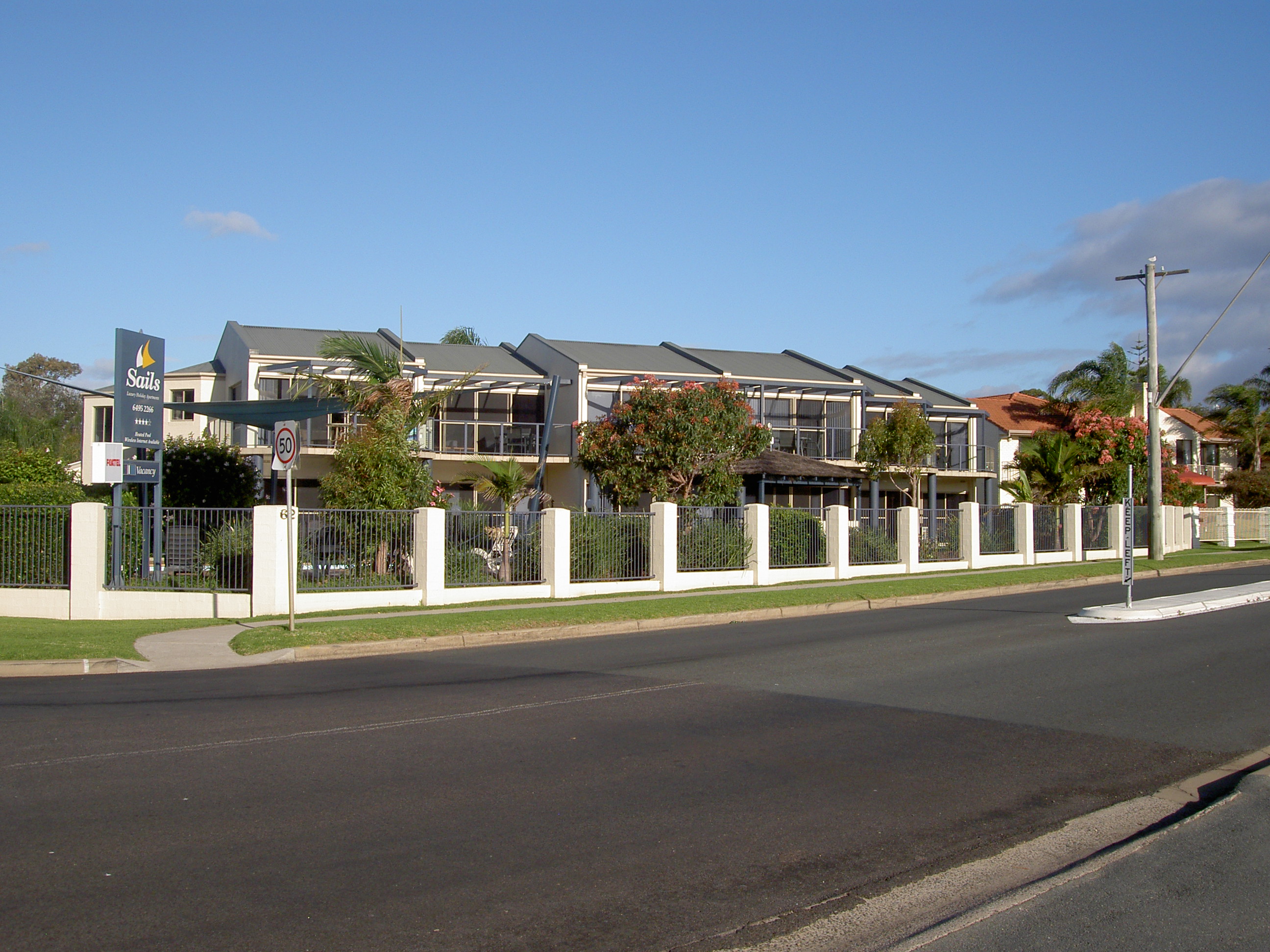
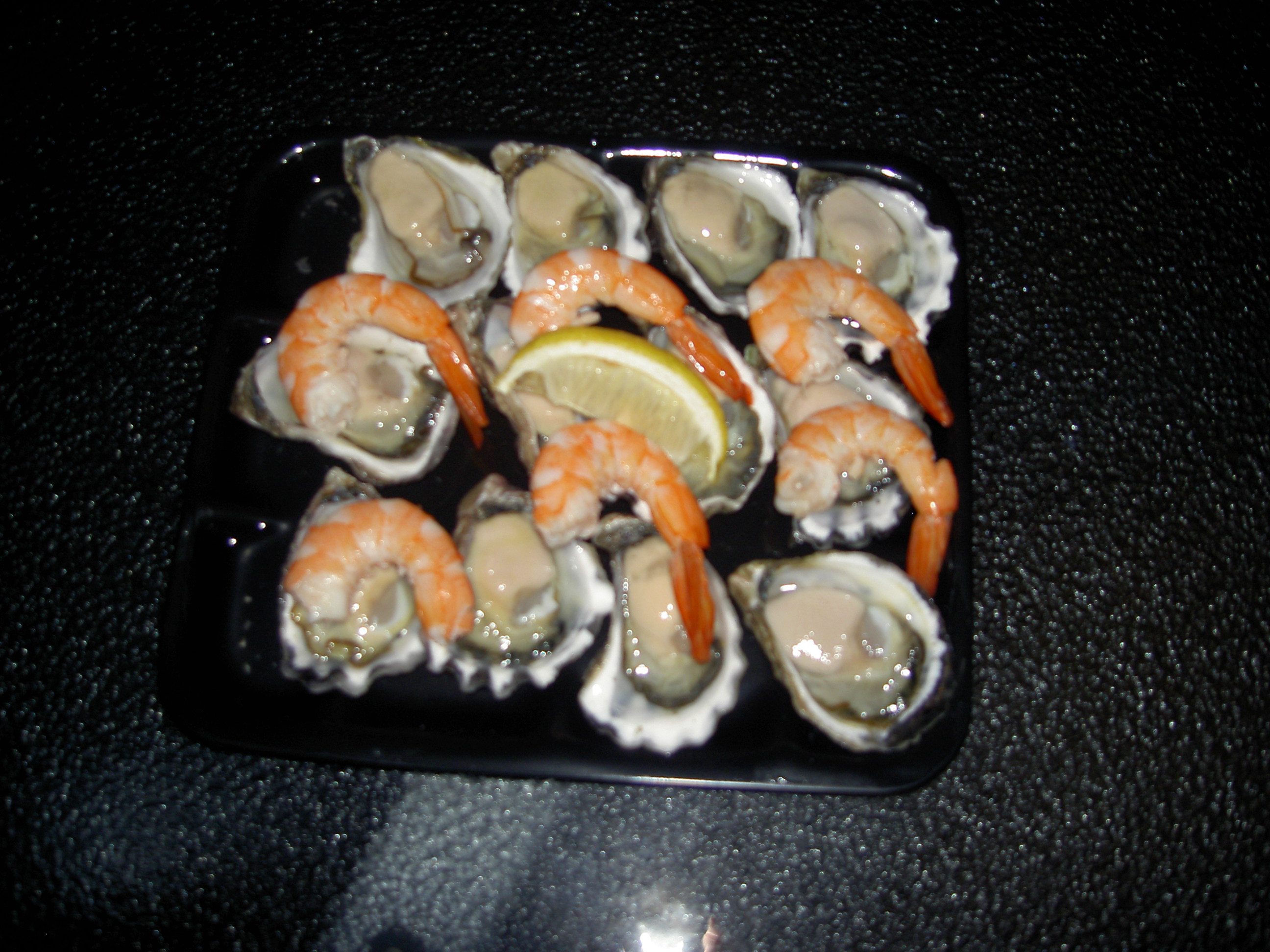
After coming down from Bombala, we made our first port of call the excellent Wild Rye bakery in Pambula, for some bread and cakes. Then we drove the few kilometres to Wheelers Restaurant to stock up on prawns and oysters for dinner, before completing the last couple of kilometres past the golf course and airport to Merimbula. Arriving at Sails Apartments, we were greeted by our hosts, Leanne and Reece, and it was not long before we were settled into our first-floor apartment. We had decided to go upstairs this year following the great result of Ann’s two knee operations, as the view across the lake is even better from the added height.
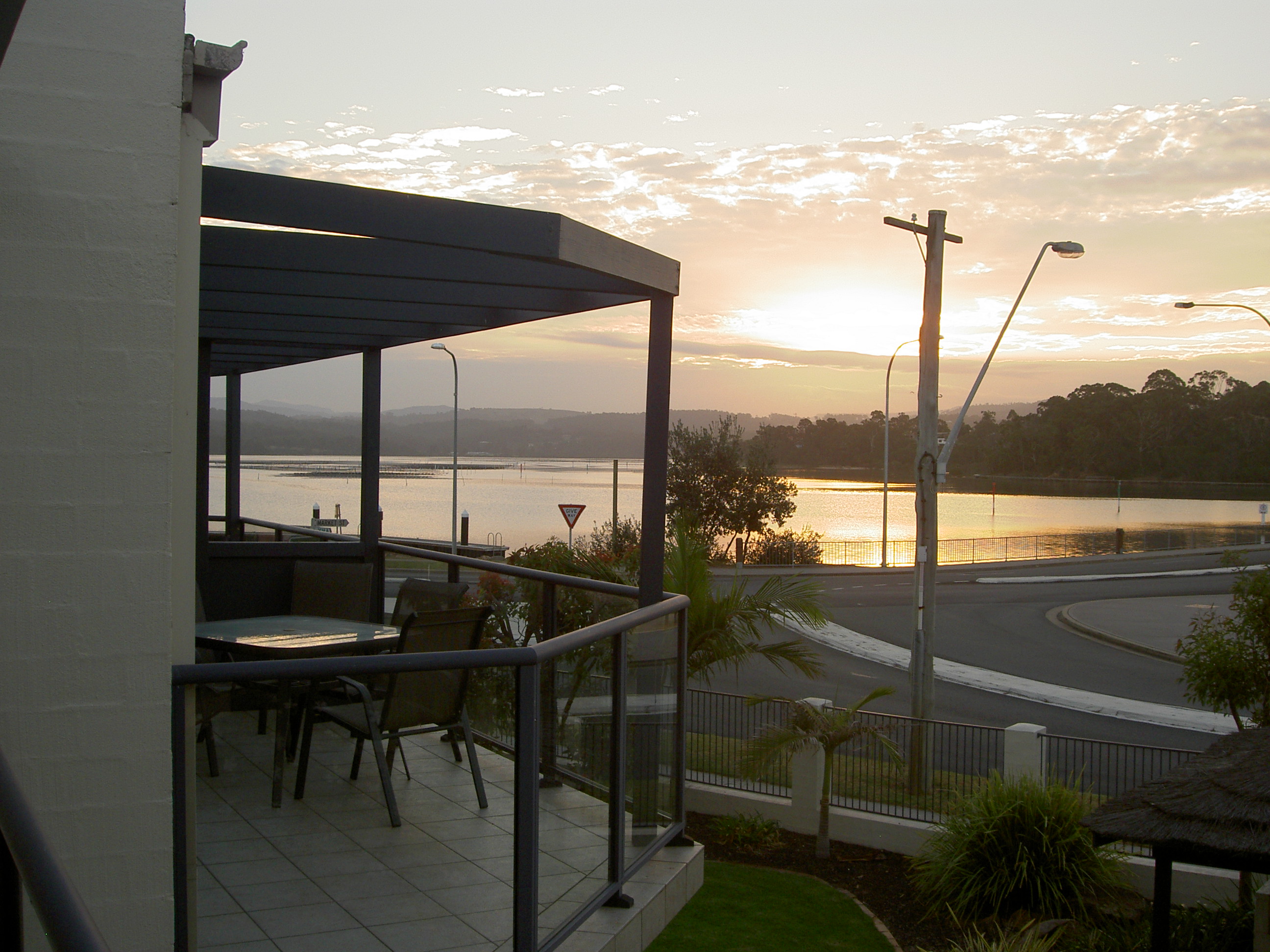
Sunset over Merimbula lake

It was very pleasant indeed eating our dinner of prawns and oysters, drinking a nice crisp dry white wine whilst watching the sun set across the lake.


Nothing much has happened in Merimbula since we were last there, and our activities were pretty much the same as on previous visits. The apartment was as clean and comfortable as we expected, the pool area and BBQ were both attractive and spotlessly clean.
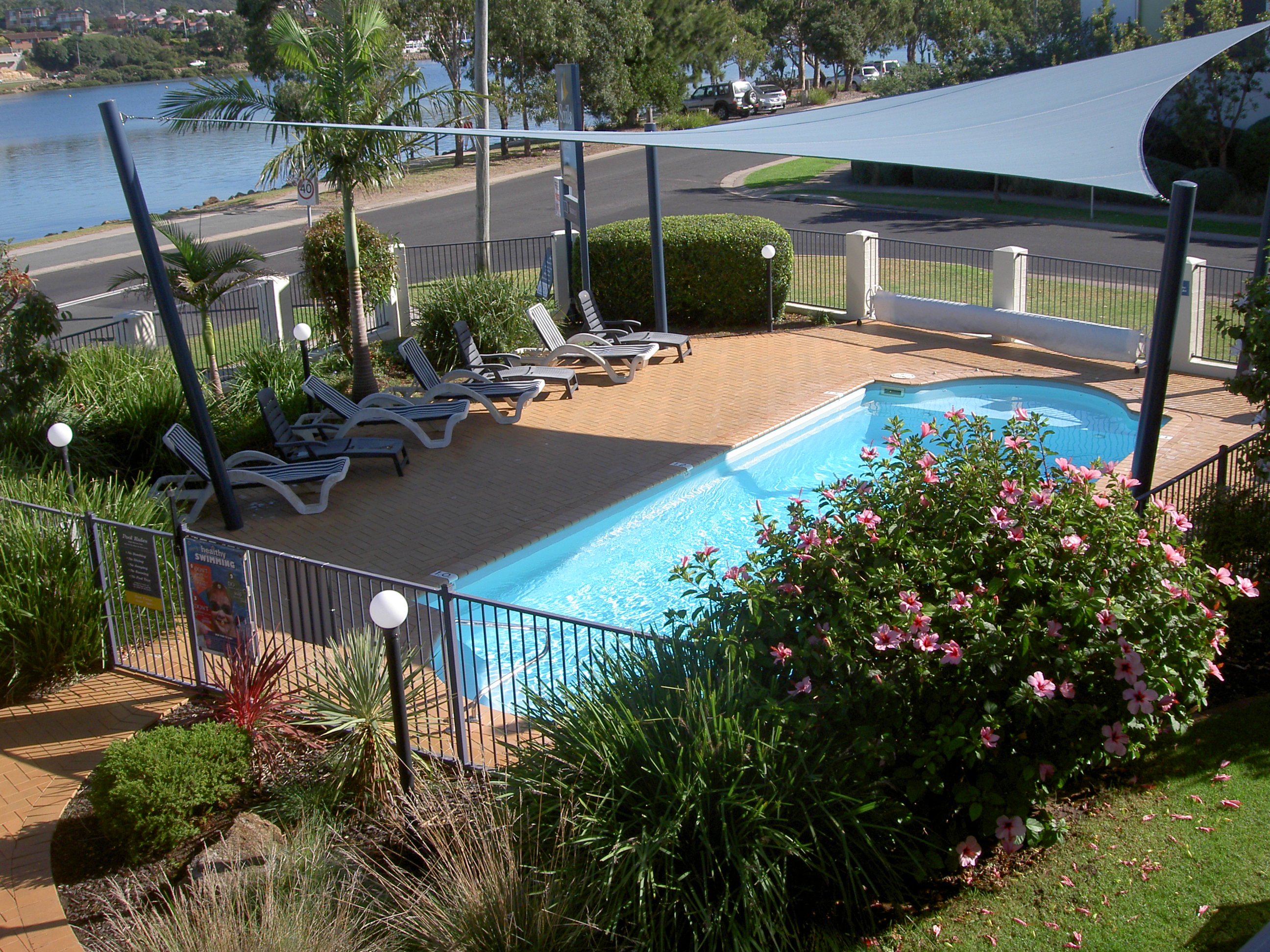
Pool at Sails
Pool at Sails

One major improvement was the provision of a balloon whisk in the kitchen, but I suspect that was provided especially for my benefit, and the same utensil would not be found in the other apartments! Anyway, it was put to good use in the preparation of an omelette later in the week. Our activities were confined to walking, a little golf, a little fishing, a little painting and sketching, a lot of reading, quite a deal of eating and drinking, and not much else. Twice I went fishing at Bar Mouth Beach. The first occasion yielded only two very undersized flathead, but the second outing was very productive with the largest flathead I have ever caught, and a bream of equivalent size. The day started with a magnificent sunrise, with the sunlight reflecting off the windows from across the lake.
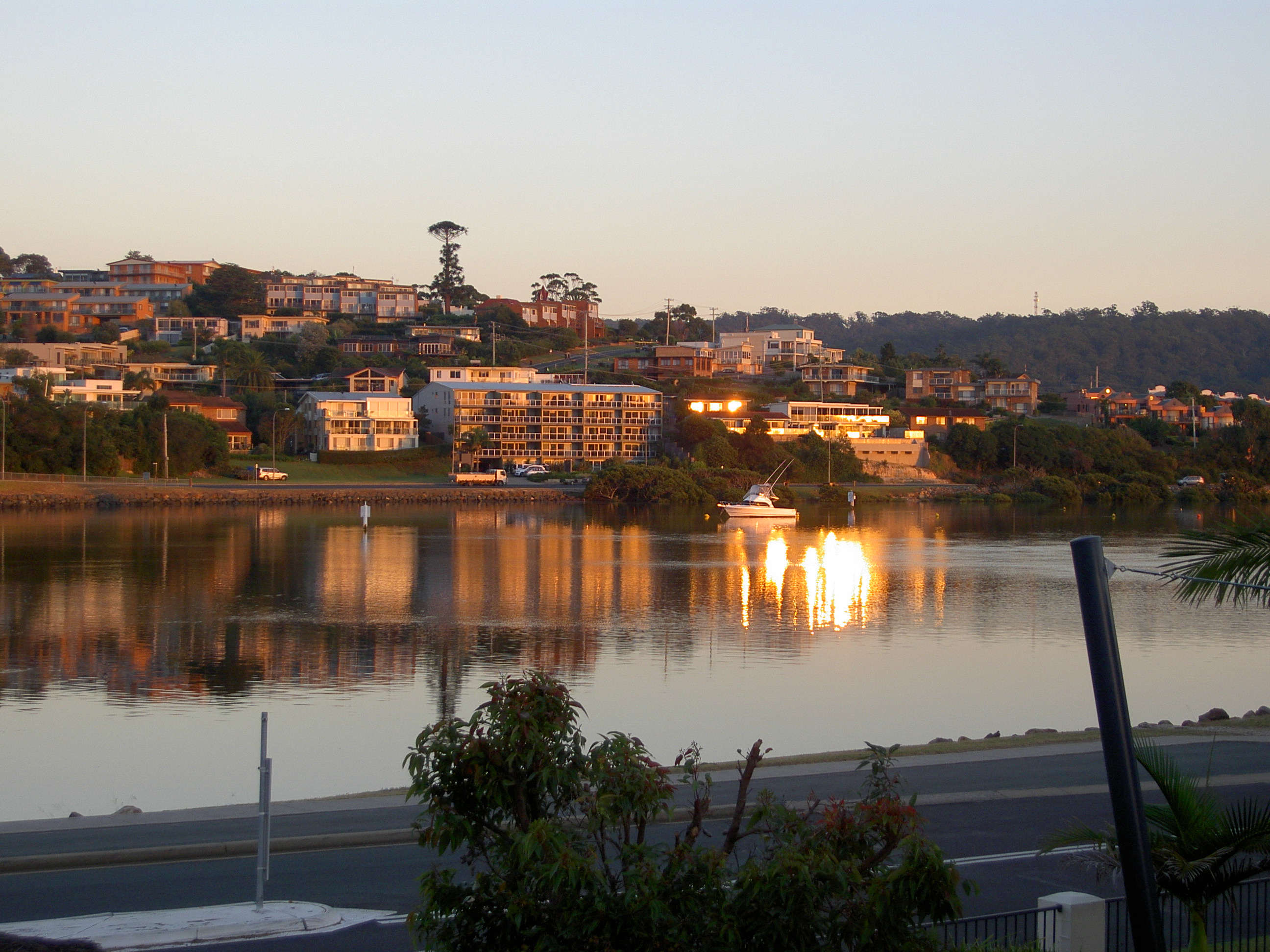
Sunrise over the lake

Bur the weather deteriorated into a very strong wind and cold rain, but the fishing, as I have said, could not have been better. But I have to admit that I rather spoiled the opportunity of baking the large bream whole, and that meal was a bit of a disaster. I blame it entirely on the low quality of the electricity in this part of the world. I am not sure where it is generated, but by the time it gets to Merimbula it appears to have lost some of its power. I am convinced that it takes longer for the kettle to boil, longer for the toast to cook, and that the oven does not get as hot as it should do. Thus, the fish was still undercooked by the time the other components of the meal were ready, and I had to resort to transferring it to a pan and frying it. By the time I got the fish to the table, it looked as though the cat had had first go at it! But it tasted very nice! The following day I cooked the flathead to perfection, so redeemed myself somewhat.

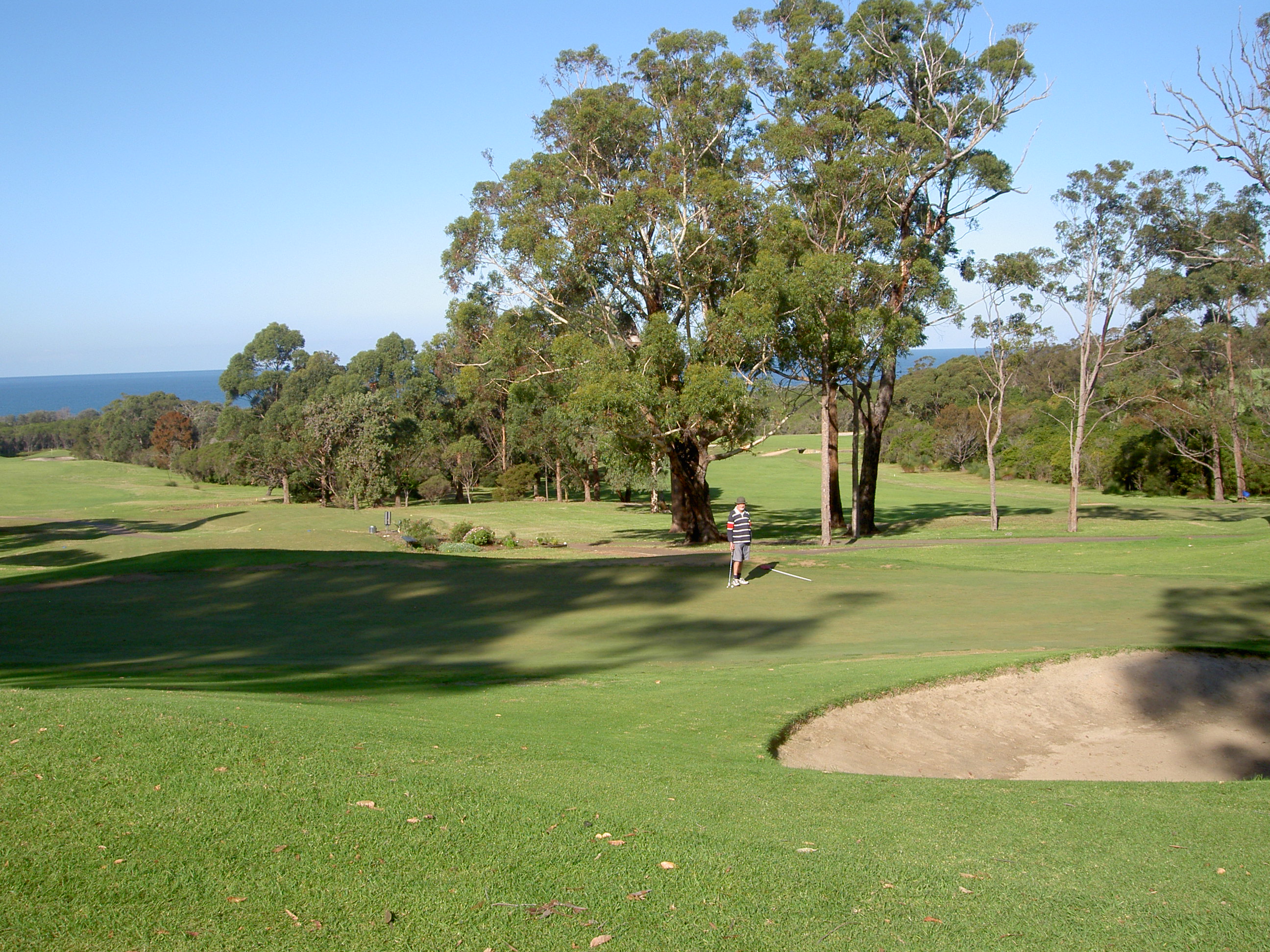
As for the golf, I had a couple of outings. The first was to Mandini Resort, where a bucket of balls hit into the lake got the swing going very well for an assault on the course itself. All was going well until the 4th tee, where a rather unwelcome spectator appeared in the shape of a long shiny black snake. Keeping one eye on him, I misaligned myself with the fairway, and the ball disappeared some 200 metres into the bush off to the left of the fairway. Re-aligning myself a little, but still with my spectator visible in the corner of my eye, I speared a drive straight down the middle, but because of the slope of the fairway, it then kicked to the right when it landed. The spectator looked as much as to say “can’t you do any better than that?” and had it had any shoulders, it probably would have shrugged them in contempt. It then slithered off toward the third green, presumably to watch the approach shots of the next group of golfers. However, it would have had a long wait as there was not another soul to be seen anywhere on the course.. For my second outing, I had intended playing at one of the local ‘proper’ courses. But Merimbula Golf Club charges $40.00 a round, plus $6.00 for a buggy, and I was not prepared to pay that sort of money. So I phoned Tathra Country Club, which has a much lower fee. Unfortunately that day the course was closed for a ladies competition, so I drove to Tura Beach, which has a special lower rate for seniors after 2.00pm. However, that course was closed for a corporate day, so I returned to Mandini. The shiny black observer  of the previous game was not visible, but a baby brown snake, no fatter than a drinking straw and about 30cm long, positioned himself between my ball and the hole on the 7th green. No danger to myself, of course, but I was unsure what the rules according to St Andrew had to say about removing snakes from the green, and as I did not want to hurt him with the ball, I picked up, added two to the score for the hole, moved on and played the last couple of holes. And that was the end of the golf for the week.

General walking went very well, with Ann’s new knees. As well as walking around the ‘Fish Pen’ a couple of times, we went all the way along the board walk and back—a trip of the order of 3.5km. We saw plenty of wild life, including a small stingray, innumerable fish, large and small, a huge swimmer crab, and a pair of Lewin Water Rails.
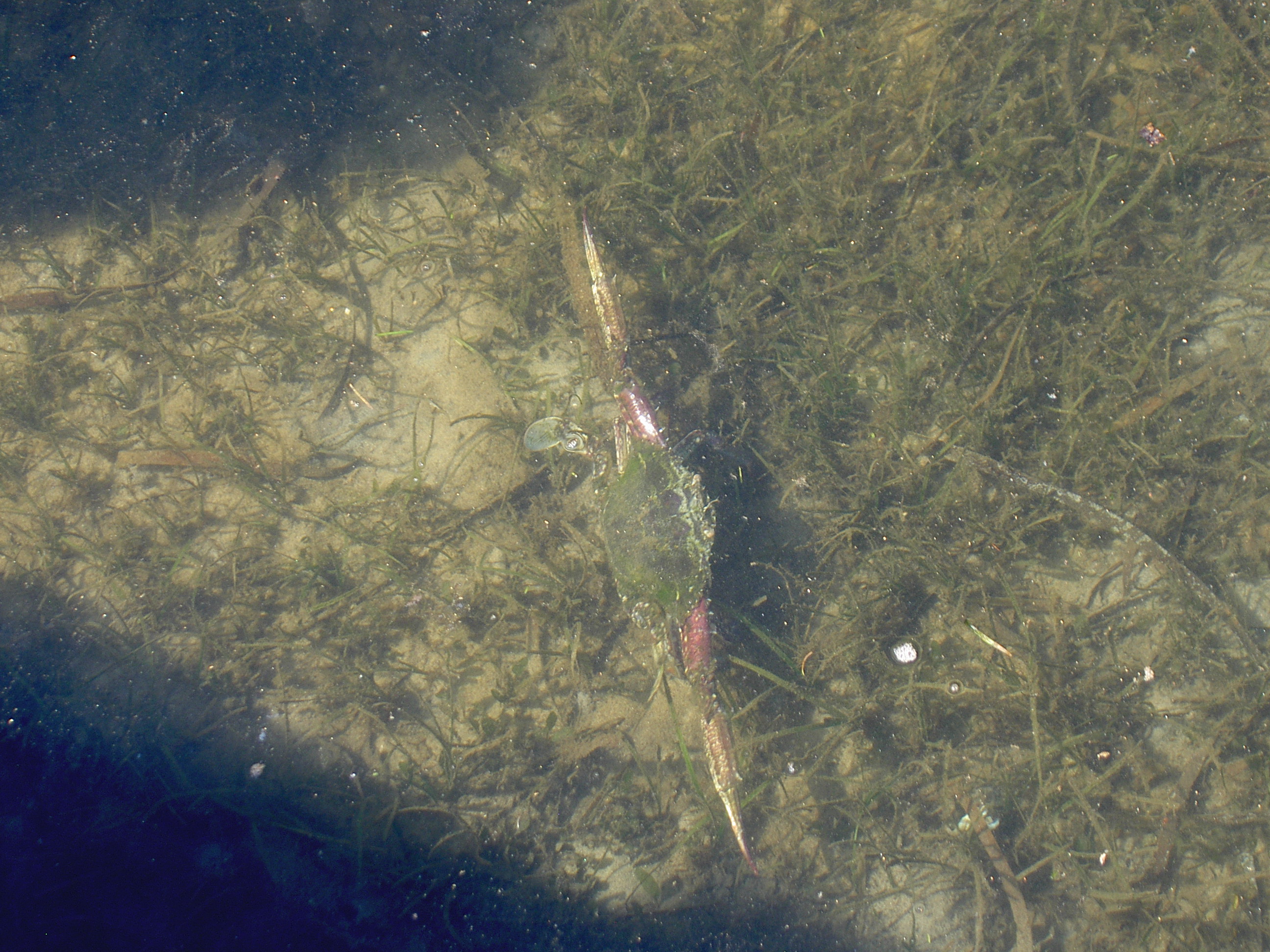
Swimmer Crab
Swimmer Crab

At the far end of the boardwalk, there is a ramshackle shed, which serves as the office of the boat-hire man, and also serves possibly the best coffee in Merimbula.
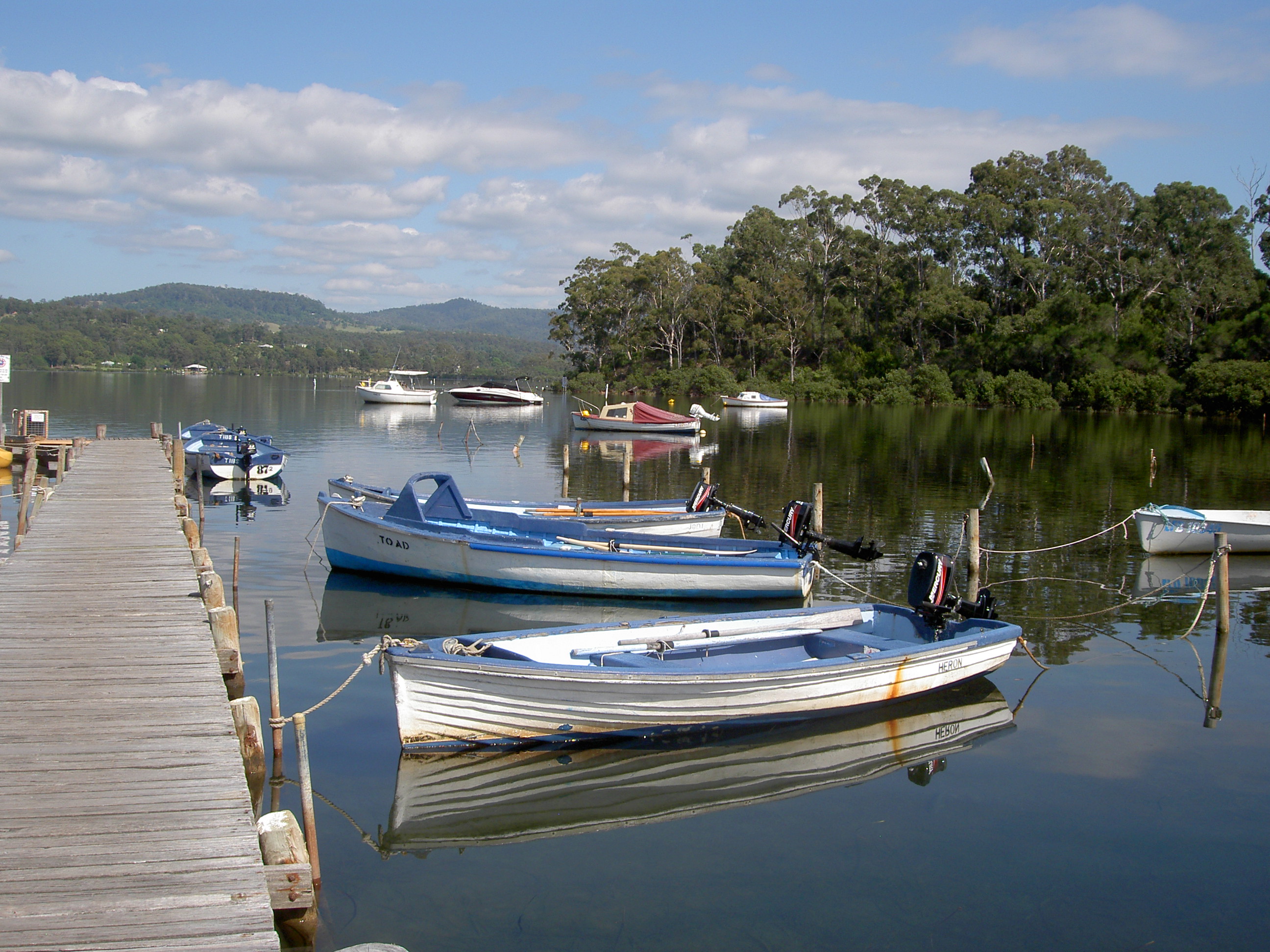
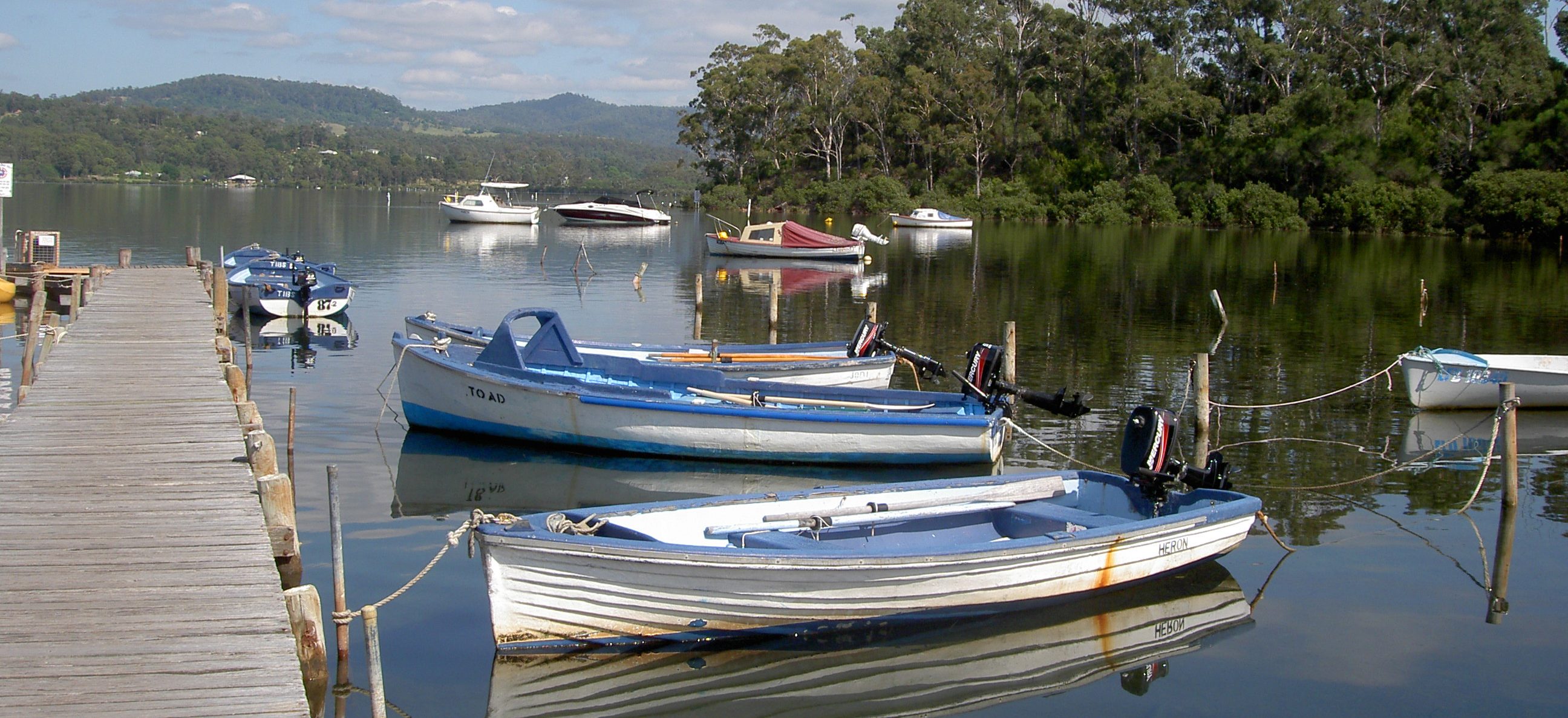
Hire boats at the end of the Boardwalk

It is idyllic sitting on the deck outside the shed, drinking first-class coffee and enjoying the magnificent view of the lake with the hills behind, and the quaint boats that are for hire lying quietly at their moorings on the mirror-smooth lake. On other walking/coffee drinking outings we saw large pods of dolphins, white-breasted sea eagles, and sting-rays about the size of a kitchen table. There were also notices around the lake warning people to “stay away from the resting fur seal”, but we were not fortunate enough to encounter him. However, we did meet a couple of ladies who had come across him one evening, and he was apparently very grumpy at having his rest interrupted as they walked past him whilst he snoozed on the footpath.

We did a little drive to Tathra one afternoon, and after a stroll along the sand spits at the mouth of the Bega River,
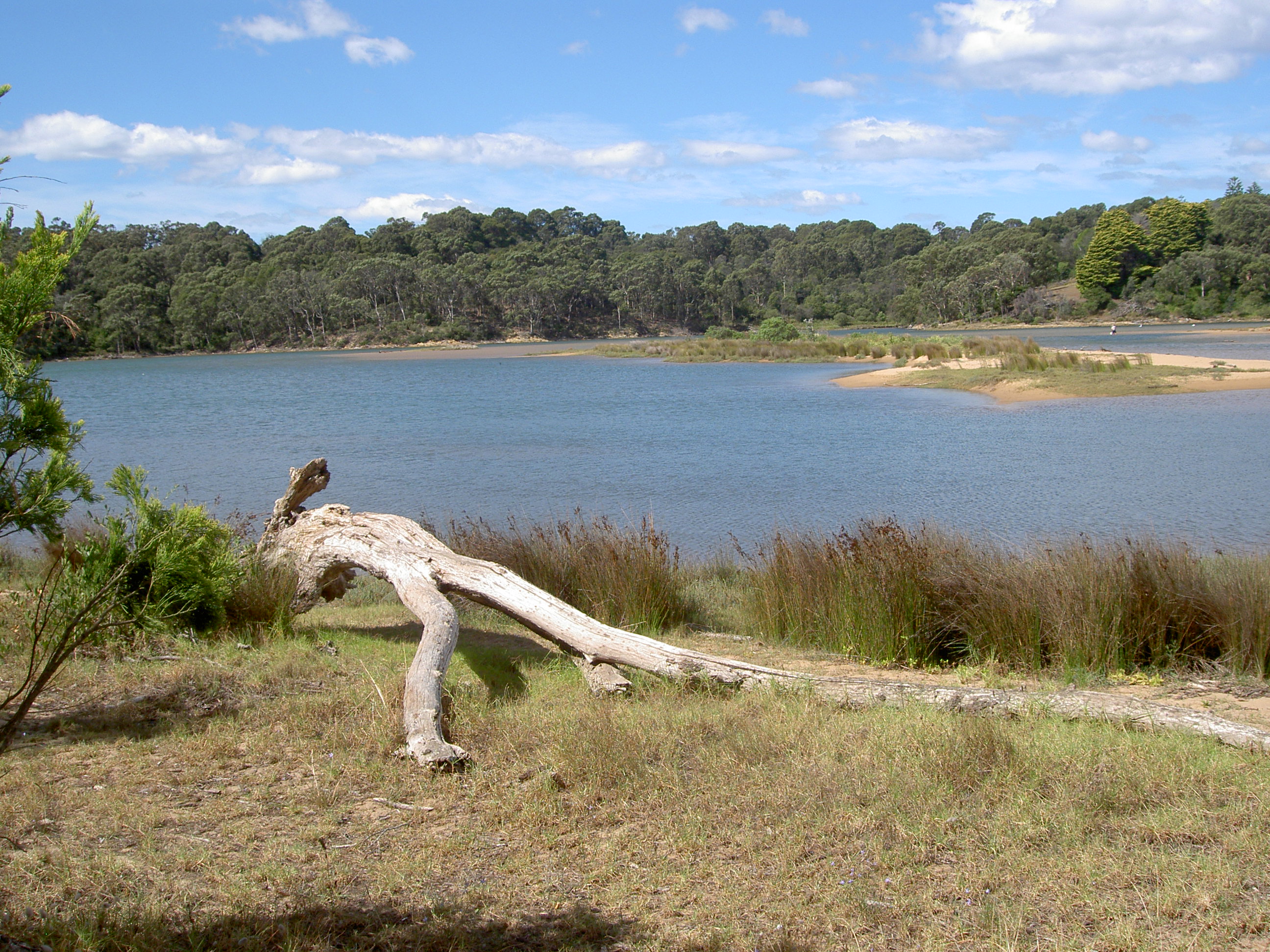
Mouth of the Bega River

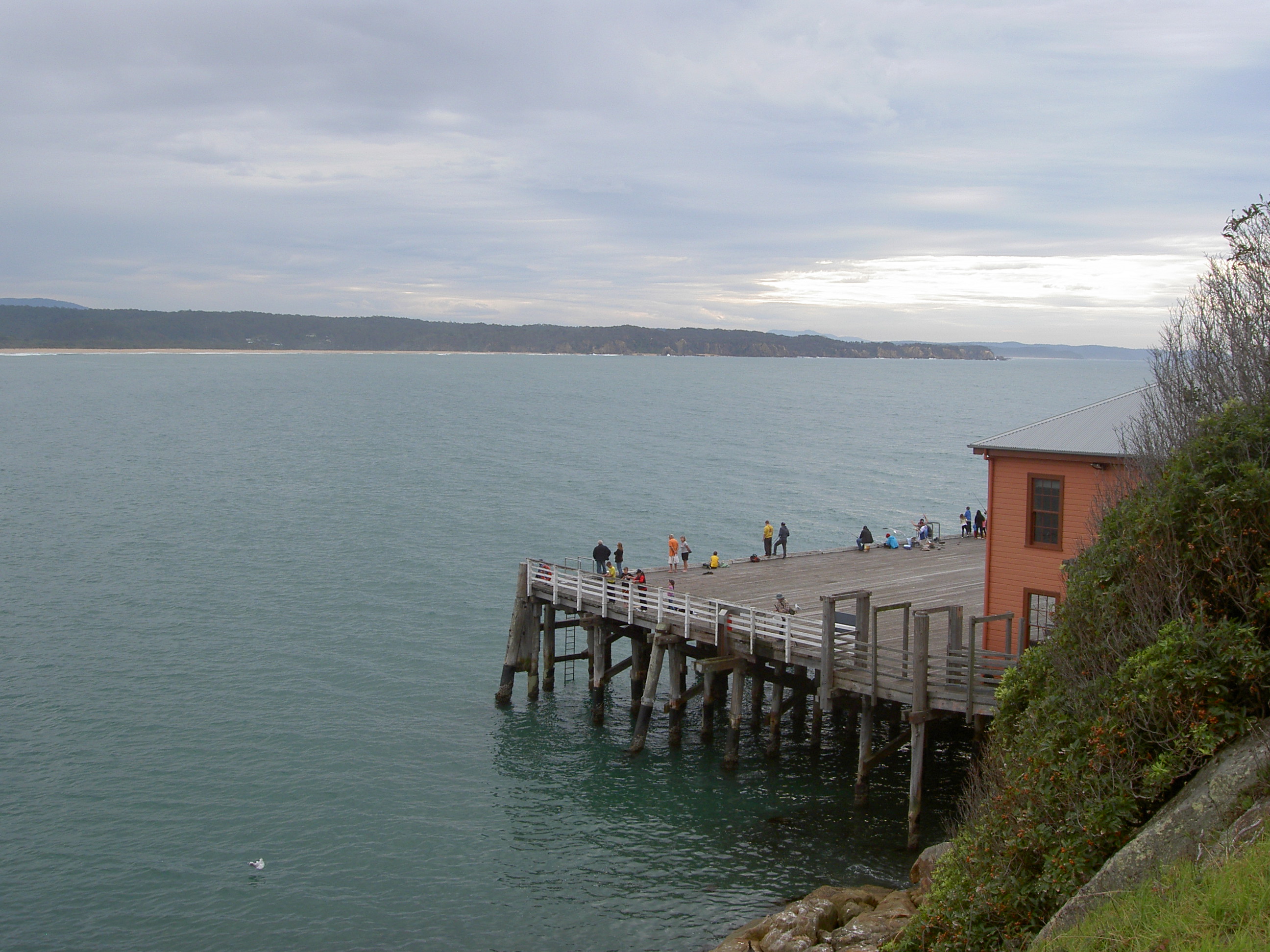
took afternoon tea at the café now established in the heritage-listed wharf building, which was very pleasant. After tea, we walked along a cliff-side track, which quite clearly had, at some stage in the past, been a sealed road, as there were patches of the original pavement still in place.
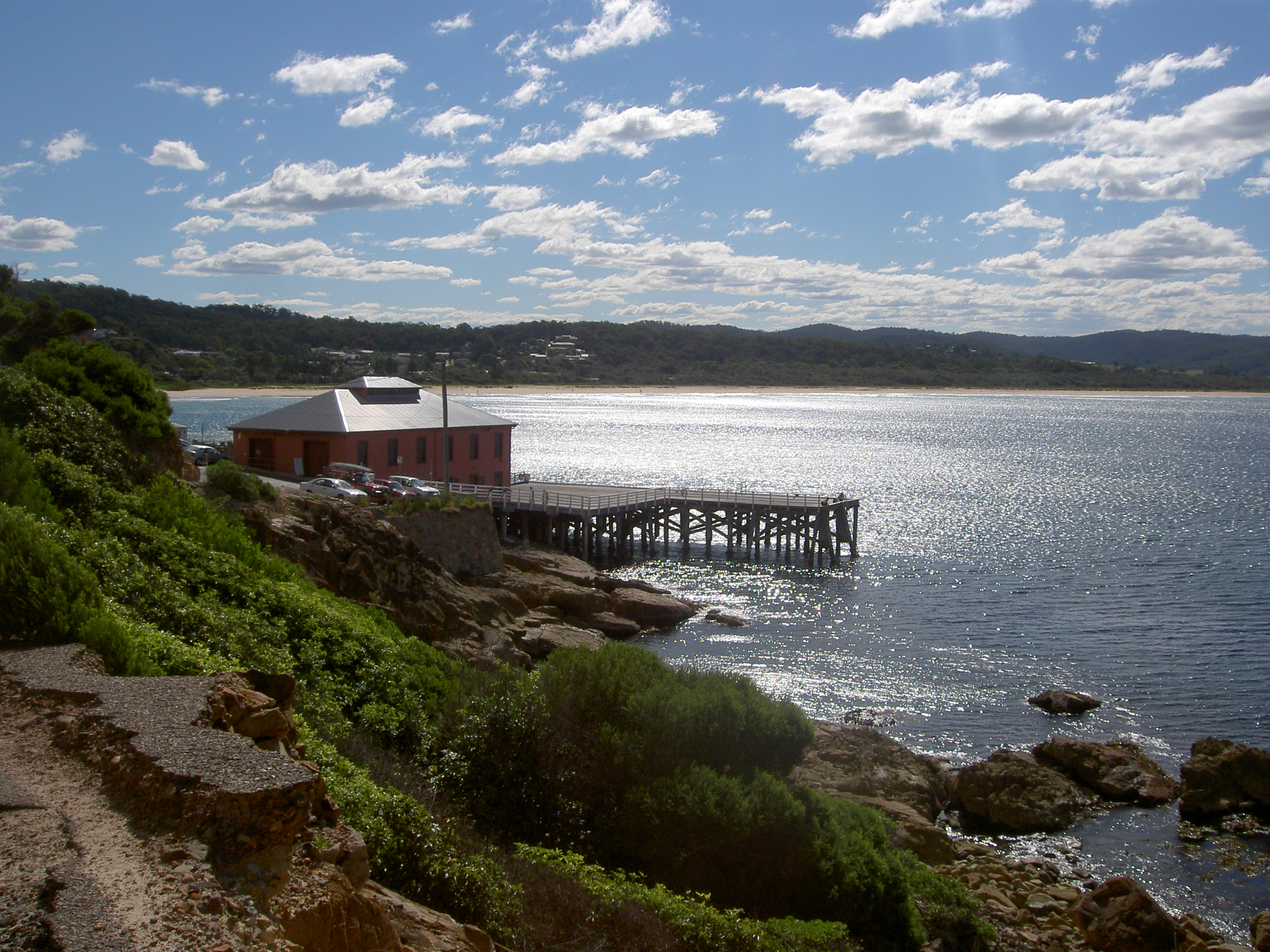
Tathra Wharf
Tathra Wharf

Following the track as it wound round the headland, we eventually came to a well-maintained area of parkland, which had a number of information boards around its periphery, telling of the local history. It transpired that the track was the original road to the wharf, but a severe storm and exceedingly high and rough seas simply washed most of it away. That was in February 1971 and the storm and encroaching seas flooded much of the Bega Valley below the town. Two people were reported as being swept away and drowned. The road was a good 30 to 40 metres above normal sea level, so it must have been a doozy of a storm to have done so much damage. They have since built a new road approaching the wharf from the other direction. It seems as though these storms are quite regular occurrences, with one in 1919, another in the mid-1950s, the ‘big one’ which destroyed the road in 1971, and some serious flooding in March 2014, (but nowhere near ‘the big one’ of ’71). The other interesting thing about the small park, is that it serves as a memorial garden, and there are plaques along the edges of the paths in remembrance of deceased residents of Tathra. There is no cemetery at Tathra, so people are buried or cremataed elsewhere, but they are remembered in this small park. Right next to the Memorial Garden is the Tathra pub, which has an extensive deck out the back with great views of the ocean, and on the warm evening it was very pleasant to enjoy a cold beer and, for Ann, a glass of local white wine, before heading back to Merimbula.

And that was about all we did and saw on this trip. On Saturday we left Merimbula and headed home, with the intention of spending another couple of days at Lakes Entrance. So more on that in the next blog.


Sketches of Merimbula Seven

February 27 to February 28, 2015

The morning of Friday February 27 saw us once again heading off in a packed car toward Merimbula. The load of course included fishing and golfing gear, but not much in the way of cooking utensils other than a balloon whisk. Our first stop was no further away than Yarragon, some 90 minutes away from home. The reasons for this early stop are many and varied. First, it is an opportunity to meet with our cousins who live in this area. Second, there is an excellent art materials shop, and Ann wanted to take the opportunity of stocking up on a few bits and pieces for her watercolour painting. Third, there are good toilets in the main street. So, whilst Ann went into the art shop before our cousins arrived, I took a wander along the street, and spotting a sign for an “Olde Fashioned Lolly Shoppe”, headed in that direction. Unfortunately, as I neared the door, a whole bus load of school children descended on the shop, presumably with permission to spend some pocket-money on lollies. I followed them into the shop, and immediately wished I had not done so. They were behaving like, well, like kids in a lolly shop, and the noise of the high-pitched voices was more than mortal ears could bear. But I was determined to buy some of my favourite Olde Fashioned Lollies, being ‘humbugs’ and ‘bullseyes’. I eventually found these delights in a corner of the shoppe, packed with a dozen or more children. One child picked up a bag of bullseyes, studied the packet for a few seconds, and put it down again. Another then picked up a packet of humbugs, and did likewise. Unable to resist, I asked if any child could tell me the name of Bill Sykes’s dog. This met with very blank expressions on the childish faces. “Does anyone know who Bill Sykes is” I asked. The blank looks continued. “Oliver Twist?” I asked, but still not a flicker of recognition of the name. I felt compelled to enlighten them, telling them the dog was Bullseye. I then asked who was it that said of Christmas, “Bah Humbug!”. Nothing. “Scrooge?” said I. Still nothing. “A Christmas Carol?”. Still nothing. “Charles Dickens?’ the nothingness and blank faces continued. By this time I had lost interest in the bulls eyes and humbugs and left the Shoppe empty-handed.

I bent my steps toward the café at which we had agreed to meet, and ordered a coffee and a raspberry muffin. In response to my question, I was assured that no, the muffin had not been purchased from the United Metropolitan Improved Hot Muffin and Crumpet Baking and Punctual Delivery Company, and what was more, the café proprietor had never heard of the company, and even if he had, he would continue to bake his own muffins fresh every day. I am really amazed at the general ignorance of matters Dickensian displayed by most people!

Anyway, we had a nice, but brief time with our cousins before hitting the road again for Lakes Entrance, where we had decided we would spend the night.

We stayed at the Esplanade Motel, which is clean, comfortable and very moderately priced. In fact I would be happy to recommend it to anyone wanting a brief stay at Lakes Entrance. Right opposite the motel is one of two floating restaurants, which is very good, and not over-priced. So that is where we had dinner, preceded, and followed, by walks along the wharf.PICT5133

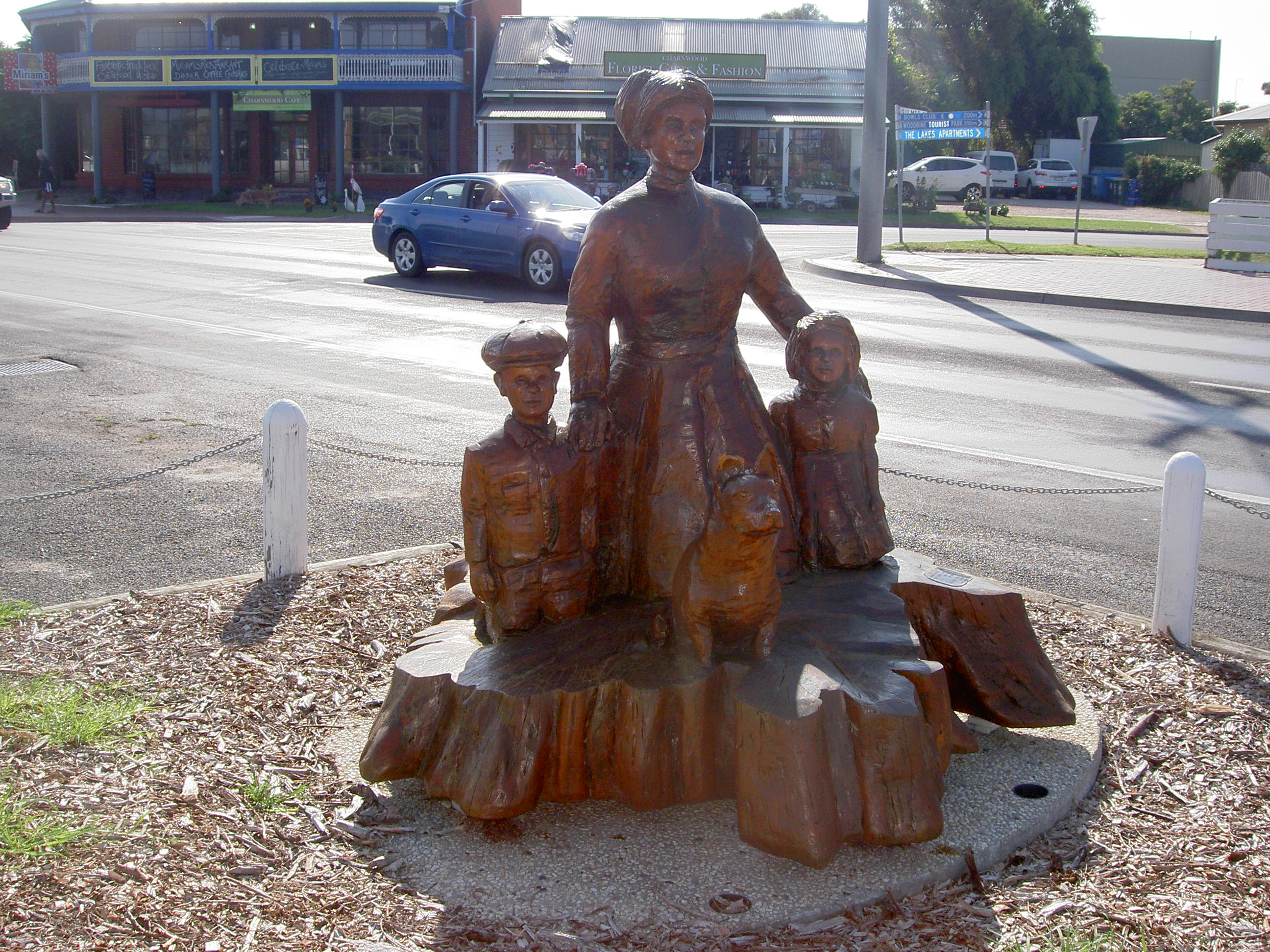
Now apart from the lakes, the surf beaches, the golf course, the mild climate and the surrounding countryside, there is not a lot to recommend Lakes Entrance. And I suppose by that I mean that there is not a building in the town of any architectural significance. The shops and cafes along the esplanade are all single storey buildings, and most other buildings are holiday accommodations of one sort or another. There are increasing numbers of houses on the slopes inland overlooking the lakes that appear to be constructed for people with more money than taste, so really the built environment does very little to enhance the natural attractiveness of the place. But there are some very good examples of chain-saw sculptures along the Esplanade. Unfortunately, the sun was at the wrong angle to get a good photo, but this is one example.PICT5134

Saturday morning, and we continued our journey. First stop was Cann River, a couple of hours from Lakes Entrance. Good coffee is to be had at a café called Pelican Point, near the eastern end of the small township. And then rather than drive to Merimbula by way of Mt Drummer and Eden, we chose this time to travel inland to Bombala. The road is excellent, and follows the Cann River valley. At this time, the valley was very pretty indeed, with lush green grass on either side of the river which winds up the valley. On the couple of occasions that the river gets very close to the road, it is very pretty, with crystal clear water tumbling over rounded boulders, making little waterfalls into the pools below. Unfortunately, at these spots, there was nowhere to safely stop and take photos, or to establish the likelihood of there being any trout in the stream.

The road is almost one continuous up-hill drive, as Bombala is at the south-eastern end of the Monaro High Plains, some 700m above sea level. It is a very pretty little town, with a population of the order of 1200, on the banks of the Bombala River. The local industries are mostly cattle grazing and timber, but at one stage it was seriously considered as the site for the Capital of Australia because it is roughly equidistant between Sydney and Melbourne. Tourism is now becoming increasingly important, one of the attractions being the very large populations of platypus.

From Bombala, the road drops down the 700m more steeply than the route up from Cann River, as it winds through Cathcart and Wyndham, joining the Princes Highway at Pambula, which is then only 4 or 5 km away from Merimbula. The Bombala route is a little longer than sticking with the Princes Highway, but makes a very nice change, if you have the time.

Well, this sketch has not even reached Merimbula, but the next one certainly will.

A Sketch of Halls Gap


February 13 to 15, 2015

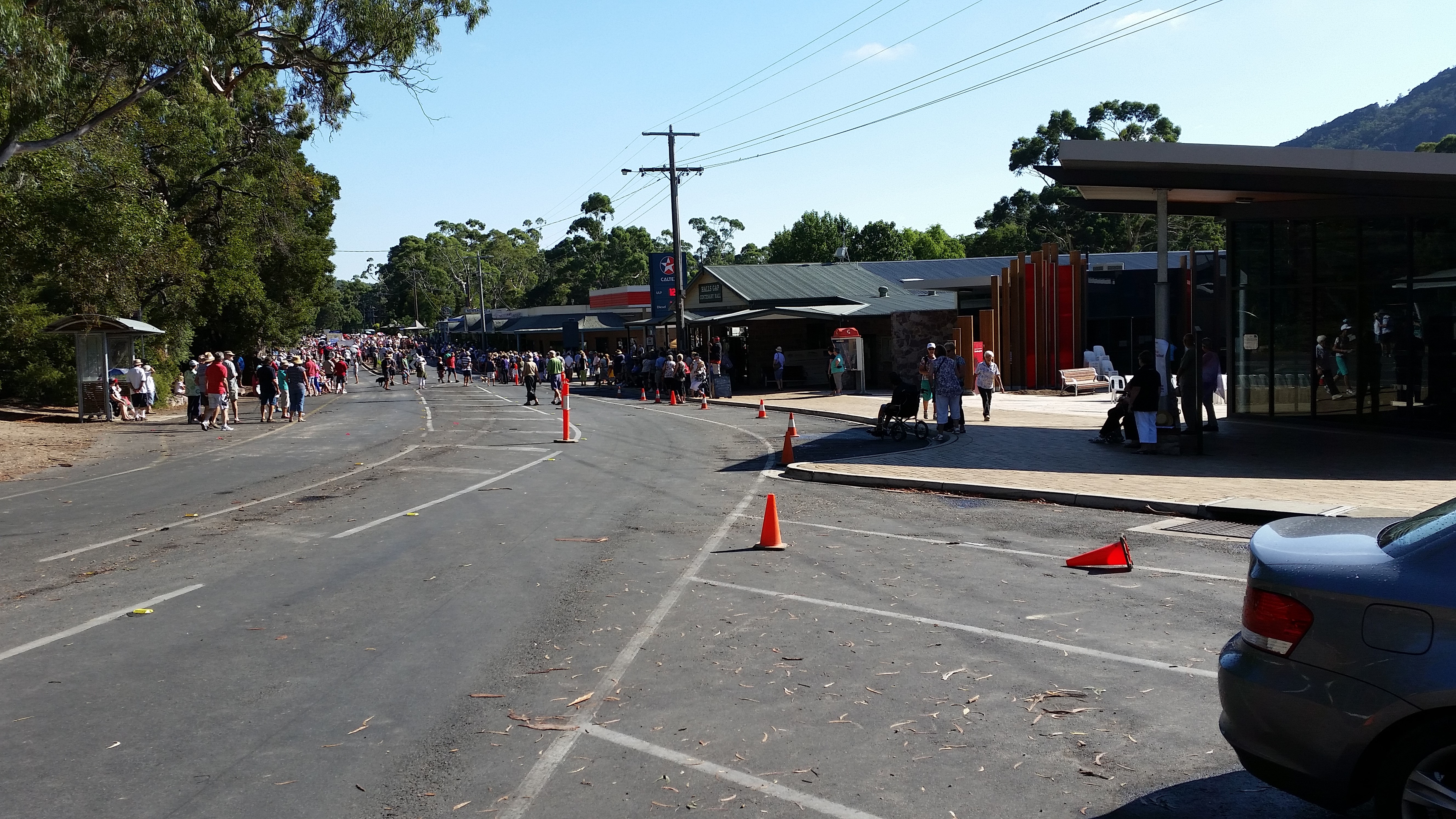
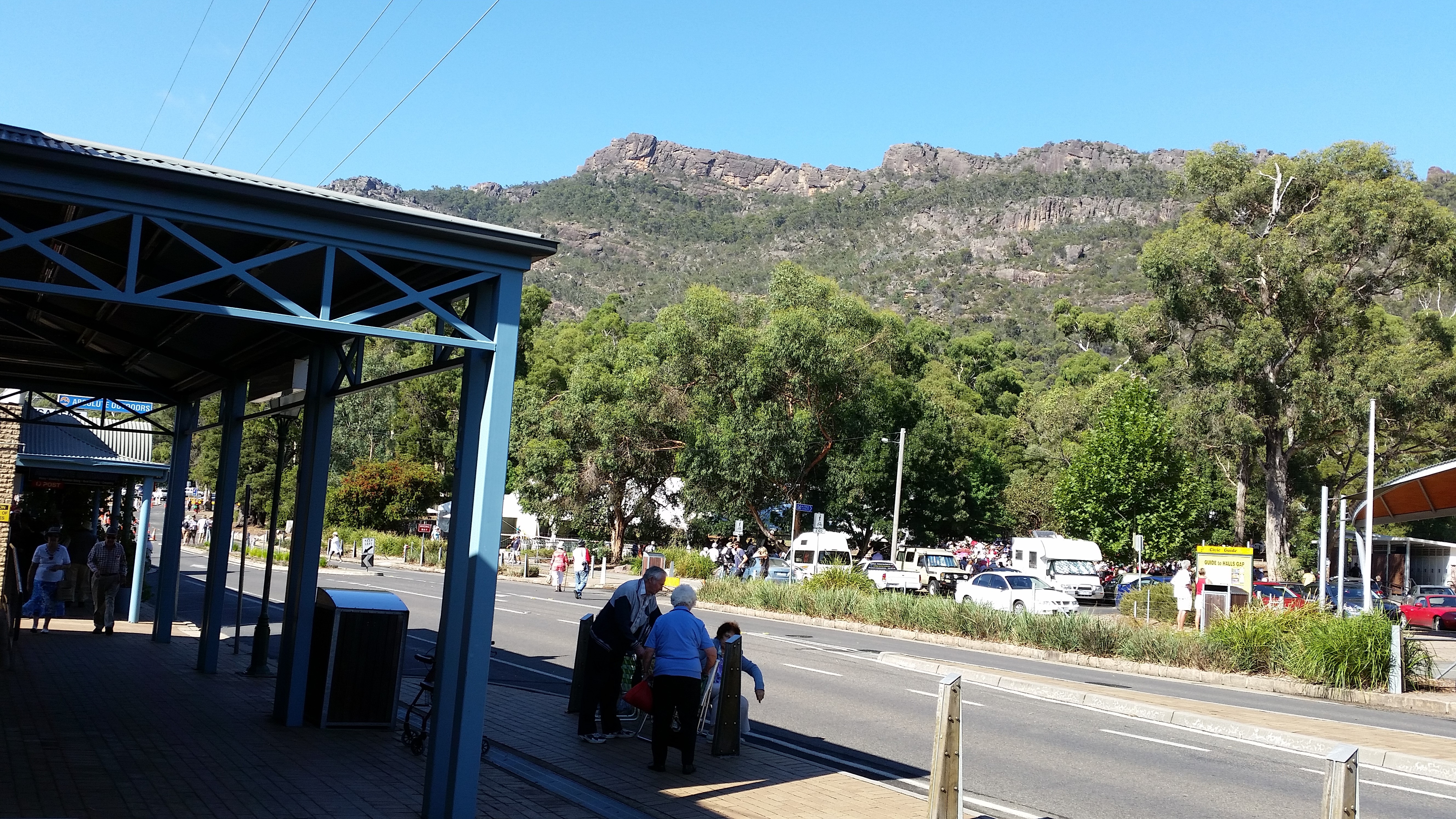
Halls Gap is a very small hamlet, located in the Fyans Valley in the Grampian Mountains, west of Melbourne. It has a resident population of some 600 people, and is a very popular tourist destination. In fact, the town is dependent on tourists for its livelihood, there being very little other opportunity for employment. The ‘town centre’, if you could call it that, would fit very comfortably on the fairway of the average 500m par five right-hand dog-leg hole of a golf course.

Main Street, Halls Gap

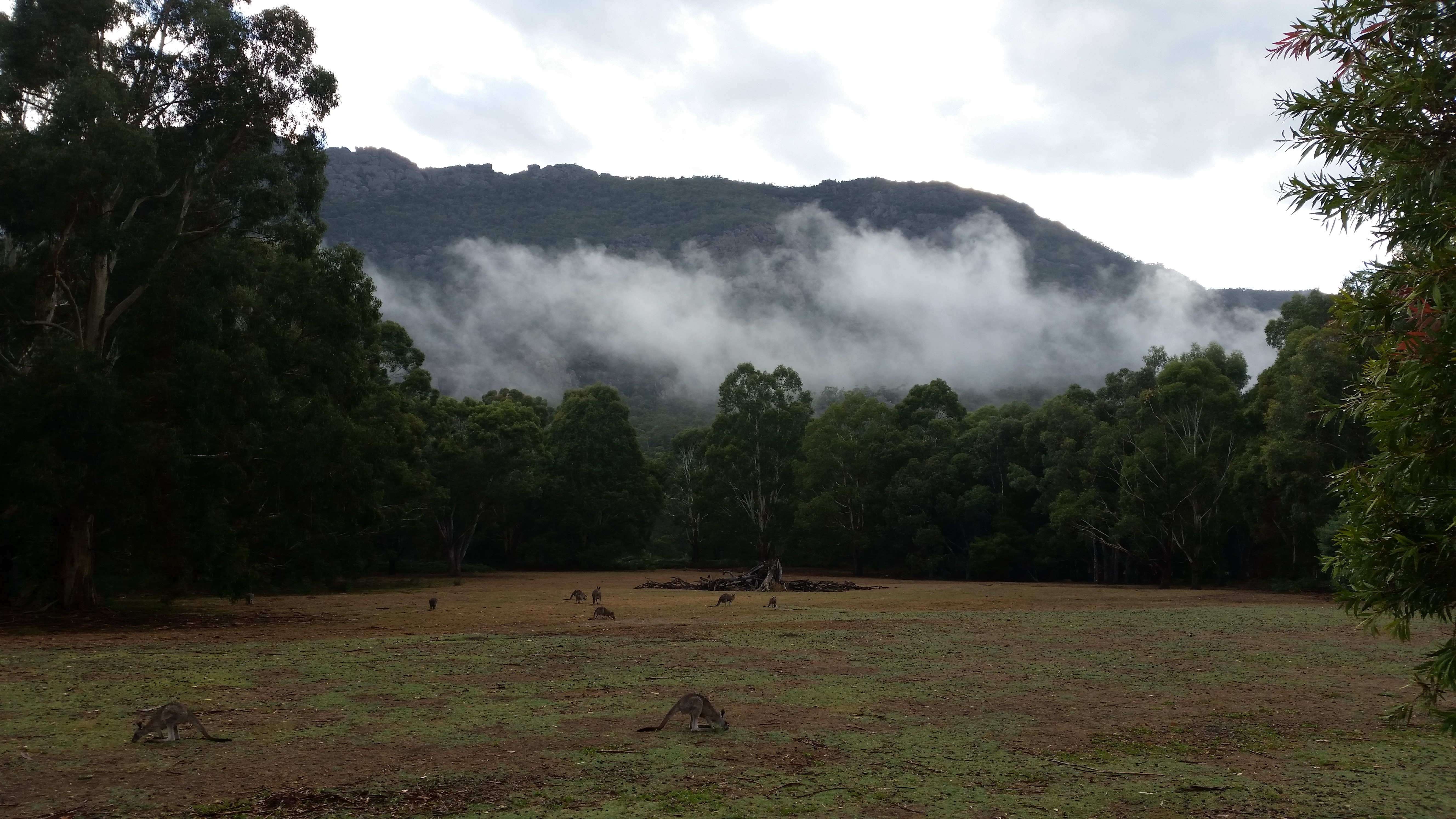
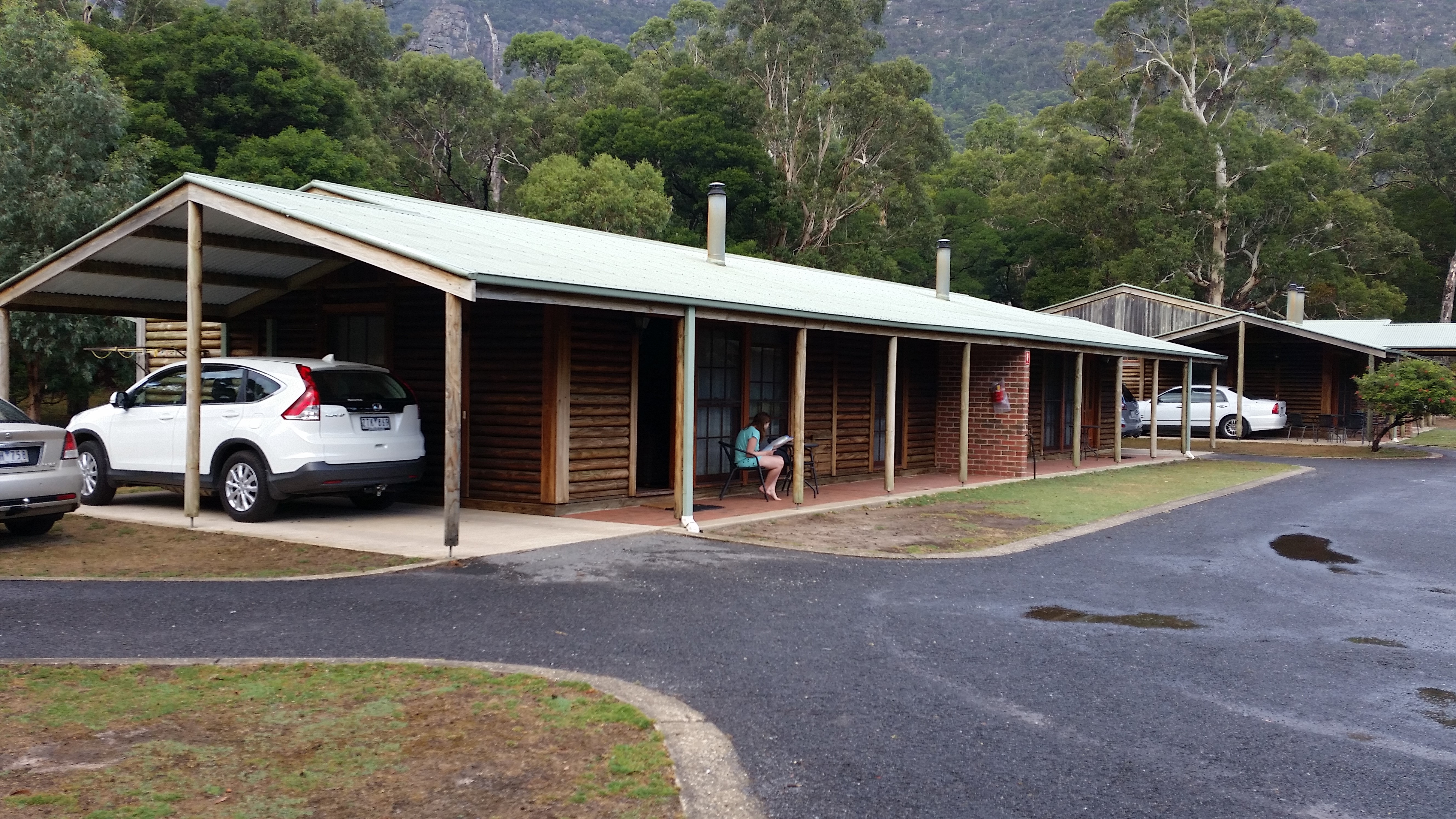
With the tee at the village hall, you would hit over the petrol filling station, a couple of cafes, and an empty book-shop. Your ball would land on an ice-cream parlour. Your second shot would fly over the small supermarket, over another café, and the newsagent, before landing on the second ice-cream parlour at the corner of the dog-leg. Then a 9-iron from the corner would take you over a souvenir shop, the bakery, another café, and the ball would land somewhere near the chemist. This part of the dog-leg overlooks a nice patch of grass, and a very pretty, but dry, stony creek bed. And that is it for the town centre. Opposite the longer part of the shopping strip there is a public toilet block, and a swimming pool; and the rest is pretty much all camping ground. Along the road to the south and to the north of the centre, there are a couple of kilometres or so in each direction, of holiday accommodations, ranging from swish motels and resorts, through self-catering apartments and cabins, to basic camping grounds. The furthest south is the Lakeside Caravan and Camping Park beneath the dam wall of Lake Bellfield. This is a very pleasant park, and we have stayed there on previous occasions. But this year we stayed in the Grampians Log Cabins which are much nearer to the town. These cabins are very clean, comfortable, and well-appointed with nice furniture and facilities. There was no balloon whisk in the kitchen, but there was a mechanical whisk of the type where you turn the handle and two beaters whizz round. However, it mattered little as I didn’t need a whisk of any sort during this short stay. There is a very nice swimming pool and grassy barbecue area in the centre of the oval around which the cabins are distributed. From the kitchen window of our cabin, the view is to the south, along the flat valley floor, through lightly wooded paddocks with kangaroos, emus and other native fauna.

View from kitchen window

There is an efficient air-conditioning system, and in winter, heating is by means of a wood burning stove (wood is provided). All in all, a very pleasant place to stay.

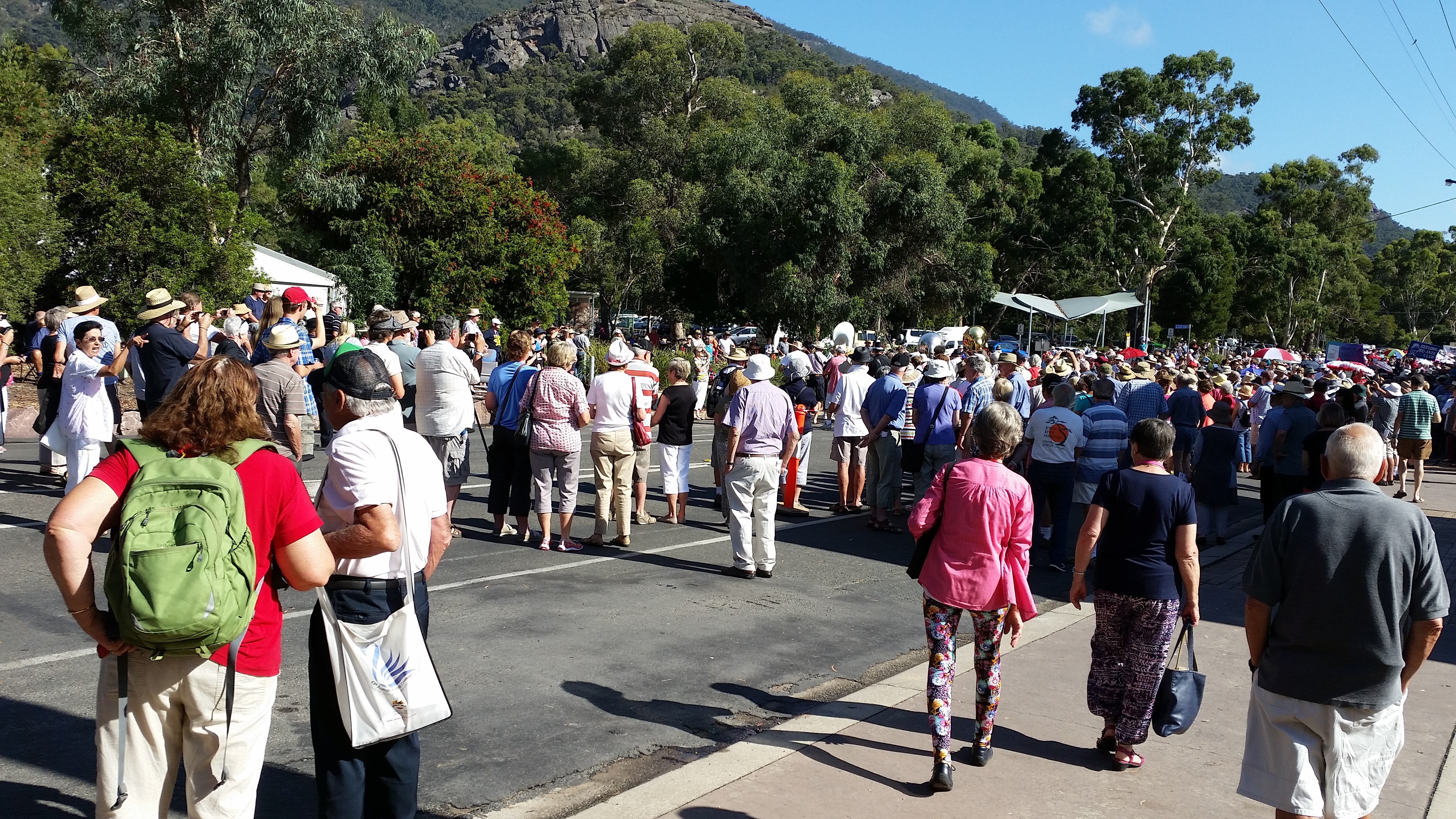
And the reason for our being in Halls Gap is very simple. Each year, at this time, Halls Gap is the venue for the Grampians Jazz Festival, and our band was playing a couple of sets. So, the population swells to over 4000 people, mostly jazz lovers, who swarm in for two and a half days almost continuous music. The main street is closed to traffic for the weekend, and there are 9 venues, ranging from a huge 750-seat marquee, through three or four smaller marquees, the Halls Gap Hall, one of the swish motels, and a couple of restaurants, with concurrent sessions running from 10.00am until 11.00pm.

Jazz Lovers
Jazz Lovers

All shapes and sizes of people can be seen carrying all shapes and sizes of instruments, as they scurry between these various venues. It would be nice to say there were people of all ages, but unfortunately I cannot say that, as they were, for the most part, very senior citizens indeed. However, there was a sprinkling of younger people, and I did spot one particularly attractive young compact enchantress in the vicinity of our cabin.

Compact Enchantress near cabin

It was interesting to note that even the younger musicians, and there were quite a few very talented youngsters performing at the Festival, seemed to attract a mostly senior audience. We have noticed the same phenomenon in relation to audiences attending chamber music recitals by young and extremely talented musicians.

Whilst there were several thousand people, car parking was not much of a problem as most people camp or stay nearby the town centre. We drove in to town a couple of times as it was a bit hot for walking far; but it was a very pleasant 20 minute walk in the evening as it cooled down a little. The walk took us along a sealed track through the bush, parallel to, and about 50 meters off to the side of the road. But at night, when it was pretty well pitch black, we were very surprised, and indeed very pleased, to find that the white line in the centre of the track was, in fact, luminous paint. It was quite eerie to be following the pale yellowish line as it snaked through the bush, and without which the walk could have been quite hazardous. And an added benefit of the luminous line over the alternative of street lights, was the fact that it in no way detracted from the wondrous glory of the everlasting stars of the Milky Way, which could be seen to great advantage in the complete absence of any light-pollution. So full marks to whoever had the bright idea of the luminous line!

In addition to the Jazz Festival, Halls Gap also hosts an annual Food and Wine Festival in early May, known as the Grampians Grape Escape. This is a festival celebrating local wine growers and food products, with over 125 food and wine artisans in attendance for you to try their offerings. But apart from these two festivals, The Grampians are worth a visit in their own right.

View of Mountains from Halls Gap

The sandstone ‘mountains’ are not high, the highest being Mt William at 1,167m, but they are very craggy and rocky, and quite spectacular. They are very popular with bush walkers, and rock-climbers, and a few years ago, even we spent a couple of days abseiling in the Grampians! And in spring, there is an abundance of spectacular wild flowers. So something for everyone in and around Halls Gap!


Sketches of Castlemaine; Three


September 14-15, 2014

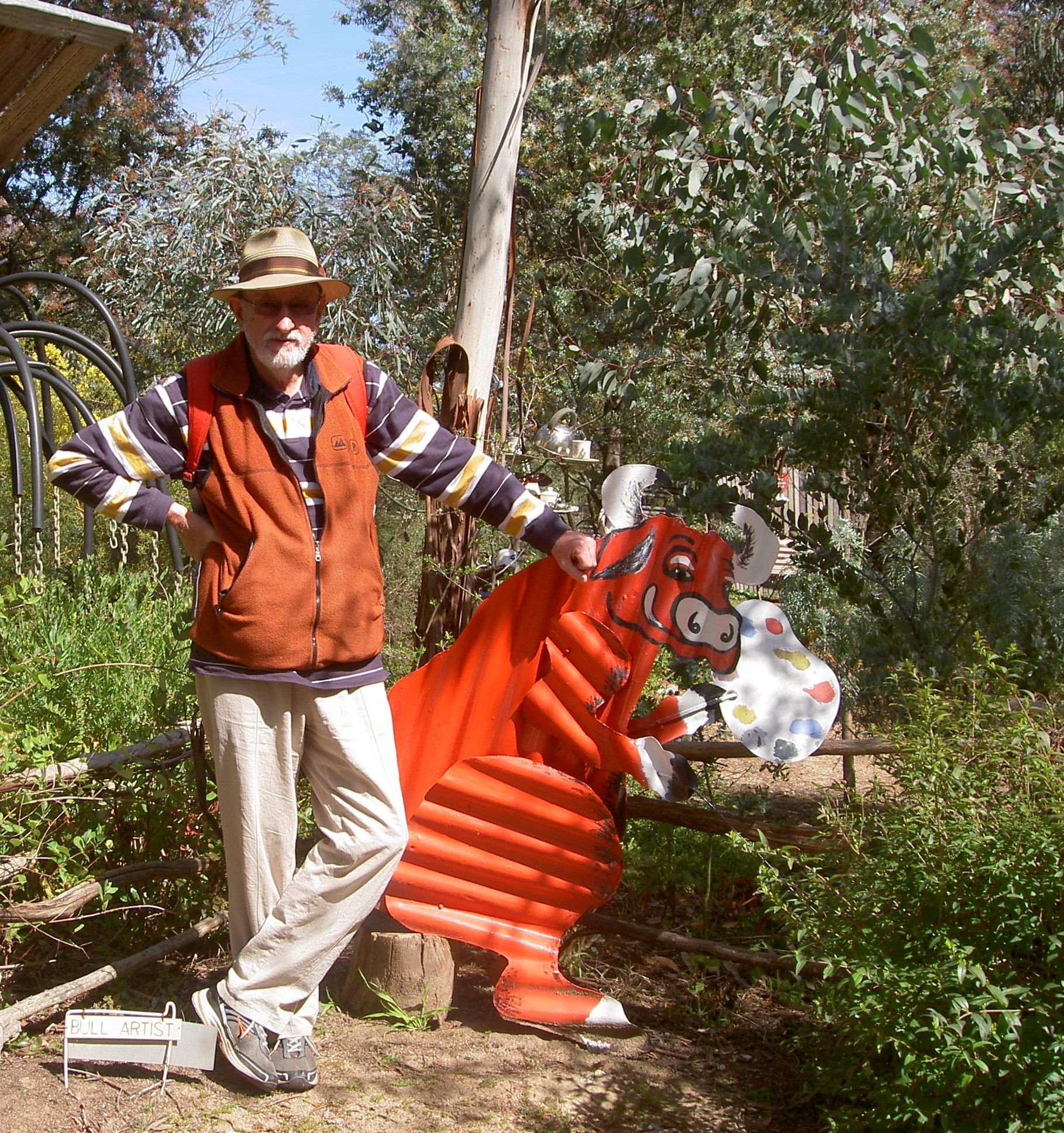
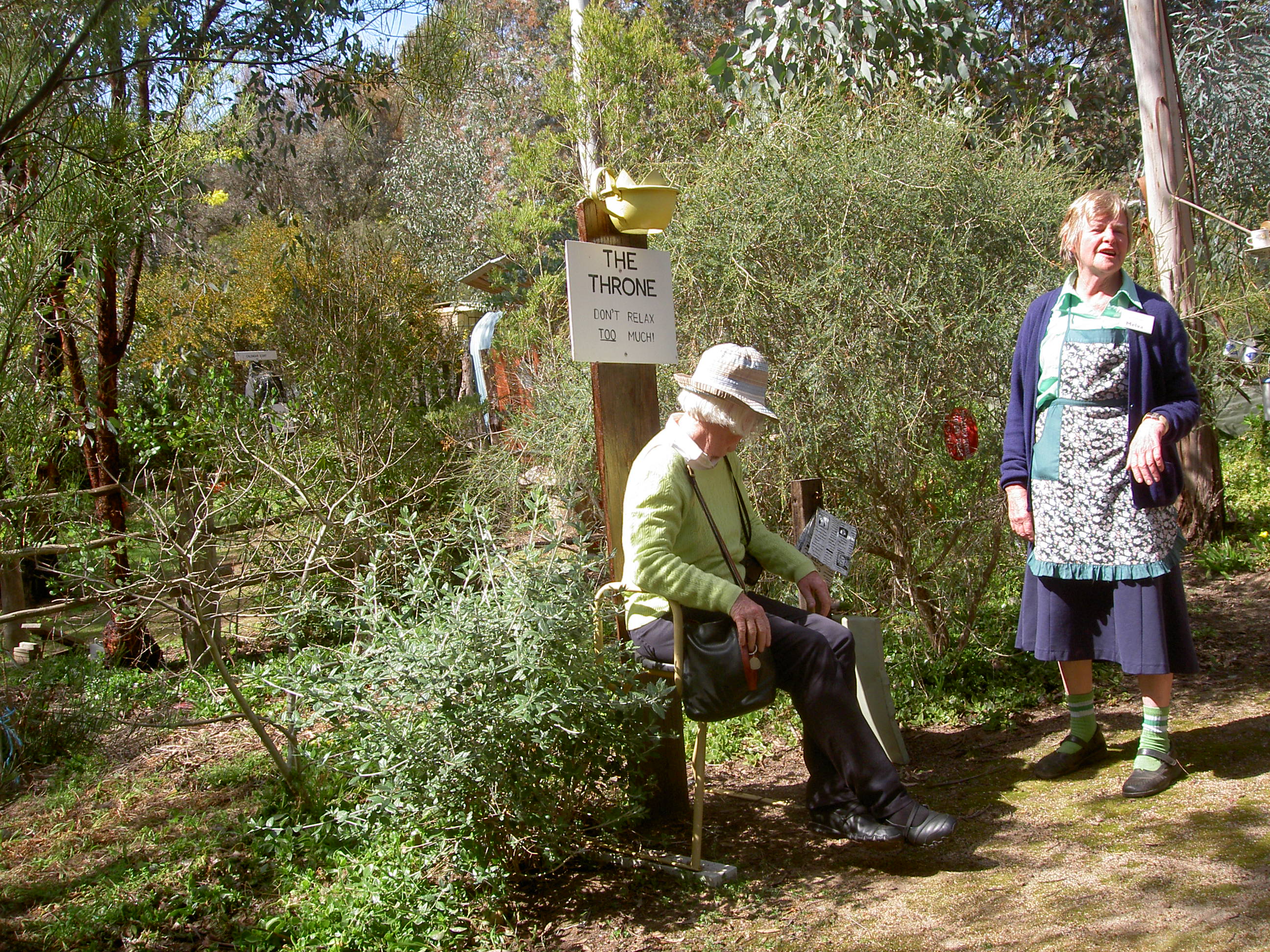
One of our party had been told of a ‘not to be missed’ attraction with the legendary appellation “Woop Woop”; and as appointments are necessary, arrangements were made to visit that place on Sunday morning. Sunday started as yet another glorious day, weatherwise, and we had a very pleasant drive of some five or six kilometres toward Harcourt, where we found Woop Woop on Blackjack Road. This turned out to be a small ‘theme park’; the theme being Australian slang and sayings. We were met at the entrance by Melva, the lady of the park, and her husband Andy, who ushered us into the park ‘café’ and souvenir shop. Melva then gave a non-stop recitation, lasting about an hour, of all the Australian slang and sayings that had been depicted in, for want of a better description, garden ornaments made mostly of bits cut out of corrugated iron sheets, and any other materials that Andy could get his hands on. Bed pans, dunnies, urinals, baths, old bicycle wheels and a hundred other pieces of bric-a-brac had been called into service and strategically placed to illustrate an endless barrage of Australianisms. As we were herded around, we were required to sit in, sit on, stand next to, stand in, a whole variety of these depictions, and I have inserted below a couple of typical examples. You can probably see the enthusiasm on my face, as I stand next to a ‘bullshit artist’.

Me, with a depiction of a 'bullshit artist'
Me, with a depiction of a ‘bullshit artist’
One of our party on 'The Throne"
One of our party on ‘The Throne”, with Melva, the lady of the park

At the end of the recital, we were ushered once more into the café, and served with tea, scones, jam and cream, and another non-stop recitation of more slang and sayings. Two of the highlights were, in fact, not Adam’s creations, but a live bronzewing sitting on natural eggs in a very natural nest, perched very precariously on one of the artificial trees; and a nesting family of New Holland honeyeaters, clearly seen through the café window. I cannot help thinking that I might have enjoyed it all more had I been allowed to roam through the park at my own pace, looking at the things I was most interested in! But that is just me, I guess.

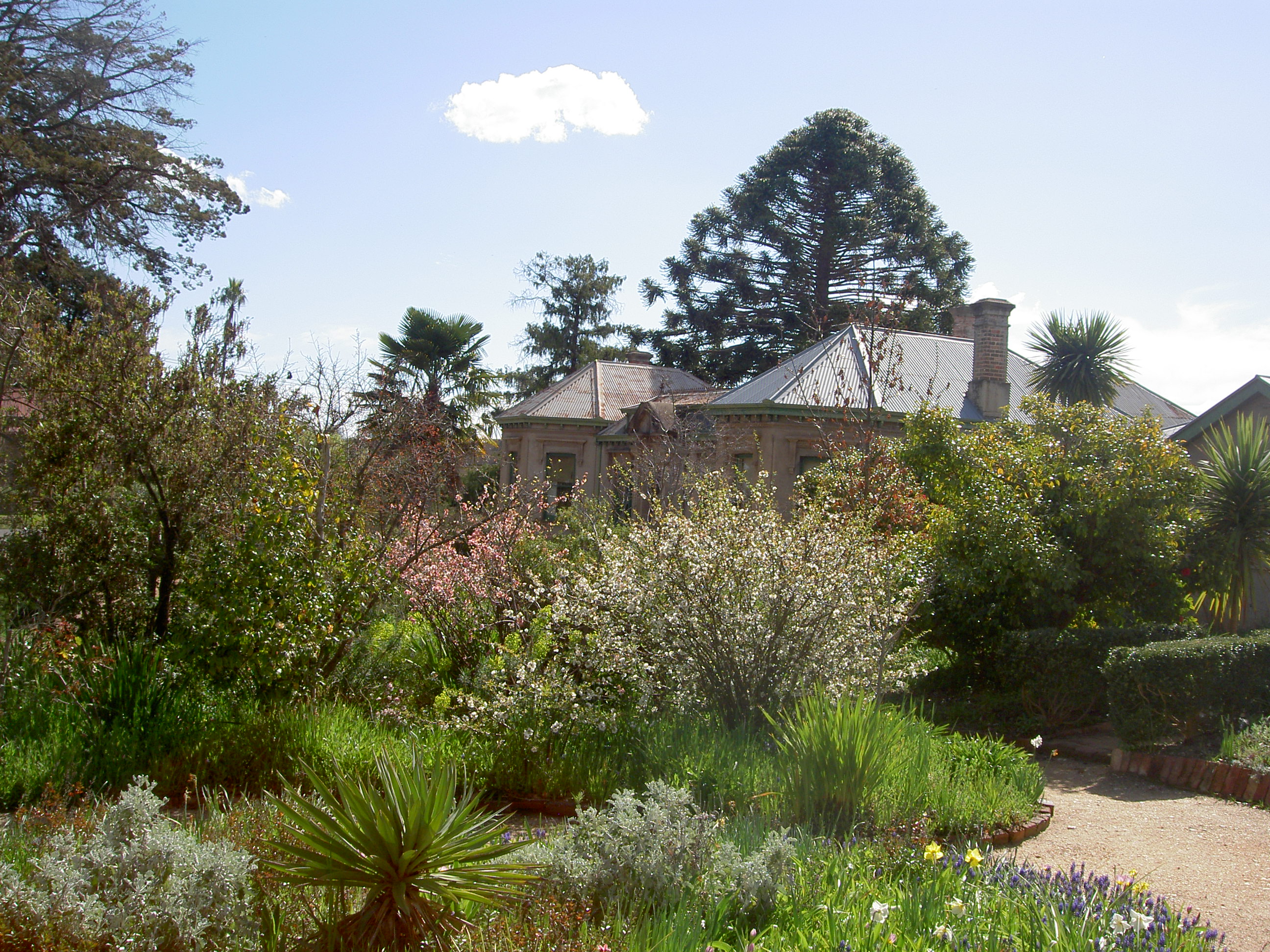
We then went from the ridiculous to the sublime, as we entered Buda, a splendid example of a wealthy gentlemen’s residence, set in beautiful gardens in the heart of Castlemaine.

Buda, Historic House
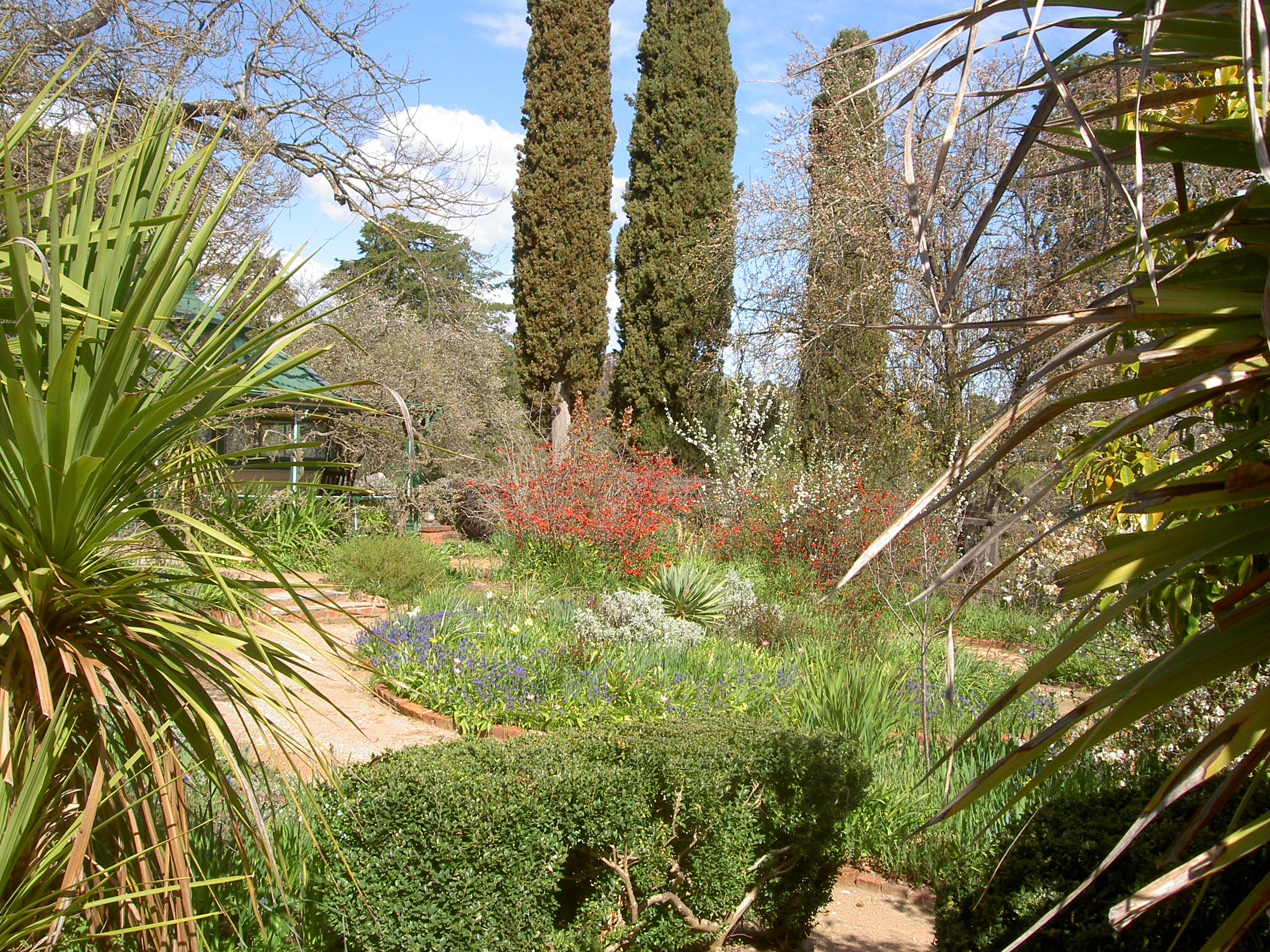
Gardens at Buda
Gardens at Buda

Built in about 1856, it was the home for over 100 years of a Mr Leviny and his descendants, before being bequeathed to the Castlemaine Gallery Trust by the last unmarried member of the family. It is now open to the public most, if not every day, and is staffed by volunteers who provide an interesting history of the place before you enter. Interestingly, one is required to wear paper over-shoes when one enters the house, to protect the carpet, which is pretty ancient, and worth protecting. Several of the Leviny daughters were very prominent in the arts world, and there are several lead-light lampshades, made by one of the daughters, still installed in a couple of the rooms. It is largely furnished much as it was in the days when the Levinys were in residence. The garden includes extensive propagating beds specialising in the older varieties of plants, and one can purchase potted plants. It is worth a visit if you find yourself in Castlemaine with an hour or two to while away.

In planning this short visit to Castlemaine, we had decided not to take golf clubs, even though a few of the party are keen golfers. Whilst we had plenty to do without playing golf, it was a pity we made that decision, as the golf course, not far from Buda, looked very picturesque and inviting when we stopped by to have a look. Despite the glorious weather, and the wonderful condition of the course, there was not a soul on it, and we could have simply put our green fees into the ‘honesty box’ and had a very pleasant round. Mind you, it is very hilly, and might have been a bit of a struggle without a cart! But instead, we turned our wheels back toward the centre of town and bent our steps toward Run Rabbit Run once more for a cup of good coffee before returning to Maggies Place for a siesta and dinner.

Monday morning dawned a little less sunny that the previous three days, so we did not feel so bad at the thought of having to pack up and return to Melbourne. So we said farewell to Maggies Place and set off home, with the intention of stopping off ‘somewhere’ for coffee. That ‘somewhere’ turned out to be Gisborne, and our choice of coffee shop was one of the worst we had encountered for a long time. The serving girl clearly wished she was somewhere else; the vanilla slice brought to the table was so old it had the texture of hardened rubber, and had mould growing on it; and the cleanliness of the cups and spoons left much to be desired. Such a marked contrast to the service and quality we had experienced in Maldon and Castlemaine!

So we left Gisborne to the fungi, and drove the rest of the way home, finally missing the exit from the Monash Freeway onto Springvale Road due to a very large truck obscuring the view of the signpost as we approached. But it would not have been a trip out for us, if we did not miss at least one essential turn-off! (See some of my earlier French travel blogs for more examples of our getting lost!).

Quite when, and to where, our next trip will be is yet to be decided, but when it happens, you will be able to read about it in a future blog.


Sketches of Castlemaine two

September 12-13, 2014

My last blog, Sketches of Castlemaine One, promised further sketches detailing more of the town and its environs. And this is it.

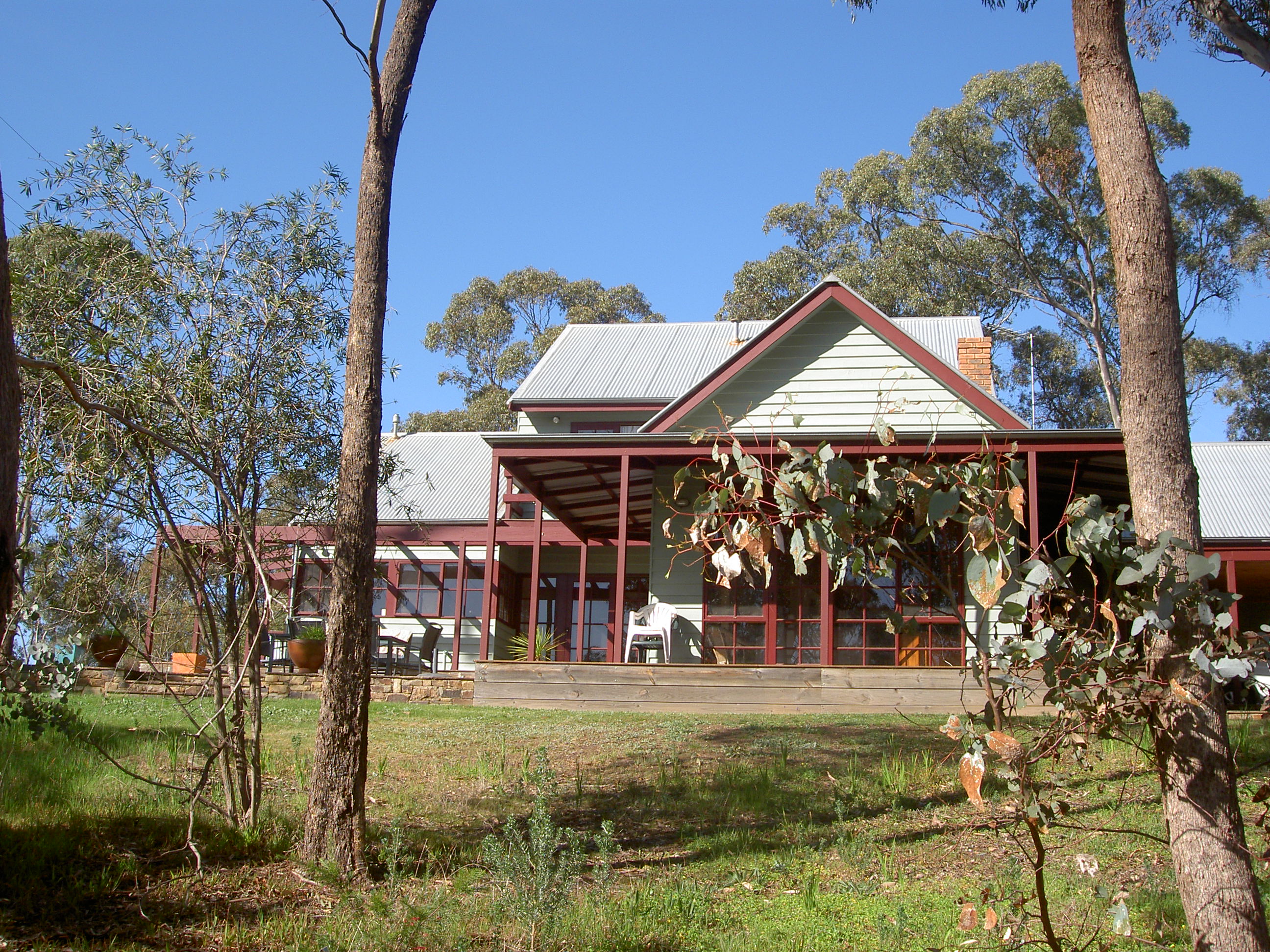
Our route here was the same as last time, except that we were very careful not to miss the exit from the Westgate Freeway onto the Bolte Bridge; and so we arrived in just under two hours from leaving home. It was cold, particularly as we came through the vicinity of Mt Macedon, with the odd shower, but otherwise a very straightforward and pleasant journey. On arrival at Castlemaine, I thought I knew exactly where to go to our accommodation, and I was nearly right! But I turned right into the street, rather than turning left, and consequently had a scenic detour to find our address. The accommodation, Maggies Place, is very nicely designed and constructed, and served our purpose very well. Built to accommodate six, by arrangement with the owners we managed to accommodate a seventh, with very little difficulty. There is a very nice rectangular lounge, with an open wood-burning fire, a gas heater, and a very high cathedral ceiling. The furnishings are comfortable, but we could have wished for a small table on which to place my glass of scotch. Windows in two walls provide lovely views across to the town, and to the old gaol.

View from kitchen window

The rest of Maggies Place comprises three generous bedrooms, two bathrooms, a well-appointed kitchen (but no steamer nor balloon whisk) with nice views whilst you are preparing food or doing the dishes; and a nice dining area. It is surrounded by a ‘bushy’ garden, beautifully constructed timber decks and perfectly laid Castlemaine slate patios. It is all very nice, but some might think the carpets and internal paintwork have reached the stage in their lives when they need replacing.PICT5070

We did not visit the town on this first day, other than to find a pharmacy in search of replacement medication for one of our number who had forgotten to bring essential supplies. The trip was very successful, and the Amcal Pharmacy is to be congratulated and thanked for their wonderful assistance, including a phone call to the pharmacy back home in Camberwell for additional essential details relating to dosages.

Whilst we enjoyed the warmth of the open fire throughout the evening, we did find our bedroom a tad cold in the small hours; but it had dropped to near freezing under the moon-lit cloudless skies. Friday dawned with a beautiful clear blue sky and bright sun. A hasty, simple breakfast and we all walked into town to explore the areas we had not visited on the previous trip. For some, that included the Information Centre, which had an exhibition of works by local artists.

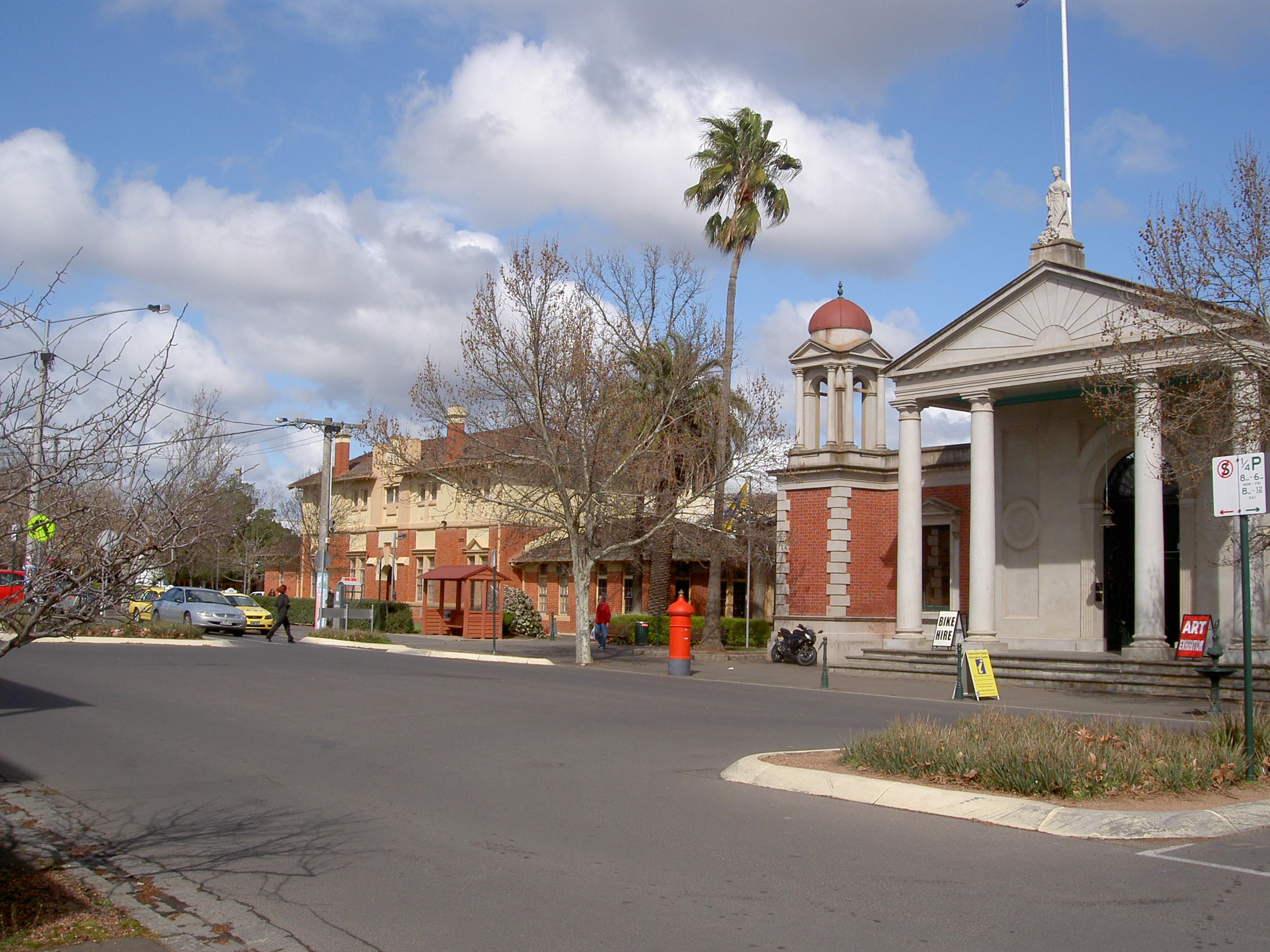
Information Centre and IGA store

For others, it was a walk to the Mt Arapiles Bookshop in search of another lost Dickensian volume. Unfortunately Andy was not in the shop, and thus it was closed until Saturday, so a return will be necessary. We all met at Run Rabbit Run for coffee, which was excellent, and served by very friendly staff. The building housing this café was once a funeral parlour, but was reconstructed during the 1980’s, and no one could tell us whether the rather unusual architectural features were in fact original, or part of the reconstruction. But it matters little, as it is the coffee that is important! From there, we all made the pilgrimage to the Restorer’s Barn, a trove of old fixtures, fittings and hand tools; and other interesting items too many and varied to mention. One could spend a deal of time in this emporium, and a deal of money if one were to be restoring an old house.

Following that Aladdin’s cave, we again split, some to find a micro-brewery (which, as it happened is not yet in existence!). But on the way, we did find a wonderful cheese shop, which included Compté, D’Affinois and some Scottish cheddar in its range as well as some of the best Australian cheeses. One could sense the cholesterol levels rising with every deep breath! There was also a collection of different hams and terrines, all too appetisingly attractive to miss; and a remarkable selection of Opinel knives.

The streetscapes are very interesting, with many substantial buildings dating from the 1860s. In the centre of town, the IGA supermarket is accommodated in what was the original High School, and has a very impressive façade.

Old High School, now the IGA store

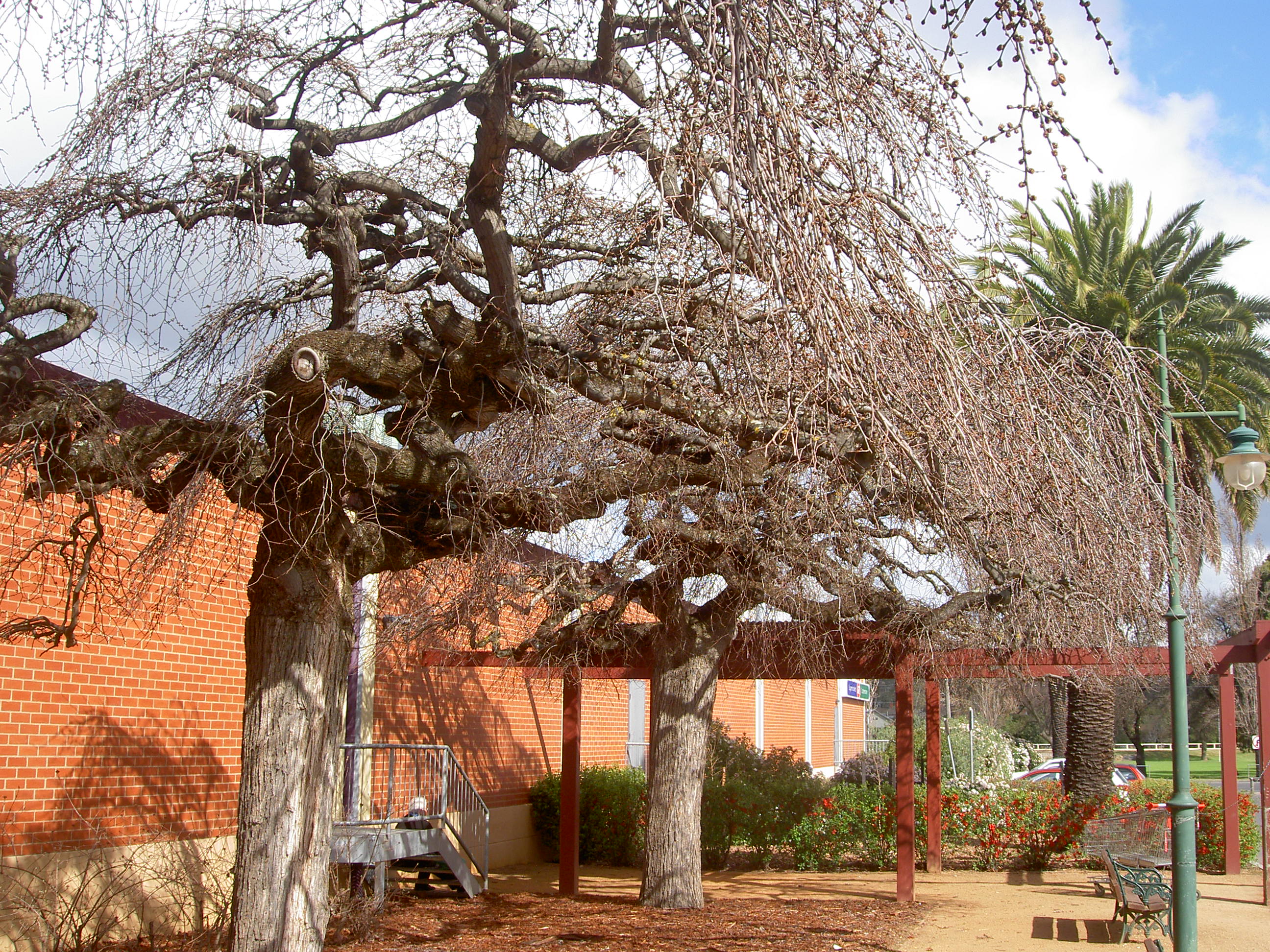
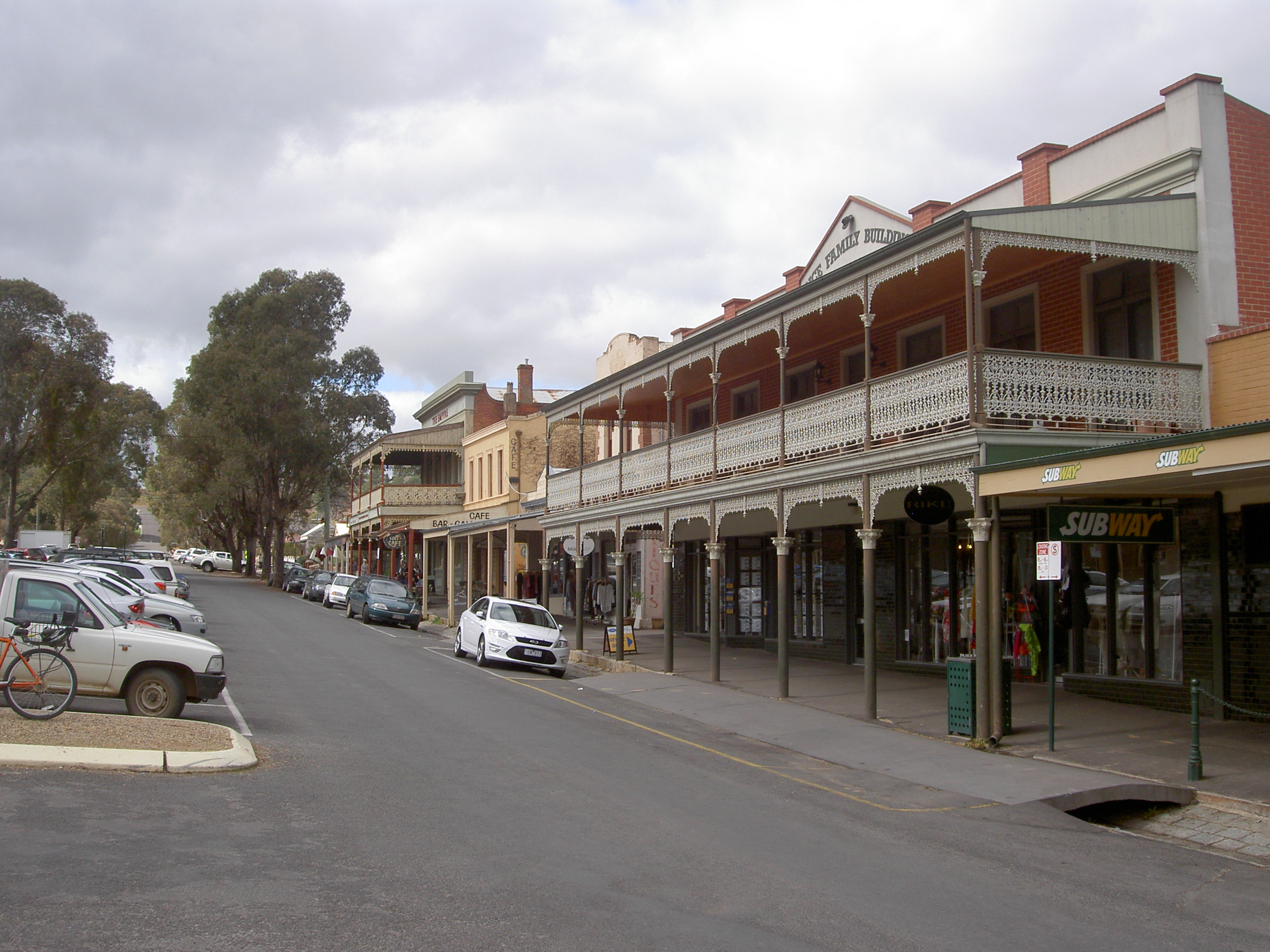
It also has some very unusual trees along the west wall, under which one imagines generations of school children have taken shade from the sun. As is usual in these small country towns once wealthy with gold, the banks are still today housed in very impressive and substantial buildings; and it is nice to wander along the streets in the shade of the wrought-iron lace-work verandas that are a feature of many old buildings.

Castlemaine streetscape

Dinner had been arranged and a table booked at the Naam Pla Thai Kitchen to accommodate the seven which comprised our party. An early start was necessary, as the popularity of this place means they need to run two sittings to meet the demand. Whilst we do not usually dine so early, we were relaxed about it, as we could repair to Maggies Place and relax beside the fire for the evening. The quality of the food was excellent, very reasonably priced, and it was very plain to see why it is so popular with locals and visitors alike. It is to be highly recommended, but we do suggest you make a booking in advance.

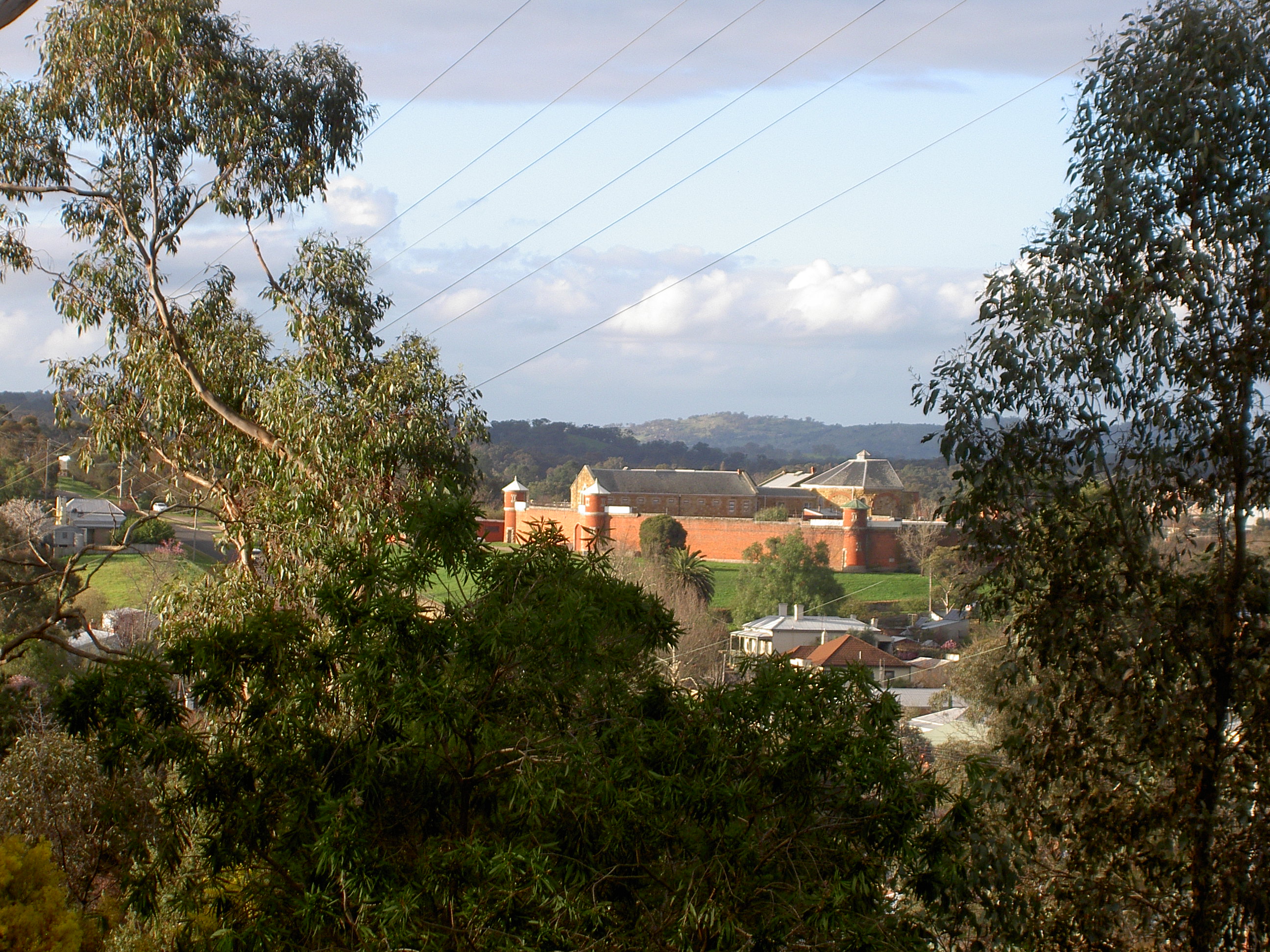
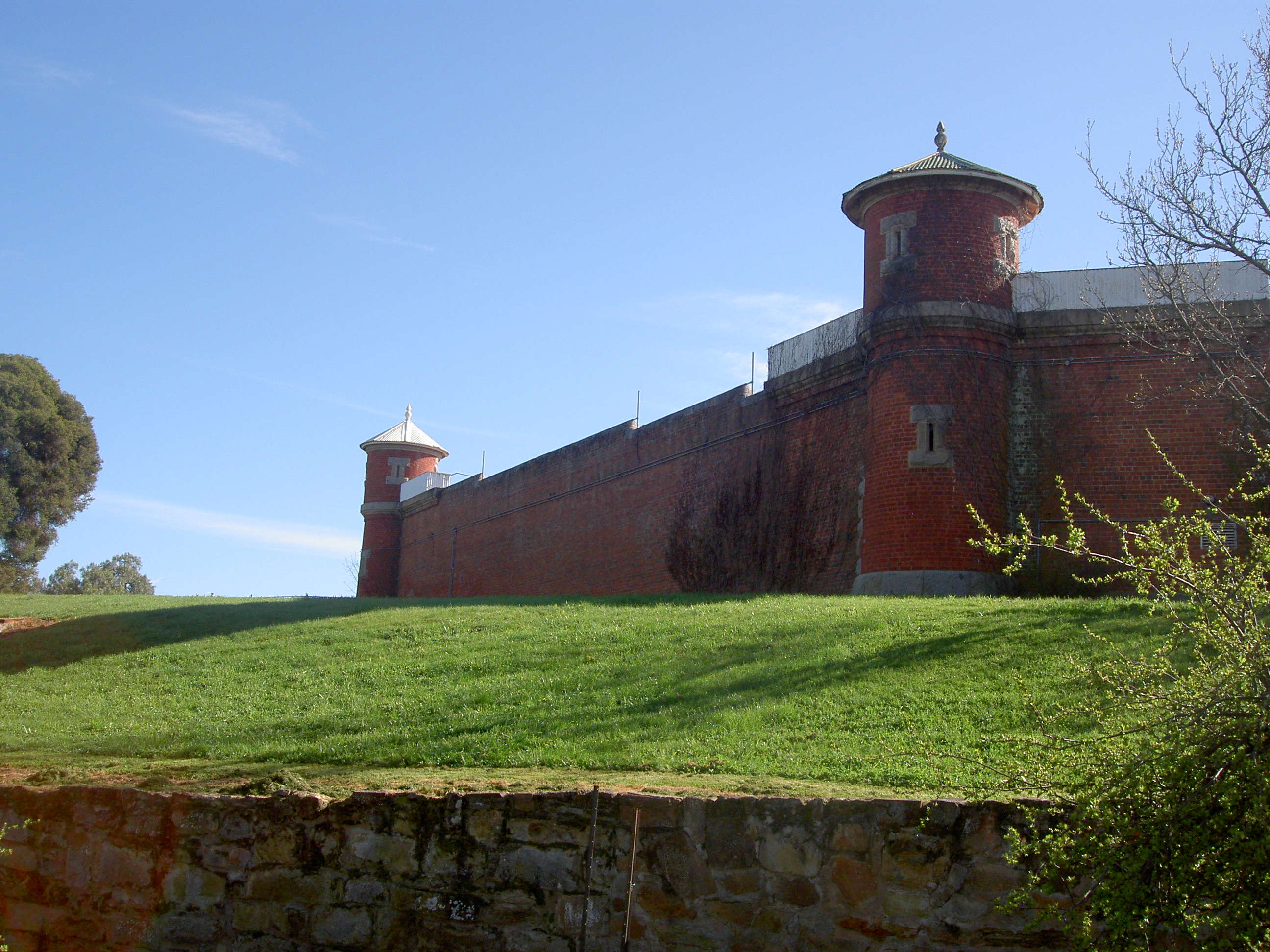
Saturday morning was much the same as Friday as far as the weather was concerned. So it was an ideal morning to walk to the old gaol. It is built with an outer wall  of warm red bricks, having straight sides forming half an octagon, with guard turrets on each corner. It is not exactly Vauban (see earlier blogs on travels in France for more on Vauban), but it is a building which is pleasing to the eye, but which probably brought terror to the hearts and souls of its inmates in days gone by.

Perimeter wall of goal

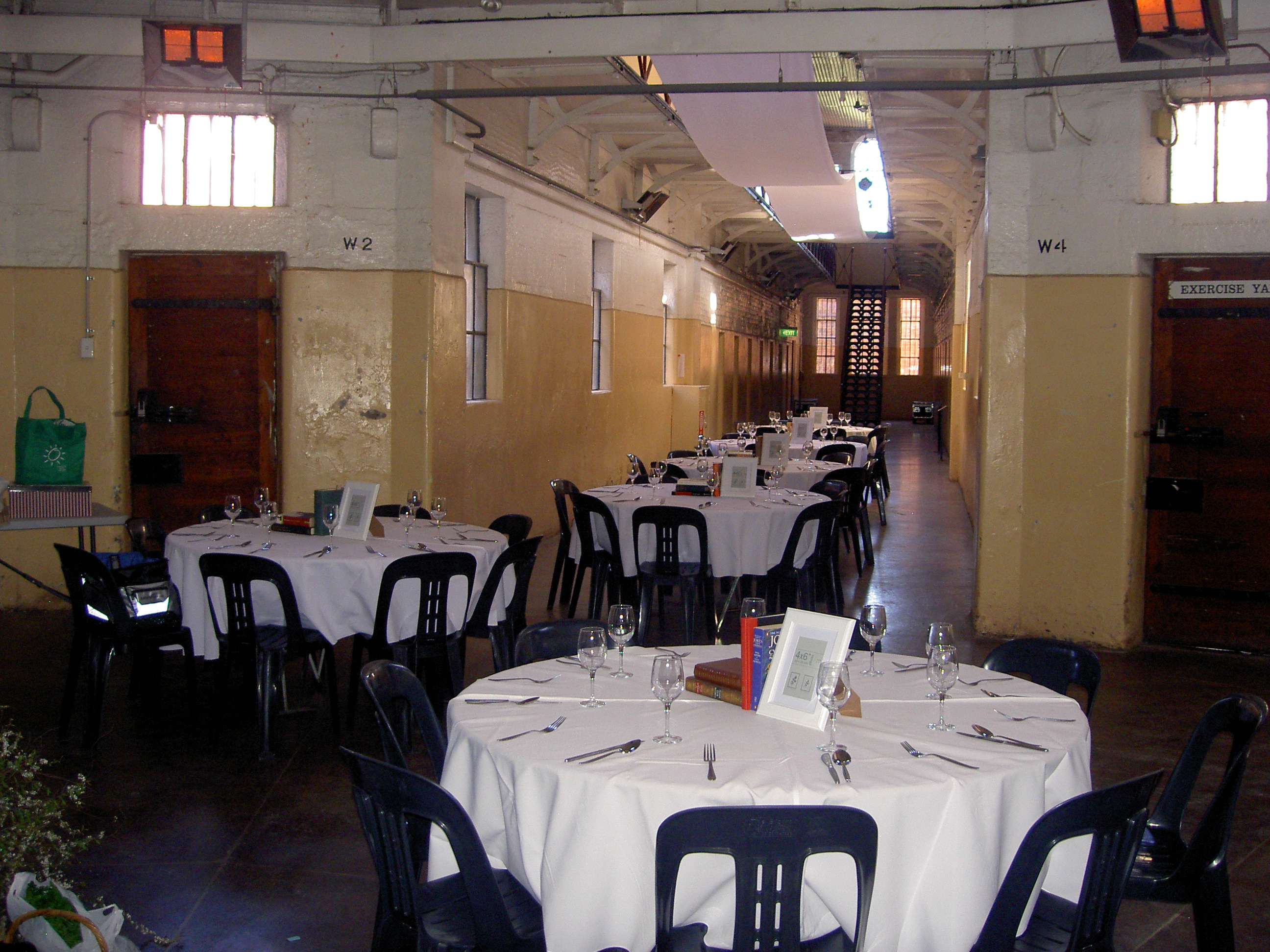
It is now privately owned, and the current owners are deriving some income from letting out some spaces to accommodate activities such as the local community radio station, a pilates group, kick-boxing classes and the like. We were very fortunate that one of the owners was in attendance and invited us to have a look around the interior, as it is not open to the general public; but they have every intention of obtaining appropriate permits to do so. The main cell block, built of the beautiful local Harcourt granite, was being set up to accommodate a wedding reception for this evening, and one wonders what the old inmates would have thought of the luxury of the entertainments that were to take place.

Main cell block set up for wedding reception

The cells are incredibly small with miniature barred windows which admit very little light. The exercise yards were not much bigger in area than the cells, and it would have been a pretty gruesome place to spend a few years at His or Her Majesty’s Pleasure, waiting to be hanged at the neck etc. Between 1865 and 1878, a total of ten men were hanged for their crimes. Until the recent change of ownership, ghost walks were a popular tourist attraction, and the old gaol is claimed to have a very high level of paranormal activity flowing from the restless souls of those executed and buried within its walls.

We then drove to the once thriving gold-mining town of Maldon, which is now a sleepy tourist village, very pleasant to a flâneur such as myself. Rummaging through a few bric-a-brac shops and quaint old-fashioned general stores, was a relaxing way of working up a hunger and thirst before settling into a very nice ‘beer-garden’ for lunch.

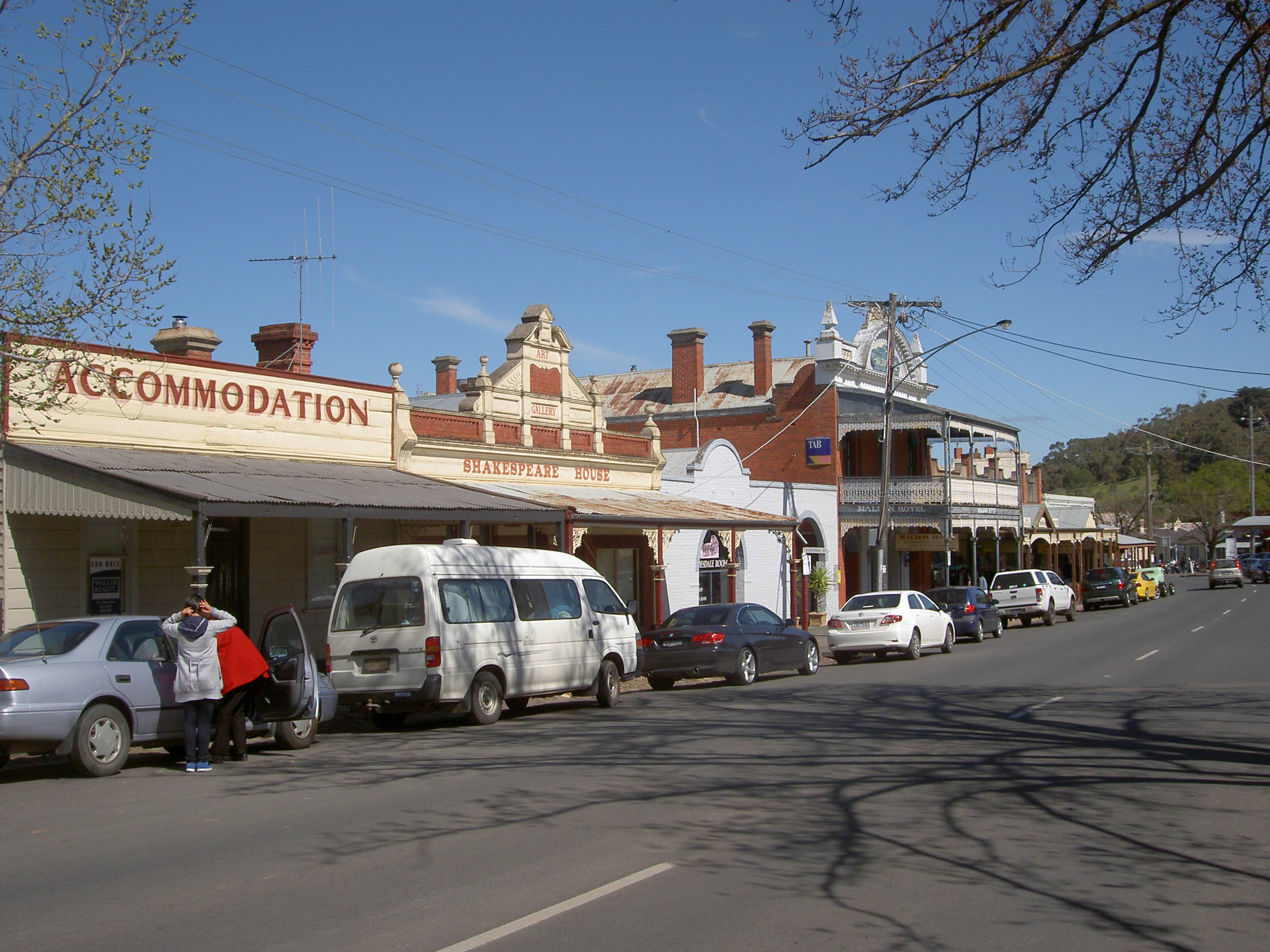
Streetscape in Maldon

Like Castlemaine, wrought-iron lace-work verandas are a feature of the main street, and most of the buildings date from the 1860’s. The staff of every shop we entered, whether paid or volunteers, were very cheery and helpful, just as their counterparts were in Castlemaine.

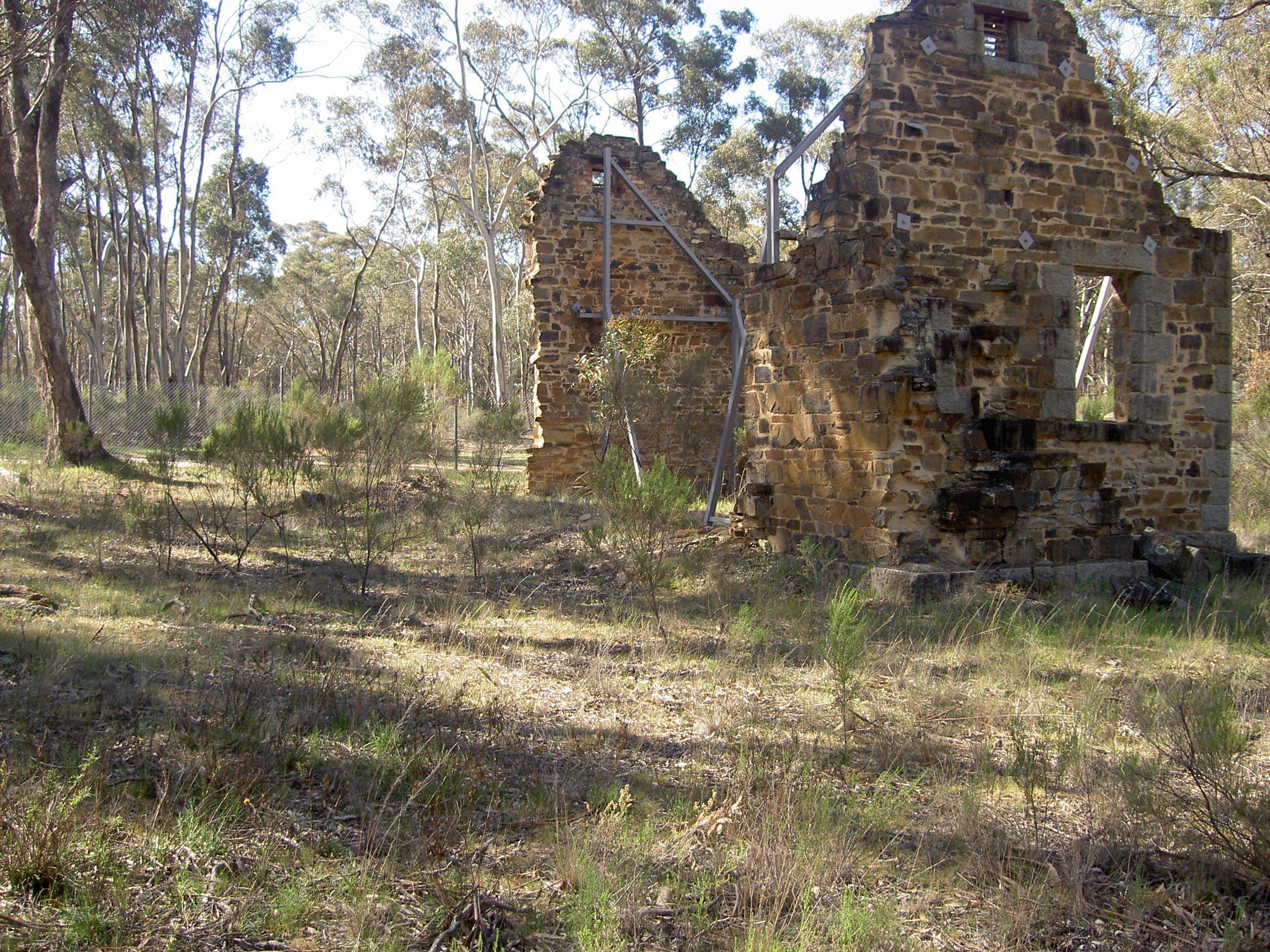
Old Gower School
Old Gower School

On the return to Castlemaine, we made a very brief stop to visit the ruins of the old Gower school, before returning to Maggies Place for dinner and to once more while away the evening in front of the fire.

More on Castlemaine in the next post.

Sketches of Castlemaine; One

Sketches of Castlemaine: One

On June 7, 2014, we went to the small town of Castlemaine, about 90 minutes’ drive north and slightly west of Melbourne. It was the Queen’s Birthday long weekend; the event was the inaugural Castlemaine Jazz Festival; and our band was playing a couple of sets. We left home early, about 7.30am, and set off on the Monash Freeway, intending to take the Bolte Bridge onto the Calder Highway. But be warned if you are thinking of going that way; the signage on the Westgate Bridge Freeway is really very confusing. Emerging from the tunnel, we saw a large green sign clearly marked “Bendigo”, over the right-hand lane so got into that lane. However, very shortly after that, there was a large green sign over the left-hand lane also clearly marked ‘Bendigo”. But by the time we managed to get across the several lanes of heavy traffic, it was too late and we had missed the exit ramp. We could see it very clearly as we drove parallel to it for nearly a kilometre, about five metres to our left; but we were separated from it by an impenetrable concrete barrier. We saw it sweep away to our left, then, in a great arc, sweep back, over our head and onto the Bolt Bridge. But we were fain to continue over the Westgate Bridge, drive toward Ballarat until we reached the Western Ring Road, and drive along that monstrosity of a road until we came to the Calder Highway exit—a distance of some 15K beyond the missed exit. We were not best pleased, as you might imagine.

But the rest of the drive was very pleasant. The sun was rising nicely, and there were pockets of mist in the hollows and valleys, looking like calm lakes, with trees sticking up like masts and tattered sails of old square-rigged sailing ships that had sunk quietly to the bottom. Everywhere was green, and it was very nice to drive along, sometimes through rolling countryside, sometimes through remnants of bush. Traffic was light, and thus the journey was very enjoyable. Just before  Castlemaine we drove through the old quaint village of Chewton, and made a mental note to revisit it sometime when we had a bit more time to spare. But we had to get to Castlemaine this time, so drove on.

Arrived at Castlemaine, we had no difficulty locating the Festival Registration Office, conveniently located at a large car park, meant to serve the local IGA supermarket. Registration completed, we repaired to the Comma, as the old Commercial Hotel is now called, to set up for our first gig starting at 11.00am. In all, there were to be seven venues running concurrently; each band having 45 minutes playing time, with a 15 minute changeover. Being first cab off the rank, we could take our time setting up, and still have time for a coffee. Our groupies, who were not needed to help with setting up took themselves off to the nearest coffee shop, and ordered their coffee. We followed some 15 minutes later, to find them still waiting for their drinks to be served. We ordered, and before ours came, the others received their coffees and had finished them whilst we still waited. Our drummer then arrived and ordered his coffee, and ours eventually arrived, and was consumed. The drummer gave up waiting, cancelled his order and got a refund, as before his had arrived at the table, it was time to scamper back to the Comma to start our first set. We must say, at this point, that the coffee was excellent, which is a compliment one could not extend to the service.

The bar of the Comma was filled with chairs of every description imaginable, arranged in higgledy-piggledy order and every one was accommodating a backside or two. Being 11.00am, the audience was one of mostly coffee drinkers, who had obtained theirs from the Comma itself, and the gig went off very well. We finished, and as it was noon, we decided to find somewhere for lunch, before taking in some of the other bands. A nice café was found on Mostyn St., and lunch ordered. Again, the service could only be described as woefully inadequate, even though the food itself was very good. It became very clear that the cafés had not anticipated the increased patronage engendered by the Festival, and were very short-staffed. It is quite probable, of course, that in such a small town, additional staff would not be readily available, and we should perhaps be a bit more sympathetic.

After lunch the band members decided to go their separate ways, and to meet again at the Bridge Hotel, where we were to play our second set at 7.00; for dinner there at 5.30; and a table was booked accordingly. We decided to walk to the New Northern Hotel to see one of the other bands, and bent our steps in that direction. Some local knowledge had been sought, and we were assured it was about a 20 minute walk. It was not many minutes before we came across a second-hand bookshop, a facility we find irresistible. In we went, to find it jam-packed with so many books that it made our head spin. So we left, but very soon came across another, which seemed to be more organised in the arrangement of shelving, and the books were nicely displayed. Now we need to say that some 50 years ago, we inherited a set of books by Charles Dickens, which was missing 5 volumes, and over the intervening years, we have made a point of popping into every second-hand book shop, in search of the missing books. A couple of years ago on a trip to England, we found one of them in a shop in Broadstairs, but were still missing four. No sooner had we stepped into the shop when the young man asked if he could assist in any way. We explained we were seeking missing volumes from a specific edition of Dickens, and referred to the 1937 edition by Hazell, Watson, …..when he immediately added “and Viney”. He then asked whether we were looking for the burgundy binding, or the blue. We could hardly believe our ears. Here, for the first time, was someone who seemed to know what they were talking about. We were very impressed, as he turned to his computer, and in no time at all, had found Barnaby Rudge, one of the missing books. Suffice to say at this stage, we ordered all four books, and now look forward to them arriving by post from England. There was service that could not have been bettered!

But to return to Castlemaine and the Festival. We continued on foot to the New Northern, to find it was a more up-market establishment than the Comma. The bar was rather elegant, and the jazz was being played in a proper auditorium, with neat rows of matching chairs; not at all like the mishmash, but more atmospheric, Comma. The band we saw was very good, and when it had finished its set, we returned to the main part of the town, to the Cumberland Hotel. This again was more up-market than the Comma, with a number of chairs at each of the circular tables in the large saloon. Clare Castle Jazz Band was playing, and there was a good atmosphere and vibrancy emanating from the crowd. By now it was time to find The Bridge, which, as it happened, was out of the main part of town, not far from the New Northern. Now here we found a really ‘pubby’ pub with loads of atmosphere. It was fortunate that we had reserved a table, as we had to elbow our way through the crowd to get to the bar for a drink and to order food. It was also fortunate that we had allowed plenty of time, because, like the other venues at which we had ordered consumables, the service was appalling! When the food did eventually arrive, it was very good, but was spoiled by having to gobble it down as quickly as we could, in order to get set up ready to play as soon as the previous band had finished.

The audience for this set was quite different from that in the Comma earlier in the day. For a start, it was now evening, and rather than drinking coffee and tea, they had been well into the beer and wine for quite a while before we arrived! It was an exciting audience, that showed its appreciation by loud cheers, accompanied by enthusiastic whooping and stamping of feet. Probably the most animated audience we had ever played to, and very rewarding.

We did not dwell long after finishing the set, as we had to return to Melbourne. But there was time to find one more café for a coffee before we left. The place we chose was opposite the IGA, on Hargraves St. It specialised in Japanese food during the day, and Thai in the evenings, (or perhaps the other way round). The coffee was excellent, and we are delighted to report that the excellence of the coffee was reflected in the excellence of the service. And following this coffee, we set off for the drive back to Melbourne.

Now you will probably have noticed that this sketch is somewhat deficient in that we have not given much of a description of the town itself. So, suffice to say that it is a delightful place, and we have now booked to return for a four-day stay during September, during which visit, we shall have more leisure time to explore the town in greater depth, rather than just rushing from one jazz venue to another. And we shall also take our camera next time. So, come the middle of September, be on the look-out for Sketches of Castlemaine Two.

Sketches of Merimbula, six

May 14 to May 17, 2014

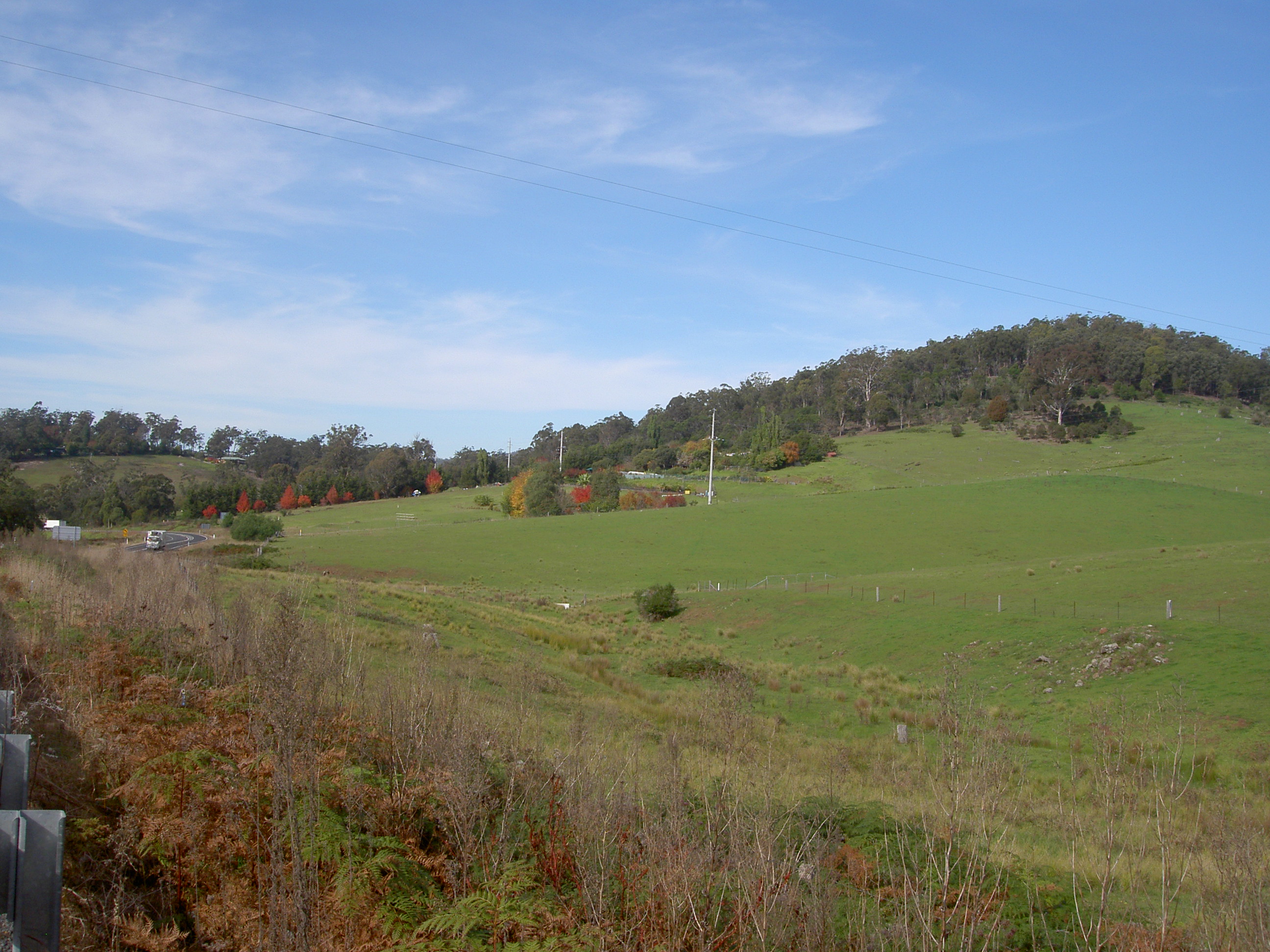
In Sketches of Merimbula 4, we mentioned the rolling hills in the hinterland around this part of the world, and the splashes of vibrant colours in the clumps of deciduous trees. Well, on today’s little jaunt, we came across a similar view which, as luck would have it, was close to a safe and convenient stopping place, so  we were able to take a photo, which is shown here.

PICT5011

Also, in Sketches 2, last year, we mentioned the golf driving range at Mandeni Resort, where one hits ones golf balls into the lake. We also mentioned last year that there is a 9-hole pitch and putt course where the holes are between 60 and 100 m in length; and a full-length 9-hole, par 34, course at this resort, but said no more about them. This latter course used to be pretty rough, and we had not looked at it in several years, but today we did. And we were very pleasantly surprised to find it very much improved. It is not over-long, with three par threes of 120 to 190 m, five par fours, from 240 to 320 m, and one par five at 415 m. It is well laid out, and any shot that is at all wayward results in a lost ball. The first hole is a par three of 123 m, but there is no fairway—just the tee and the green, and between the two, a lake. The par five needs a perfectly straight drive of at least 180-200m, and anything going at all right is lost in the lake. The second shot needs to be a push forward of about 60-80 m to get past the scrub on the lake edge, before one can get a 150 m shot across the lake to the elevated green. All the holes really do need very good straight drives to stay out of trouble. The fairways are much improved since earlier years, but the greens are still a little bumpy, with more kangaroo poo than is necessary!. Still, it is great fun, and very nice surroundings, with very few people to laugh at you! And we can modestly report we went round the 9 holes in 44!

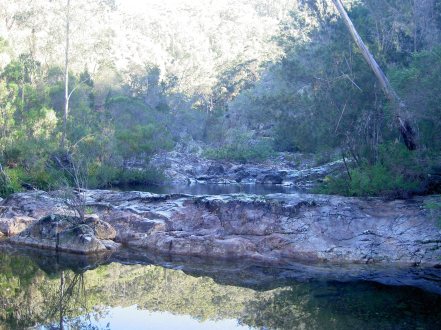
On Wednesday we drove into the hinterland in search of Nethercote Falls. We had with us our I-Pad, with a maps ‘app’ which displayed a blue dot to represent our position on the map. As we drove, our wife, instead of admiring the lovely scenery, spent the entire journey looking at the blue dot move along the lines representing the roads, and gave us the directions in a voice similar to those to be heard on ‘sat-navs’.  The falls were in some ways disappointing in that there was no water, it not having rained in these parts for some time now; but the liPICT5009ttle creek was a very pretty series of rocky water-holes, and there were quite a number of birds to be seen and heard.
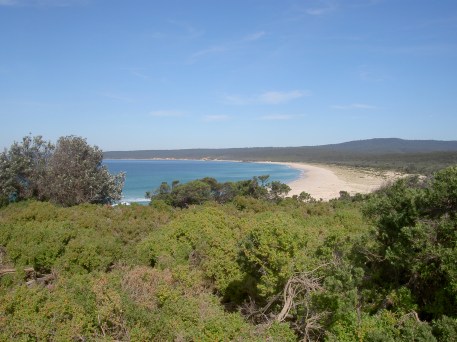
Thursday’s outing was a trip to Haycock Rock, one of our favourite walks. The scenery there is stunning, with magnificent views along the pristine beaches which run all the way to Eden to the south; and the weather beiPICT5013ng the perfect conditions we have come to expect, made for a lovely morning. Following our picnic lunch, we spent three hours trying to catch fish at Barmouth Beach, but the hunter failing miserably to provide anything toward dinner, the gatherer was fain to drive to the pizza shop for take-aways! It has been quite some time since we have had take-away pizza, and we were rather surprised at the cost. Maybe they are just as expensive at home, so we shall have to investigate when we return!
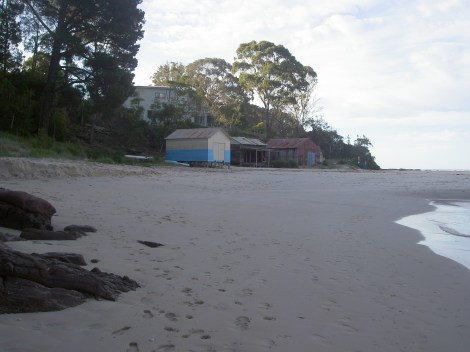
Friday, our last day here. We had another hit around the 9-hole course at Mandeni, with perhaps a little less success than on the previous outing. But nevertheless, it was a beautiful day, and very enjoyable. We did not try to catch any more fish, the tides being all wrong, so we bent our steps toward Wheelers Restaurant for dinner, and were very delighted to find that it was every bit as good as last year. Then, back to our apartment to pack all the stuff, to be on the road home on Saturday morning almost before the larks breaketh wind. Traffic was very light going our way, but we were surprised at the number of caravans heading toward where we had just left. We hope they all had as good a break as we did!

Sketches of Merimbula, Five. May 11 to May 13, 2014

Sunday May 11, 2014 and it is Mother’s Day. Accordingly, Merimbula turned on the perfect ‘season of mists and mellow fruitfulness’ morning for the bacon and egg BBQ breakfast provided for the guests by Leanne and Rhys, the managers of Sails Apartments. It was very pleasant to gather around the BBQ area sipping sparkling white wine, with or without orange juice, and chatting with other guests whilst watching someone else do the cooking. And the breakfast was cooked to perfection; and then brilliantly served by the children. This is indeed what holiday apartments should be like!

After breakfast we made a sentimental journey to Pambula Hub Caravan Park for a coffee at the kiosk there. We had intended going to another, equally sentimental, café, but found it to be closed ‘due to family illness’, which was unfortunate. We hope they are soon restored to health, and can open their café once more. The second choice of café we failed to find at all, not really remembering where it was, and giving up after driving some 15k inland along a very narrow road. So the Hub it was, and I must say the coffee, whilst served in cardboard cups, was very good. Then, a short drive to the Mouth of the River Beach, and a nice stroll along the low-tide sand. The old boat sheds are still there. Goodness knows how old they migPambula boat shedsht be, but each year they seem to get further from the water’s edge as the sand builds up in front of them.  Finally, we drove to Wheeler’s Seafood Restaurant, opposite the Merimbula Golf course, to purchase some prawns and oysters ready for dinner that night. Dinner comprised the sea-food entrée, followed by a delicious steak and potatoes baked in their jackePICT5004ts, and some very nice wines.
Shortly after dinner there was a knock on the apartment door, and Leanne appeared bearing a balloon whisk, having read my previous blog! Now there is service worth commenting on! Now, lest any of our readers think we are a bit precious about some trivial things, let us hasten to add that we regard the shape of a whisk or the colour of our whisky glass in our holiday accommodation as being ‘21st century, 1st world problems’. That is to say, if they are the only sort of problems we have, then let’s face it, we have nothing whatever to complain about. And that is true. We may not have millions in the bank, but we still have sufficient to live on, to have a glass of scotch, to have eggs to whisk, to have the occasional holiday away from home.  And as we used to say of the young lady with very large knockers who worked at the local library when we were at school, ‘very nice, but really, any more than a handful is wasted’! Yes, we have no real problems living here in Australia, so you might occasionally find us ‘complaining’, with tongue very much in cheek, about some totally trivial ‘problem’ or other. Take no notice of it, it is just our slightly warped sense of humour.

Monday started as another perfect Pambula day. A crisp early morning, a still, warm day, perfectly blue sky, and a cooler evening. Beautiful. Just the day for a game of golf at Tura beach. This would have to be one of the most picturesque courses that we have played on. It is just a pity that our golf is not as good as the stunning views. There was the usual mixture of brilliant, mediocre and shit shots, but, wPICT5006e think, a very slight shift away from the shit end, toward the brilliant end, of the bell-shaped distribution curve. If only our wife would not laugh so much at those shots which, through nothing more than unbelievably bad luck, were unfortunate enough to hit a tree or to find the lake.

Tuesday was once more a perfect day, much like the previous three days. We had been told that there was excellent coffee to be found at the ‘other end’ of the Board Walk. We had started on this walk before, but had never persevered to reach the far end, a distance of only about 1.75km. So today, we drove to the ‘other end’, and found, on the way, some remarkable hilly roads with stunning views that we had not encountered before. We had our walk along the boards at the lake’s edge, meeting and greeting hoards of people, before actually going to the café for our coffee. Like the boardwalk, the café, which doubled as a boat hire shed, was very busy, so we shared an outside table, in the sun, with a gentleman who was evidently a ‘regular’ there. He was an interesting character, having been born and raised in Merimbula, and living his whole life there. He had certainly seen many changes in the last 70 years or so, with the increasing number of holiday makers. His wife had unfortunately died some 18 months ago, and it was clear that he was missing her very much. He was filling up his time with sailing his boat and camping, in solitary, around the lakes in this part of the coast. He did have friends who came on short visits with him, but he really missed sharing his experiences with more permanent company. We talked for about an hour, he telling us about his life, we comparing his relaxed living in Merimbula with our rather more hectic living in outer Melbourne. He told us how he had some minor repairs to make at his home, but was putting them off as he was now planning to take a rail trip somewhere, but he could not decide where to go. We rather thought that in days gone by, maybe his wife had been involved in those sorts of decisions.

We finished the day with a modest dinner of nachos and prawns, at the local Mexican restaurant, before sitting down to write this installment of Sketches of Merimbula.

Sketches of Merimbula, Four, (May 6 to 10, 2014)

Almost exactly a year has passed since we last visited this part of the world, and we wrote Sketches One, Two and Three. During that time, our granddaughter has spent seven months studying in England and visiting several places in Europe; our niece in Melbourne gave birth to a second daughter; we were visited by our sister and brother-in-law from England; Ann has had a knee replacement; Brian has had a coronary artery stent, Helen has walked 71 km in 20 hours on a charity walk; and Phil had a trip to Sydney to collect an award on behalf of his community radio station! So, here we are once more in Merimbula for a few days of rest and recuperation having left Melbourne last Tuesday, and spending one night at Lakes Entrance on the way here.

You may recall that last year we stayed at Aquarius Resort, and enjoyed it all very much, even though some of you maybe thought otherwise. This year, in a bid to spread our patronage around a bit, we have moved next door to Sails Apartments.Image We are still at the busiest intersection in Merimbula, and still directly in the flight path for the airport, but we have a wonderfully uninterrupted view across the lake. The block of twelve apartments (six at ground level, and six upstairs) is neat and tidy, with new managers who are clearly maintaining the very high standards set by the recently retired managers. Inside, we have two very  generous bedrooms, one with an en-suite facility. There is a separate bathroom with a spa bath, and a very large kitchen/dining/lounge area. The kitchen is well provided with cooking utensils, even a wooden spoon, but regrettably, no balloon whisk! There are glasses the right size and shape for our scotch, but we would have preferred them to have been colourless glass, rather than pale blue. I guess we are among those people who are never satisfied!

The end wall of the lounge is wholly glass windows and doors, through which we have the view of the lake, and beyond which we have a nice sheltered and paved patio with a table and four chairs, and lawn. There is a heated pool, and a couple of gas fired BBQs toward one end of the garden away to our right. A couple of flowering gums (angophora?) attract rainbow lorikeets, and it is all very pleasant indeed.

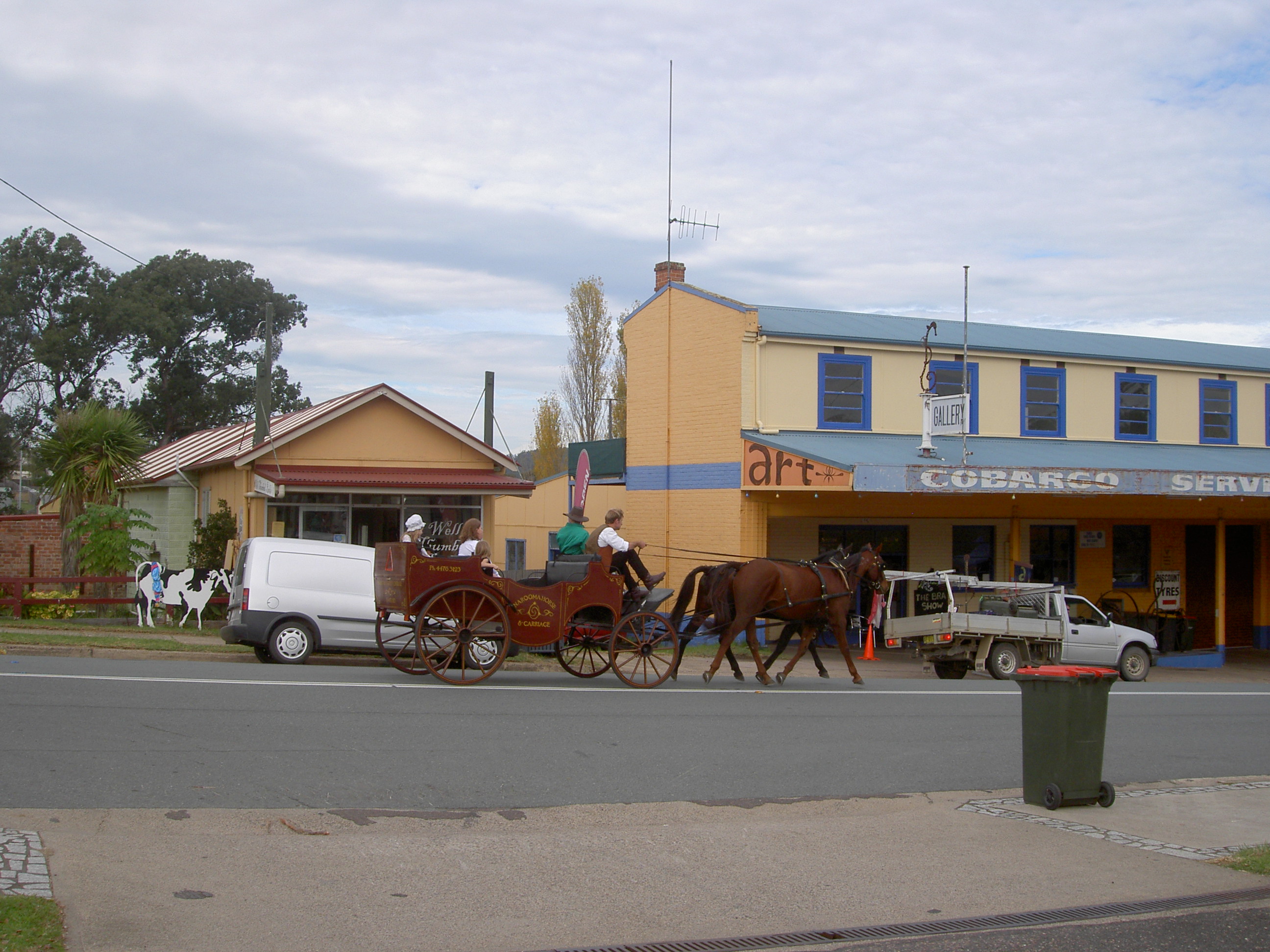
Our first fishing trip was rewarded with a large dusky flathead, which provided ample dinner for us. The second trip yielded a slightly smaller one, but still very nice to eat. Today, (Saturday) the weather being less settled, we headed north through Bega to Cobargo. The countryside is stunning. The gently rolling hills that have been cleared of most of their native trees are covered with lush green grass, with splashes of the brilliant red/orange/yellow colours of deciduous trees displaying their very best autumnal foliage. The rest of the countryside is still covered with its native vegetation, and very pleasant to drive through. Cobargo has not changed much in the 25years since we last visited. It is almost like a pioneer village museum, with a working forge, a potter, a leather worker and so on. Public transport appears to be horse and cart, and the service station that seems to have closed through lack of modern business, has been converted into a curious sort of art gallery.Image The current exhibition is of various decorated brassieres! Almost next door is a very good second-hand book shop, into which, of course, we had to go. There were a few ‘market’ stalls with homemade cakes, locally grown fruit and vegetables, and handicrafts scattered along the foot-path of the main street. The old Grain Store café has changed its name to Salt and Pepper, and that is about the only change in 25 years. Fortunately unchanged, the coffee there is just as good as it was before.

Leaving Cobargo we returned south, detouring to Tathra, where we had a very pleasant lunch in the old warehouse on the wharf. There were quite a number of people, young and old, male and female, fishing from the wharf, and whilst they were all having quite a lot of success, we regret to say that most of them were keeping fish that were definitely undersized.

Image

Then it was back to the apartment, where we had omelettes for dinner, made without the aid of a balloon whisk!

The Invisible Woman

“Never let the facts stand in the way of a good story”, so the old saying goes. And that is exactly the approach taken by Claire Tomalin who wrote the book, and by Ralph Fiennes who made and acted in the film The Invisible Woman. This purports to tell the story of the relationship between Charles Dickens and the actress Ellen Ternan. And the fact that they chose to ignore is simply that there is not a shred of credible evidence so support the case that Ellen was Dickens’s mistress, and that she bore him a child. Sure, there is evidence to show that there was a significant relationship that lasted from the time they met during performances of The Frozen Deep in Manchester in 1857, until Dickens’s death in 1870. There is evidence that Dickens kept Ellen pretty much hidden away for most of this time, providing accommodation for her, her mother, and to a lesser extent her sisters, in a variety of places including in and around London and in France. But this is only circumstantial as far as a sexual relationship is concerned. The prejudiced argument is, of course, that no man would do that unless he was getting his share of sexual favours. But as far as actual evidence goes, there is none. On the contrary, according to J.T.W. Ley, Ellen’s maid of many years has said “Tell Ellen’s daughter, if she ever asks, that I never mentioned the matter to her because it could only cause her pain, but that if she had ever asked me, I should have been able to say solemnly that her dear mother never was the mistress of Charles Dickens”. Now, I agree that this is merely hearsay, and therefore does not constitute ‘evidence’; but then those who do believe the story are also relying totally on hearsay!

The first ‘revelation’ was made by Thomas Wright of Olney, in his Life of Dickens, published in 1935. In that book, Wright claimed that he had been told by Canon William Benham in about 1900, that in about 1897, Ellen had ‘disburdened her soul’, ‘told the whole story’, and had told Benham that she had been Dickens’s mistress. Wright had already made the statement that he had ‘long been aware that Ellen had been Dickens’s mistress, but that until Canon Benham told him, he had no evidence to prove it’. Quite what Wright had based his ‘long awareness’ on, he did not say. But it does indicate a predisposition to interpret anything that Benham might have told him, in a sexual way. We cannot be at all sure, that what Wright eventually published, was anything like what Ellen might have said to Canon Benham some 40 years earlier. By the time Wright published his book, everyone, including Canon Benham, who could have confirmed or refuted the allegations, was long dead. So what we have here is totally unsubstantiated hearsay!

I do not need to repeat here the actual statements made by Wright, as you can get a copy of his Life of Dicknes and of his autobiography, and read them for yourself, but the ‘whole story’ contained not a single mention of pregnancy, child birth or death.

The next ‘revelation’ was made by Gladys Storey in her book Dickens and Daughter published in 1939. In this book, Storey claims that in 1927 she was told by Dickens’s daughter Kate, that from the relationship between Ellen and Dickens, there was ‘a resultant son, (who died in infancy)’. There was no indication as to when or where the baby was born, or when, where or how it died. There is just that one simple statement, and no corroborating evidence.

Of course, like the claims made in Wright’s book, there was no-one left alive to confirm or refute Storey’s statement. But ever since that time, people have been searching for the missing baby, and to date, not a shred, not a whisker, of evidence has been found. But many people have, like Tomalin, accepted this hearsay as truth. And it keeps being repeated, but the doubts which such a serious lack of evidence should give rise to, are no longer mentioned. All I can say is, that as Tomalin and Fiennes and all the others are so very willing to convict on such nebulous and fragile evidence, I hope they are never called upon for jury duty!