Further to my last Blog relating to dealing with Telstra, I can report that in the true spirit of the Circumlocution Office, nothing got done!
As the technician failed to materialise between the appointed hours, I phoned Telstra, had the usual unsatisfactory conversations with, in sequence, the computer, the operator in Manilla, and someone in Melbourne, who then put me on to someone else in Adelaide. This last person found that ‘something must have gone wrong’, as there was no record of my request on my account. So, he now promised that a technician will appear on my door step between the hours of 8.00 am and 12 noon, on Monday next.
For a description of the Circumlocution Office and its workings, refer to Little Dorrit (chapter 10) by Charles Dickens.
We have decided to purchase a new computer to replace the rather antique machine that has done good service for nearly 15 years. We have also decided to re-organise our lives a little, by re-allocating various rooms in our humble house, converting a room currently used as a bedroom into an ‘office’, and swapping a couple of other rooms around. The first step in this re-organisation, is to install a phone connection in the bedroom which is to become the new office, so that the modem can be connected. A few years ago, I would have done this myself, but I am getting a bit long in the tooth to climb ladders into confined roof spaces or crawl under the house, poking wires through small holes in the wall cavities. So I bent my steps to the local Telstra shop to make arrangements for a Telstra technician to come and do the job. However, the Telstra Shop was unable, or perhaps just unwilling, to help with this, and simply gave me a number to call. This I did, and was immediately connected to a computer with a rather plummy, but polite, female voice. The conversation went like this:-
computer “Welcome to Telstra. So that I can connect you to the ‘right department’, please describe in a few words what service you require.”
me “I need to make arrangements for a technician to come and install an additional outlet in my house”
computer “I’m sorry. I did not understand. Please use fewer words”
me “I would like an additional outlet socket installed”
computer “I am sorry, I did not understand. Do you need a new phone?”
me “No, just an additional outlet for my existing phone”
This time the computer either understood, or gave up, and went on to the next question:-
computer “ So that I can be sure who I am talking with, please give me your date of birth. I have the year, so just the date and month, please”
me “27th August”
computer “I’m sorry. Was that 20th of July?”
me “No. It was 27th August”
computer “I’m sorry. Was that 20th July?”
me “NO!”
computer “Just hold the line while I connect you to an operator”
I secretly wondered why I could not have got to an operator rather than a computer in the first place.
operator “Welcome to Telstra. How we help you?” This was a very thin tinkly voice from afar, in barely comprehensible English.
me “I would like to make arrangements for someone to come and install an additional phone point in a room that does not have one”
operator “I am sorry, but I not understand”.
me “I need an additional outlet socket installed for my existing phone line”
operator “I am sorry. Do you need new phone?”.
me “No. Just an additional wall socket for my existing phone line”.
operator Ah. You need Australian technician?”
me “Yes please”
operator “Telstra technician very expensive. Better you do it you self”.
me “I am too old to climb up ladders”.
operator “Ah”. Can we help with anything else?”
me “No thank you. I just need a technician, please”.
operator “We cannot do that from here. You need to call technician in Australia”
me, very quietly, “Bollocks”
operator “Please stay on line and answer some user satisfaction survey questions. Thank you for calling Telstra”.
survey “Was your matter dealt with?”
me “No”
survey “on a scale of 0 to 10, how likely would you be to recommend Telstra to anyone?”
me “zero”
survey “Why did you give that score?”
me “because my matter was not resolved. I have spent nearly an hour talking with computers who do not understand English, and operators whose lack of English language skills make it very difficult for me to understand them, or them me.”
Later in the day I tried again. I phoned the number, and spoke with the plummy computer, who once again thought my birthday was 20th of July. In light of my previous experience, when she asked for a few words, I simply said “New Phone”. I was ‘transferred’ to an operator, once again in Manilla, who, once again, was almost impossible to understand. This time I simply hung up without bothering about trying to get any further. Then I thought I would try on-line. Putting “Telstra” into my favourite search engine, I eventually got to the “complaints” and “contact us” page. But before I could lodge my complaint, I was instructed to seek help from the 24/7 help chat -line. So I clicked on the appropriate button, and was told to stay on line, as I was nearly at the top of the queue. Eventually a sentence appeared:-
“Hi, My name is Ricky. How may I help you”
I typed my reply “I would like to make arrangements for someone to come and install an additional point in a room that does not have one”
Ricky typed back “do you mean you want a new phone?
I typed “NO I JUST WANT AN ADDITIONAL OUTLET FOR MY EXISTING PHONE LINE”. (This was the nearest I could get to the old strategy of ‘if you shout loud enough, they will understand’!)
Ricky asked for my phone number. I typed it in. He typed back that he would contact someone, and would get back to me. Stay on line he said. So I did. Eventually the phone rang, and it was Ricky. He said, in very good English with a marked Indian accent, that he had someone on the phone who could help, and I should hang on while he transferred me. Over the phone then came the very polite voice of a young lady with a very marked Indian accent, but perfectly understandable English. “How could she help?”, she asked. I went through the whole rigmarole again, and asked where she was speaking from. “Adelaide” came the reply. I said that at least that was not quite so far to come with a ladder and a few tools to install my socket. She then explained that she would not be doing it herself, but would get someone in Melbourne to come, and she asked me to hold the line, whilst she contacted someone who could help. (Sounds familiar!). So I held on, for about 10 minutes, listening to some dreadful noise which I assume passes for music somewhere in the universe. After this time, she advised that she had been in touch with the ‘right department’ (presumably the one that the original computer would have transferred me to, if only it could have understood!) and someone would come and do the job. When would I like it done? I replied that as soon as possible, please, but not on a Wednesday. Another 10 minutes of the dreadful noise. She then took details of my address etc, and advised that the technician would arrive between 8am and 12pm next Tuesday. Just to be sure of the actual time period, I asked could she please confirm whether she really meant 12 midnight, as that is what 12 pm is. No, she assured me it was 12 midday. I asked about paying. Another 10 minutes or so of the dreadful noise, before she came back with the advice that it would be added to my next bill. I thanked her, and that was the end of the call. In all, it had taken over four hours to make this simple arrangement.
The next task was to arrange for an electrician to come and install an additional power outlet. I looked up a number in the phone book, dialled it, and within 90 seconds had arranged for the electrician to come next Thursday to install the point. Why on earth could Telstra not be just as efficient?
Having got all that off my chest, there are a couple of points I would like to make. First, there has been a lot in the Australian news of late about the over-use of what are known as 457 visas. If an employer is unable to fill a position with a local resident, they can import workers on these 457 visas. A significant number of these ‘457’ workers come from the Philippines and from the sub-continent. I seems to me that if our educational system cannot train the workers that Australia needs, then we should send a delegation of expert educationalists to those developing nations to inspect their educational systems, and restructure ours to the same standard—-whatever that might be.
The second point I would make is this. At least the 457 visa system provides for the workers to reside in Australia. They (presumably) pay some Australian tax, and spend at least some of their wages here in Australia. Of much greater concern is the off-shoring of jobs. In this case, all of the money passes overseas, no Australian tax is paid, and not one cent of the wages is spent here. It may be a bit cheaper for Telstra and others to send this money overseas, but I fail to see how it is possibly in the national interest to do so. Personally, I would rather pay a bit more and get some good service, than pay less and get absolutely nothing for it. My experience today with Telstra only strengthens my opposition to the off-shoring of Australian jobs.
Lest some of our readers may have gained the impression that we did not enjoy our stay in Merimbula, let us hasten to reassure them that we enjoyed every minute. It is true that we may have painted a somewhat jaded picture of the apartment. Every word was true, but reported with tongue very much in cheek. Let’s face it, who would bother, whilst on holiday, to cook a recipe which required a wooden spoon as a prerequisite for success. And who would really grumble about the size of a scotch glass, especially when we have frequently consumed our drinks from empty Vegemite pots, and even, on occasions, from empty jam jars. The weather being mild, the apartment was cozily warm at night, and it was not necessary to call the wobbly heater into service, so the absence of one wheel was of no consequence whatsoever. The busiest corner in Merimbula is as nothing compared with the traffic we endure every day on Springvale Road; and the comings and goings of the planes were a constant source of fascination, rather than a nuisance, so the location of the apartment was excellent for our purpose, which was, of course, an easy and pleasant walk to the town centre. The view of the lake through the steps of the stairs was a novelty which we found amusing, and we could, and in fact did, easily take the three steps to the right, to a patio not below stairs—but of course, we then denied ourselves the view of the ankles. Lastly, the comment relating to the helical light globes was a dig at our political leader’s misguided attempt to reduce our carbon footprint by forcing us to use those dreadful items. Of the 24 helical globes installed by agents of our local council to replace our perfectly good incandescent globes, 12 failed within the first 4 months, and we were then required to purchase replacements at greater cost to us. What is more, the old globes contained nothing but a small piece of harmless tungsten and nitrogen, whereas the helical globes contain toxic mercury . So much for them lasting 8-times longer than incandescent globes, and being more efficient. We very much doubt that we will ever see any reliable data to demonstrate whether they have reduced carbon emissions, even by one jot.
We could have written in our blog that “The apartment is clean, well appointed, and has a view of the lake”. But how boring that would have been. We can state categorically that we did enjoy our ten days, and that had we not, we would most certainly have said so in a totally unambiguous manner!
We finished our last blog by stating that we were just going out for dinner somewhere. We in fact went to Wheeler’s Seafood Restaurant, directly opposite the golf course. Like the golf course, the food is expensive. But unlike the golf, which you may recall was skewed toward the crap end of the curve, the food was excellent! Ann had a prawn entrée-size meal, and I had and entrée calamari dish. Both were first class, and the serving size generous, to the extent that we by-passed the main course, and went direct to the sticky date pudding. We can really recommend the Wheeler’s restaurant.
On Friday we decided to head into the hinterland, to visit some of the smaller places we had been to before, and made for Candelo. Now there never was much happening at Candelo, just a pub, a bowling club, a couple of rather quaint cafés, and, surprisingly, a golf course, albeit with sand greens. Well, the cafes have closed, maybe just for this out-of-season time, or maybe permanently. And despite the signposts still pointing to a golf course, we did not manage to find it again, so that has probably closed too. So we headed for Kameruka, an old pastoralist estate built something like an English village, complete with its own church, cricket ground, and village pond. It was originally settled by a chap from Kent, a Mr Tooth, who established Tooth’s breweries. Well, that is now all closed up and no longer open to the public as a tourist attraction. According to the lady that served our lunch a bit later in the day, it has been sub-divided and is being sold off.
So we headed for Bega, but just before we got there, we spotted a sign post for Tathra, so we bent our steps in that direction. Or, to be more accurate, since we were in a car, we turned our wheels in that direction. Tathra was just as we remembered it. The pub, still picturesque, the village store (with a large sing saying ‘your friendly grocer’. We wondered where the unfriendly grocer might be). Feeling peckish, we decided in favour of having some lunch before going to the old wharf, and went into a cafe with stunning views across the bay. Pea and ham soup and some crusty bread went down very well, and we headed for the wharf, where we found a delightful café and museum sort of shop, with the shuttered windows fully open to the sea. But of course we had no need for further food, but next time…..
There were a few men catching mackerel from the wharf, and surprisingly, a huge seal was swimming around. It was interesting to watch him. He, or perhaps she, took no notice whatsoever of the fish, and what is more, the fish, clearly visible to us, took no notice whatsoever of the seal. The seal did look rather plump, and probably not hungry.
A brief drive along to the mouth of the Bega river; an even briefer inspection of the golf course, and we headed back for Merimbula. On the way, we called into a cabin resort called Mandini, which has a ‘golf facility’. This comprises a 9-hole full-length course, a 9-hole pitch and put course, and a driving range. Now, many golfers find that if they have to hit anywhere near water, the ball is drawn inexplicably toward, and into, it. The driving range at this park would be ideal for those golfers in that it is a huge lake, and the balls, supplied at $8.00 per bucket, actually float! So, a bucket was purchased, and we began hitting, rather well, I must say, into the middle of the lake. However, a text message from our grand-daughter advised that she had just e-mailed a draft of her assignment, and would we proof-read it for her. It was due for submission at 5.00pm, and the time was now 3.30. So, we rushed the remaining balls, losing all concentration, and spraying them all over the lake. But we got back to the flat in time to do the proof-reading and return the draft in good time.
Saturday, after walking the 6 km into Pambula, we decided to catch a nice flathead for dinner. However, the fish were not so keen on the idea as we were. In fact, they were decidedly unco-operative, and so once again we had to go out for dinner. But, whilst on the beach at the mouth of the Pambula river, it was very nice to see a pod of dolphins swim by, and to watch the sea eagles again. Come dinner time, as we had already decided that we would have fish, we went to the other seafood restaurant, Captain John’s, where we both had the chef’s special prawns, which were excellently presented in a delicious mild garlic/citrus/cream sauce with rice.
Sunday dawned with a strong north-westerly wind blowing, to the extent that there were white horses on the waves in the lake. We thought a trip to Severs beach would be good, as the path is amongst the trees, and very sheltered. Interestingly at the beach there are signs warning us not to interfere with the middens of ‘cultural significance’, under pain of being fined if we did. The middens, or to use a more common name, the scrap heaps, have been carbon dated and are over 3,500 years old. It is fascinating how old rubbish tips are protected, but if today we started building a scrap heap in the same National Park, there would be public outcry, and an individual throwing away picnic scraps would no doubt be fined if caught. Rubbish is rubbish after all, and even the now-protected middens were once new.
Severs Beach is a wonderful place for bird watching, and the masses of small soldier crabs, advancing in armies across the sand banks, provided nearly half an hour of entertainment.
A new touristy development on the flats just out of Pambula combines an art gallery with a nice café, a shop selling local produce, an extensive garden shop and plant nursery, and an animal nursery. The caramelised pork belly on an orange and fennel salad at the café was excellent. Then it was off to Tura Beach golf course for nine holes at the bargain after 2.00pm fee of $9.00. We have been going to Tura for some 30 years now, and it is amazing how the hills in the fairways have got steeper over that time. Normally one would expect erosion by wind and rain to have reduced them, but not so, they are definitely steeper. Any way, we played some golf in which the curve swung ever so slightly back in favour of the brilliant—but not by much.
This is our last night at Aquarius Resort, as tomorrow we head back to Melbourne. .
Tomorrow has dawned, with the sun shining, and the lake like a mirror once more.
In a few moments, we shall leave the apartment for one last walk to Fishpen before driving home. We hope you have enjoyed this couple of Sketches of Merimbula
This time last year, that is to say June 2012, we were preparing to leave for a 12-week trip to Europe. The toll that trip took on our finances—already somewhat diminished by the Great Financial Crisis of a couple of years earlier, led to our decision this year to re-visit one of our favourite Australian holiday destinations, Pambula/Merimbula. For many years, when the children were still at school, and Victorian schools had holidays in May, we stayed in on-site caravans on the Pambula Hub Caravan park. Those old on-site vans have long since been replaced by modern, some even luxurious, cabins. A heated swimming pool has been installed, and the name changed to “Pambula Beach Resort”. As the children grew older, and no longer wished to holiday with their parents, we relocated ourselves to some nice log cabin accommodation in the bush a little to the north of Merimbula. However, whilst there were some nice walks to be had, they were a bit too far out to walk to the cafés, shops and the beach, so this time we decided to stay right in the actual town, but of course we wanted a room with a view of some water. We were recommended some very nice units at the top of Fishpen, but we thought they were just a little too far from the shops for comfortable walking, so we opted for the Aquarius Resort, and booked our ten days there. We knew exactly where it was, nicely situated at the intersection of the road to Fishpen and the causeway over the lake. Thus it is on perhaps the busiest corner in the town. Further, it is wonderfully placed right under the flight-path of the twin-engine Rex Airline planes which come and go every few hours, at an altitude of about 50 meters, or so. As it was dark when we arrived, we missed the place completely, even though we knew where it was. The reason for this was simple. The huge, fifteen meter high sign announcing its location no longer lights up at night. We get the feeling that it is somewhat embarrassed about shouting to the world the appellation “Aquarius Resort”, when really, let’s face it, it is a collection of holiday flatlets. Sure, there is a small out-door pool, a smaller heated indoor pool, and a tennis court, but we do not think that constitutes a ‘resort’, which should have, in our view, at least a restaurant and a bar. And presumably the sign board shares our view, and refuses to shine at night.
Those who have read our blogs of our European trip will recall, perhaps, that we usually managed to stay at shabby-genteel hotels. The Aquarius Resort is perhaps a little shabby, but it shows no signs of gentility whatever. Our apartment is large, and very oddly shaped, and may once have had pretensions of luxury, complete with a spa bath in the bathroom. But the furniture is now rather tired, and the wall-lights, designed to accommodate small soft-light incandescent globes, now look ridiculous with the hideous helical fluorescent globes our government insists we use, protruding several inches out of the bottom of each fitting.
View from the apartment
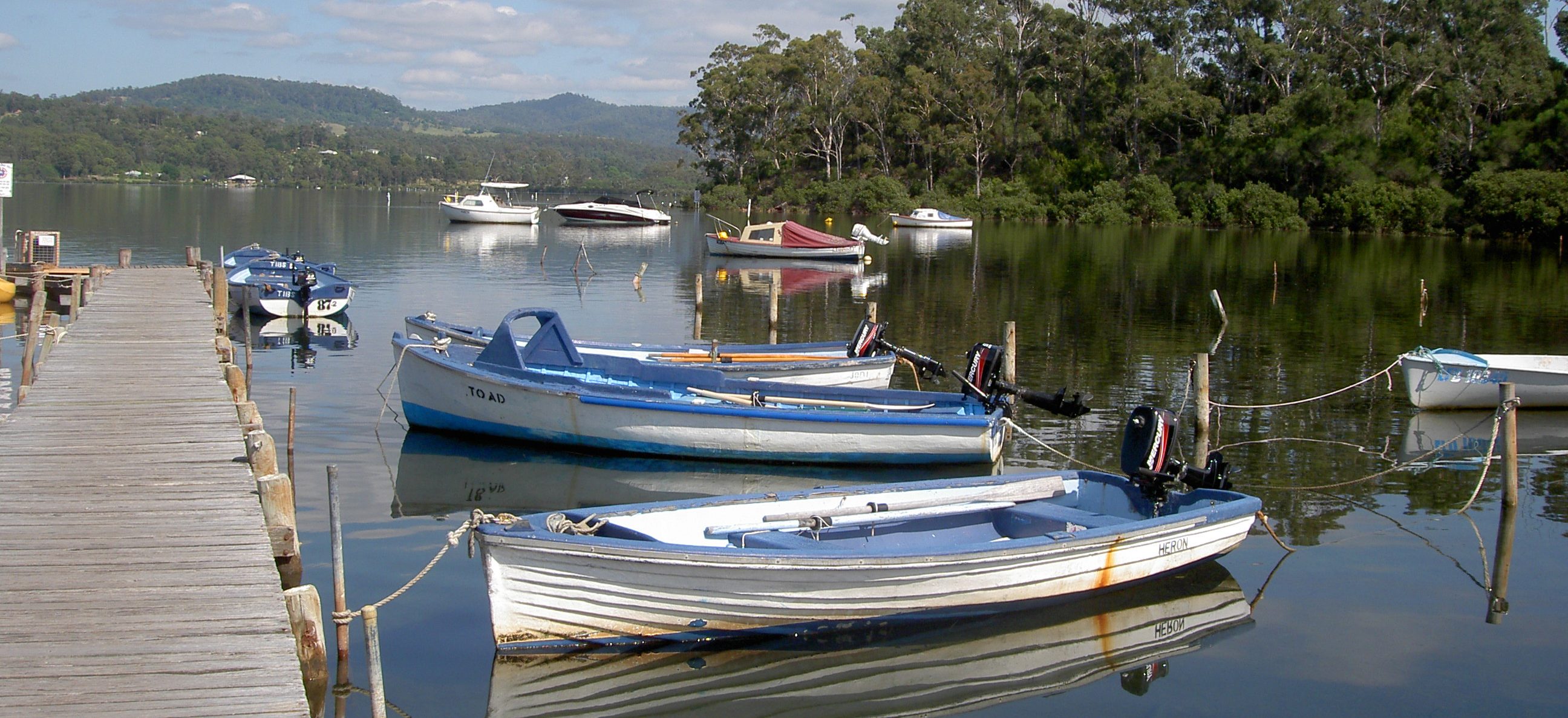
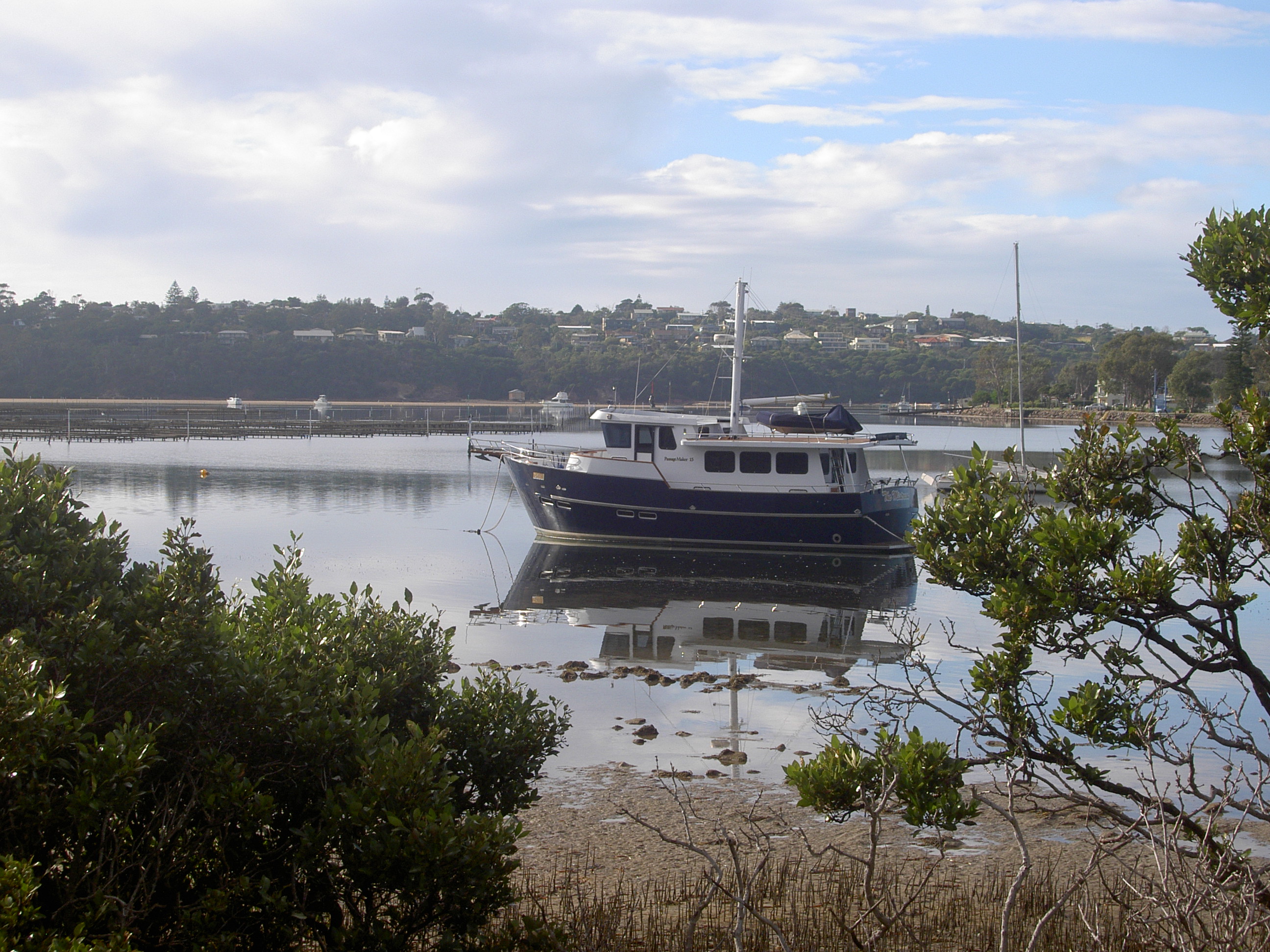
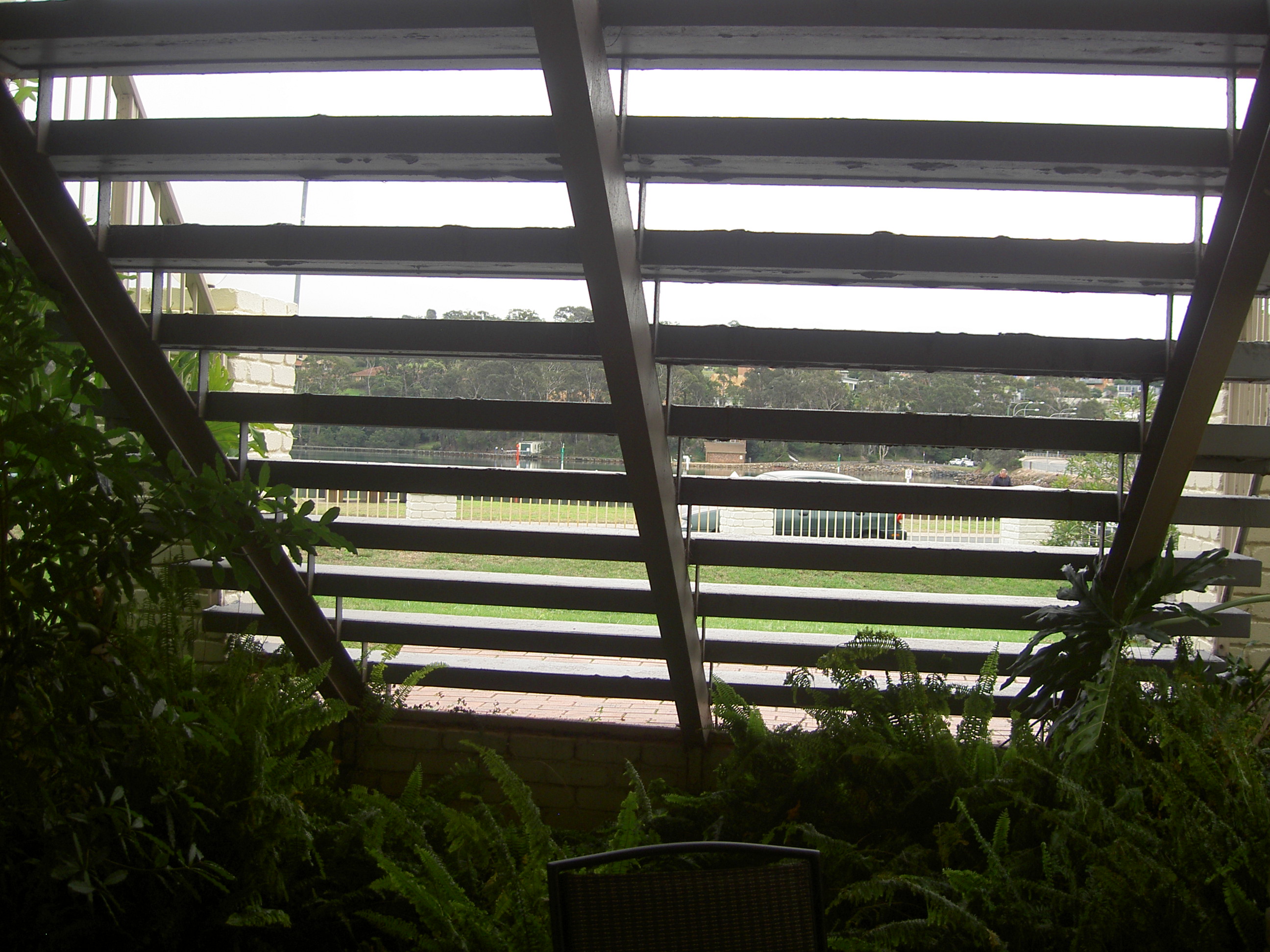
However, we do have a view of the water. If we stand in the lounge area, close to the window, we can see, through the treads of the stairs leading to the upper apartment, the lake and oyster beds for which Merimbula is famous. The view disappears if we sit down. But we can sit outside, sipping our chardonnay in the shade of said stairs, and admire the ankles of the patrons inhabiting the upper apartment as they come and go.
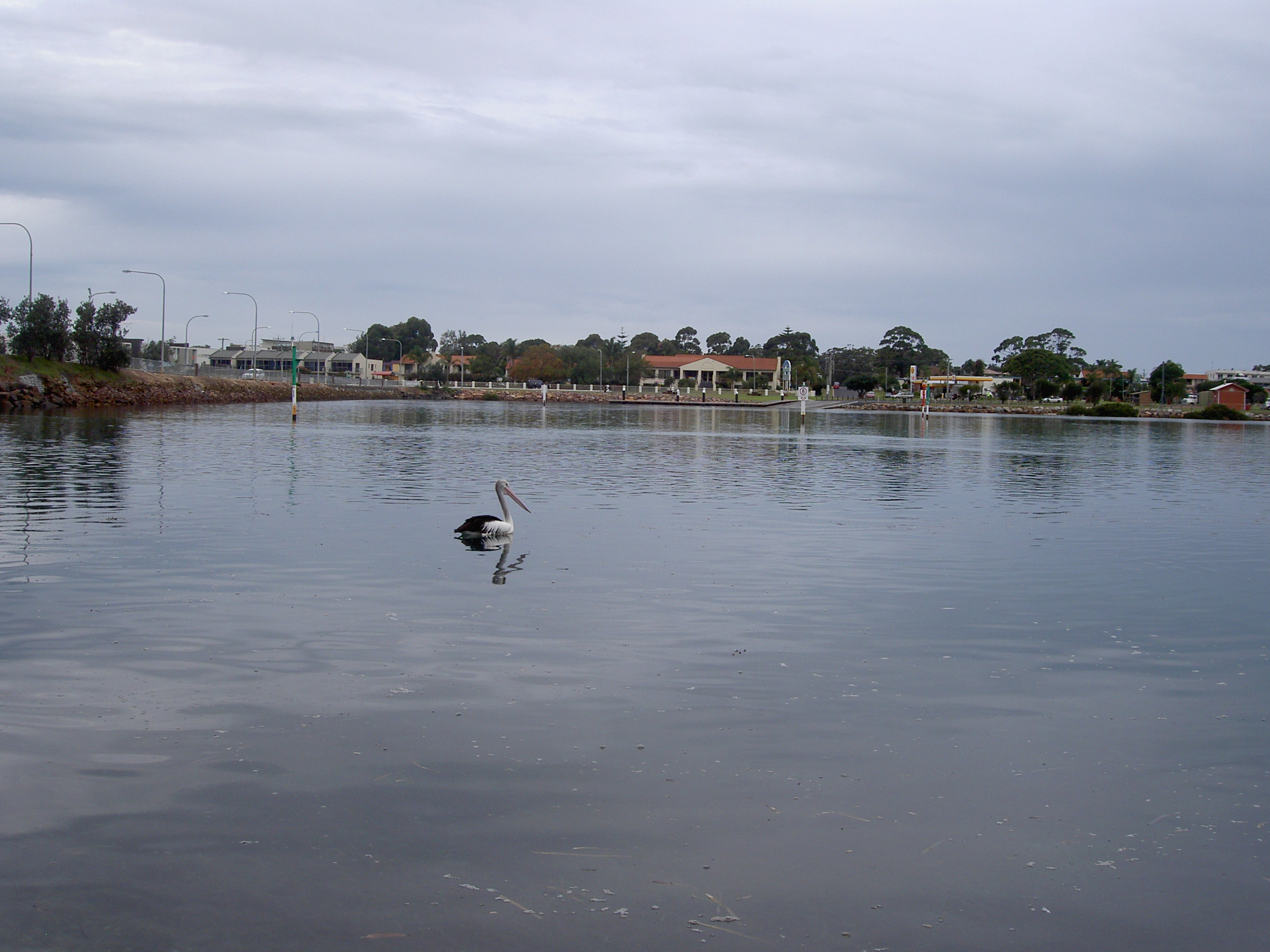
The apartment from across the water
The kitchen is well appointed, but not quite so well equipped as our tent kitchen. For example, there is no wooden spoon, and despite an adequate number of glasses, not one of them is appropriate for our scotch. A trip to the local op-shop, and the expenditure of 50 cents remedied this latter deficiency. We decided that perhaps we could manage without a wooden spoon, so left it at that. The DVD player does not work, and the portable oil-filled electric radiator in the bedroom is missing one of its four casters making it more difficult to push than the average Safeway trolley. But having said all that, the apartment really is not too bad; it is clean, serves our purpose, and is relatively inexpensive.
We have now been here for five nights, and the weather has been perfect ‘Pambula weather’. That is to say, cool misty mornings, clearing to still warm sunny days, concluding with cooler evenings and clear skies at night. Perfect weather for a game of golf on the picturesque Pambula/Merimbula Golf course. Picturesque? very. Expensive? ditto. A round of golf is $40.00 for 18 holes, $25 for 9. A motorised buggy another $40.00. No reduction for seniors. Merimbula frequently being referred to as ‘God’s waiting room’, everyone here is a senior, so reductions are out of the question. We played on Monday, being a quieter day. There were a good many ground staff going about their work, but to a man they were grumpy, and gave the impression they would rather have been somewhere else. We acknowledge that ground staff have right of way, but when a tractor driver actually deviated from his spraying route to squash my ball into the ground, I was a trifle miffed. We usually play at Garfield, Lang Lang, or Trafalgar, where a round of golf is of the order of $17.00 for 18 holes, the staff are cheery, and the courses every bit as good as the Pambula/Merimbula course. It was not as though the golf was any better. We had the usual mixture of brilliant, mediocre and crap shots, distributed on the usual bell-shaped curve, but with, we are disappointed to say, a definite skewing away from the brilliant, in favour of the crap.
But the fishing has been good. Using Captain Google to inform us precisely when high tide would be, we succeeded in catching a flathead exceeding 40cm, which was more than adequate for the two of us to dine off this evening.
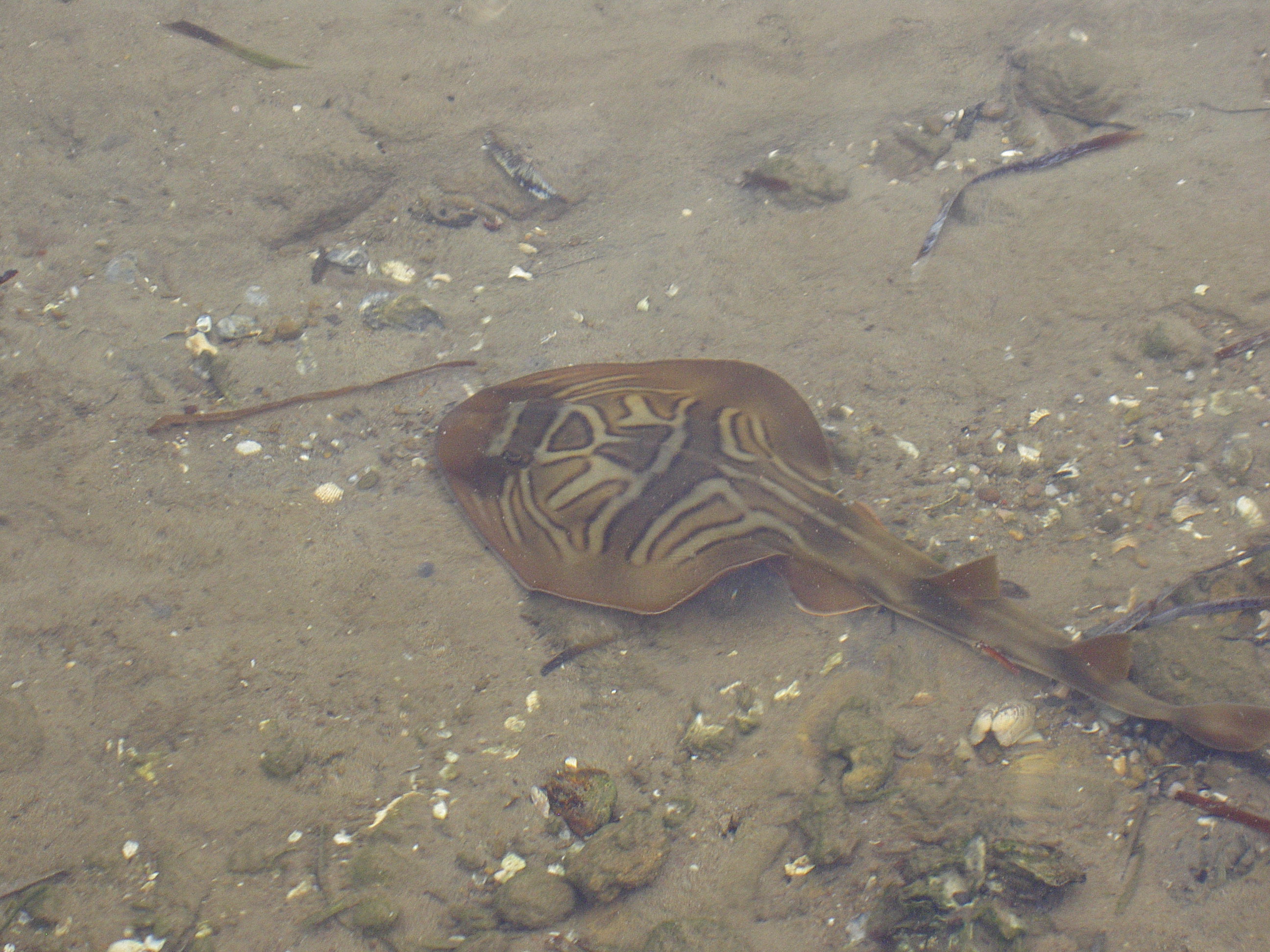
One of the rays
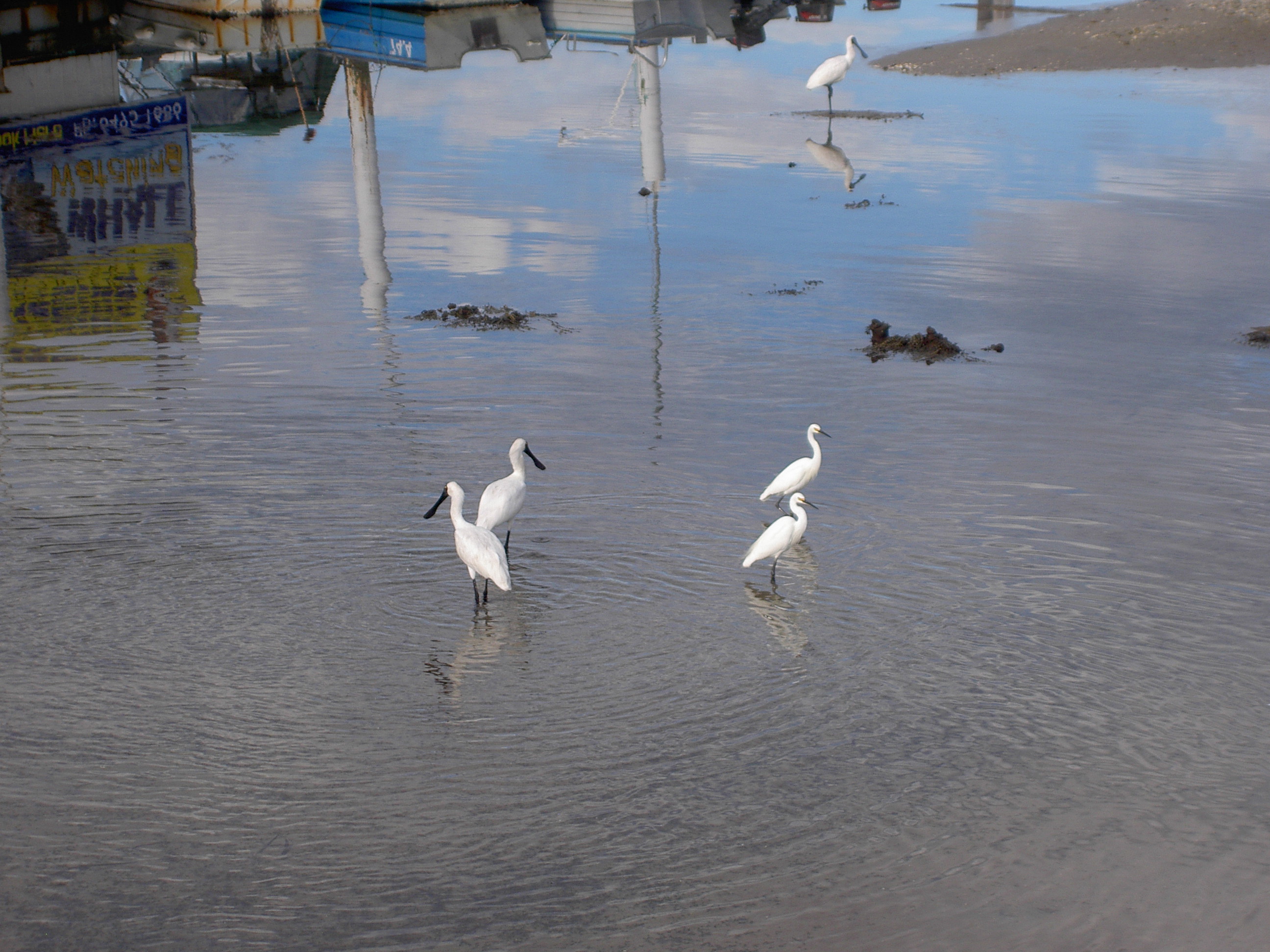
We are not particularly interested in the night-life of Merimbula, and as far as we can determine, that does not matter very much as there does not appear to be any at this time of year. Even most of the shops are putting up their shutters by 4.30, and the book shop closes at 3.00. But the wildlife is fascinating. It was very nice to watch a pair of white-breasted sea eagles wheeling around just above our head; to watch a large seal swim slowly under the causeway bridge as we walked along; to watch two different species of ray flop along on the sandy bottom of the shallow lake, as we walked along the board-walk.
Tonight we shall dine out somewhere, and we shall report on that, and the rest of this trip to Merimbula in a later blog.
The train to Paris left on time, as one would expect, and it was rather nice to watch the countryside slip by without having to concentrate on driving. Arrived at the Gare St Lazare, it was a simple taxi ride to the Hotel Studia on Boulevarde St Germain. Simple for us, of course, no quite so for the Taxi driver. Cars, busses, cycles, both motor and pedal, seem to behave like the same poles of hundreds of magnets—that is to say they came very close, at reasonable speeds without ever coming into contact. It was an entertainment in itself being driven in Paris. Unfortunately the taxi meter keeps ticking, even when stuck behind a bus that has become jammed between some road works and a lamp-post, so the trip was a little more expensive than it might have been.
Hotel Studia has lost none of the shabbiness that we remembered. The room we had on the third floor was spotless, the linen equally clean, and the bed very comfortable. The carpet on the floor was threadbare, as was the stair-carpet, and the lift was perhaps even slower than 5 years ago. But it has made some progress toward modernity in that one could pay using Visa card, and there was free WiFi—but only in the reception area, not in the rooms.
For dinner Saturday night, we went to a little place nearby that we had been to on a previous trip. The food was good, and very simple, but a bit more pricey than before and therefore not quite such good value. Monsieur le Patron was still there, as unsmiling as ever, but no sign of Madame, his wife.
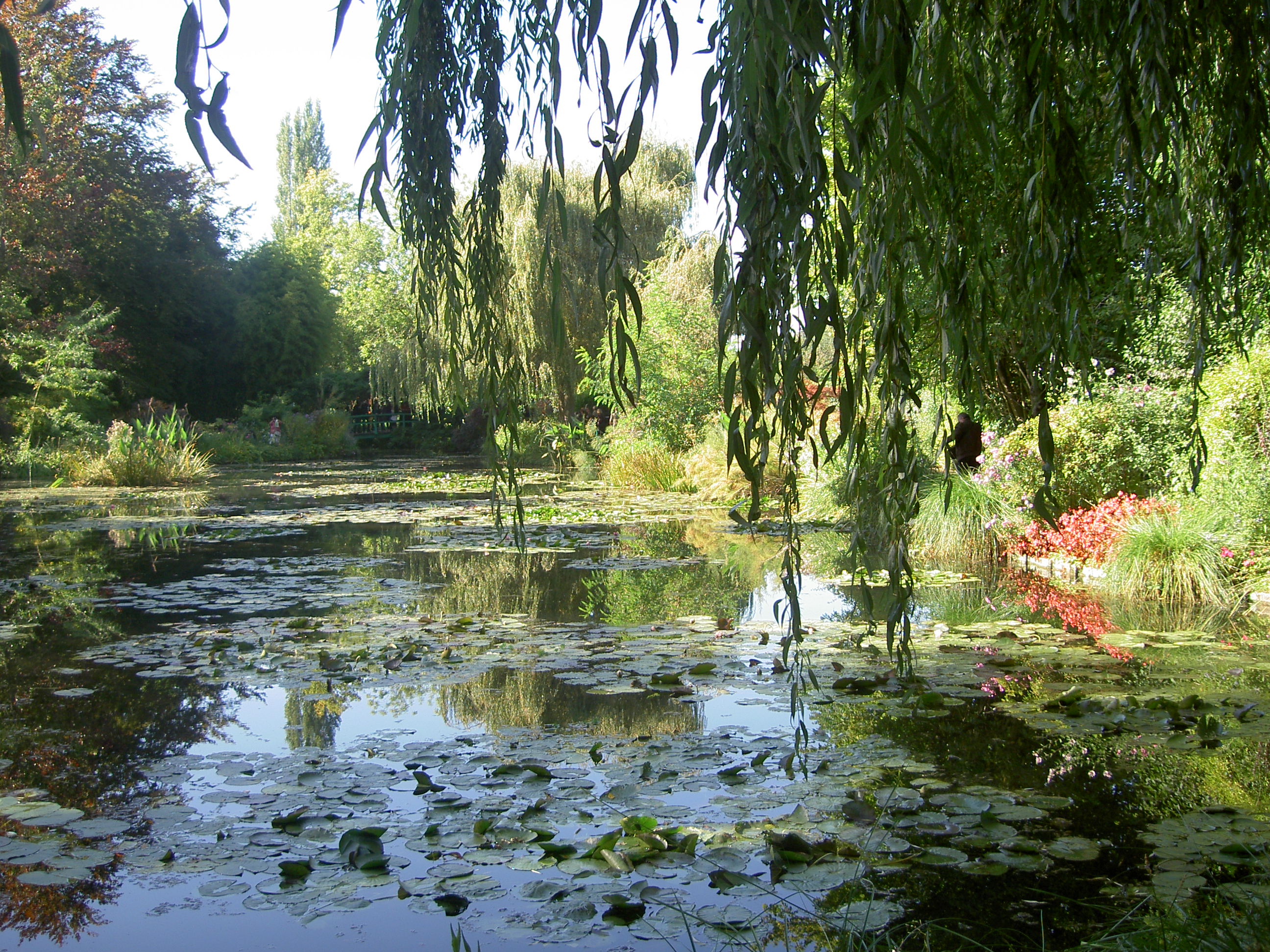
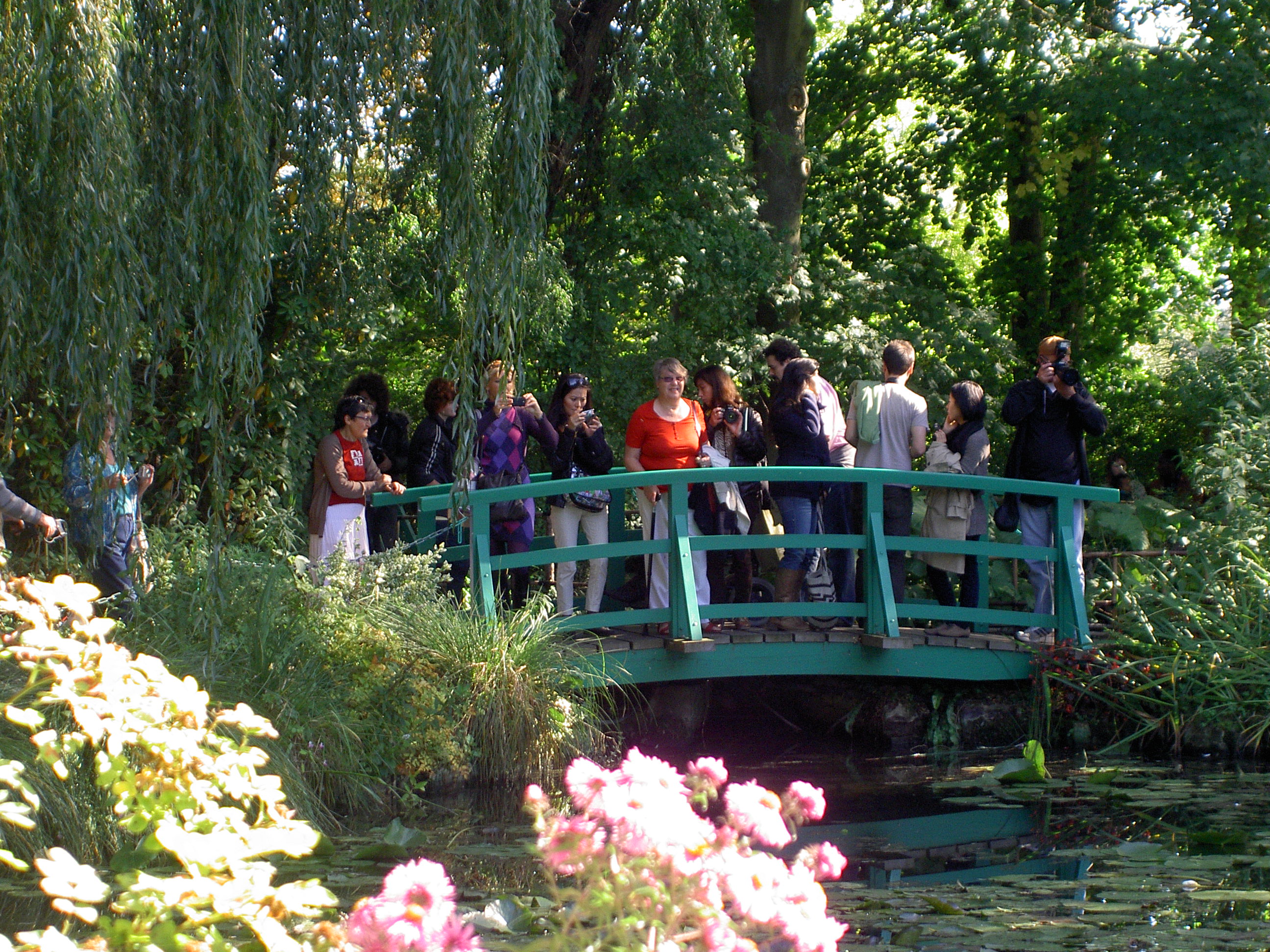
Sunday dawned very pleasantly so we decided on a bus trip to Monet’s place at Giverney. There were eight in the minibus, of which 5 were Australian and three from the US. The minibus reached speeds of 150k on the autoroute, so the journey was not too long. It was lucky that when Monet bought his house, there was plenty of spare ground around it for car parking, but I doubt that he gave that much thought at the time. There were loads of people, but fortunately, being a bus trip, we were allowed in through a side entrance, as the normal queue was over 100m long when we arrived. There was a sort of one-way route through the “Japanese” gardens, over the famous bridge (not the original, however) over the end of the waterlily ponds. Progress was slow, as every small party wanted to take photo of each member standing on the bridge, but it gave plenty of time to see all the garden at leisure.
Waterlily Pond, Giverney
Waterlilly pond
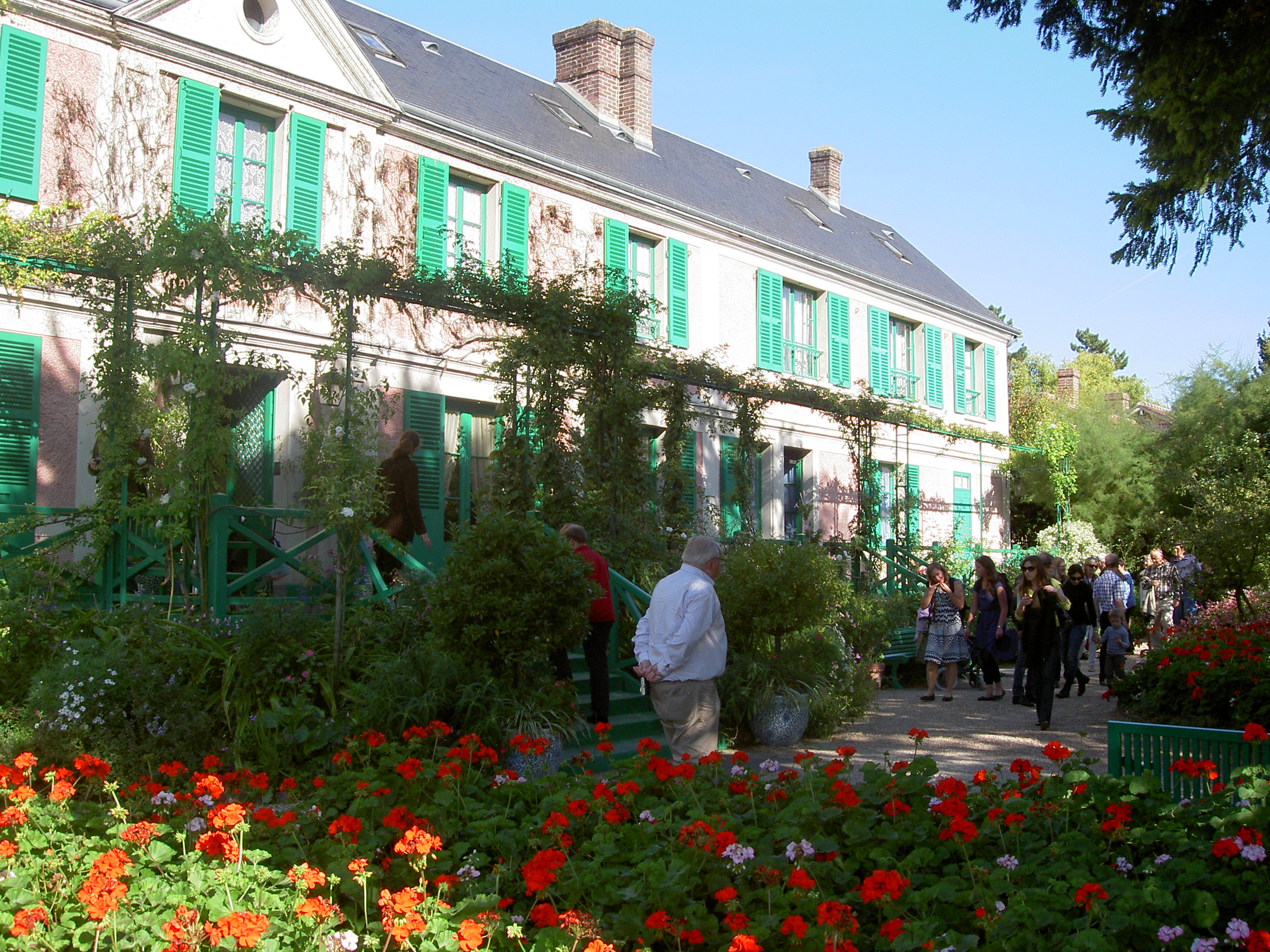
To reach the other garden and the house, the authorities have built an underpass under what would be a pretty busy road, and so that is the direction we took. This part of the gardens has an enormous range of plants, so there is always a mass of colour, and as the sun was shining, we were seeing it at its best.
Monet’s House
Mind you, not being much of a gardener myself, I would be hard pressed to name even one of them. The house itself is also interesting. One room, Monet’s studio, has been set up as it was at one stage during Monet’s life there, from photographic records. There are about 60 “Monet” paintings around the walls, just as there were back then. Except these are not Monet originals. The last Monet to be auctioned sold for 53million Euros, so the guide told us. 60 paintings at 50 mil each would be about 3 billion, and would require an enormous security effort to protect them. So these are all copies; but in all probability 99.9999% of the visitors would not be able to tell the difference! The art world is a funny business. These copies are pretty worthless, but to the non-expert, indistinguishable from the real thing. When Monet first started exhibiting his ‘impressionist’ paintings, he could not give them away. By the time of his death he was able to live comfortably, but now, I wonder what he would think if he knew how much people paid for his work. Even in the souvenir shop, people queued to by a whole range of trinkets with reproductions of his paintings on.
The return trip to Paris was very quick for the first half, but as it has been such a great day weatherwise, it seemed that half the population had been out, and were now returning home! The second half, from the point of view of distance, took nearly an hour longer than the first half. But get back we did, and made another poor choice of restaurant for dinner!
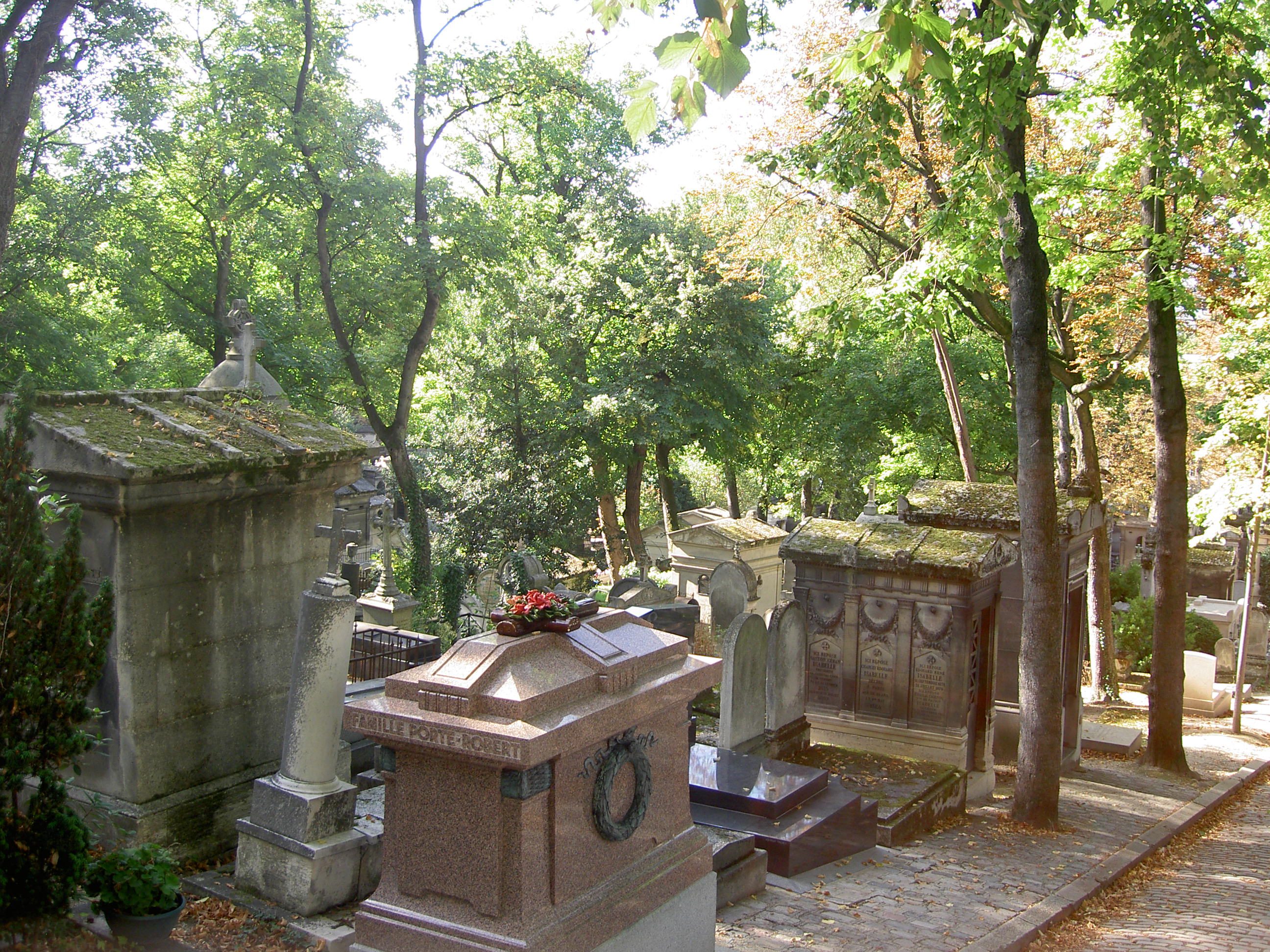
Monday morning was again very nice, so we caught the ordinary service (number 69) bus to Père Lachaise Cemetery, wherein lie the remains of thousands of people, some of whom are very well-known. It was for the well-known people that we looked, including Oscar Wilde, Edith Piaf, the writer Collette, the painters Delacroix and David. The cemetery is vast, and quite hilly. Not only that, the mausoleums, most of which resembled brick or stone telephone boxes at slightly tottering angles, were packed in with very little room to squeeze between them.
Pere Lachaise Cemetery
We picked up a map at the office, but failed to find anyone other than Edith Piaf and Oscar Wilde. The former was fairly easy to locate once we were within about 100m, because the remnants of the Piaf Fan Club were gathered in a cluster, singing “Milord”, rather flat and discordantly! Oscar was also easy, once we were within 100m because it is the only tomb in the whole cemetery to have been defaced—both by loyal admirers, and by his detractors. So bad has it become, that the authorities have enclosed the tomb in a very large Perspex box, which has also been so defaced as to render the tomb invisible; and around the box is a large fence, over which people obviously climb. It is such a pity.
After visiting the cemetery, we returned to central Paris by the number 69 bus, and went to an exhibition of works by French designers in the Hotel de Ville. The building itself is worth a visit, and the exhibition was also very good, The companies involved were very old established firms, some dating back several hundred years, such as the Lagiole knife manufacturer, and as well as their old traditional designs, the major focus was on works by their current designers. To be honest, I preferred some of the traditional designs, but it was interesting to see the newer pieces.
Tuesday morning we spent at the Panthèon, close by the Sorbonne University. Originally conceived in the 18th century as a fitting place for the remains of St Geneviève, (the Patron Saint of Paris), it has been used as a church, and more recently, as the final resting place for men and women of importance to France. For example, Victor Hugo and Madame Curie are there, along with Rousseau and Voltaire.
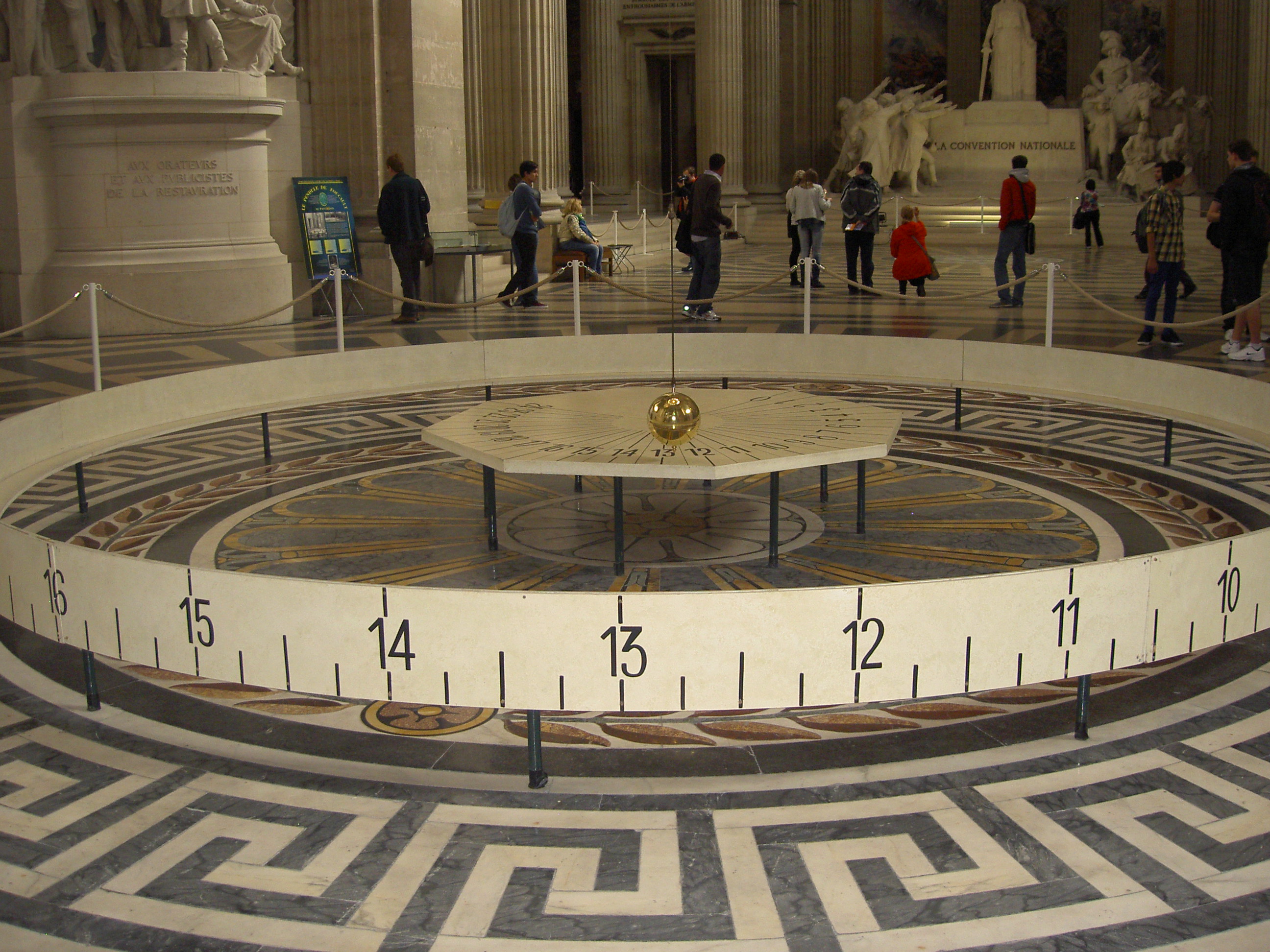
The main dome is where Foucault first demonstrated the rotation of the earth with his pendulum, and the pendulum is still there, although recently fitted with a shiny new ball. The paintings on the walls depict the life of St Geneviève, and other heroic deeds. It is very worth-while to spend a couple of hours there.
Foucault’s Pendulum
Following our visit, we had an excellent lunch in a restaurant at which we had dined on our previous trip to Paris, and this time we were not disappointed! When Baron Von Haussmann reconstructed Paris in the 19th century, some little corners escaped his bull-dozers, and this restaurant, dating from the 16th century is in one of them. Another area to escape the “Genie with the Lamp” was the ‘Latin Quarter’ in the vicinity of the Sorbonne. This is now a very popular restaurant area, with excellent little restaurants providing very good food at very reasonable prices.
The afternoon was spent in a local launderette—all very exciting! And we went to the Latin Quarter for dinner, followed by a Chopin recital in a very old church .The pianist was very good indeed, but the acoustic properties of the old church were such that there was far too much reverberation, so the music sounded a bit ‘muddy’.
On our last morning, we visited the Museum of the Middle Ages, housed in the Palace of the Bishops of Cluny, just along the Boulevard St Germaine from the hotel. Once again, the building itself is amazing and very worth a visit, having escaped Haussmann’s handiwork; and the exhibition of art, mostly religious, from the middle ages is excellent. The tapestries, including the Lady and the Unicorn, are extremely well preserved, and the other pieces of art, both large and small, are very well presented.
After a final Parisian lunch, we collected our luggage and took, what was for Paris, a very sedate taxi tide to the Gare du Nord for the Eurostar.
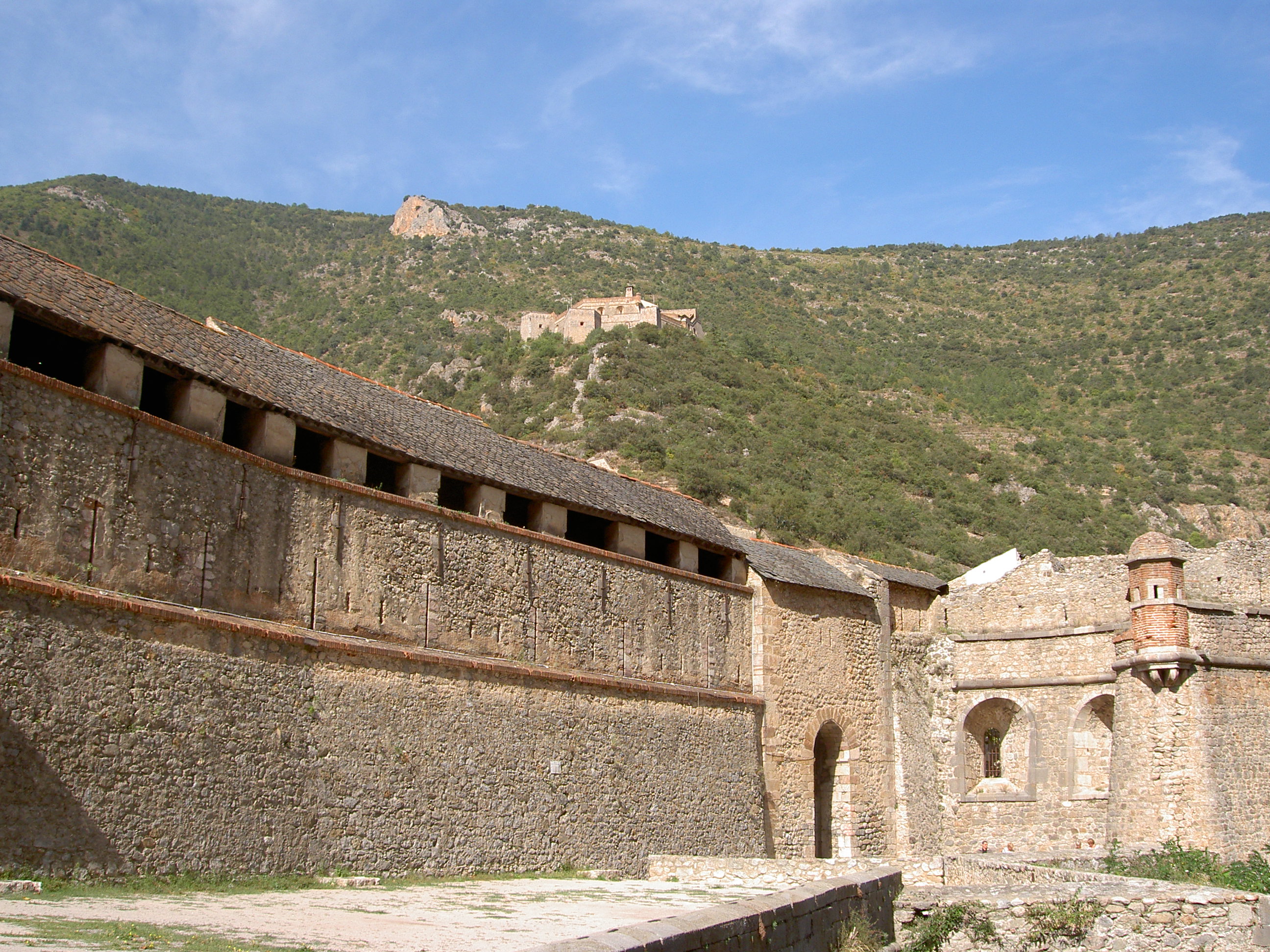
After two and a half weeks at Argelès, we followed the example of most other people, and left! First to Le Boulou to fare-well our friends Sylvie and Patrick, and then off, by way of Thuir and Prades, to Villefranche de Conflent, a distance of some 60 K. Founded in about 1090 at the confluence of the Tet and Cady rivers, it was an important control point for the routes which would use the two river valleys to travel between Spain and France. In 1126, it became a sort of capital of the area, and in 1263 , the King of Aragon, Jacques 1st, ordered the construction of three bridges on the Tet. But, they were severely damaged or destroyed by the great flood of 1421, and only the Pont Saint-Pierre was restored. During the 13th, 14th and 15th centuries, the town underwent several re-fortifications, but this did not stop the French besieging the town, and capturing it in 1654. Naturally, Vauban re-did the whole thing again, in 1669.
Villefranche fortifications
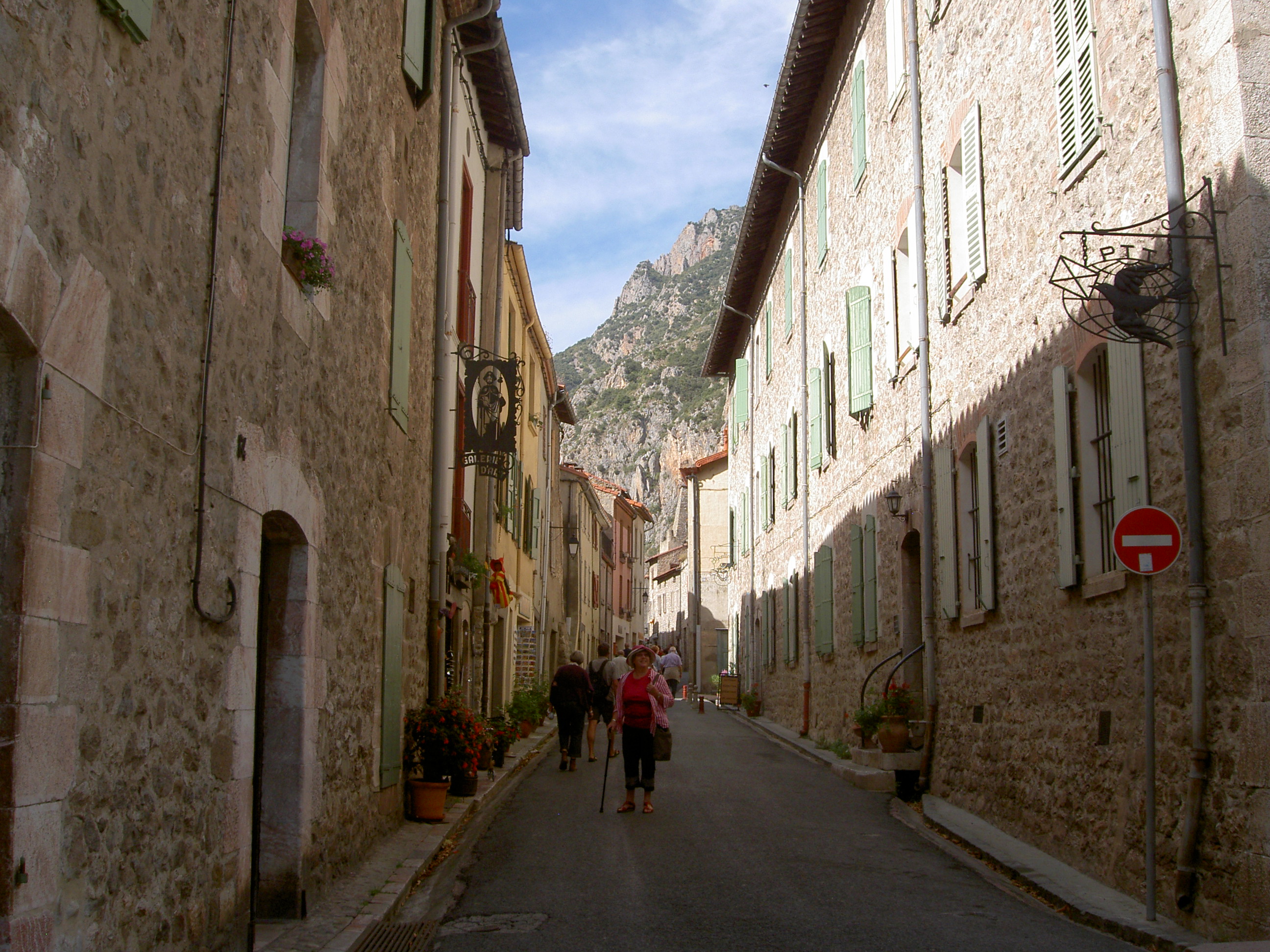
Work also began on a new fort, Fort Liberia, higher up on the hillside overlooking Villefranche. This work continued into the 18th century. Today, the whole town is a tourist venue, and the narrow stone streets are full of souvenir shops, cafes and bars.
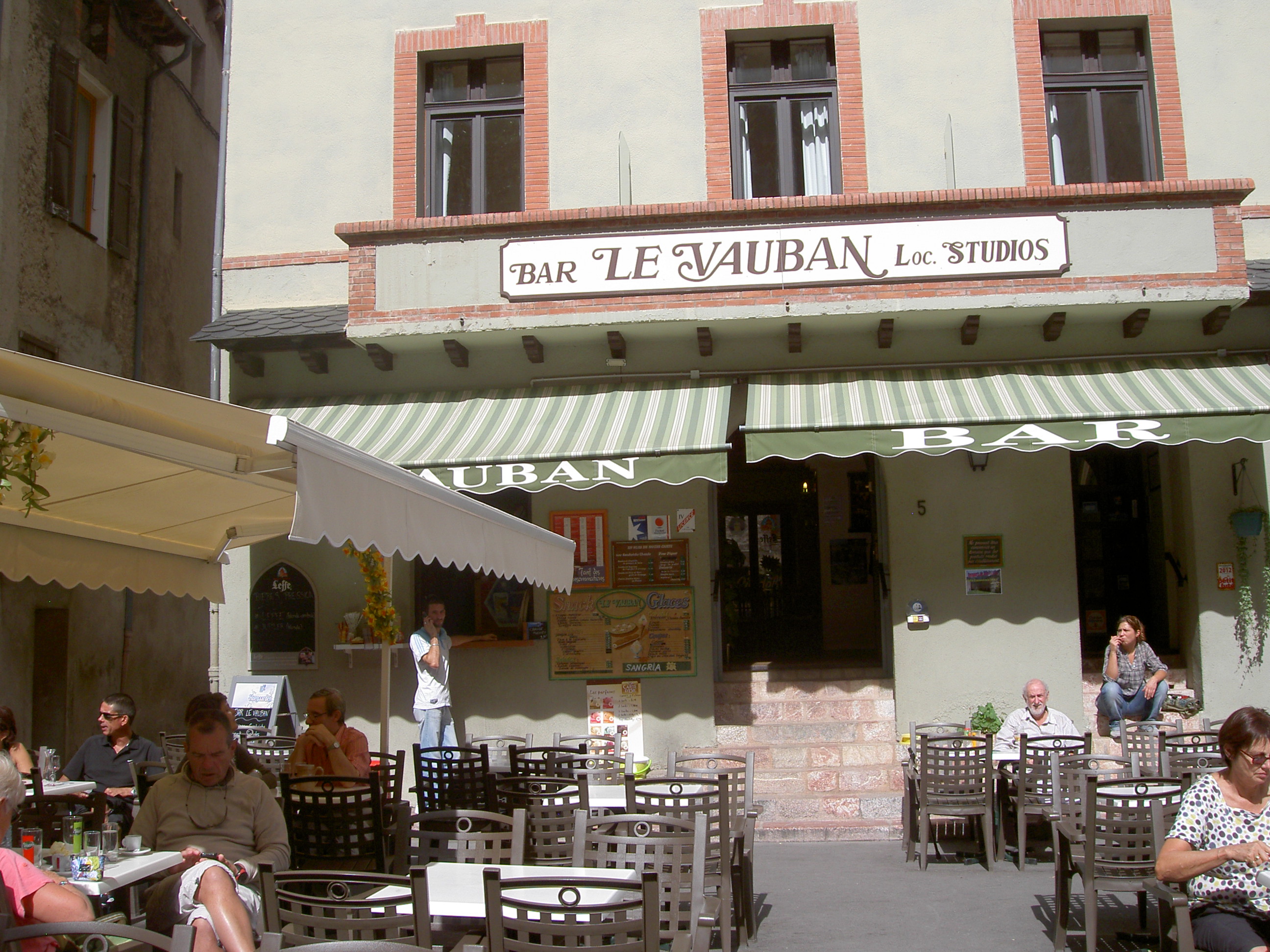
Villefranche streetVauban Bar, Villefranche
We left Villefranche, and headed for Carcassonne by way of a yellow road through the mountains. It was a stunning trip, with fantastic gorges, some very steep and very narrow, others more like those in the Tarn with spectacular limestone features. At its highest point, the Col Du Jau, it is 1530M above sea level. We had seen part of this route on the Tour de France a couple of years ago, as it went along the river Aude through Axat. Unfortunately, the SD card in my camera was full, so I have no photos of this part of the trip!
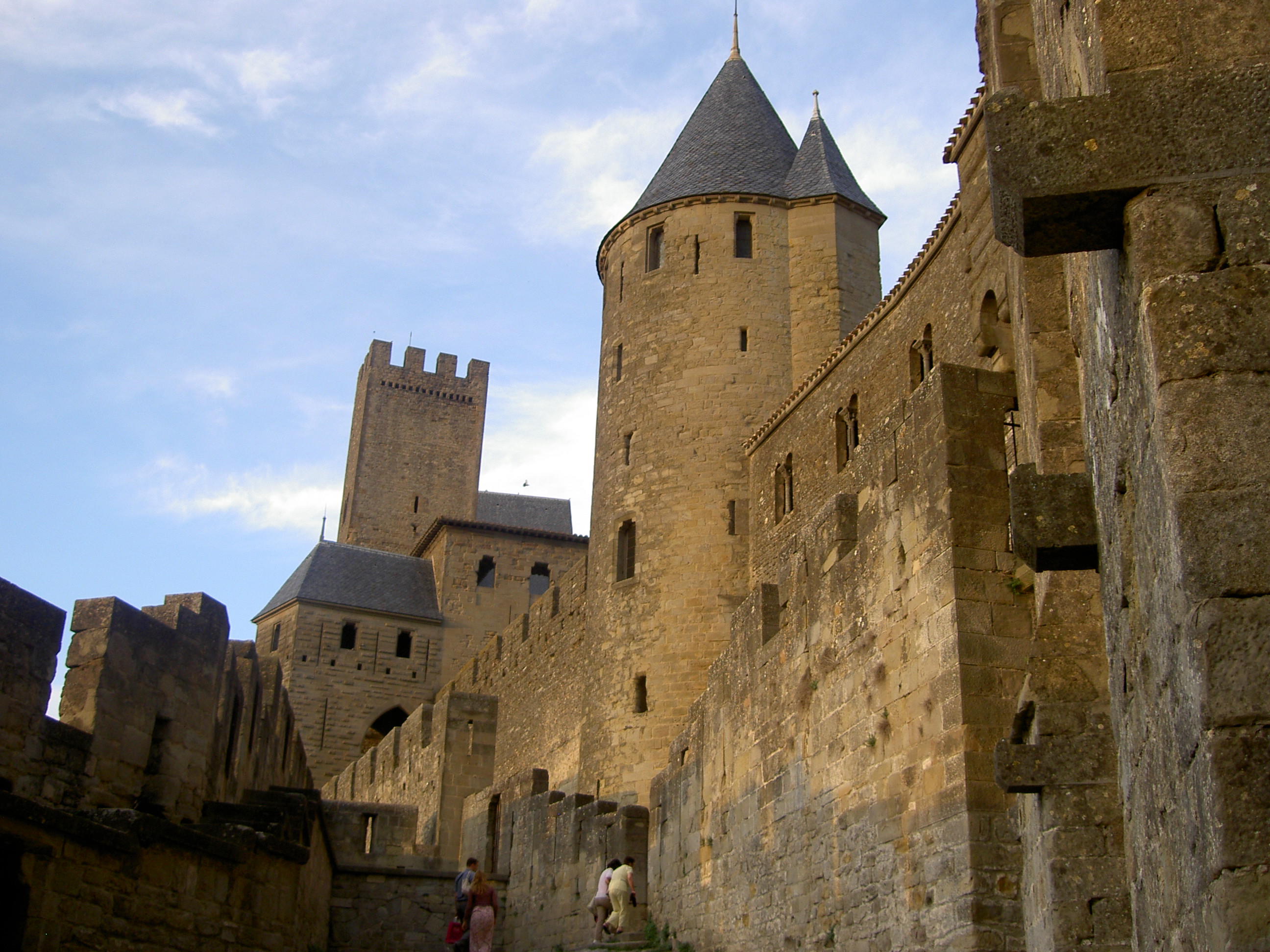
We made it to Carcassonne about mid-afternoon, and found a very posh (for us, anyway!) 3-star 19th century hotel, with its own car-park. We were so tired from the mountainous driving that we simply decided to hang the expense and stay there the night! A quick freshen up, and we walked into the shopping area to find a shop selling SD cards. The part of Carcassonne that we went to first, was not the old fortified part, but nevertheless, it had straight, very narrow streets, all crossing at right-angles, and all one-way for traffic. It was largely re-built in the 19th century. The SD card purchased, a drink was called for, and we found a very nice café along one of the streets. Monsieur le Patron, was an interesting character who made us very welcome, and told us about the little train which we could catch from nearby, to go to the fortified city. So, refreshed with a beer, we left the cafe, and saw the little train approaching—but we were nowhere near the stopping point. However, the driver saw our plight, gesticulated the way to the stop, and waited for us to arrive, which was very kind. The train (like those in large shopping centres—ie, a car made to look like puffing Billy pulling a few open carriages), took us up the hill to the main gate—-but we had left our run a bit late as usual and the Church and the castle keep were closed. Also, we had missed the last train back to town, so after a quick look round (which was all that was needed as the most spectacular parts are seen from the outside—most of the internal bits being tourist souvenir shops and the like), we had a rather longer walk than we had anticipated over some very cobbly streets!
Carcassonne, Fortified City
However, we plodded along, and fortunately the bar at which we had had our drink was almost exactly halfway back to the hotel, so we decided to stop there for a rest, and for some much needed food. Only 40K away from Carcassonne, is the equally old city of Castelnaudary, the legendary birthplace of cassoulet. So, I thought, Carcassonne would be as good a place as anywhere to have that wonderful bean and meat dish!. So I did, and it was magnificent! Ann had blanquet de veau, which she reckoned was as good as she had had anywhere. Given the excellent food, and the fact that it was a beautiful evening and the tables in the little street were packed with both locals and tourists, the day ended on a wonderful note!
The old fortified city, like the newer part of Carcassonne was largely restored during the 19th century. However, its history goes way back to Roman days. In the 9th century, it was under the control of the Saracens. Charlemagne laid siege to the city, but the siege went on for so long that both sides were running out of food. Legend has it that Madame Carcas had an idea to demoralise Charlemagne’s troops. Having very little food themselves, she got a piglet, fed it what corn could be found, and threw it over the city walls. When it hit the ground, it burst open, revealing its last meal of corn. Thinking that the Saracens had so much food to spare that they could even feed their pigs well, Charlemagne decided it was time to leave! Madame Carcas sounded the trumpets with a victory call, and hence the name “Carcas-sonnee”!
The legendary origins of cassoulet are similar. In that siege, the Castelnaudrians were running out of food, and had only a few bags of dried beans, a few bits of pork, a couple of geese, and a few sausages. With nothing else to eat, they cooked it all up together and ate their last meal. Thinking they now had nothing more to lose, they threw open the fortified doors to the city and rushed headlong into the enemy Full of pork and beans, they blew the enemy away, and the city was saved!
After my cassoulet, we simply walked back to the hotel spent a very pleasant night in out 3-star room, and left the next morning.
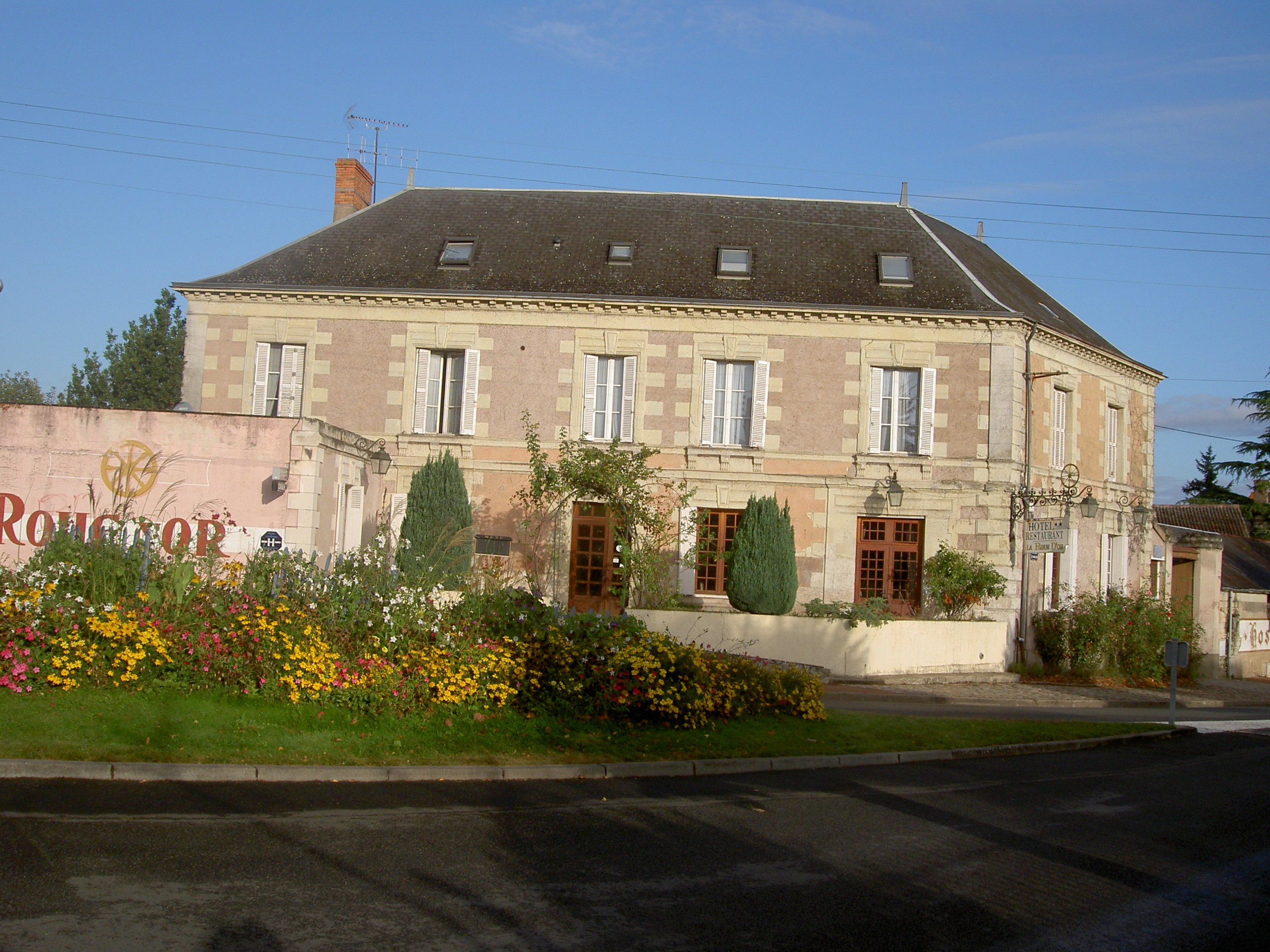
The morning dawned wet and very cold—about 10 degrees!. But we left the town without getting lost, as there was a huge green signpost for Toulouse right outside the hotel car-park gate. We drove north, on péage, on autoroute, and on green roads (incidentally, if you are wondering about the colour of French roads, maybe I should point out that the colours are those on the map—which happily coincide with the colours of the road signs, at least, for green and blue), until we reached the Loire valley. At the town of Loudun, of which we had never heard, we stopped for the night. In fact, having only about four hours driving before us to get to Cherbourg, we decided to stop two nights, and explore the area a bit. The hotel, The Roue D’Or, was our typical shabby two-star affair.
Hotel Roue D’Or, Loudun
Perhaps I should mention here that we use the word ‘shabby’ as a term of endearment. To qualify, the hotel must be clean and reasonably comfortable, but is allowed to be tired and run-down, so long as it shows vestiges of its former glory. And this one was certainly tired and run-down! We were checked in by a pleasant young lady, who was apparently the daughter of the owner. When we asked for a nice place for dinner, she indicated a restaurant about 200m away on the other side of the road. After settling in, we headed to the restaurant, and were met by the same young lady! The restaurant was a pizza place, and like the hotel, a little tired! The building, dating from the early 19th century, had previously been an olive crushing mill, and much of the machinery was still there in the bar. But it was all very interesting and the pizzas were not bad.
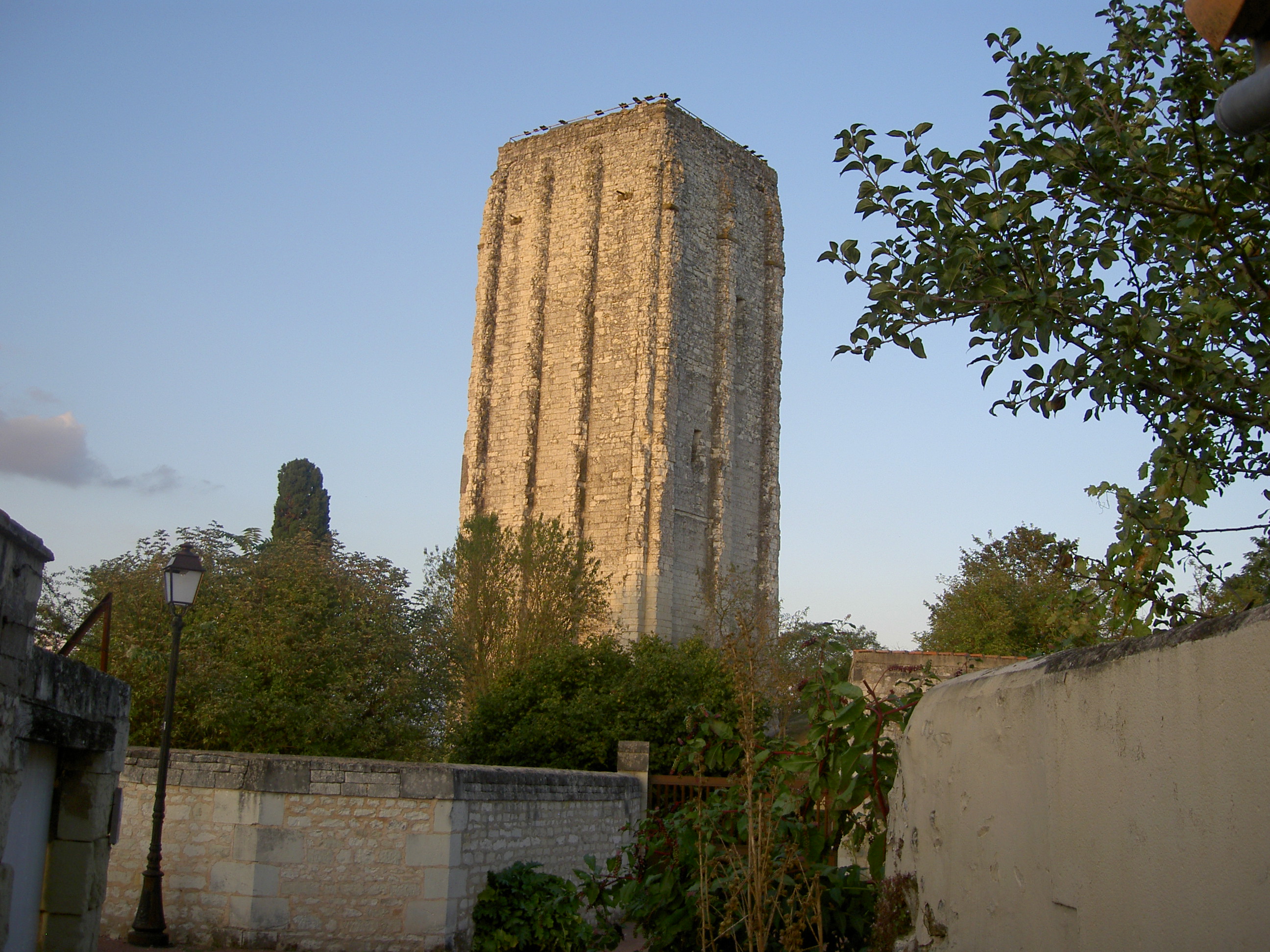
The town of Loudun had had a violent history. Originally established in the 9th century, it was fortified in the 10th. However, the only thing remaining from that time is a tall, square tower.
Tower, Loudun
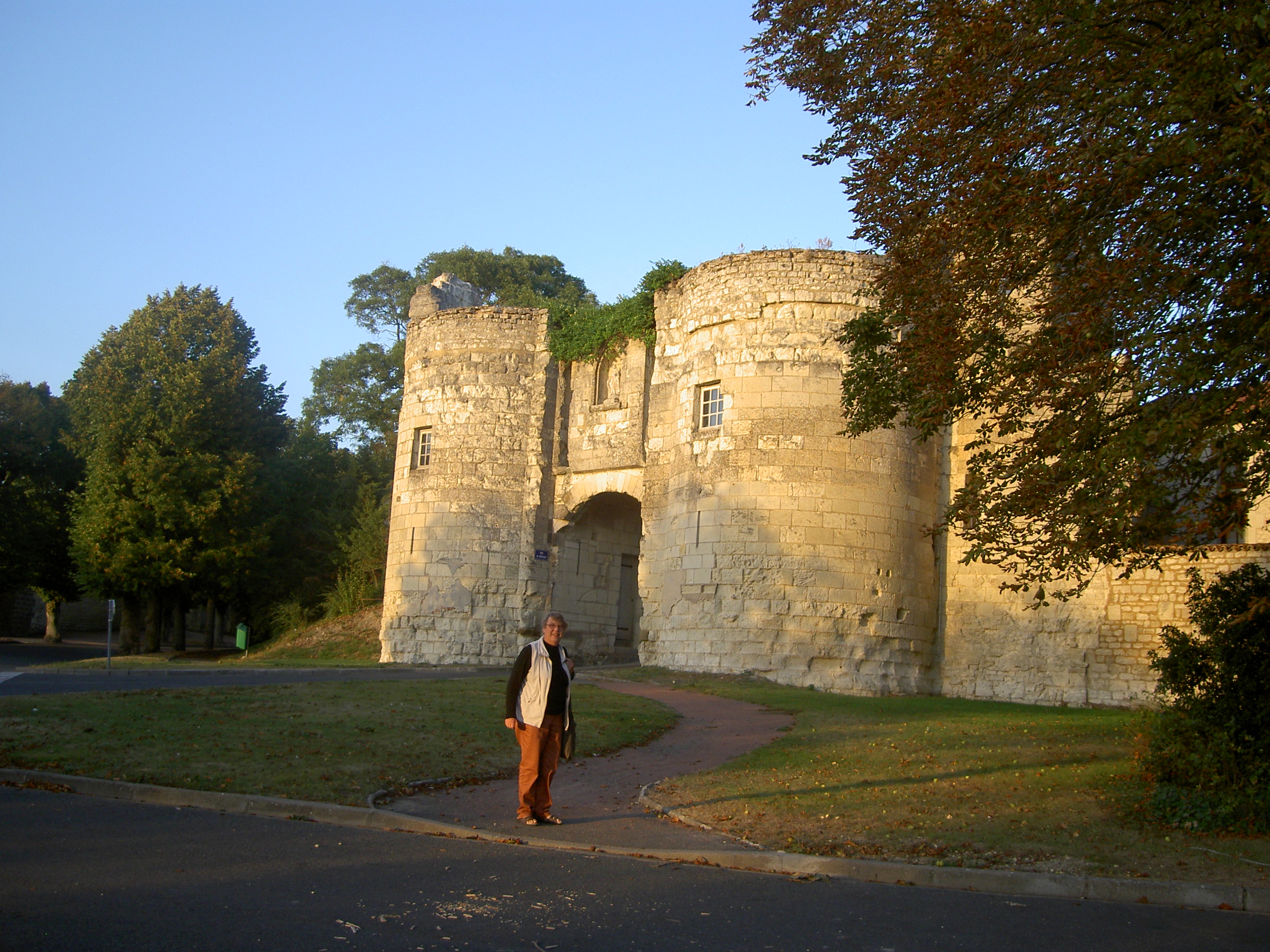
It was then rebuilt up to the 13th century, and was completely enclosed with a wall. But that did it little good, as the only part remaining from that time is one gate.
Ancient Gate, Loudun
It was rebuilt, but suffered badly in the French revolution, and was finally rebuilt in the 19th century. In this rebuilding, they decided to keep to the early mediaeval street plan, resulting in quite a quaint town, but with hopelessly inadequate streets for today’s traffic. In fact, whilst we were having dinner the second night, at a restaurant right in the centre of the town, a huge semitrailer got itself very nicely jammed trying to get round a corner, and was still there as we left. For all we know, it might still be stuck there.
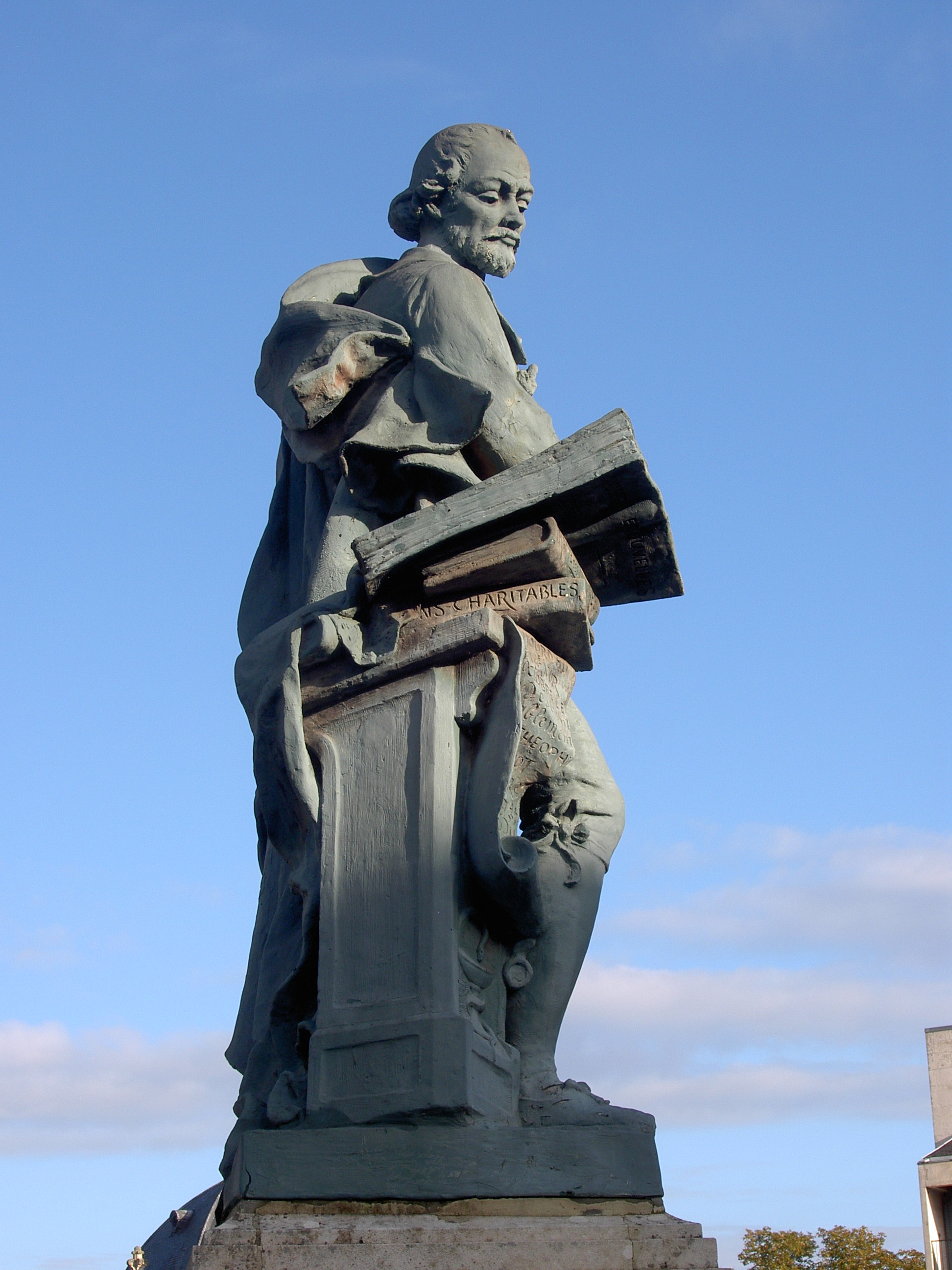
Loudun’s other claim to fame is that it was the birthplace, in 1586, of Théophraste Renaudot, the ‘father’ of journalism.
Theophraste Renaudot
From Loudun we went about 25 k along a very straight road to Fontrevaud. Here there is a 13th century “abbey”, well worth visiting.
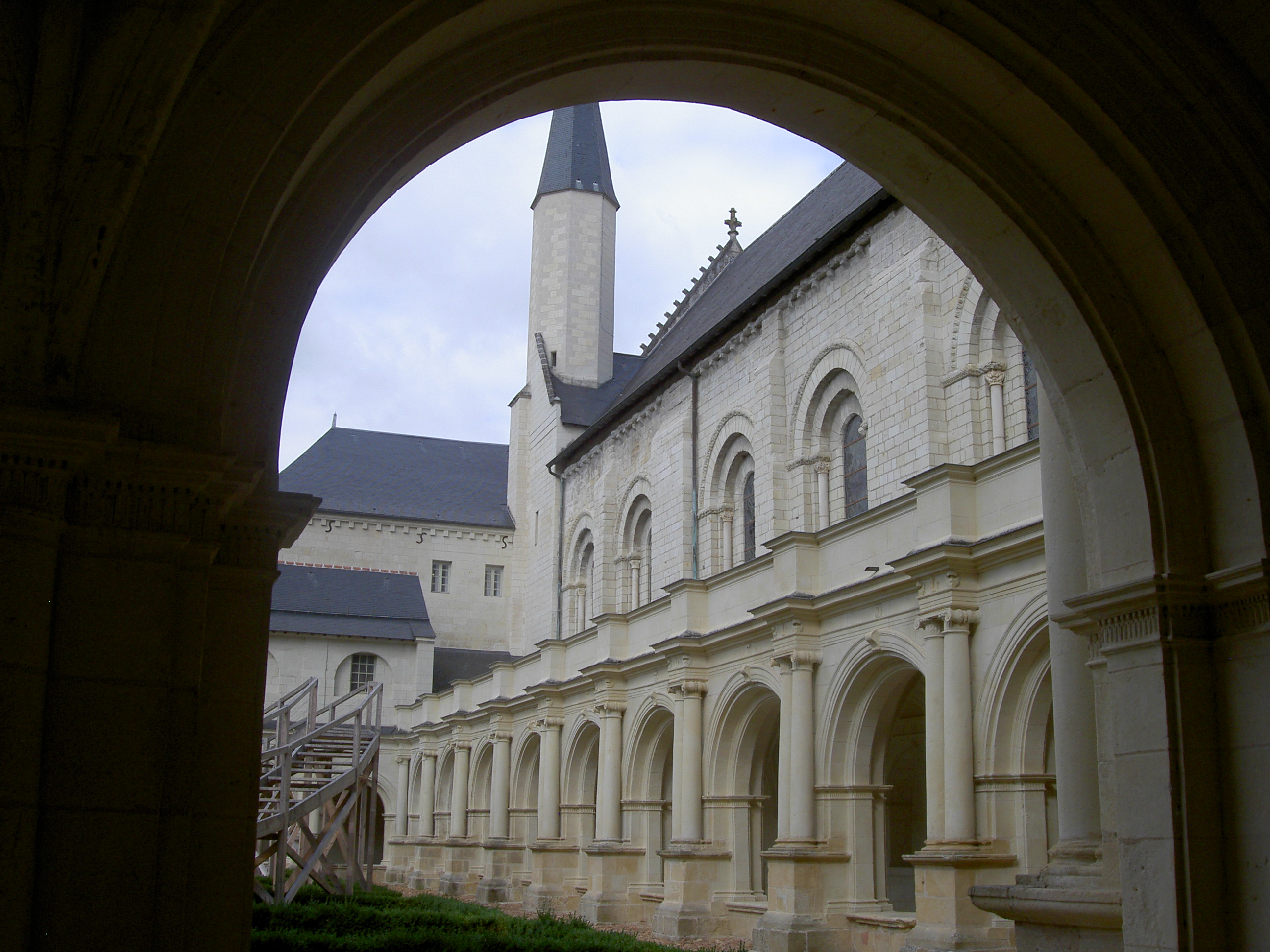
Cloister, Fontrevaud Abbey
4615
It was founded by a chap who insisted that it would be completely controlled and managed by women, but it was open to all comers—rich or poor, so long as they were prepared to spend their time growing food, and living in poverty, silent contemplation and prayer.
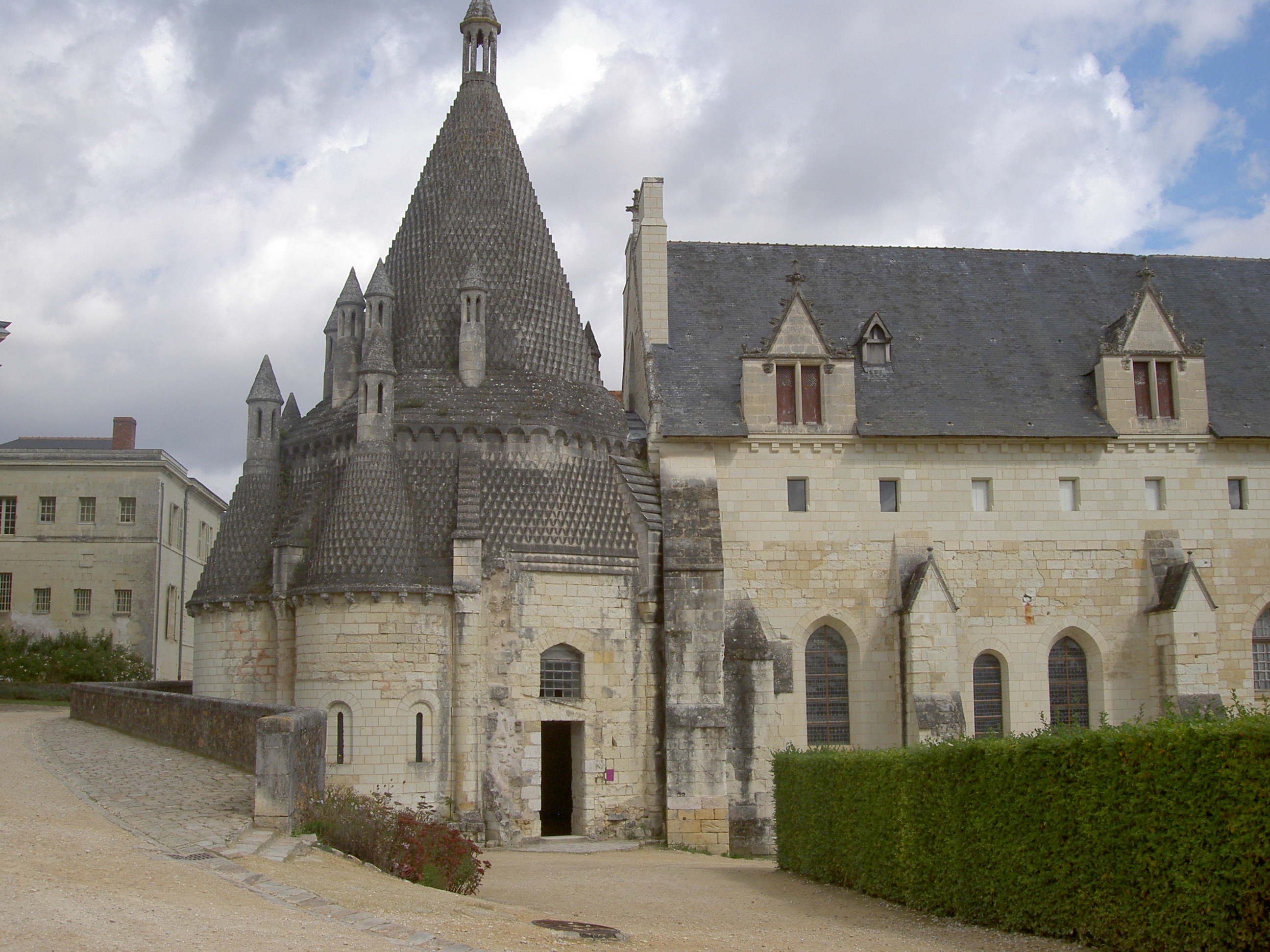
Roman Kitchens, Fontrevaud
Apparently it worked very well for centuries, and became a very wealthy order. Quite how they reconciled their wealth with their vows of poverty is not clear! It received royal patronage, and Henry 1V, Richard the Lionheart, Eleanor of Aquitaine and someone else (who I have forgotten the name of) are all buried there. But like all good things, times change and eventually, after the Revolution, it was turned into a high-security prison, and remained with that role until the mid-20th century. During this time, some restoration work began, and today it is in magnificent condition. No longer a prison, it is a major tourist attraction, with restaurants, gardens, and of course the buildings. But it is by no means ‘touristy’, in the same way as, for example, Carcassonne. In fact, despite the number of people there, it had an air of tranquillity, much as it would have had before the Revolution. A couple of things did detract from it, and they were both “installation art works”. One, a massive thing like a wooden scenic railway, better suited to Lunar Park, occupied the cloisters, and a bizarre “sound and light” art-work occupied the main refectory. Both places would have been much better un-occupied!.
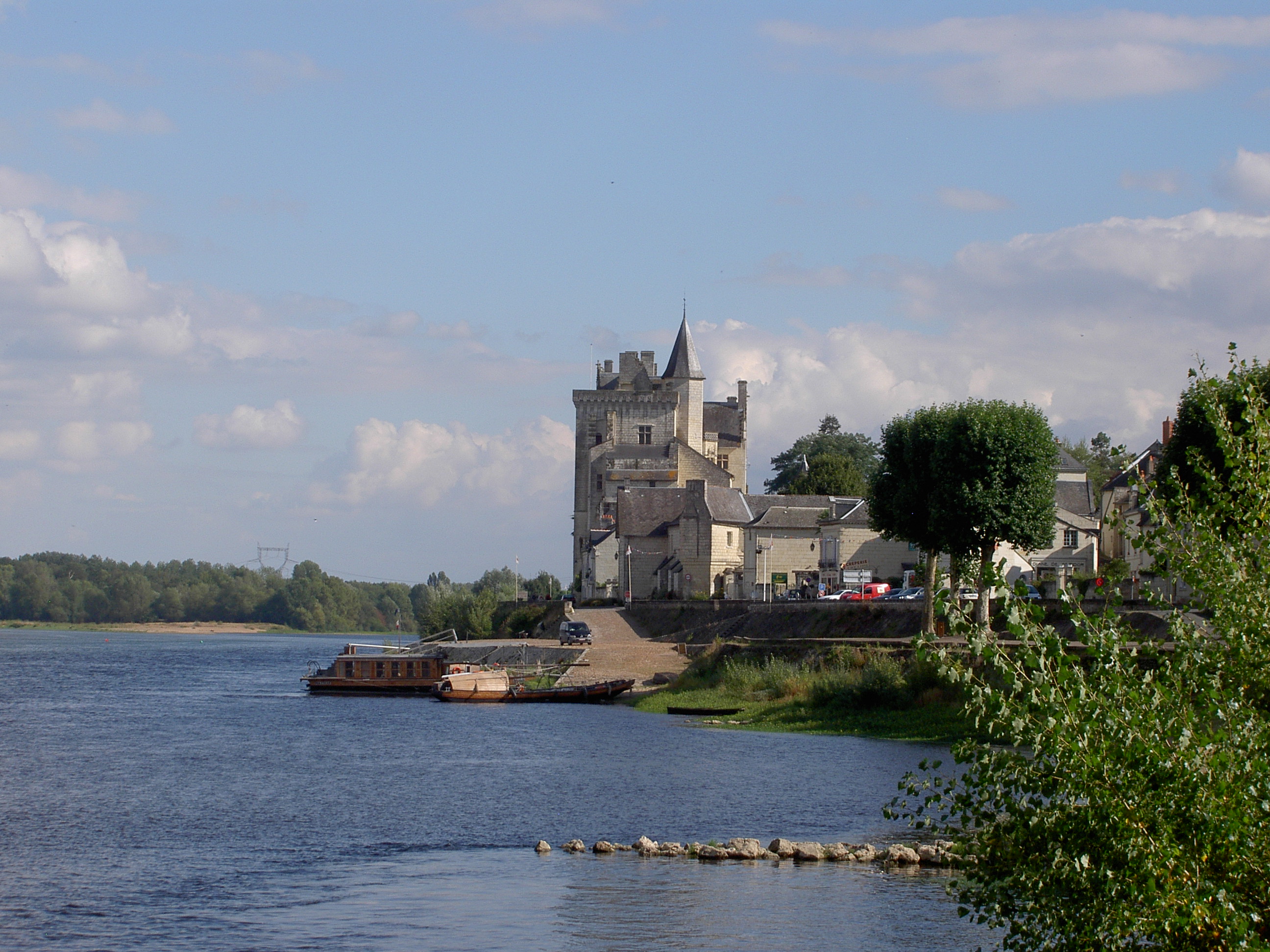
Fontrevaud is about 5 k from the tiny town of Montsaureau, on the confluence of the Loire and Vienne rivers.
Montsaureau
A very pretty place, with a modest chateau (open to the public, but we declined), at which we had our picnic lunch before returning to Loudun for our second night.
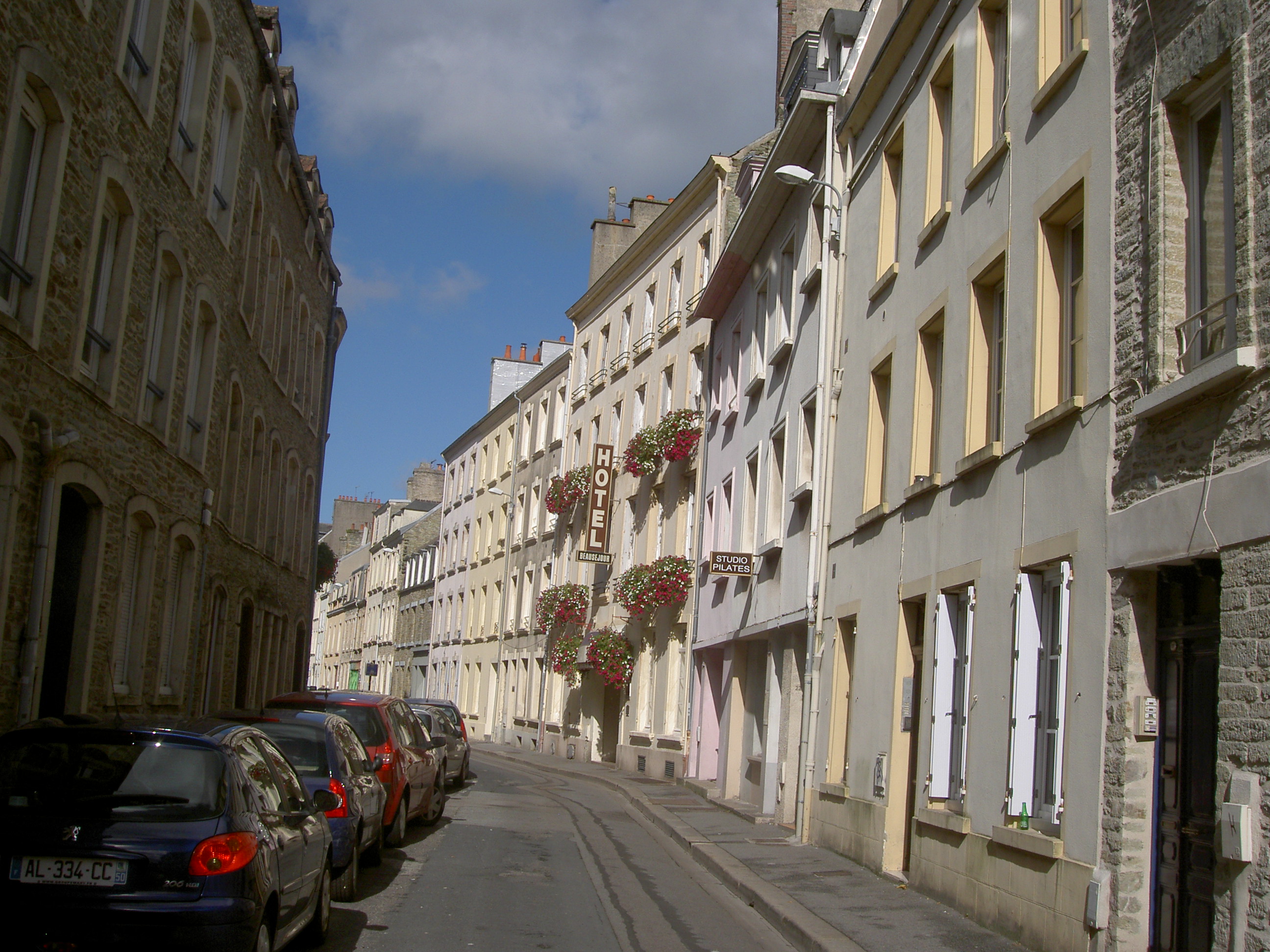
Friday morning, and we were on our final driving part of the trip. We drove through more of the Loire valley, passing, at Saumur, the winery of Veuve Amiot—makers of the fizzy white wine we drink a lot of in Melbourne. Then, pretty well non-stop to Cherbourg. We had already booked a room at the Hotel Beausejour, (at which we had stayed on our very first night in France following the cross-channel trip from Portsmouth) and we found it again without getting lost!
Hotel Beausejour, Cherbourg
Dinner at a nearby restaurant, a good night’s sleep, and on Saturday, morning, leaving our gear at the hotel, we returned the car to FranceCar hire company. We had completed just over 4,400k.
We had a couple of hours before the train to Paris, so a stroll around the street market, a drink, and back to the hotel to collect our gear for the short taxi ride to the station.
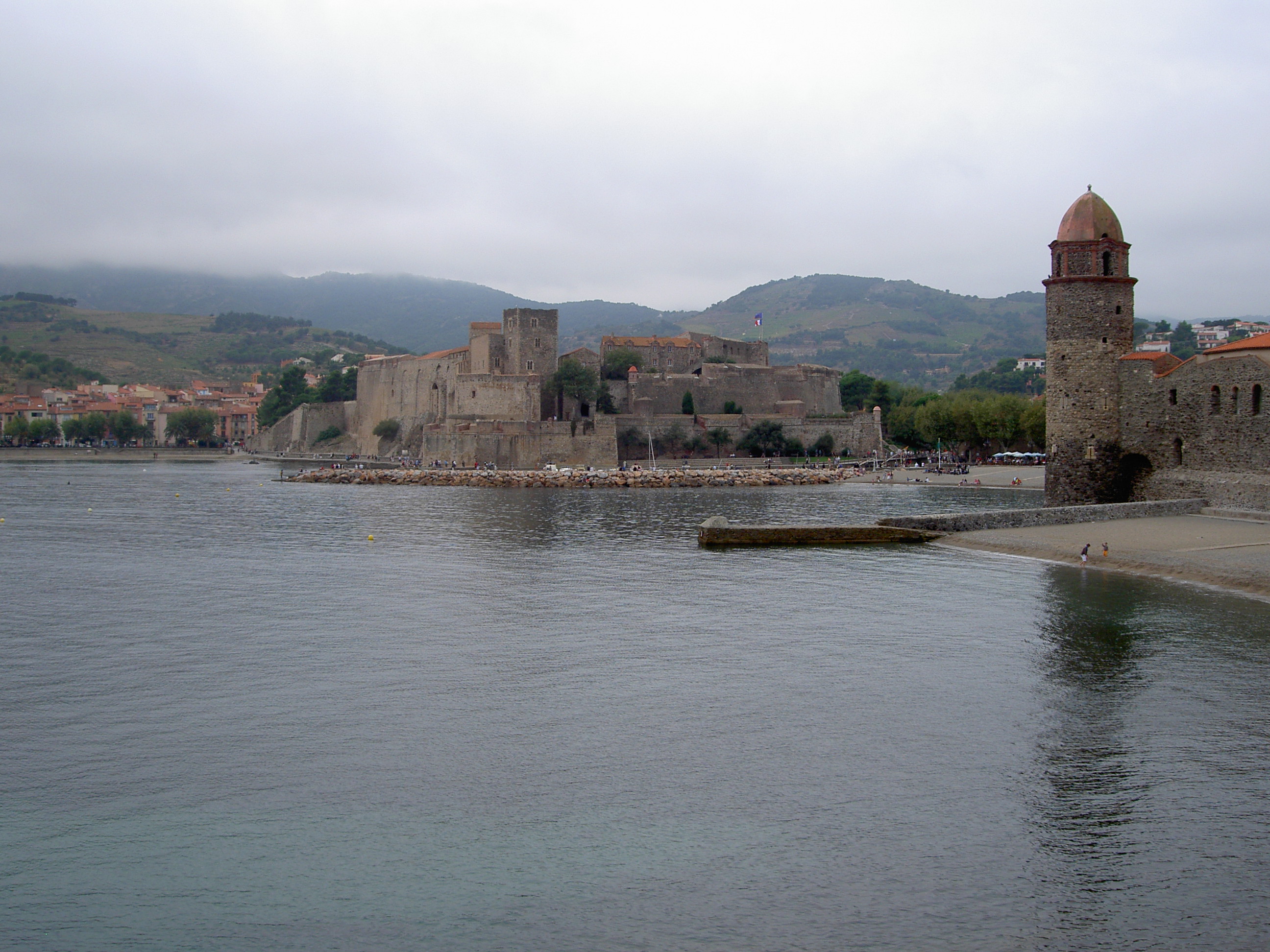
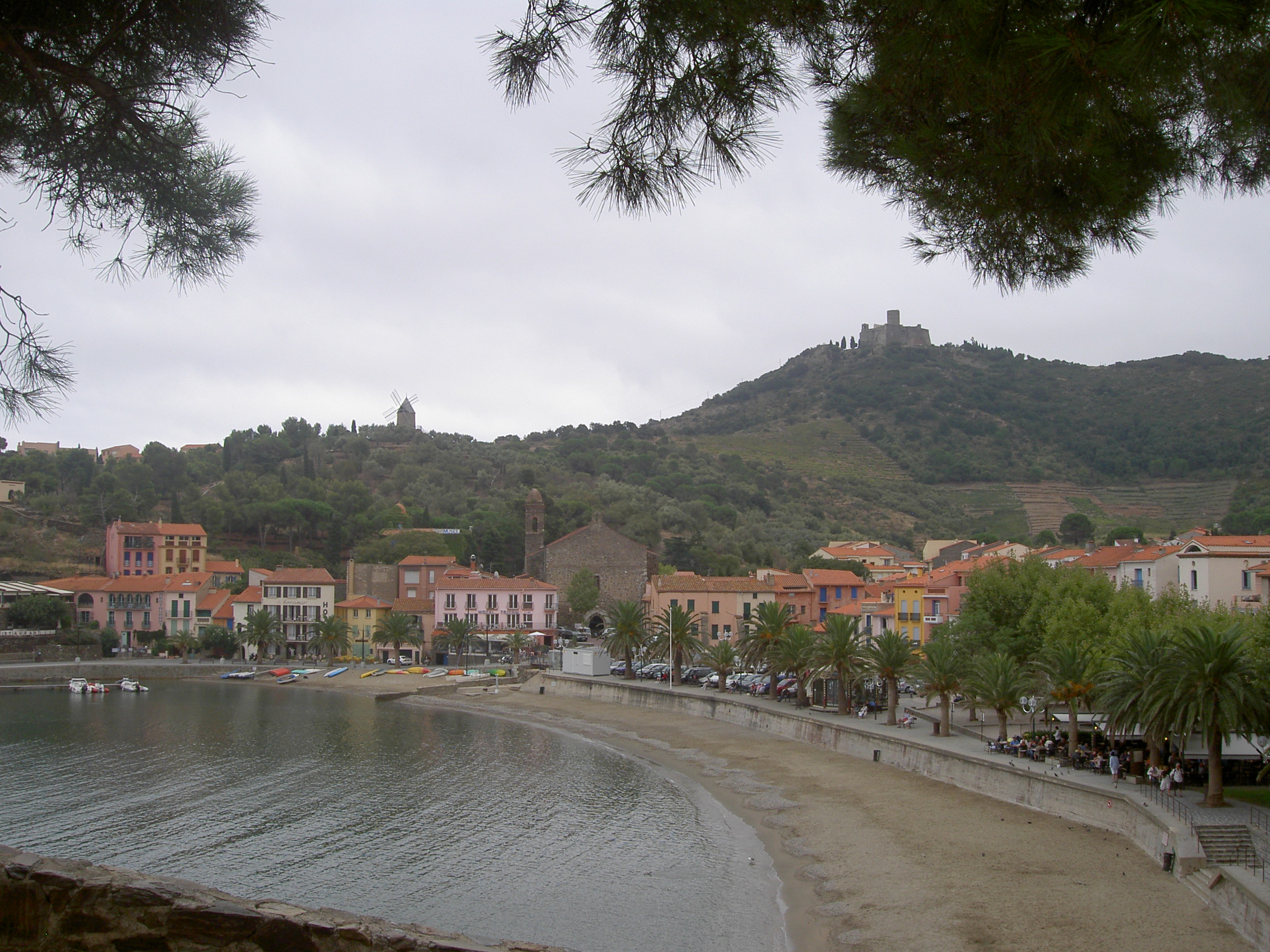
Ten kilometres or so south of Argelès, along the coast toward Spain, is the tiny town of Collioure.
Collioure
Today it is a town that relies almost entirely on tourism and the wine industry, but it has existed for a very long time, and has played its part in the history of the area. There is evidence that Collioure was a trading port for Greek merchants as long ago as 500BC; and the area was conquered by the Romans in about 120BC. From about 400AD, the Visigoths held the area, and from the 6th century AD, it became the seat of the Bishop of Elne (where there is now a splendid 12th century cloistered Cathedral). The first mention of any fortification appears in about the 7th century, and in the 12th century, Girard 11, the last independent Count of the Roussillons, bequeathed his land to Alphonse 11, (King of Aragon and the Count of Barcelona). From the 13th century, wine, cloth, oil, honey, wax, soap, tuna and sardines were among the principal exports and the merchants had to pay taxes to use the port, which made it a very wealthy place. There were also naval workshops, and it was this combination of factors which gave it its importance, and brought it to the attention of successive powers including the powerful King of Majorque. You may recall from an earlier blog, that the Kings of Majorque also had a palace in Perpignan. They were an itinerant lot, who travelled around the place, frequently moving between Perpignan, Montpellierr, and Collioure. In the16th century, after a brief occupation by Louis X1 of France, the Spanish Habsbourgs, starting with Charles Quint, again occupied Collioure. In the 17th century, Collioure was at stake in the wars between the Spanish Habsbourgs, and the French Bourbons. In 1642, Louis X111’s troops lay siege to the Royal Palace and Collioure. 10,000 men occupied the hills overlooking the town, and French ships blockaded the port. The French destroyed the wells that supplied water to the town, and so the Spanish had no option other than to surrender. In 1659, the French, now under Louis X1V, annexed the Roussillon, formalised the arrangement with the Treaty of the Pyrenees, and it has been French ever since.
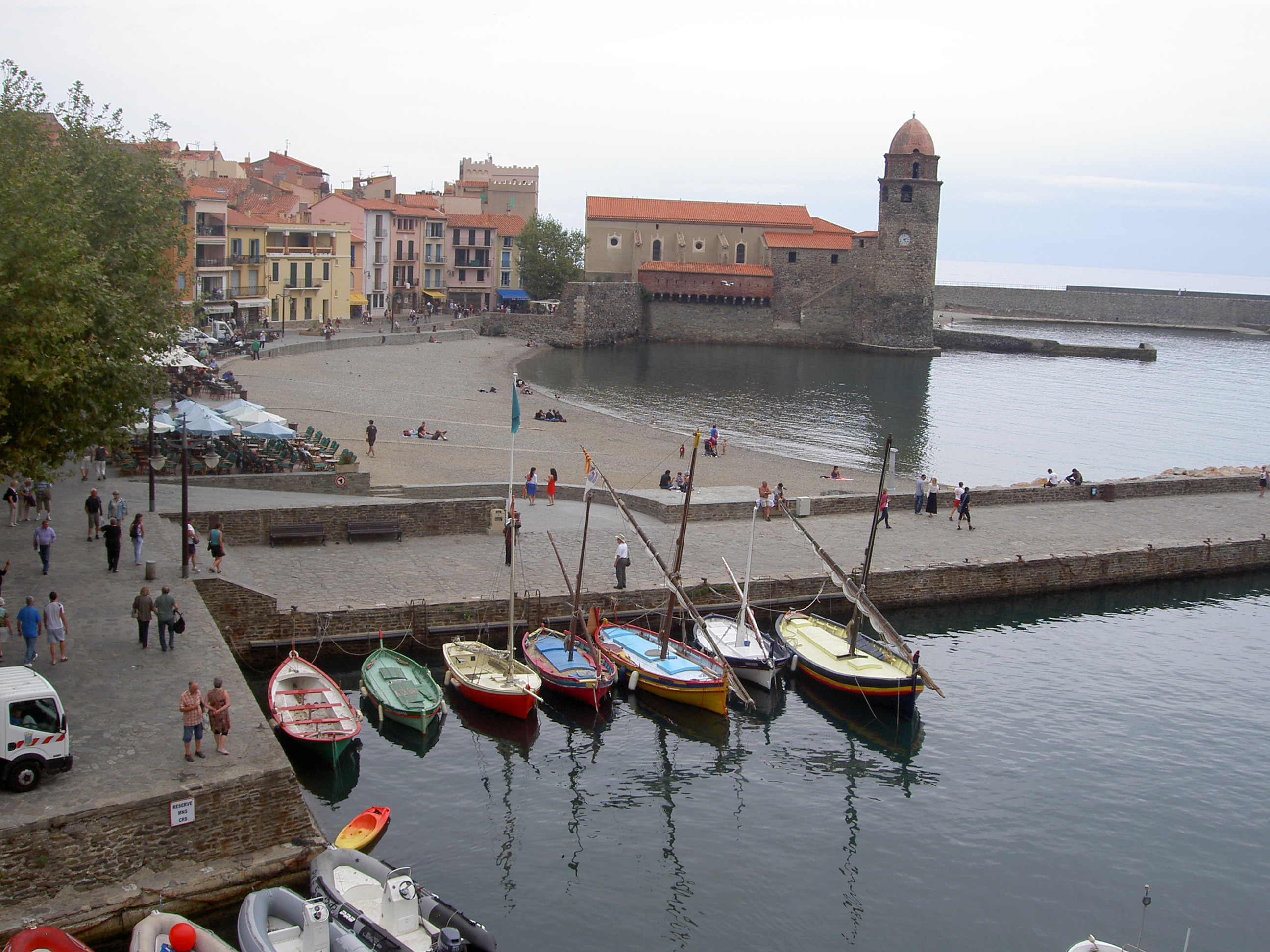
As each successive power occupied Collioure, so they added their own fortifications to the palace, the most recent being good old Vauban, who fortified it for Louis X1V, enabling the French to hang on to it since finally capturing it in 1659. What I find surprising, is that despite its importance over the centuries, with several ‘kings’ living there, it never grew into anything more substantial. It is true that it is a very small valley, surrounded by fairly steep hills, but that of itself would not have prevented growth. The hills were, and still are, important for the production of wine, so maybe it was determined that the vines, which are grown on terraces on the very steep hills, were more important than houses. Whatever the reasons, the result today is a very nice compact town, which is a delight to visit. It caters for its many visitors not with Kiss-me-quick hats, fairy-floss and hot-dogs, but by simply providing adequate cafes, restaurants and bars of a high quality. In one of these, overlooking the beach end of the harbour, we had a very nice lunch. In another, overlooking the boaty end, we had a very nice drink whilst waiting for our boat to arrive.
Catalan boats at Collioure
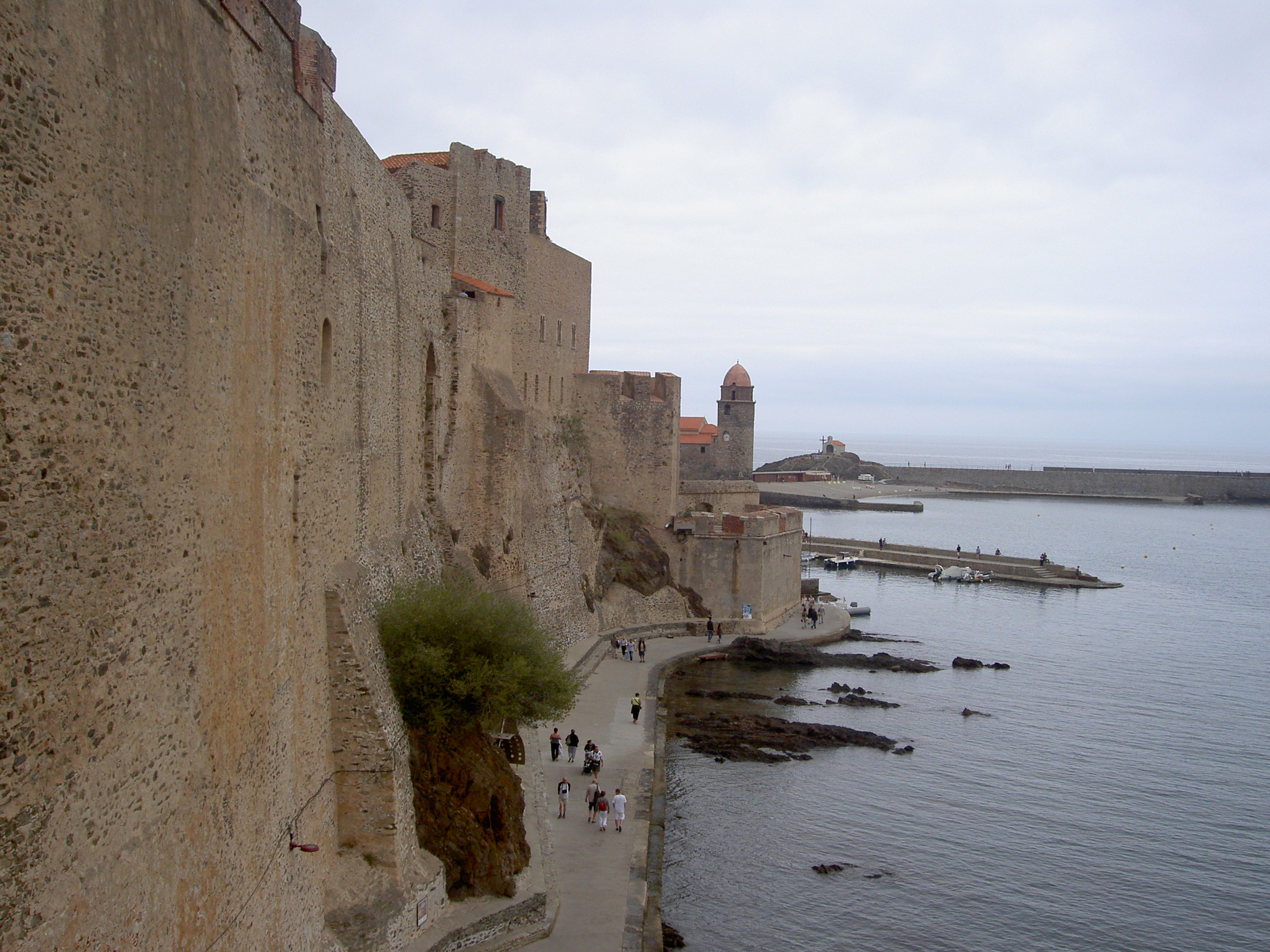
There are a few ‘souvenir’ shops, but these are tucked away up the many very narrow alleys which wend their way between the houses. The harbour provides very safe swimming, with reasonably good beaches. The ‘sand’ is not at all like the 90 mile beach, but is a rather greyish, coarse mixture of flattish pebbles and grit. The town is dominated by the fortified Royal Palace, built right along, and towering over, the harbour.
Royal Fortified Palace at Collioure
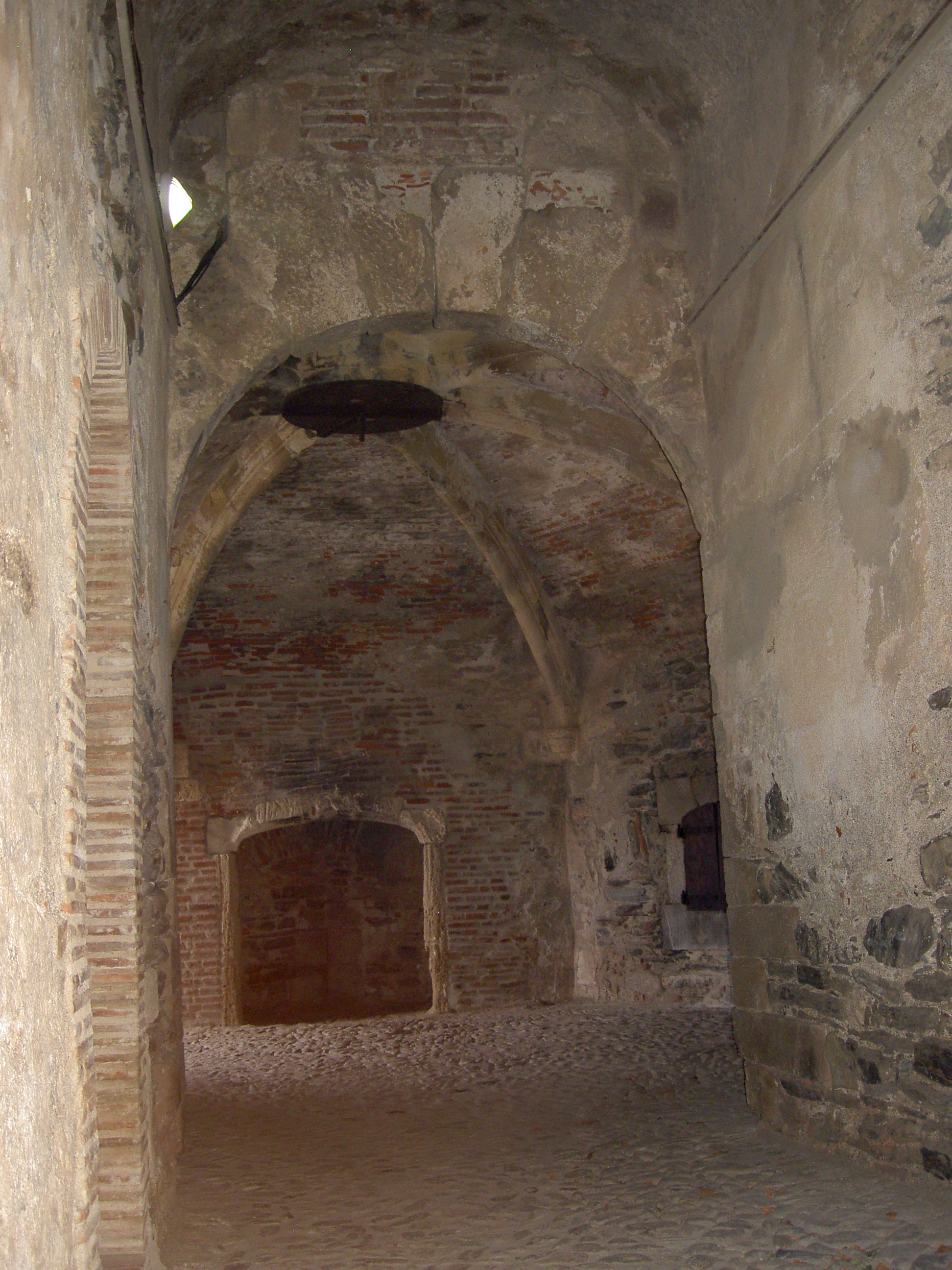
The entry fee for oldies is 2 Euros, and represents excellent value. The Palace is huge. There is a labyrinth of underground tunnels, some of which have been made safe for visitors to wander through, and there are about 4 levels of above ground rooms, all open to the public, and the whole thing encloses a large Place D’Armes or parade ground.
Tunnels at Collioure Palace
Many of the rooms open to the public currently have exhibitions of art works (not, I’m afraid, to my taste!), and others are simply empty. It may be improved a bit by including some period furniture to give more a sense of a lived-in Palace, but I guess one of the difficulties, if one wished to be authentic, would be which period to choose, given that its history spans many centuries and nationalities.
In addition to the main Palace, there are ruined fortifications all around the town, which we did not have time to visit. There is also a 13th century windmill, originally used to mill flour, and then to crush olives for oil, and is now being restored. What appears to be an old church below the mill, has been taken over for a winery, and one can smell the fermenting grapes as one walks past.
Showing the windmill and other fortifications
Truck-loads of grapes were being delivered as we were there. The Roussillon wines are really very good, despite the very sad-looking appearance of the vines on the parched hillsides!
All in all, a visit to Collioure is very worthwhile if you are in the Roussillon area. One can get there on the one-Euro bus, or by boat—car parking is a bit of a problem! We took the bus there, and returned to Argelès by boat, which made for a very pleasant day.
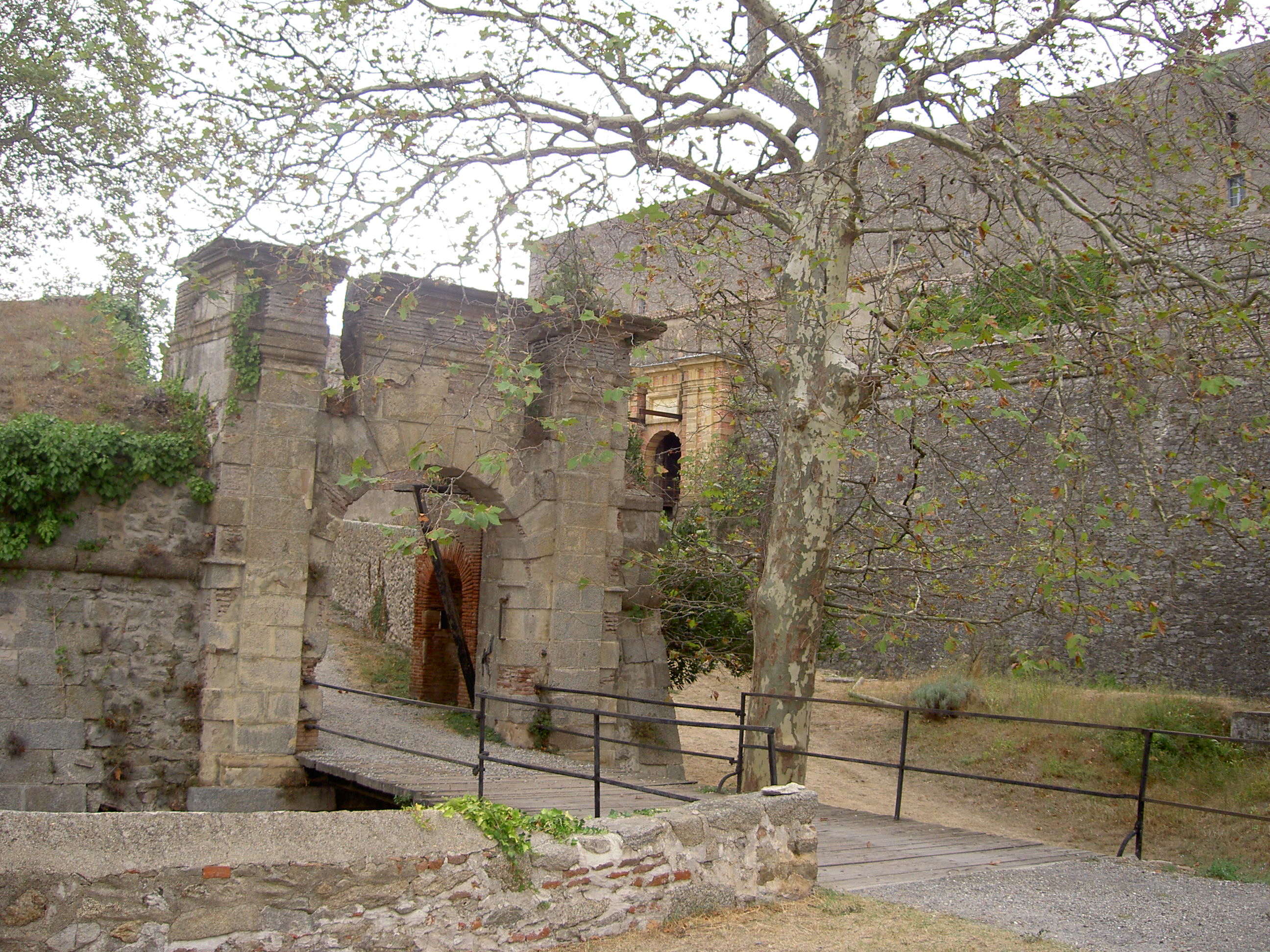
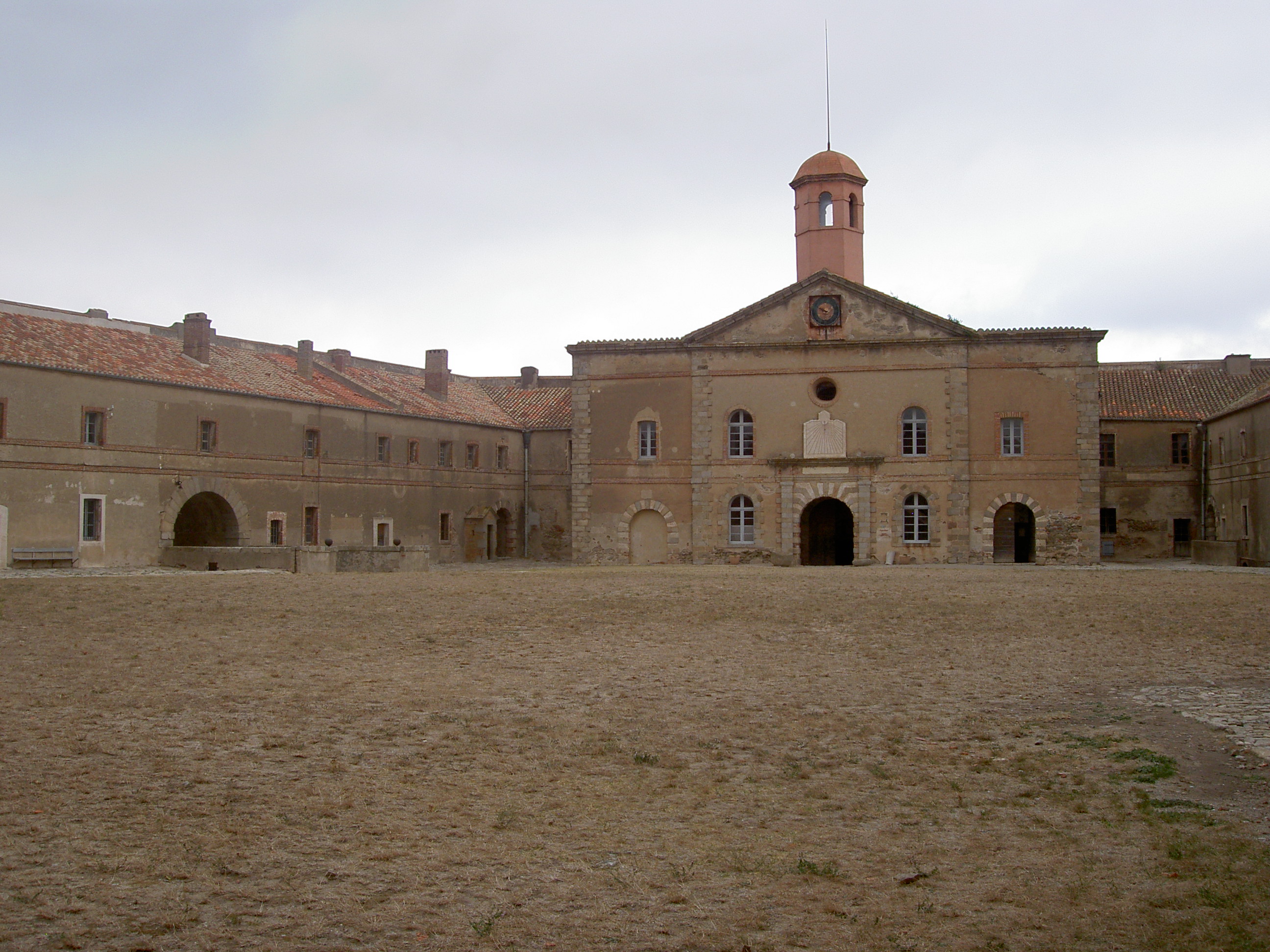
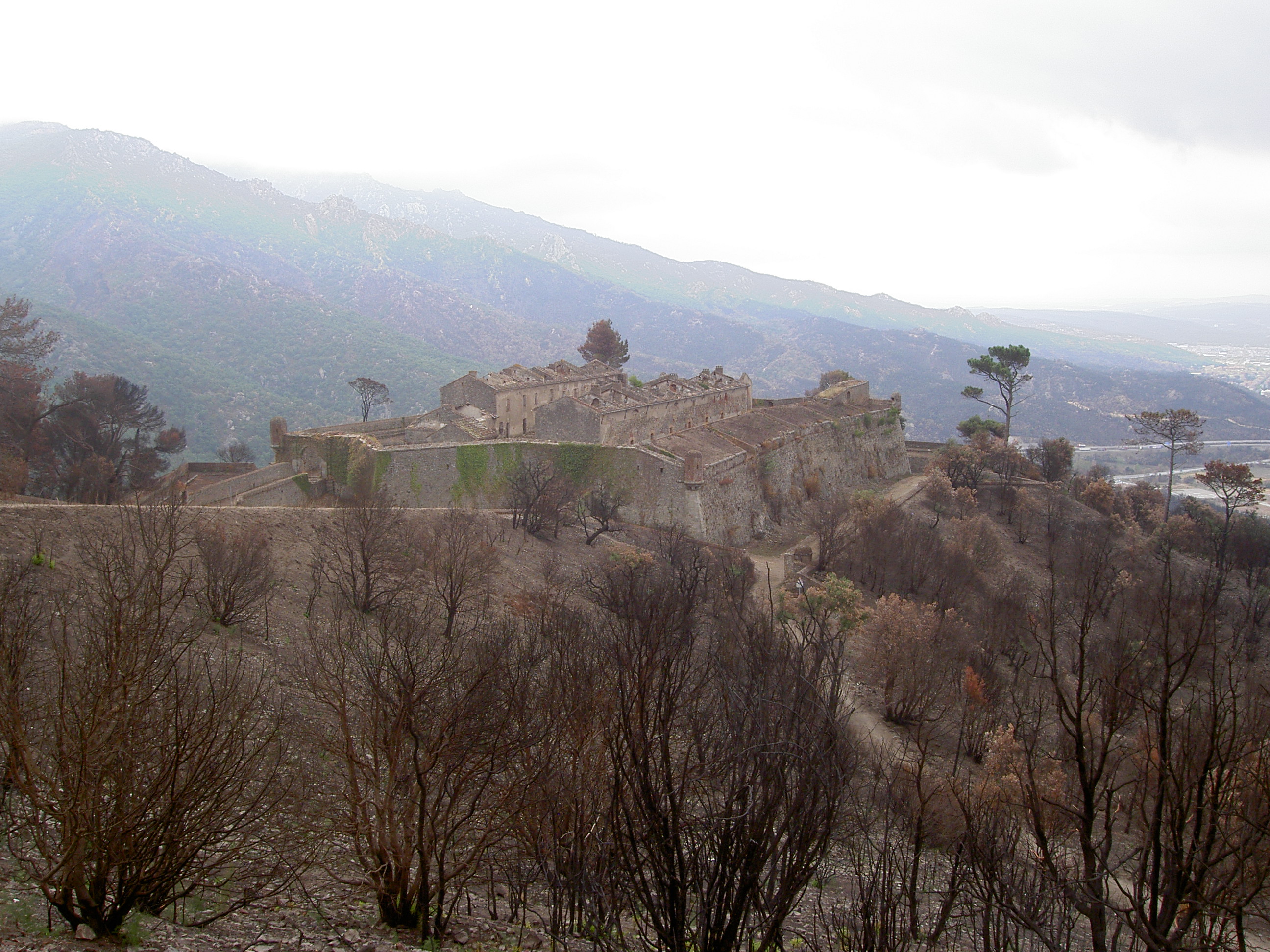
Not far away from Collioure, inland on the Spanish border, is the town of Le Perthus. Not surprisingly, given its geographical proximity, it has a similar history to Collioure. But whereas Collioure is a very pleasant sea-side village, Le Perthus town has nothing to recommend it at all. Nothing, that is, unless you like fighting your way through a kilometre or so of small shops spilling their cheap wares (clothing, watches, other jewellery, perfumes and the like mostly made, I suspect, in China) onto the footpath. It is right on the border with Spain, and the actual border post, probably now redundant because of the establishment of the EEC, is just at the very end of the main shopping street. Accordingly, I guess many of the shopkeepers are actually Spanish. But what interested us far more, was the fact that on the top of the hill towering above the town, is the fort of Bellegarde.
Bellegarde Fort, Le Perthus
Originally a Roman fort, it had undergone many transformations as different powers occupied it. Then, following the annexation of the Roussillon in 1659, Vauban went to work, razed the whole thing to the ground leaving only a very small vestige of the Roman fort, and built an entirely new fort in his inimical way.
Chapel in Bellegarde from Place D’Armes
4534, 4536
And there it still sits, an enormous pentagon of barracks and other rooms (similar to those in Brisach) enclosing a huge Place D’Armes, and the whole thing surrounded by his typical triangular fortifications, like the points of a star, with three or four levels of ramparts. Some of the barrack rooms and the original chapel have been turned into art galleries, but a lot are in need of restoration. The old bread ovens are still there, and a well, some 100m deep, is still used as the fort water supply. Vauban’s original machine for hauling up the water buckets still works, but has been replaced by electric pumps for day to day use.
The ruins of the old Roman fort are visible from the ramparts, but the path down was too steep for us to manage, so we did not visit that part.
Roman fort ruins, from ramparts of Bellegarde
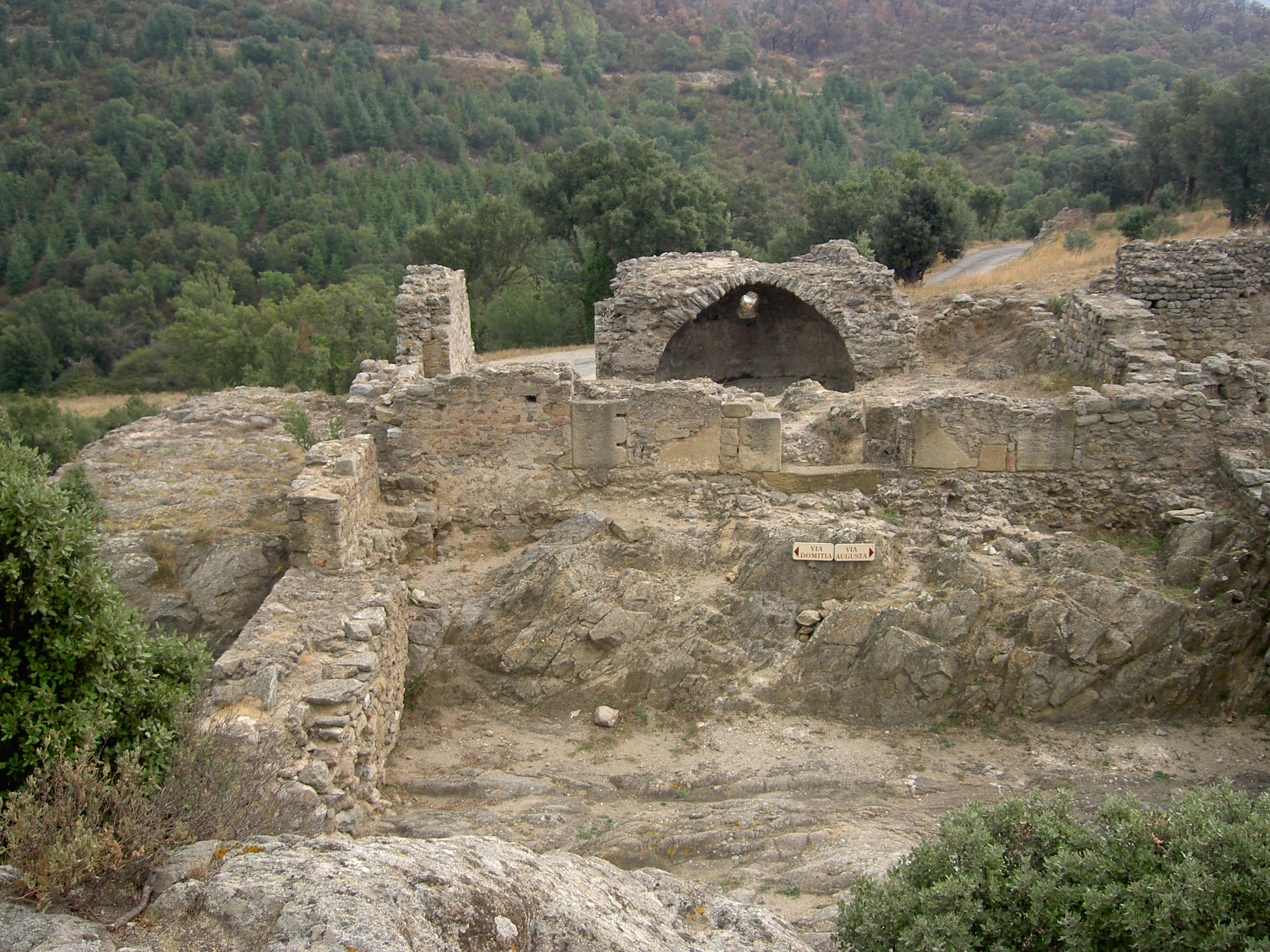
But of even greater interest, just below the Roman fort, is an archaeological site known as the Pannisars. Here, are even older Roman ruins, and the wheel tracks worn into the rocks by the chariot wheels are clearly visible.
Pannissar
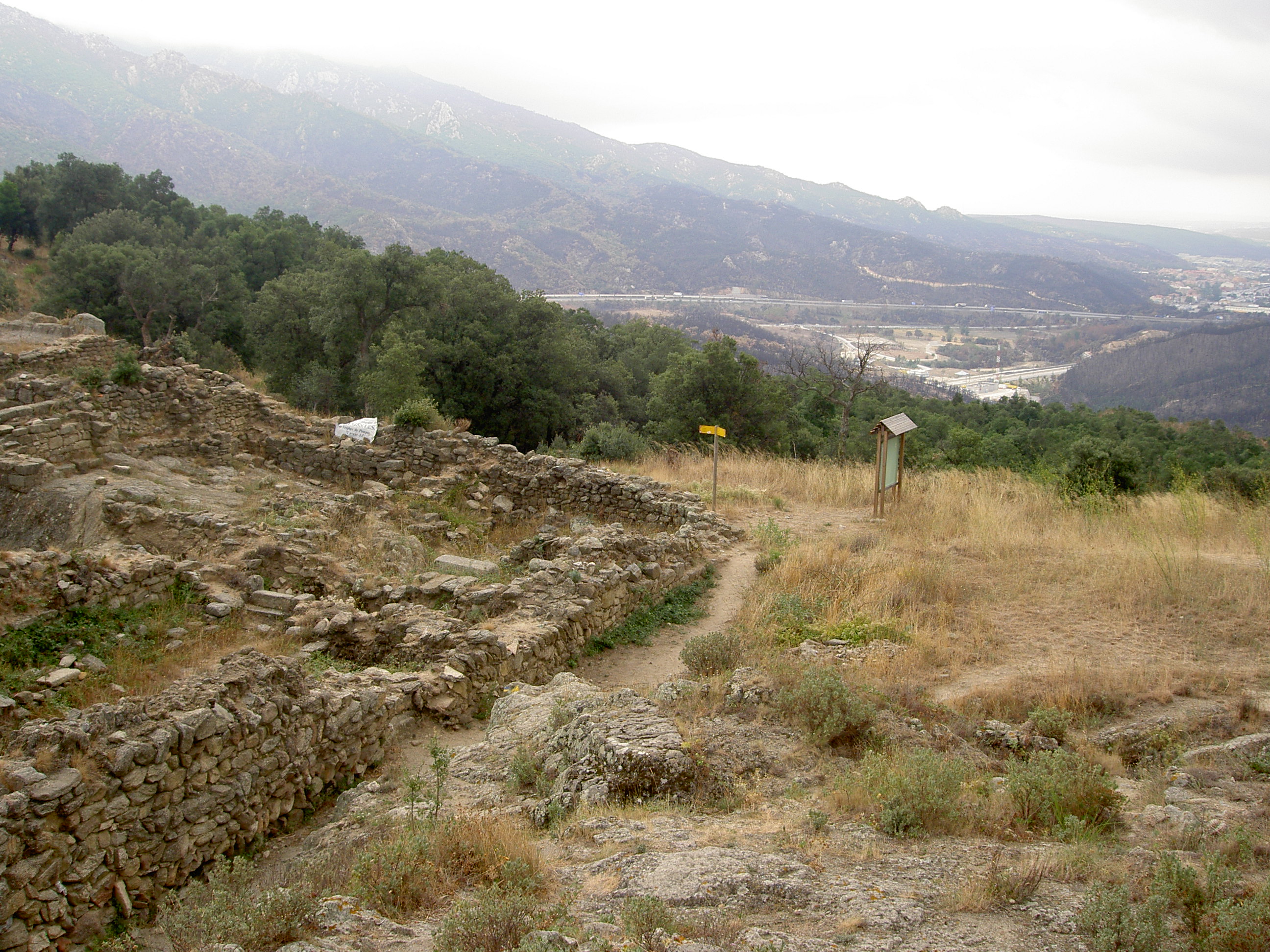
This was a check-point on the original road linking Rome and Spain, and became part of the Camino to St Jacque di Compostella, the famous pilgrim route still walked by thousands each year today. From this site can be seen only a few hundred metres away, the Péage autoroute, and the TGV train line. One wonders what those old Romans might think if they could see the hundreds of cars and trucks passing each hour at speeds up to 130k per hour, and the trains going at nearly 300k per hour, and compare those with the bone-breaking jolts they must have endured in their chariots!
Peage (autoroute) from Pannissar
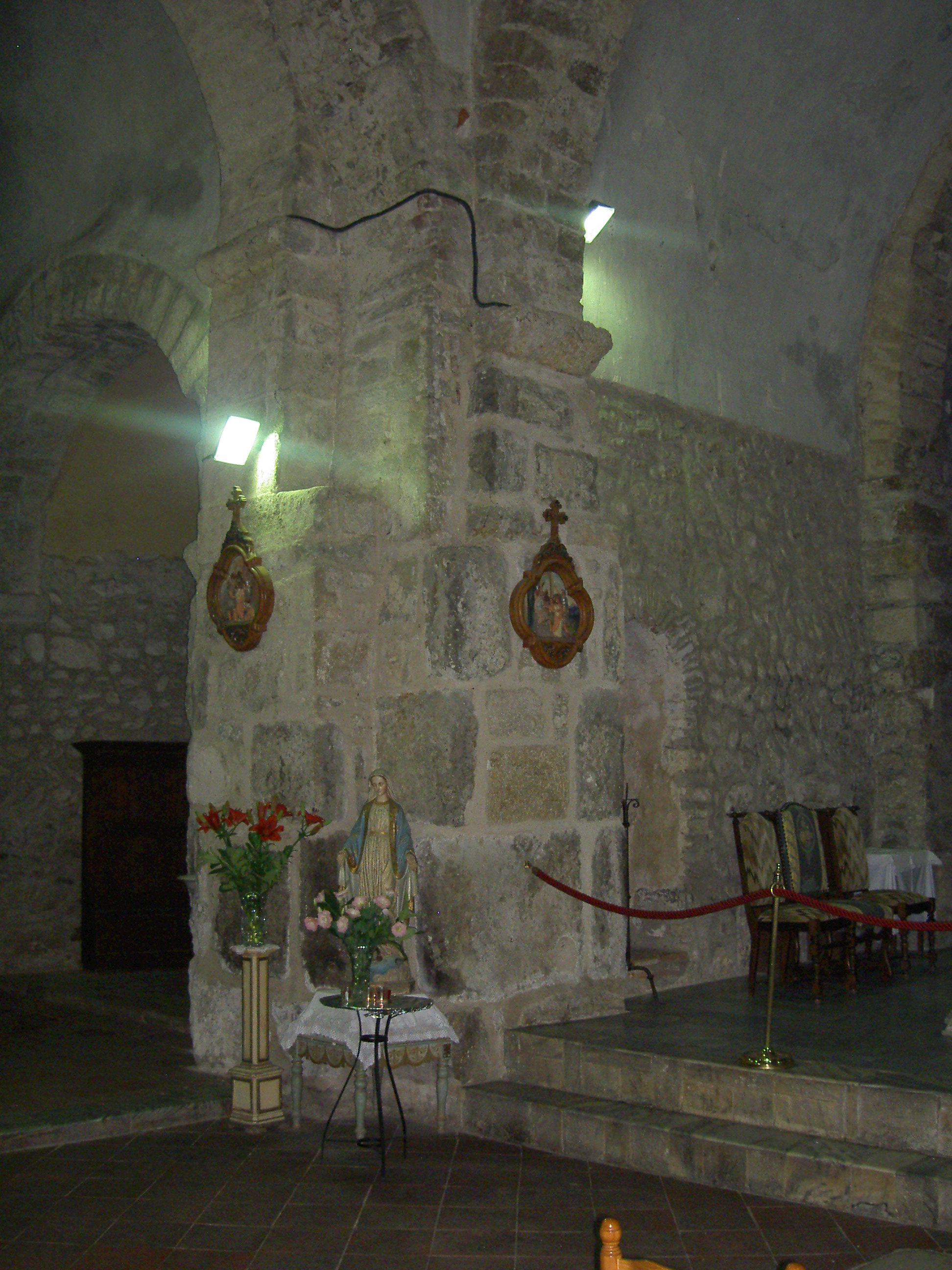
Not far from here, on the road back to Le Boulou, is the tiny hamlet of St. Marin de Fenollar, which was once on the old Roman Road, and which now exists only because of its Roman Church with well-preserved frescoes. Unfortunately, it was closed when we passed, so we did not see the inside. Other places on the old road include St Génis-des-Fontaines, with its cloistered Roman Church the inside of which we did see. It is a remarkably solid church, with huge stone columns supporting the roof, making it seem almost cave-like inside.
St Genis
In what I assume has become a Mediterranean custom, it has been fitted with an incredibly elaborate altar-piece of rather gaudy painted and gold-leaf encrusted statues. Incidentally the cloisters here had had a very chequered history of their own. Following the French Revolution, they, along with the church, were sold. Then, 1923 some of the marble columns were sold to a Parisian antique dealer, some were given to the Louvre Museum, and some were removed to a private collection in the United States. But, in 1973, thanks to a lot of diplomatic bargaining, most of the columns were recovered and restored to their original positions. For those unable to be recovered, faithful copies were made. Now it did strike us that these cloisters were not as spiritually peaceful or as calm as those at Arles-sur-Tech, and maybe this had something to do with the violence the cloisters had experience over the past hundred and fifty years or so.
Nearby, is the village of St André, which also has a Roman church similar to that at St Génis, but which has (in my view) escaped the colourful elaboration of the altar-piece.
In this blog I have mentioned some half dozen incredibly interesting historical buildings and towns. But they are just the tip of the iceberg! There are countless forts, churches, abbeys, priories and cathedrals, with and without cloisters, with and without fortifications, intact or ruined, that are scattered across this part of the world, and each has its own history. The histories I have recounted here, I have gleaned from the information hand-outs and from display boards at each place. To discover it all would take a life-time of study, and one would have needed a much earlier start than we have made!
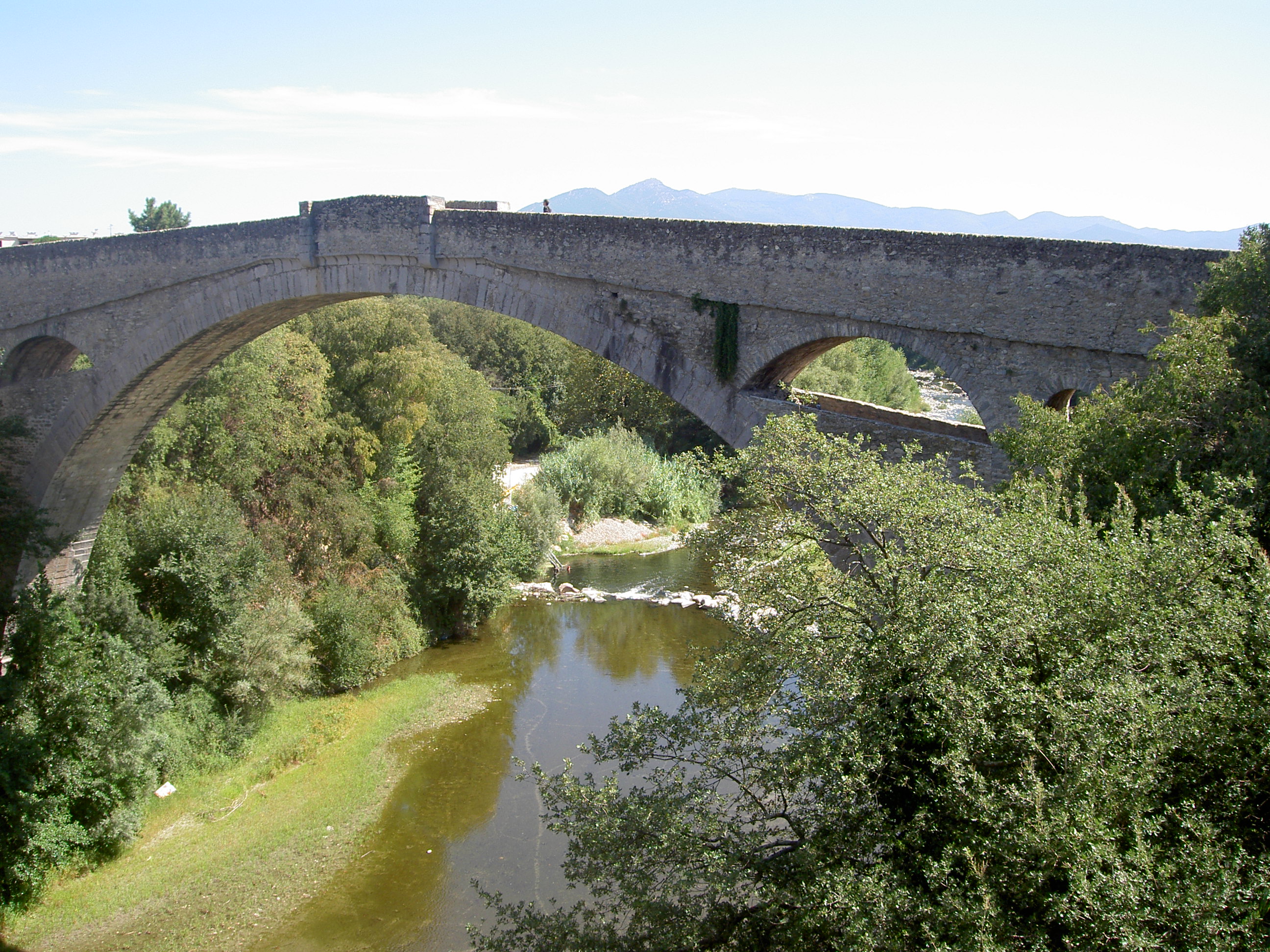
The area surrounding this part of France is steeped in history. Many of the small villages have churches, abbeys and the like which date from the 12 century and earlier, and there are lots of Roman sites. Being near the border with Spain, it has seen more than its share of invasions and strife over the centuries, but today all is peace and quiet, and the only invaders are the hoards of tourists who flock to the seaside, and to visit the old buildings. We made a second trip inland, but a bit further south than the route to Castelnou, and travelled through Le Boulou, and on to Céret. Céret is a bit of a sprawling town and its claim to fame is the Pont Du Diable (The Devil’s Bridge) which dates from the 13th century. Legend has it that it appeared overnight, and therefore must have been built by the Devil himself, as no-one else could have built it in such short time. The stone bridge spans the Tech river, and is now just a pedestrian path, having been made redundant with the increasing traffic requiring a more modern bridge.
Pont du Diable, Ceret
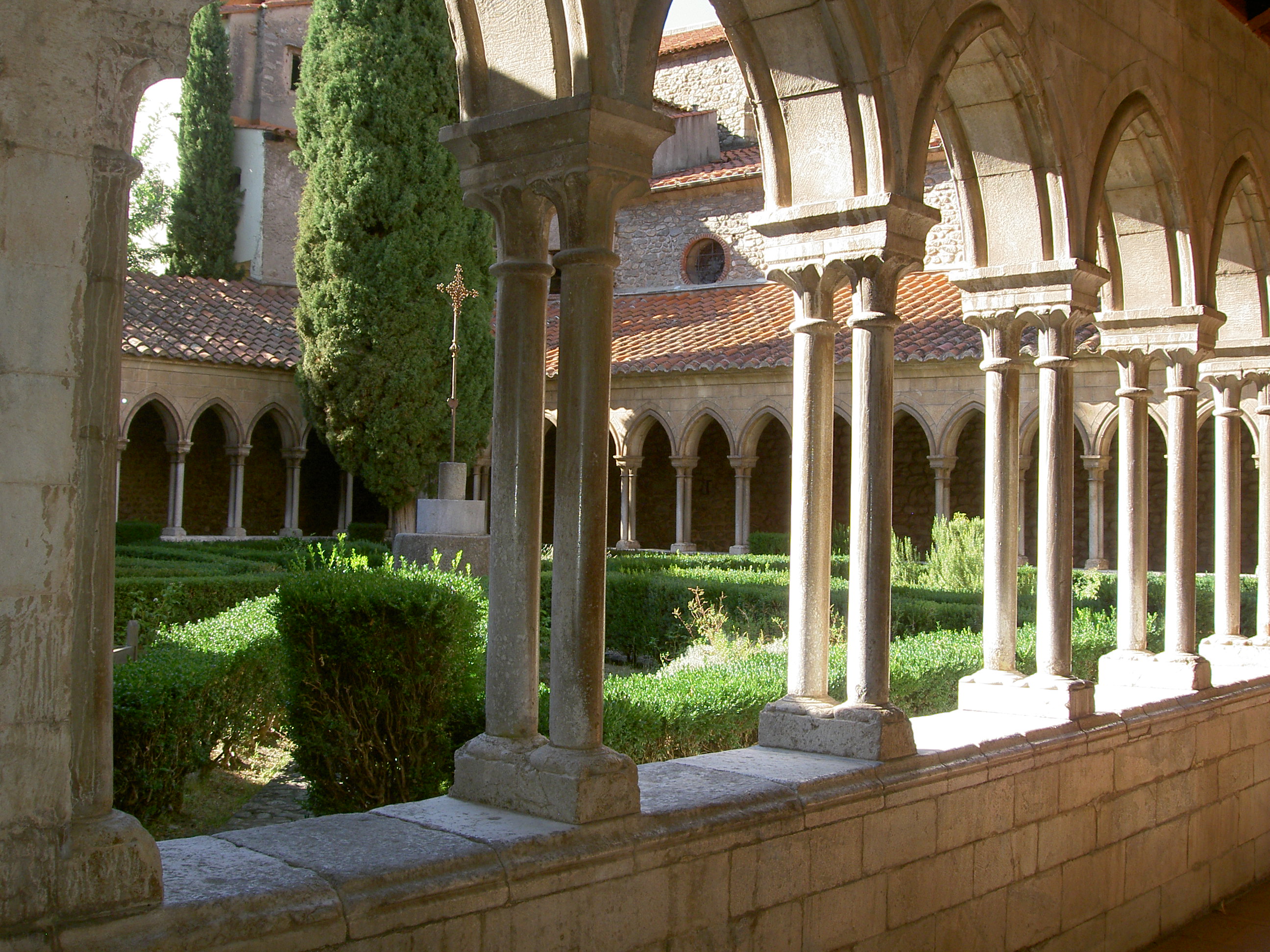
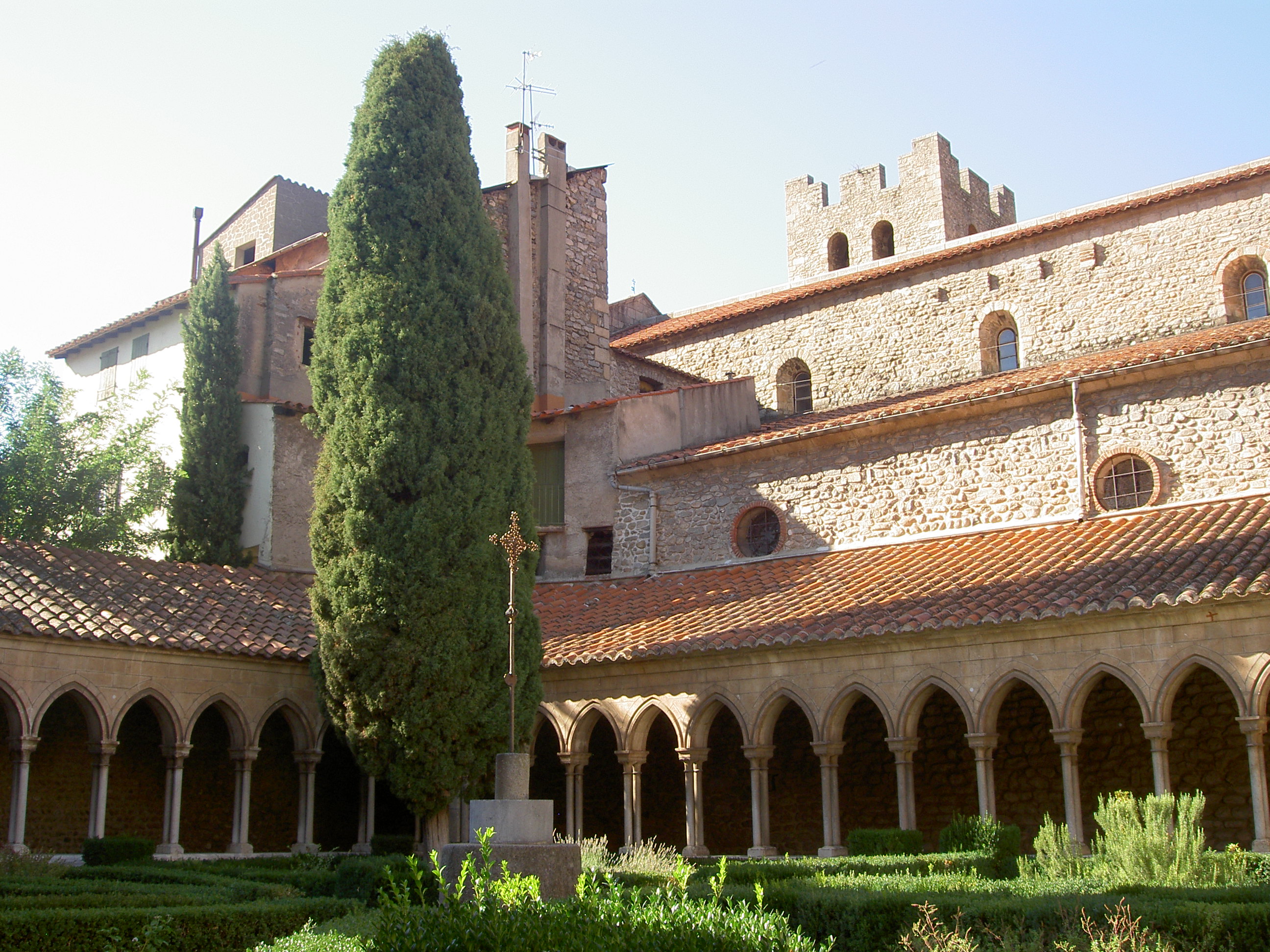
The next town is Amélie-les-Bains, a long skinny town with a one-way road in one direction, which misses the town centre, and another for coming back which takes you right through the middle. There are supposed to be thermal baths, but with the one-way road system, we failed to find the necessary road (nothing unusual about that, of course!). And then to Arles-Sur- Tech. Arles-sur-Tech has an ancient Benedictine cloistered abbey dating from the 12th century, which is stunning. The cloisters are beautifully restored, and incredibly peaceful– so much so, that Ann sat down to peruse a brochure, and promptly nodded off!
Cloistered Abbey, Arles-sur-Tech
The abbey itself is not that large, but incredibly ‘massive’, simple, and very solid. Like inside most of these ancient buildings, it is not possible to get photos which would do justice to the building. The two rows of five columns supporting the roof, which are generally round, are square, well over a metre thick, but only about four metres tall, giving the ‘massive’ feel to the building.
Abbey, Arles-sur-Tech
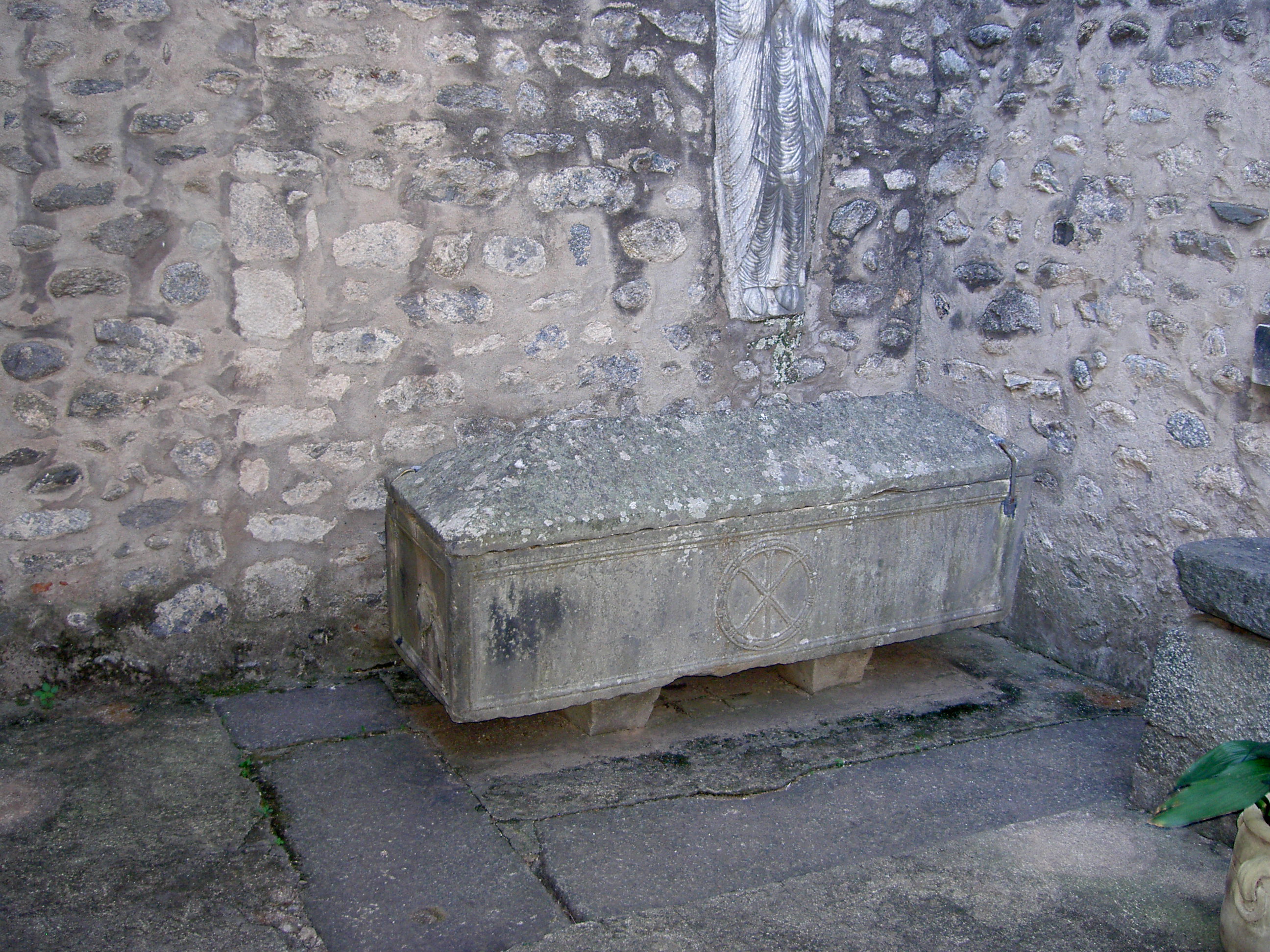
In the courtyard just outside the main door, is a stone sarcophagus dating from the 5thcentury, and said to have once contained the relics of St Marie.
Sarcophagus
Of particular interest, is that the stone sarcophagus, completely sealed apart from a small hole near the top at the foot end, fills with water every couple of weeks, and no-one has yet been able to explain it! Apparently it has been happening for centuries, and every couple of weeks, the priest syphons the water out, and gives small bottles of it to those who think it might cure them of some malady. Books and scientific papers have been written about the phenomenon, but it remains a complete mystery! However, I did see a rather suspicious yellow hose pipe on the ground outside the abbey walls, just below the part where the sarcophagus is………..
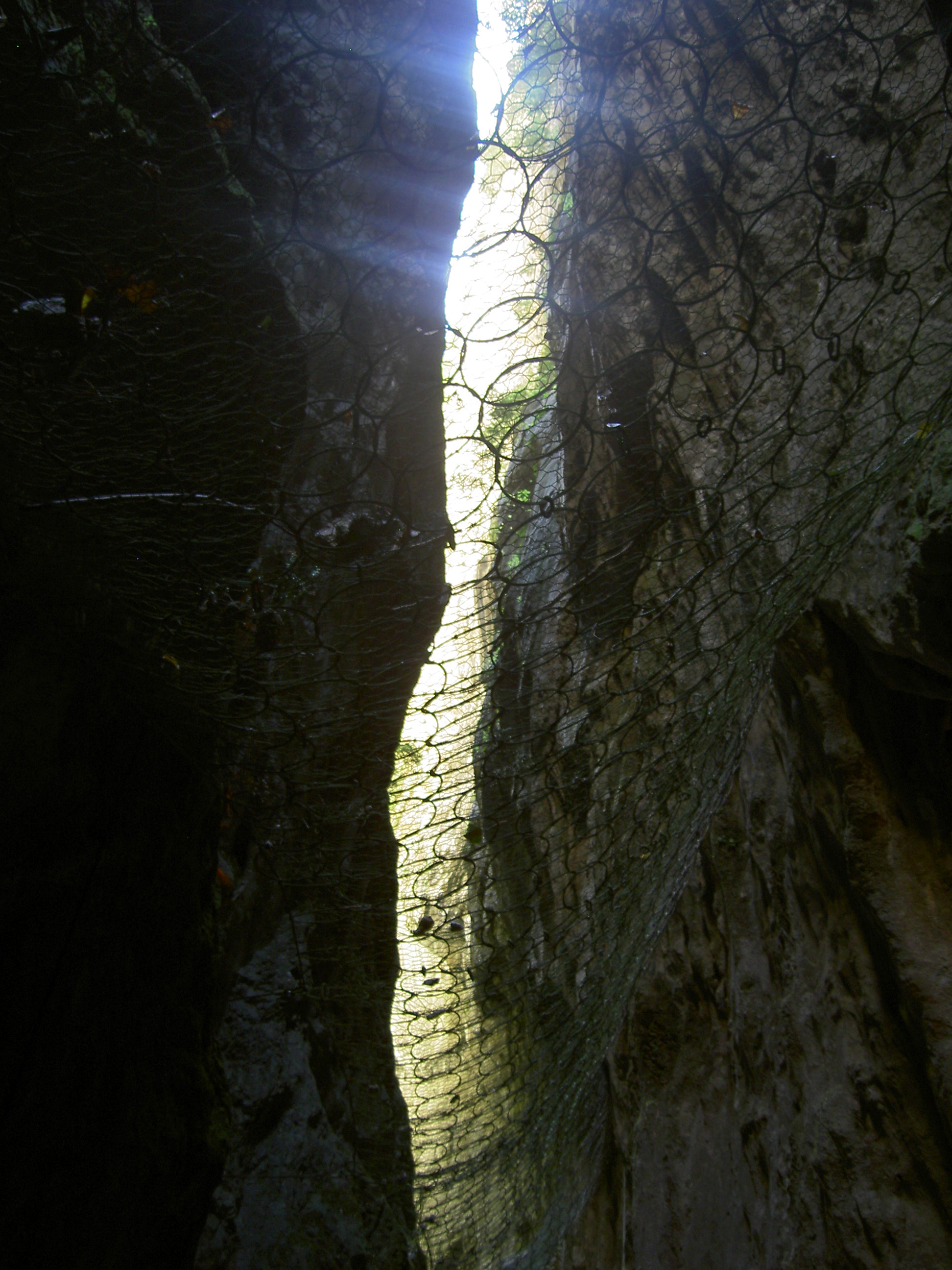
Passing further inland beyond Arles-sur-Tech, one comes to the Gorges de la Fou. A couple of weeks ago we drove though the gorges on the river Tarn. These are huge, and the Tarn is a very large river. The Gorges de la Fou is spectacular for being so narrow—-for most of the 1.5 K length, it is no more than two metres wide, but a staggering 200 metres deep! No driving through this gorge! One dons a compulsory hard hat and walks on a steel grid board-walk about 3 metres above the water, which is about 10cm deep, and 50cm wide. Just a trickle! For most of the 1.5 K, it is possible to touch both sides of the gorge simultaneously without even stretching, and at one part it is a bit of a squeeze to get through at all. Of course, it is impossible to get decent photos, so you will have to make do with this one!.
Gorge de la Fou
At its widest, it is no more than 10m. But the walls go up above you, completely vertical for between 150 and 200m for most of the way. The spectacle is diminished a bit due to the mesh about 5 metres above your head, but judging from the number of rocks resting on the mesh, it is a very necessary precaution!. There are a few huge rocks which have tumbled from the walls high in the gorge, and which have become wedged above your head. One of these, known as the Roche du Soldat, has a plaque telling of how, about 50 years ago, this huge rock crashed into the gorge from the top, complete with a sheep standing on it. But the shepherd managed to rescue the sheep, and it lived on happily none the worse for its adventure!
Car parking was not a problem on the day we went, but at times it probably would be. There are a couple of cafes right near the entrance, and as it was exactly beer o’clock when we were there, of course we had to have one—and at only 2 Euros a pot, was very good value indeed.
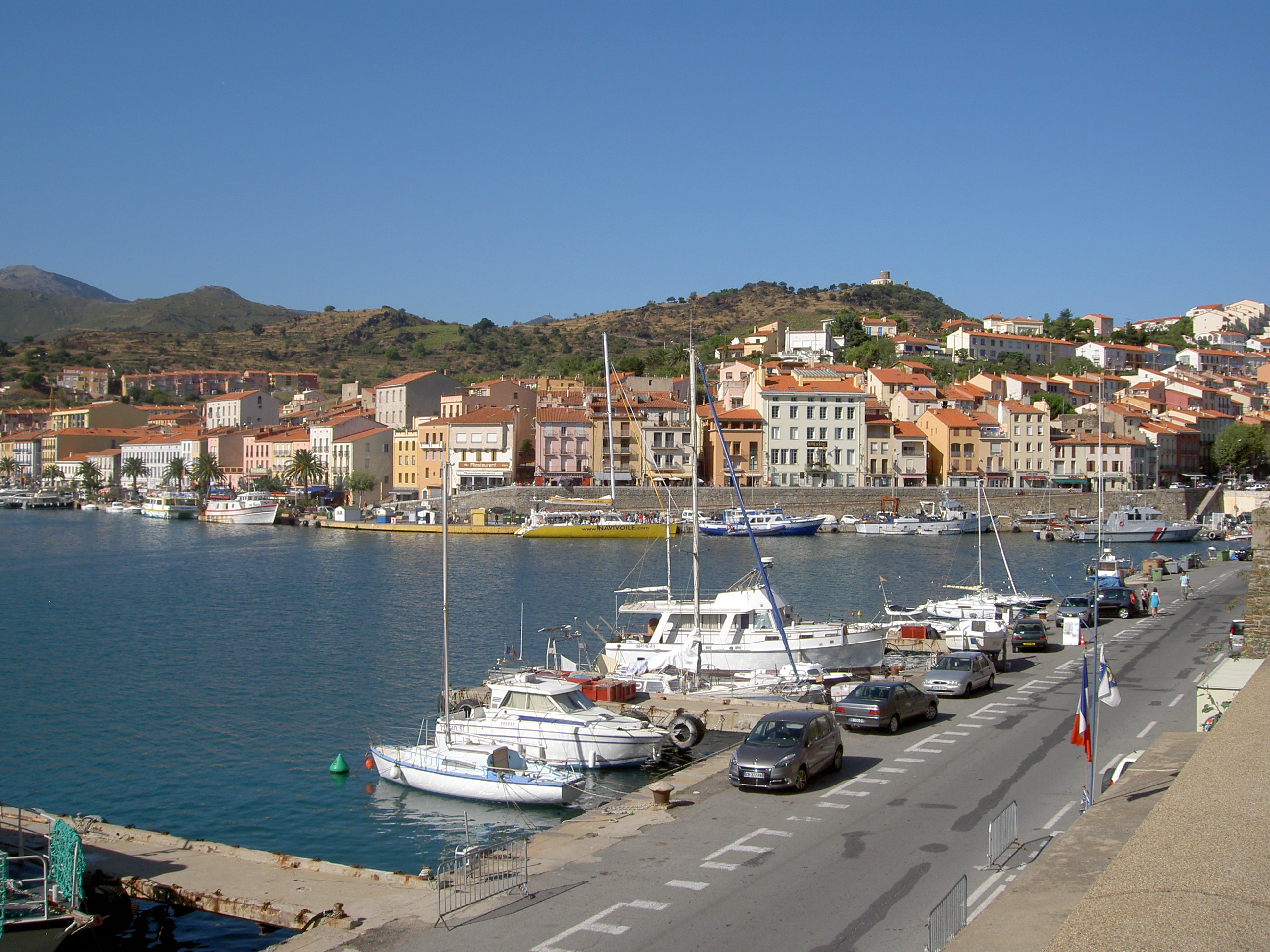
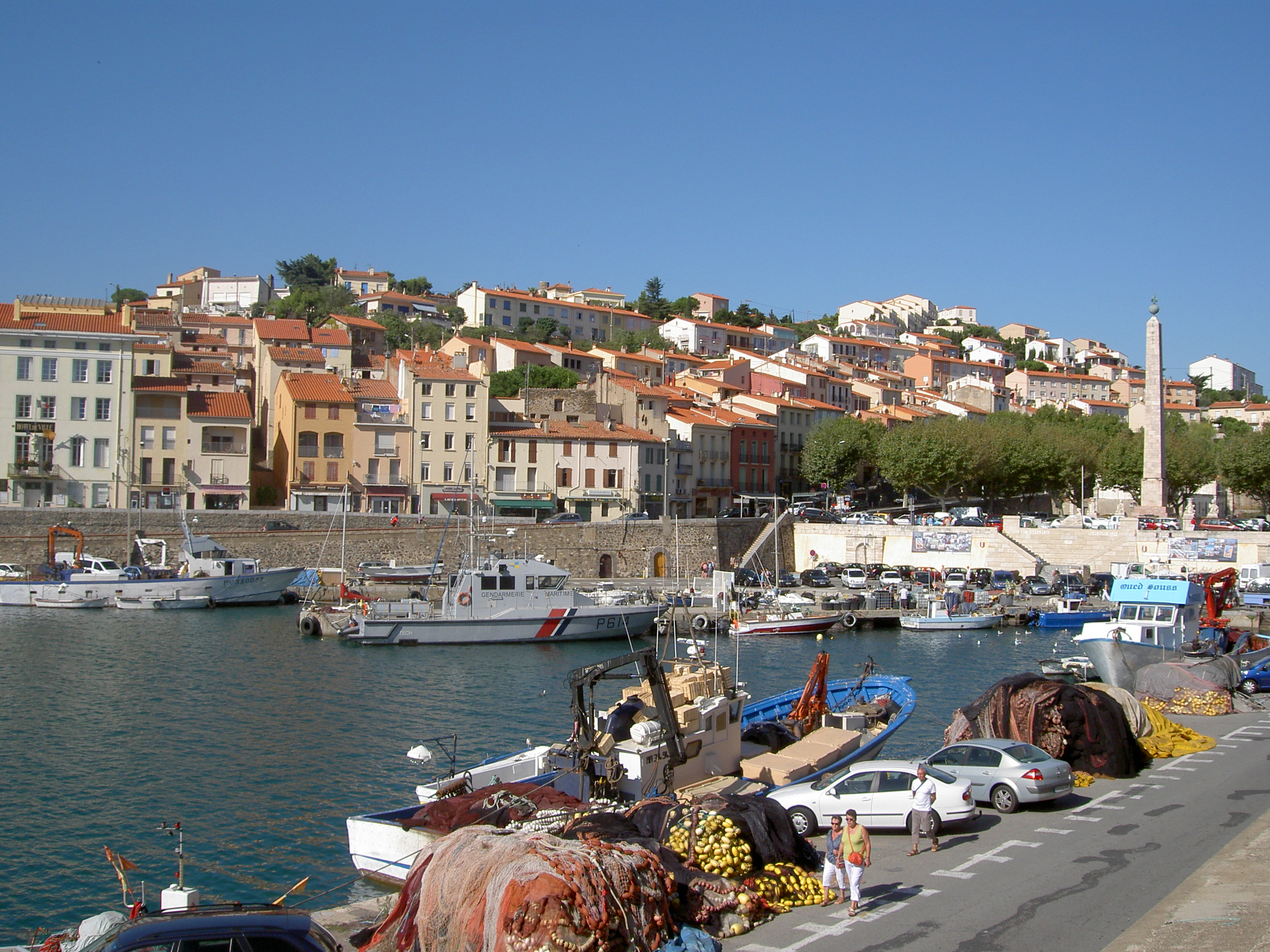
So that was our Saturday. On Sunday, a perfect autumnal day, we decided to have a drive south along the coast, to Collioure. But so had thousands of others, and when we got there, there was no parking available, even for ready money. So we just continued south to Port Vendres. Here there was plenty of parking, so we stopped for a look around. We had been here before, five years ago, and nothing seemed to have changed. Along this coast, just north of Argelès is St-Cyprien, which is nothing but a huge marina for people with huge boats. (one might wonder where they get their money from!) The port at Argelès itself is quite small, and accommodates the smaller boats of the less wealthy. Then comes Collioure, which is by far the most stunning and picturesque harbour—and more of that in a later blog. Port Vendres is very much a working port for fishing vessels, and, judging by the size of the now redundant railway siding area, was once an important port for coastal trading boats. There were a number of stalls on the quay selling all sorts of fresh fish, most of which I did not recognise. I was tempted to buy some, but being a very warm day, and with no way to keep them cold, I decided against it. But we did have our customary drink at a bar overlooking the port.
Port Vendres
We saw notices advertising an aquarium at the next town, Banyuls-sur-Mer, so we wended our way there. Now I should mention that this part of the world (the Roussillon) grows excellent wines in very ancient vineyards, and as well as being a popular sea-side coastal route, it is also a very important ‘Route des Vins’, which means that, particularly at this time of year, there are loads of people driving round doing the wine-tasting thing. So, the drive to Banyuls was very slow indeed. But we got there just on 12.00, and of course the aquarium was closed for lunch. So we had no option other than to do the same—-a bowl of moules et frites for me, and confit de canard for Ann, at a restaurant right on the beach. The main part of the restaurant, including the kitchen and bar, was across the road, so the waiters for this, and for the several other cafes in the same strip, had to dodge between the cars whilst carrying plates of food and trays of drinks, an entertainment in itself. After lunch we went back to the aquarium, but found it very disappointing, despite it being part of the University of Paris, and despite its rather pretentious second name, ‘The Biodiversarium’! Not a patch on the Melbourne Aquarium. Then it was time to once more join the traffic and get back to Argelès.
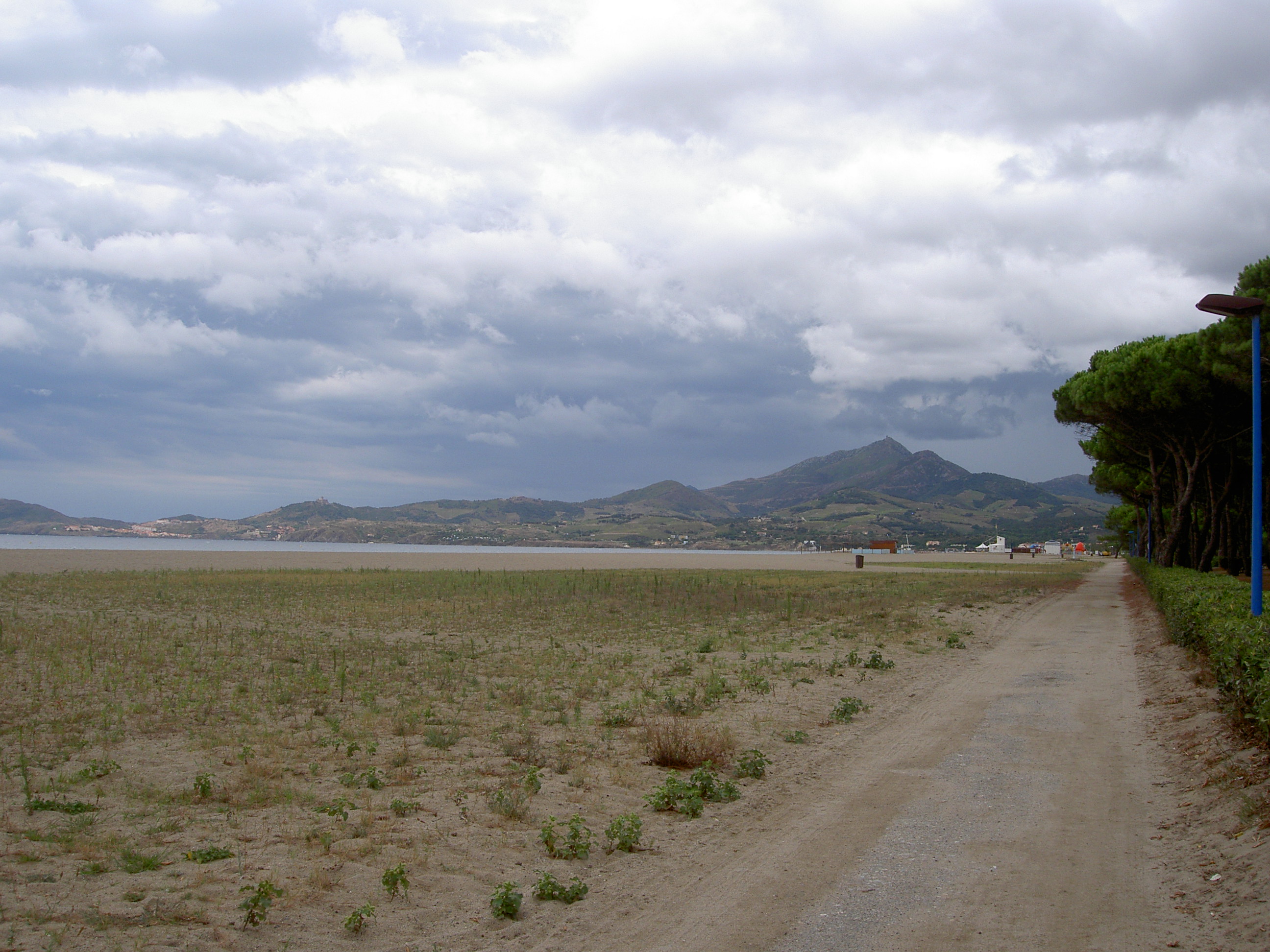
The sea-side township of Argelés Plage, at the northern end of which is where we are staying, is about 3km long, and in places the built-up area is about 500m wide. In other places it is no more than 100m, and it lies between the old town of Argelés-Sur-Mer, and the sea. The beach itself is separated from the building line by a grassy strip some 50 m wide, which is dotted with a local variety of pine tree, and where several games of pétanque can be seen most evenings. In places, there is a path through the trees, and at the ‘central’ beach, the grass is replaced by a wide, paved promenade. It is all perfectly flat, and one can walk or ride a bike the whole length without any cars interfering. Beyond the grassy/paved strip, there is about a 50m wide beach of fairly coarse sand, which is so level, I suspect it is regularly raked even though I have seen no machinery.
Argeles Plage, general view of beach
Toward the water’s edge, the beach drops a metre or so very sharply, and there is a ‘plateau’ of level sand some 2-3m wide before the actual sea. It is on this plateau that most of the beach-goers sit, so from the grassy and paved areas, the beach actually looks deserted, and it is not until you cross most of the way on the sand that you can see anyone! At this time of year, the beach-goers are mostly elderly—all the young families having returned home as school has just started again after the summer holidays. In fact, on the day we arrived, the town was jam-packed with cars, and it was impossible to find a place to park. But these were mostly the departing holiday-makers, and by the evening, it had sorted itself out and the town has been relatively quiet since.
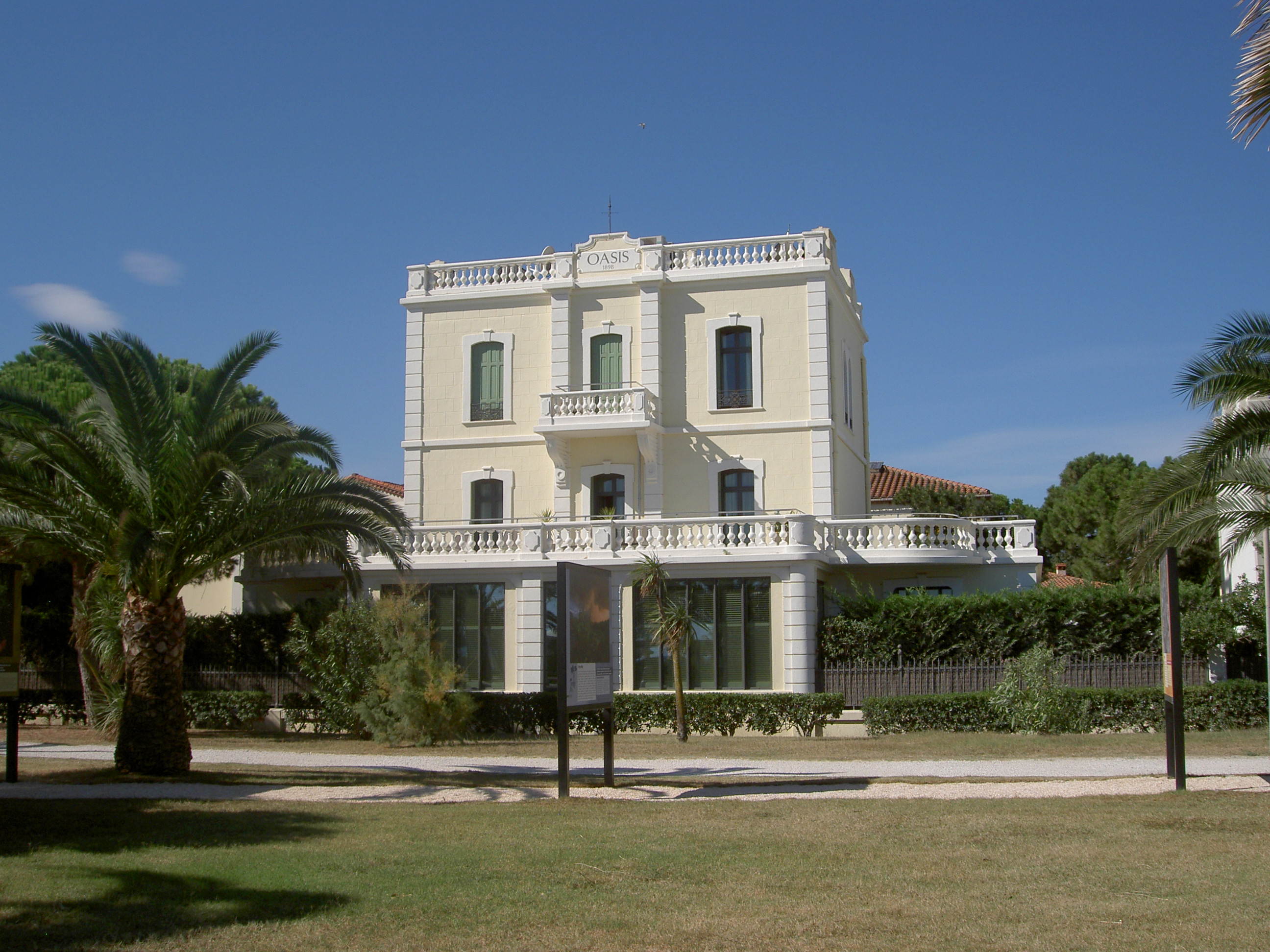
Argelés Plage itself has no buildings of historic interest whatsoever, even though it does have an interesting, if rather short, history. The first sea-side settlement began just at the end of the 19th century, as a place of retreat for the more wealthy residents of Perpignan and the more inland towns such as Toulouse, and there are a few substantial buildings remaining from that time.
One of the original houses
A few hotels and restaurants followed, but development of the town was interrupted by the 1914-1918 war. Then, in 1938/9, the Spanish Civil War resulted in over 100,000 refugees fleeing the violence there and being accommodated in makeshift camps along the strip which is now where most of the hotels and apartments blocks are found. Nothing remains of that episode of the town’s history, and it is marked only by a stone monument near the beach. Following the second world war, and the improvement in post-war family finances, there was increased demand for family holiday accommodation, and that is when the real growth of Argeles Plage started. So now, the vast majority of buildings are holiday apartments, hotels and the like, which have been built in the last 50 years or so, and quite cheaply. Further, much of the un-developed land between the Plage and the old town, is given over to camping grounds, which are heaving with people in summer, but virtually deserted now that the season has ended. In addition to the accommodations, there are a number of small retail developments, almost shanty-like in construction, being very light-weight, impermanent, and single-storey. However, they do have a lot of character, and are very influenced by Catalan culture. The one nearest to us includes a small ramshackle supermarket, a fruit and vegie stall, a couple of restaurants with most of the seating outside, a small bar with all of the seating outside, a take-away pizza place, a butcher/charcuterie, and a couple of ‘beach-ware’ shops selling beach umbrellas, beach toys etc. However, since we arrived a week ago, most of it has closed up for the winter, with only the supermarket remaining open.
Most buildings display their Catalan influences. Their walls are generally painted light apricot, or perhaps pale yellow or even pink, and the roofs are, almost without exception, made of orange terracotta tiles with a semicircular profile. The following photo of nearby Port Vendres shows this quite well.
Port Vendres
Every dwelling and shop has robust shutters on all doors and windows, even those on the upper levels. These are invariably closed tight when the occupants are out! Smaller windows, such as the bathroom, are fitted with traditional irons grills, with an outward bulge in the lower half.
The old town of Argelés-sur-Mer is a more solid-looking town, and in parts appears to be very ancient indeed. There is the usual huge ancient church, and this one has by far the most colourful, almost kitsch, alter-piece that we have seen thus far on our travels. It is huge, carved from very attractive marble, and the statues have been painted quite gaudy colours.
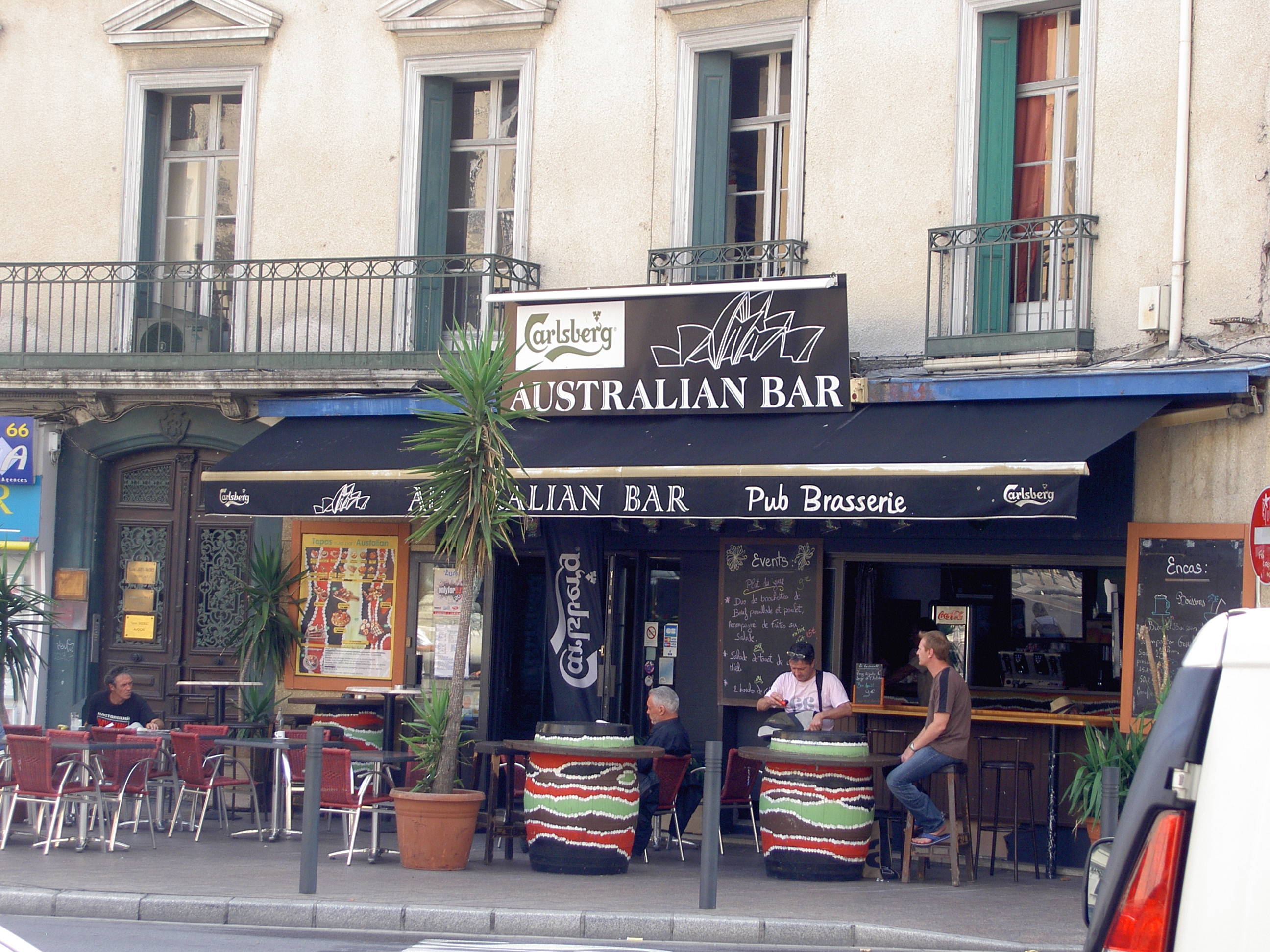
We have done very little since being here, but we have had a couple of swims in the sea, and I have had a brisk walk most mornings. We discovered there is network of busses called ‘the one euro bus’, on which you can travel, in one direction, for one euro a journey. The one through Argelès Plage starts at Collioure, and goes all the way to Perpignan—so that is where we went. We had been there before, and to be honest, the town is simply a large provincial town with not a lot for the tourist. It has good shopping in the centre, and many of the smaller streets have the familiar bars and cafes, which are very inviting on a hot day at about beer-o-clock! (but not this one!)
Not the most inviting!
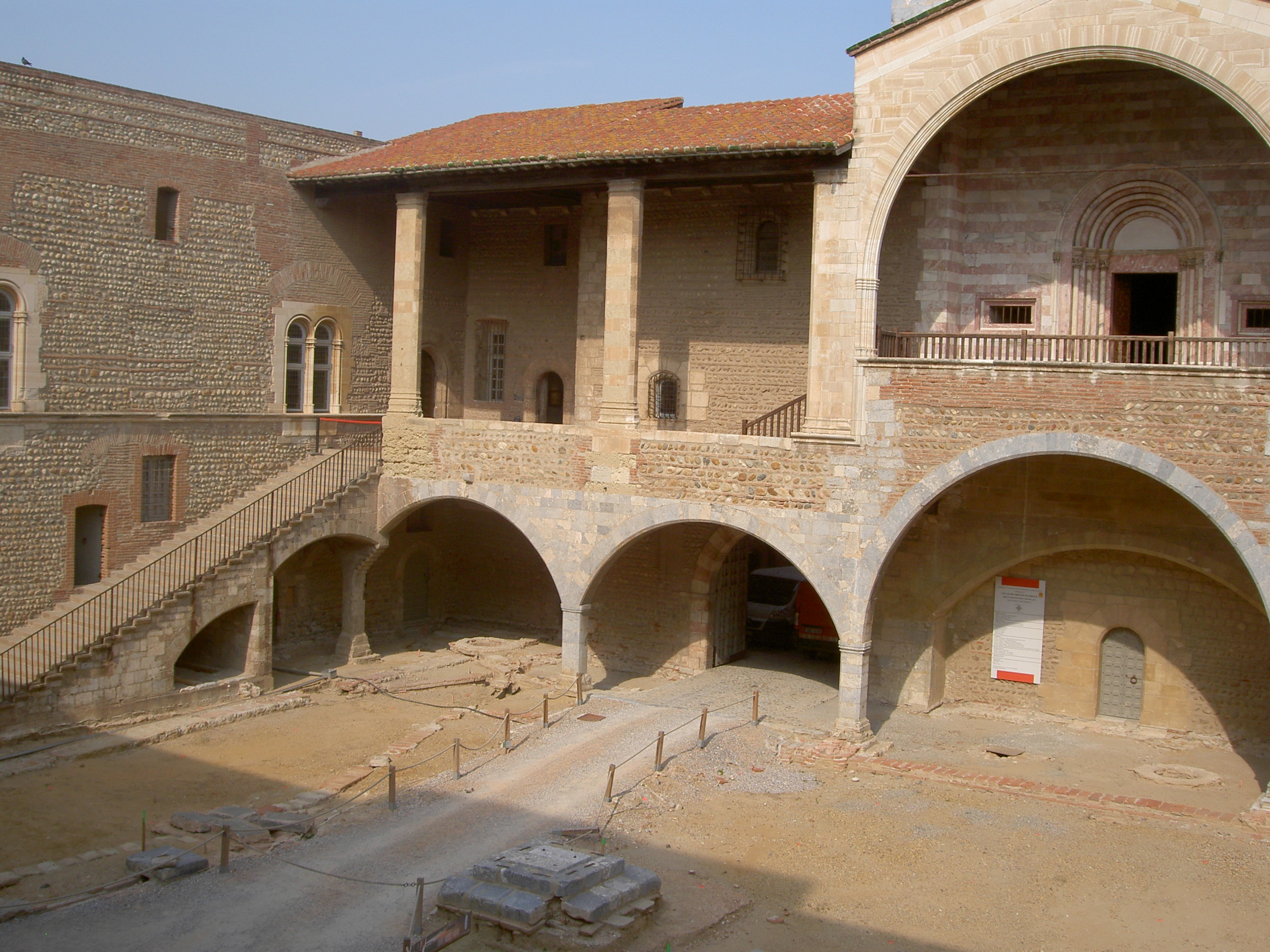
And, there is a remarkably well preserved chateau, taking up almost a quarter of the total area of the town centre, which is very well worth a visit. It was built in about the 11th century as the headquarters of the Kings of Majourque, who were important war-lords in this part of France for a few hundred years in those days. It is very solid,( almost Vauban-ish!), and is undergoing a considerable restoration just now. The more usable parts are already available for hire for conferences, banquets and the like.
Chateau of the Kings of Majourque, Perpignan
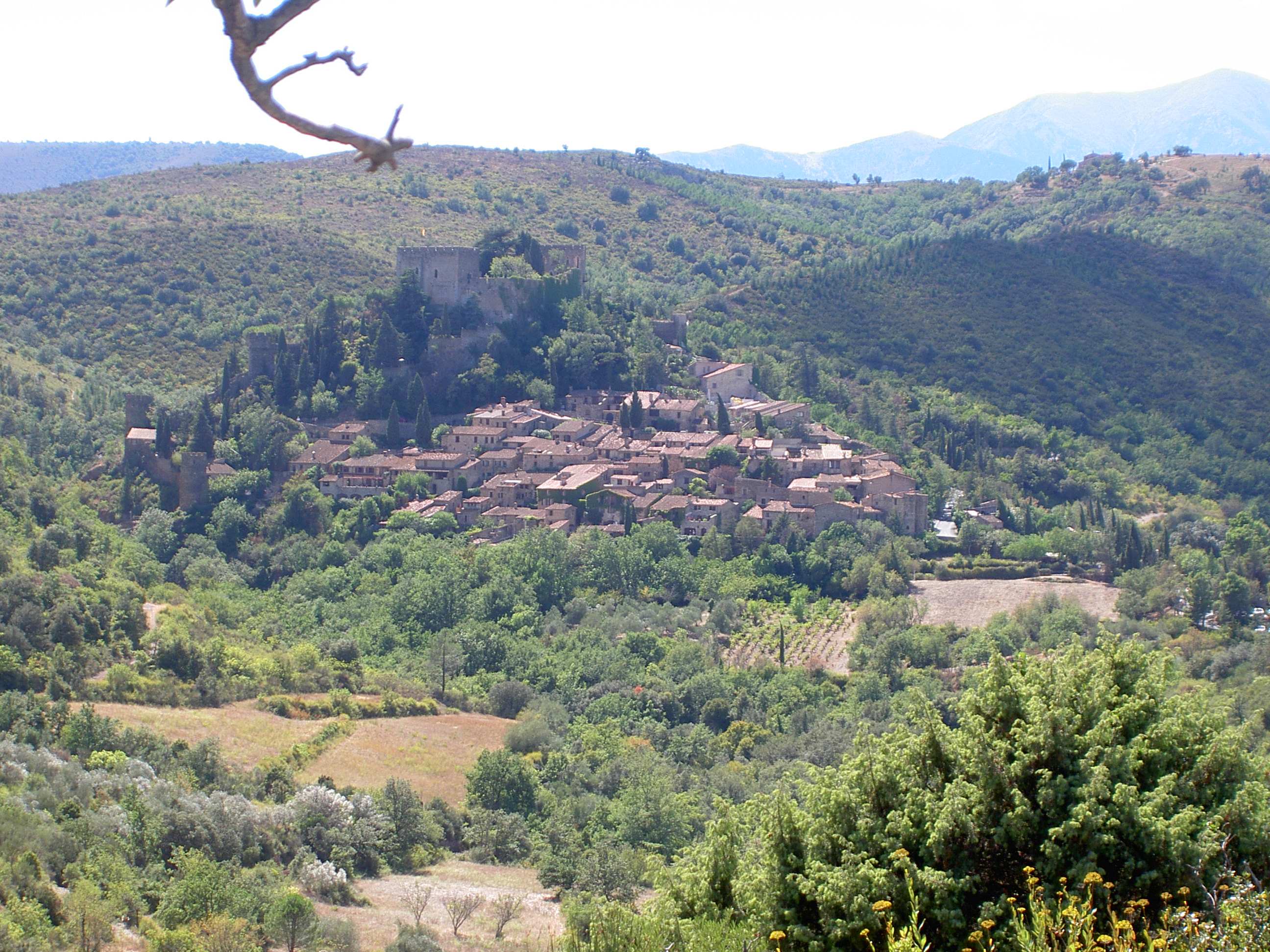
We also visited, by car, the nearby medieval village of Castelnou, some 30k from here. The castle, like that at Severac-le-Chateau where we stayed a couple of nights on our way here, is on the top of the hill, with the village clustered up against its ramparts. It is not as large as Severac, but it is more advanced in its recent restoration programme, and again rooms may be hired for functions. And unlike Severac, there has been no expansion or recent additions to the village—it is still just the medieval stone village, perfectly preserved.. It was built by a family opposed to the Kings of Majourque, and the two families fought many times over the centuries. In the end, the Majourquans triumphed, not because of winning the war, but because eventually the Castelnouvians simply died out through lack of breeding! The countryside around Castelnou is quite stunningly beautiful, but very harsh, rocky, and inhospitable.
Castelnou and surrounding landscape
The hills are covered with small coarse-looking bushes and a few pine trees of some sort. Quite why they used to fight over it is not clear to me at all, other than for the megalomanic desire to simply control more land, useless though it may be. But is does support the growth of good vineyards, and some of the local wines are very good indeed. In fact we bought a couple of bottles direct from the chateau vineyard. The lady insisted that they would keep for at least ten years, and did not seem to understand me when I said they would be lucky to last ten hours now that I have got them. There are also some very good cheeses available from this area, but thus far I have seen neither cow, nor goat, nor sheep, so quite where the milk comes from I don’t know.
Where we are is not far from the Alberes mountains, which themselves are foothills of the Pyrenees. They have an interesting, if somewhat negative, impact on the weather here, in that they produce a wind, known locally as the Tremontane, which, once it starts, blows non-stop for days. After the first few days of our stay here in perfect early autumn weather, the wind started and we are now in our fifth day of continuous gale-force NW wind. It is not cold, just very unpleasant! Local knowledge thinks it may blow itself out by tonight—we shall have to wait and see.
Well, that completes our first week here—a week and a half to go before we head north once more for Paris, and then to England again. So more blog in a week or so, I guess!
 Slingsby's Miscellany