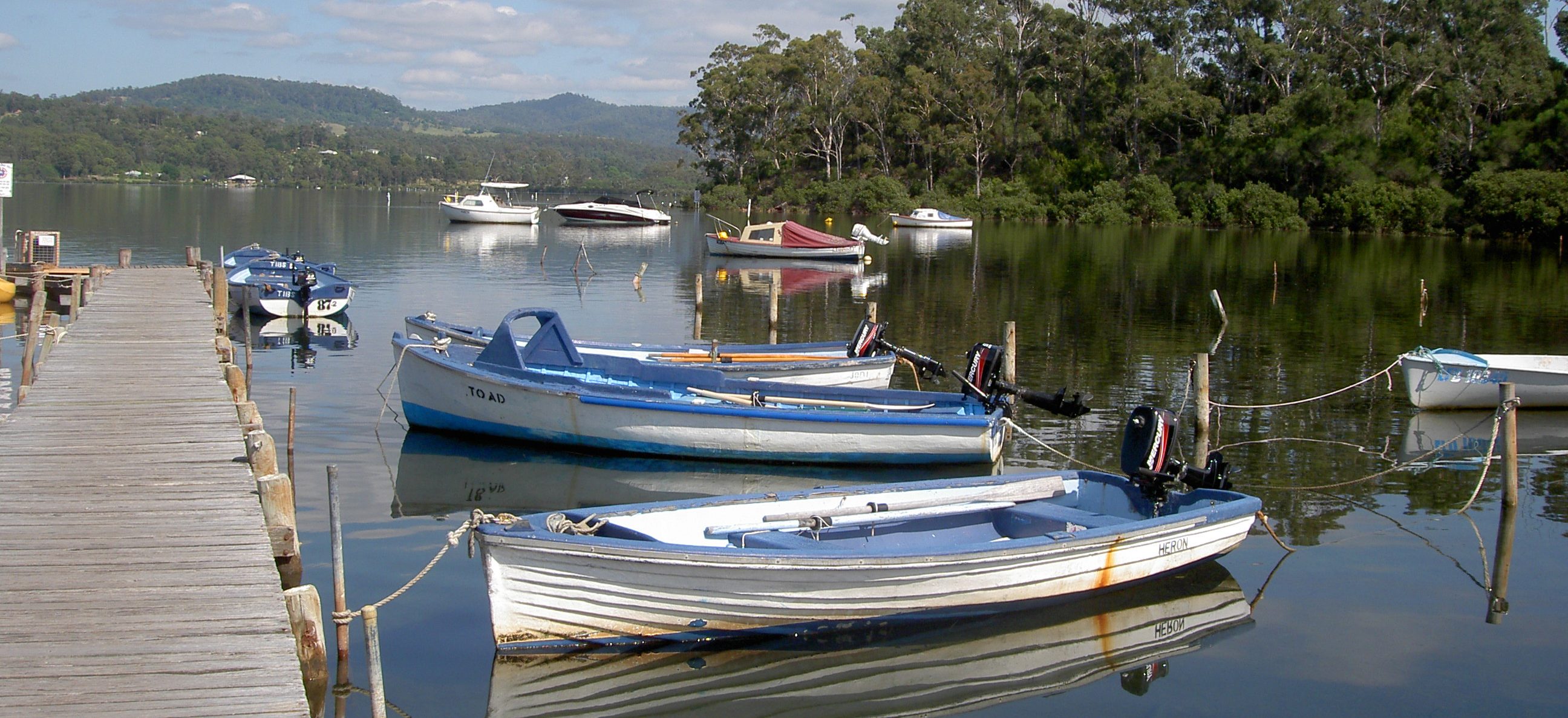
November 3 2016
November is traditionally the time when our group of friends that we refer to as The Campers take themselves away for a few days. In years gone by we all took tents or caravans, but as the ravages of time took their toll, not only has the group diminished in numbers, so the tents and caravans have given way to more solid accommodation. We now rent houses that can accommodate the 8 of us in comparative comfort. This year, our short break was supposed to start on Thursday November 3, but actually started a couple of days earlier, on Cup Day. Not that we are into horse racing, but an opportunity to share a BBQ and to watch the race that purportedly stops the nation in the company of Fellow Dickensians, was too good to pass up. And an invitation to attend an all-Beethoven piano recital at a house concert in Drouin (which is on the way to our final destination of Mallacoota,) on Wednesday morning gave an additional reason to start proceedings earlier.
The recital started with Sonata No. 13 in Eb major, and was followed by Sonata No. 14 in C# minor, commonly referred to as The Moonlight Sonata. The first movement of this very well-known sonata is usually played at a very slow tempo, but our pianist, Brian Chapman, believes it should be played somewhat faster. Beethoven’s original manuscript gave the tempo mark for the first movement as ₵ which is the allabreve sign, reducing the number of beats in the bar from four to two, whilst still maintaining the original pulse. The result is effectively a doubling of the tempo. You can find a more detailed (and accurate!) explanation at Brian’s website which is http://www.qedinteractive.com.au/LVB27-2.htm
Following the interval, Brian played Beethoven’s Sonata No 20 in G major, his so called Easy Sonata, then Sonata No 27 in E minor, and finally Sonata 23 in F minor, the Appassionata. Whilst the whole recital was wonderful, Brian’s playing of this monumental piece was outstanding, and left the audience absolutely spell-bound. I can honestly say I have never heard the Appassionata played better than on this occasion, and I doubt that I ever will!
After a very nice lunch, we bundled ourselves back into the car and headed for Lakes Entrance where we decided to break the journey to Mallacoota. Lakes Entrance has been the subject of a previous blog, so I shall say no more about it, but will go direct to Mallacoota.
We first visited this small coastal town, in the far eastern corner of Victoria some 40-odd years ago, and I don’t think we ever went back! It’s not that we didn’t like the place; rather it is because it is on a road to nowhere else. We have very often passed the end of the road to Mallacoota where it joins the Princes Highway at Genoa, on our way to and from Merimbula, but as it is some 40 km from there to Mallacoota, we have always said that ‘one day we shall take that road and visit the place again’—and that is what this trip was all about. Our accommodation had been booked well in advance, and we could not have chosen a better place. Located halfway up a gentle hill, it commanded stunning views of the extensive lake system formed from the Wallagaraugh River, as it meets the sea.
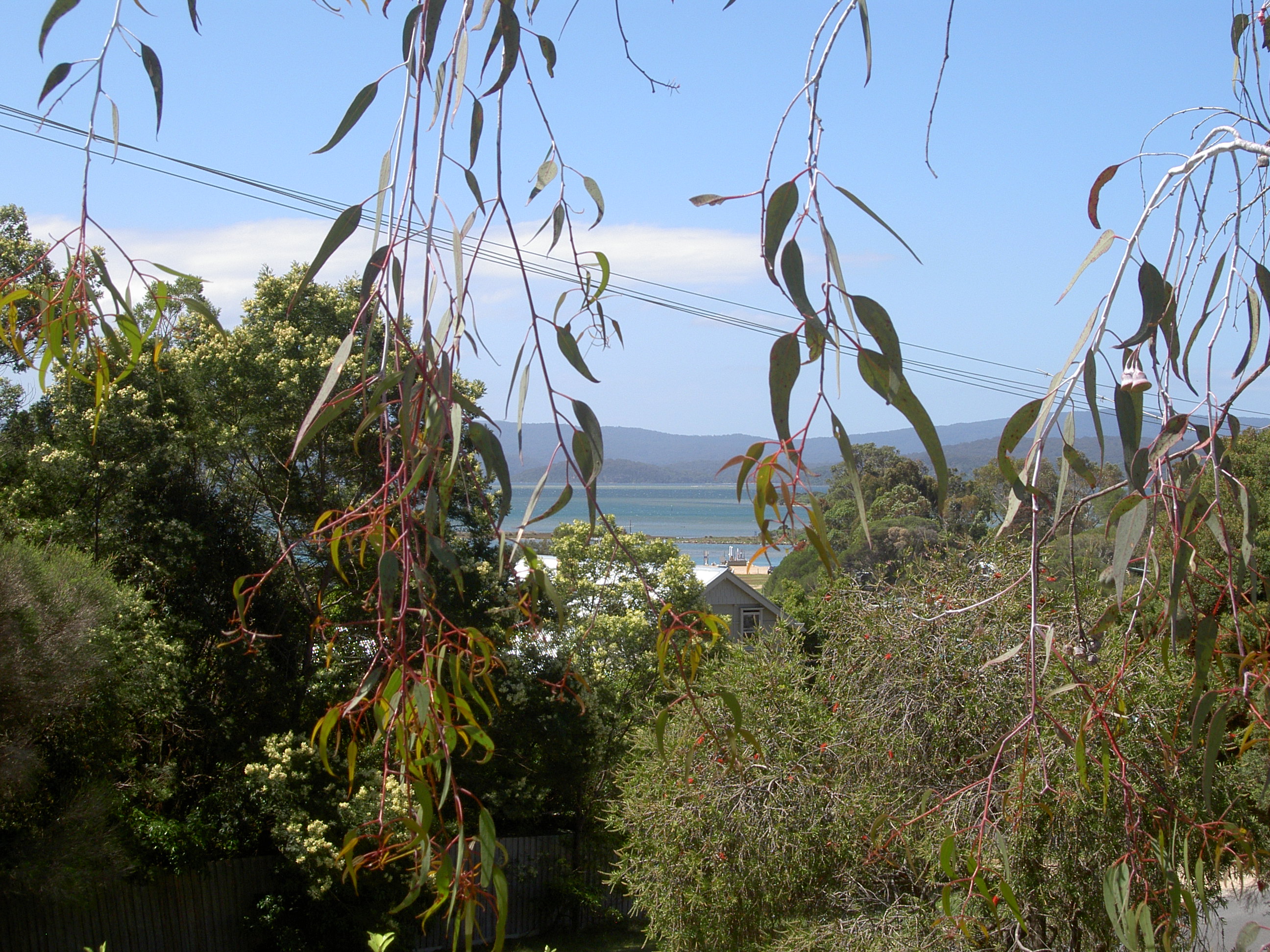
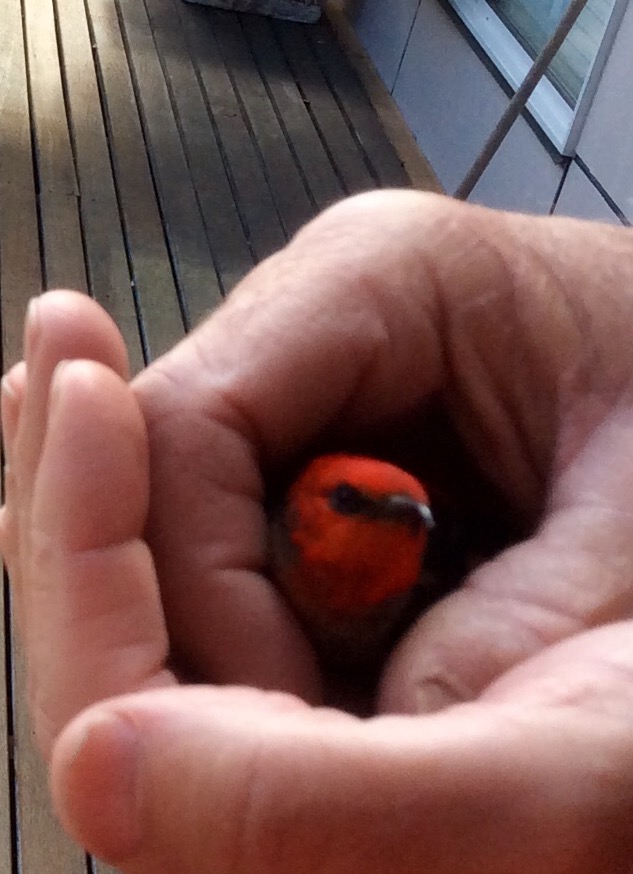
The house was beautifully furnished, had plenty of room for all of us, and had a very well-appointed open-plan kitchen. There were even two balloon whisks! There were koalas in the trees across the road, and an amazing number of birds in the native trees and bushes in the garden. We even saw scarlet honeyeaters, which none of us had seen before. In fact, one of these brilliantly coloured minute birds knocked himself out trying to fly through the double-glazed window, but we nursed him back to health, and he was soon restored sufficiently to fly away—and he continued to reappear in the callistemon tree at the end of our deck.
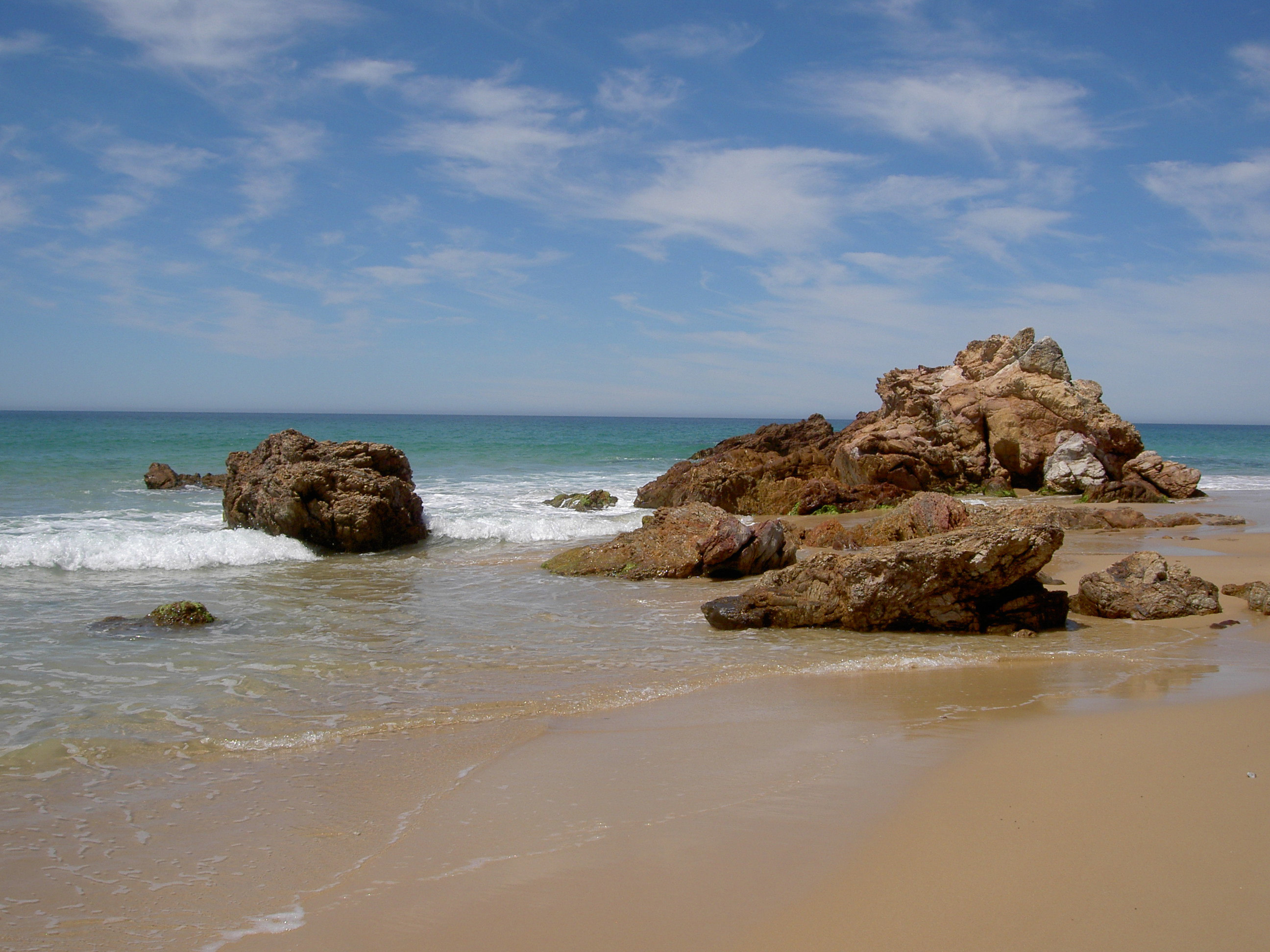
And despite being in such a lovely bushy setting, it was only an easy five minute stroll to the shops and cafés. In fact, it could not have been better. We spent a little time exploring the town, and the nearby beaches (which really are magnificent) and lakes, did a little fishing, quite a lot of walking, and a great deal of sitting around doing very little other than watching the birds, talking, reading, eating and drinking.
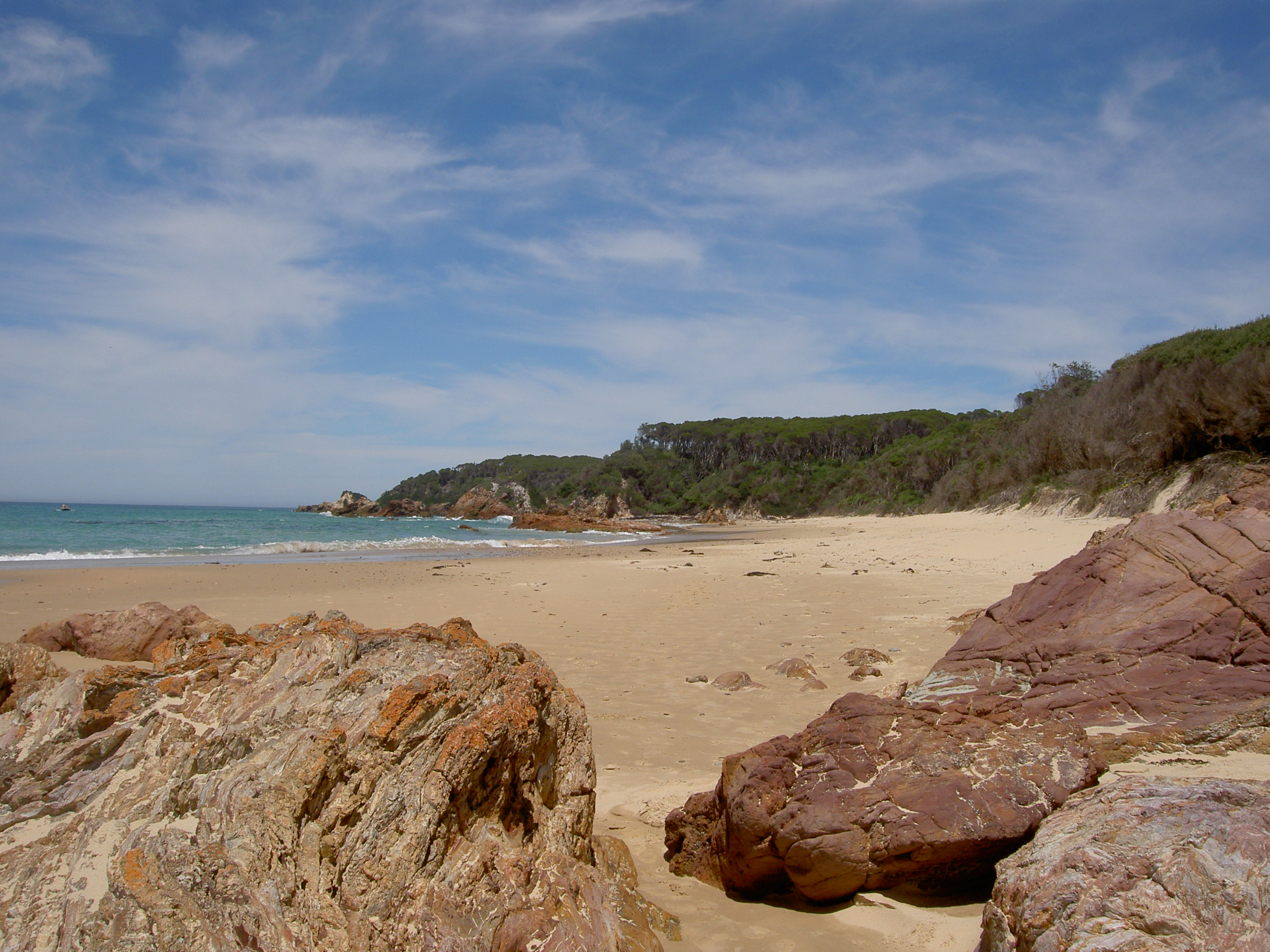
The town centre, comprising one road 200m or so long with shops on both sides and car parking in the middle, and the pub, was quite quiet, this still being outside the peak time of the summer holidays. When the main holiday period starts at the Christmas/New Year time, the population swells from the resident population of about 1000, to over 9,000, with most of the increase being campers and caravaners. In addition to the spectacular coastline with its Wilderness Coast walking track some 100 km long, and the extensive lake system, the town is pretty much surrounded by the 87,500 hectare Croajingolong National Park, which has been classified by UNESCO as a World Biosphere Reserve. It really is quite unspoiled, and certainly worth a visit.
Since time immemorial, the area had been inhabited by the Bidawal People, a tribe of East Gippsland, (who spoke a dialect of the language which was spoken by the Kurnai tribes to the west) with European settlers arriving in about 1830. Henry Lawson visited Mallacoota in 1910, and the first four stanzas of a poem (Mallacoota Bar, one of two he wrote about the area), give a good impression of what it was like at the turn of the century:-.
Curve of beaches like a horse-shoe, with a glimpse of grazing stock,
To the left the Gabo Lighthouse, to the right the Bastion Rock;
Upper Lake where no one dwelleth — scenery like Italy,
Lower Lake of seven islets and six houses near the sea;
‘Twixt the lake and sea a sandbank, where the shifting channels are,
And a break where white-capped rollers bow to Mallacoota Bar.
Gabo, of the reddist granite, cut off from the mainland now —
“Gabo”, nearest that the black tongue ever could get round “Cape Howe”;
Gabo Island, name suggestive of a wild cape far away,
And a morning gale by sunlight, or a sea and sky of grey;
Gabo, where cold chiselled letters on the obelisk record
How the Monumental City sank with forty souls on board.
To the west the lonely forests, on the levels dense and dark
Native apple tree and bloodwood, wattle, box, and stringybark;
Land of tree-marked tracks and hunters — to their glory or their shame —
For a law makes Mallacoota sanctuary for native game;
To the east the rugged Howe Range, running down without a scar
To the mighty moving sandhills — close to Mallacoota Bar.
And the folk are like their fathers — bushmen-sailors, fishermen —
And they live on fish and tan-bark, with a tourist now and then;
And of hunting? Well, I know not. And what matter if we know
That they did a bit o’ smugglin’ or o’ wreckin’ years ago?
For I love these kindly people, and ’twill give my heart a jar
When I see the figures fading on the sandbank by the bar.
It is interesting to note the reference to “six houses by the sea” and “a tourist now and then”, given the number of tourists that now flock to the area!
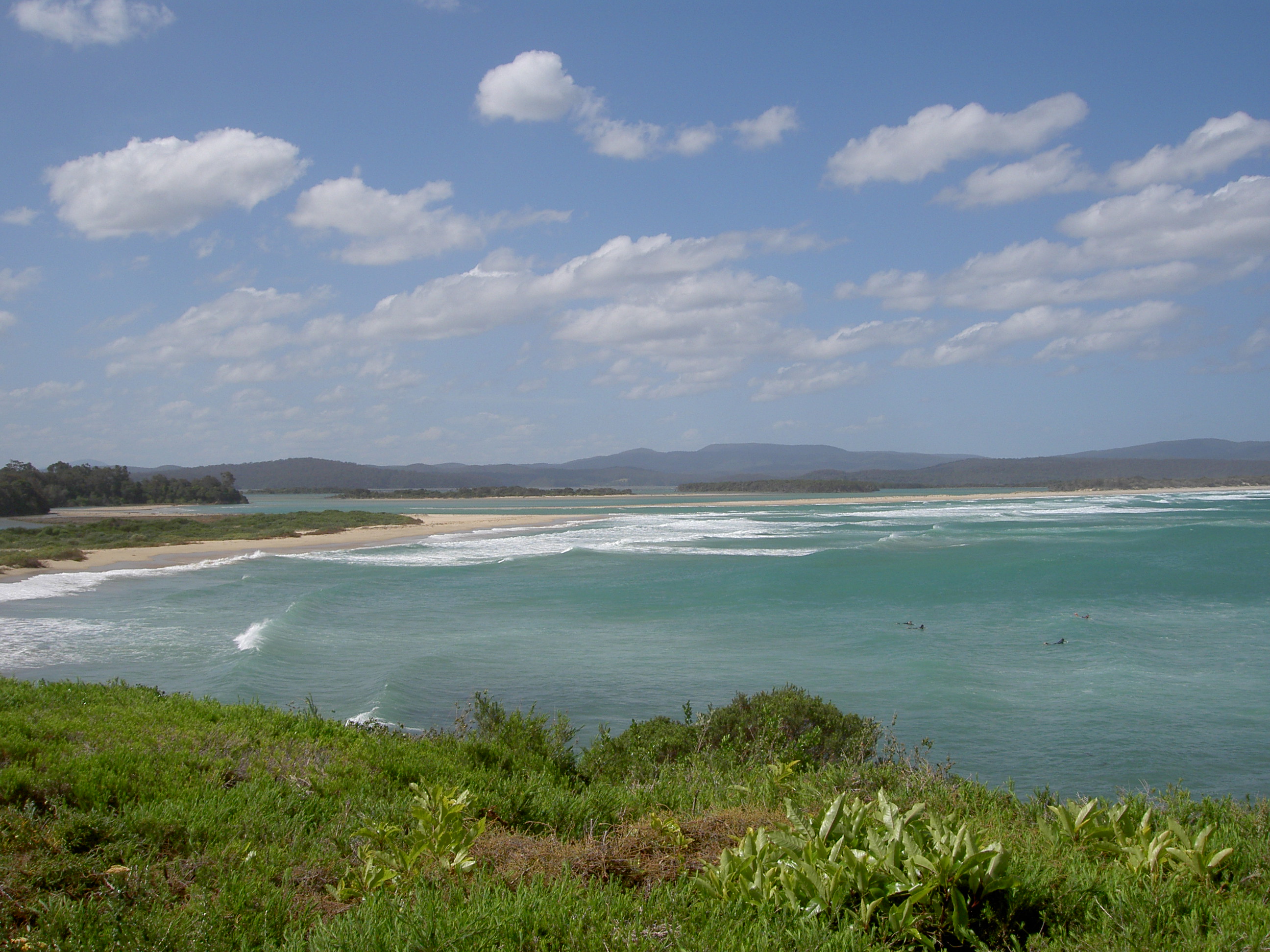
A small timber lighthouse was installed on the nearby Gabo Island in 1854, (following the wrecking of the SS Monumental City) and a permanent stone lighthouse erected in 1862. By the 1880s, fishing was well established. Coastal shipping was an important means of transport for the entire coast, but it was not without its dangers, as the Mallacoota Bar has always been a treacherous stretch of water, and many small coastal vessels came to grief trying to cross it to enter the lake system. But the loss of the Monumental City in 1853 was due to human error, and she was not actually attempting to cross the Bar.
The Monumental City was an American-built wooden hulled steamer, and was the first steam ship to cross the Pacific. She was brought to Australia as a coastal trader and passenger ship, and had made one trip from Sidney to Melbourne. On her return trip, she came too close to the coast, and foundered on the small uninhabited and uncharted Tallaberga Island just off the coast between Gabo Island and the Mallacoota Bar. For reasons unknown, the captain did not order the life boats to be deployed, rather he ordered one boat to carry a rope to the mainland, and after a few unsuccessful attempts, the rope was in place. However, many drowned trying to haul themselves along the rope, and many more were simply washed off the ship and drowned. In total, 33 (some documents say 37) of the 45 crew and 28 passengers died, the majority being passengers. There is now a monument to those who died located on the cliff at the ocean end of the camping and caravan park overlooking the bar.
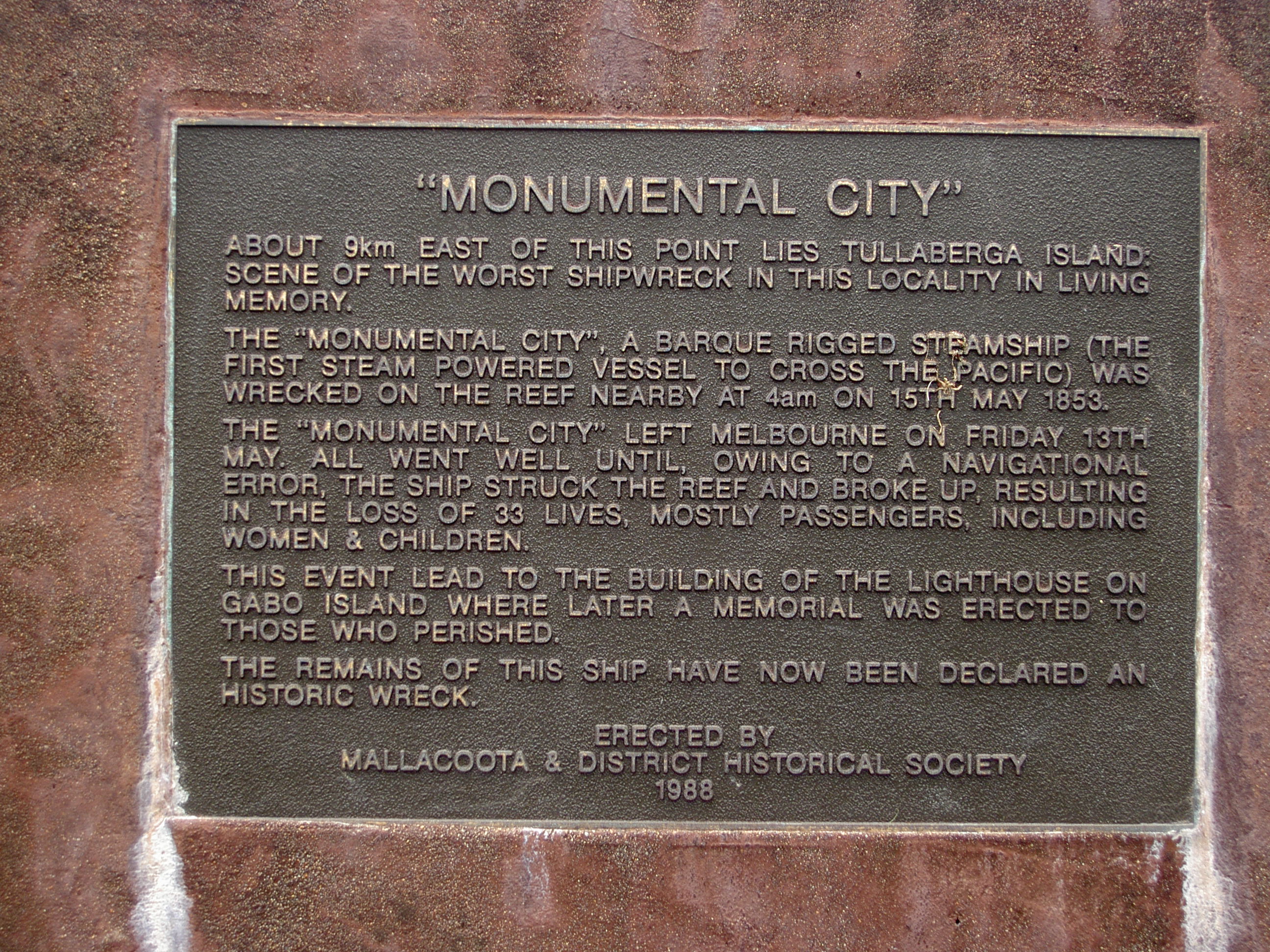
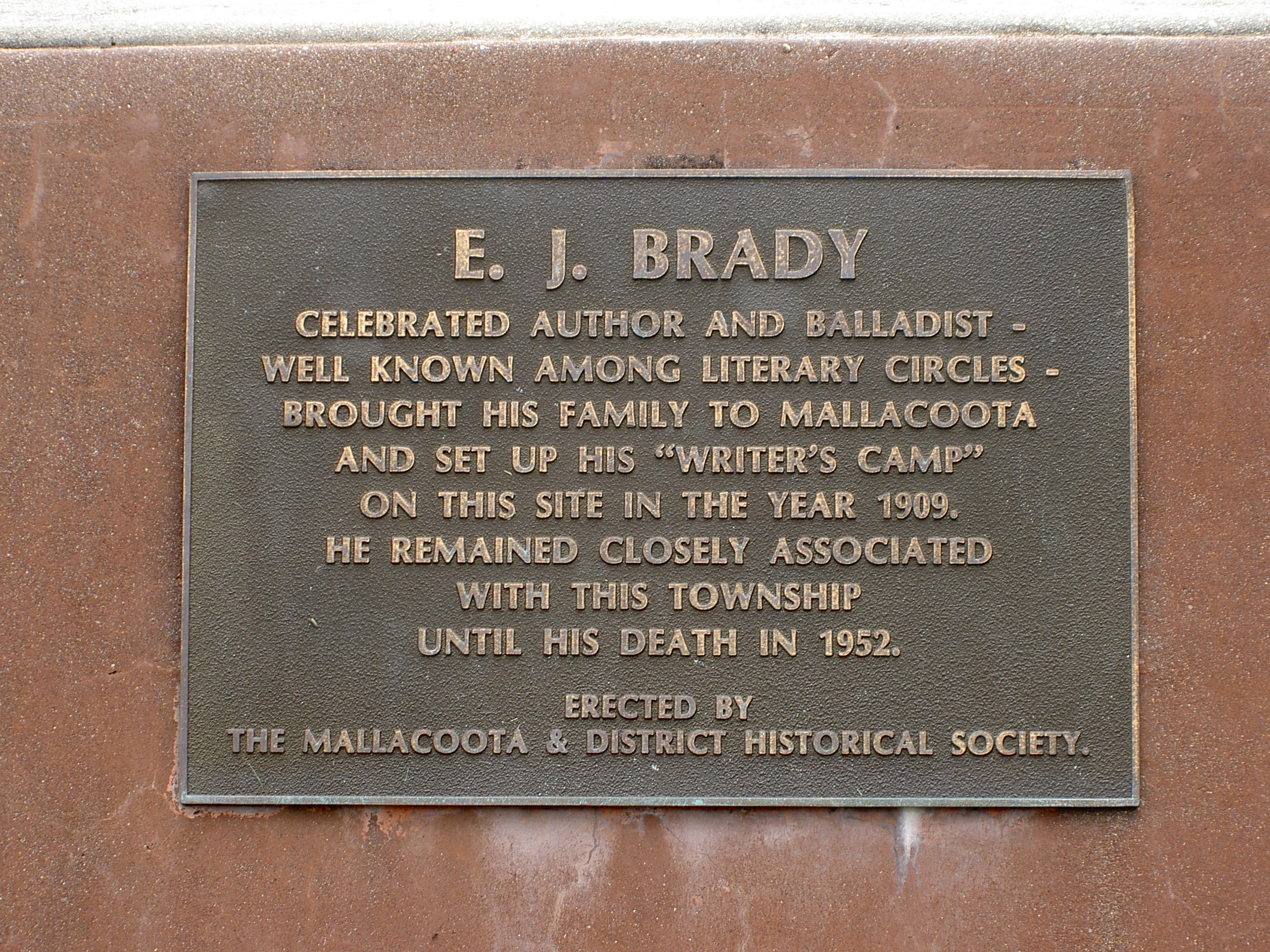
On the inland side of that same monument is a plaque commemorating the establishment in 1909, of a writers group, founded by Australian writer E J Brady, who was a friend of Henry Lawson. By 1910, after spending time in goal for non-payment of the maintenance money to his wife Bertha, and several stints in rehabilitation trying to dry himself out, Lawson’s creativity was deserting him, and several of his friends in Sydney, including Tom Mutch, the NSW Minister for Education (who had set up a committee to help Lawson), sent him on the trip to visit Brady at Mallacoota. The visit did Lawson a lot of good, and revitalised the man and his writing. Returning to Sydney, he continued with some good writing, and the start of the Great War restored his youthful zeal for a cause. It has been said that the visit to Brady probably saved Lawson’s life, actual and literary, getting him back on an even keel for a while. Brady continued to live in Mallacoota until his death (at Pambula) in 1952, aged 83.
Apart from the obvious tourist activities being a major employer in the area, the next most significant employer in Mallacoota is the abalone industry. Wild abalone are harvested by about 26 licensed divers and processed in the local factory, with most of the product being exported. Personally I have never tried abalone, but everything I hear about it as a ‘delicacy’ rather puts me off it!
There is also a fledgling abalone pearl industry, but unfortunately, Gerry Menke and his wife, who started the venture some six years ago, were among the victims of the Malaysia Airlines Flight MH17, brought down by a missile over Ukraine in July 2014. The ‘Blue Pearl’ abalone industry in Akaroa, New Zealand, is world famous, and one hopes that this component of the abalone industry of Mallacoota can recover from its terrible loss.
For golfers, there is a very nice Golf and Country Club at Mallacoota, with generously wide fairways, and perhaps more kangaroos than are really necessary. Unfortunately the only day we had available to play, the course was closed for some major competition, so I can’t comment on the condition of the greens. But it all looked rather inviting.
Mallacoota is definitely a place to which we would return, but certainly not during the peak tourist season!
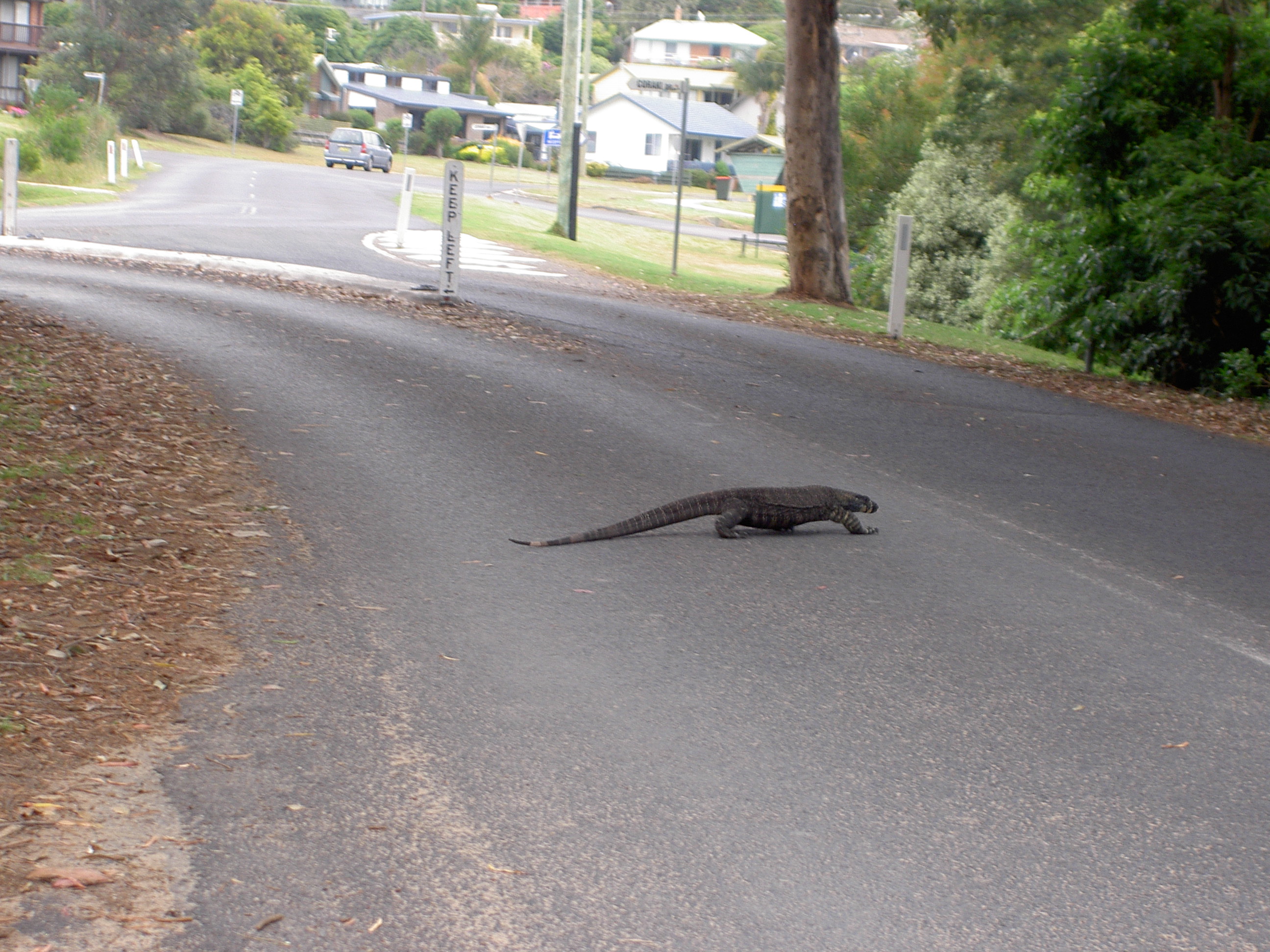
At the end of our all too brief stay at Mallacoota, we moved on to spend a few days at Merimbula. As that has been the subject of several previous blogs, all I will say about this trip is that once again Ann saw whales off Haycock Rock, and that once again I failed to catch any fish! But we did see a splendid goanna strolling across the road at Pambula Beach.
 Slingsby's Miscellany
Thank you again for sharing your holiday with us mere mortals who could only manage Paradise Beach ,a superb place ,but oh the mosquitoes