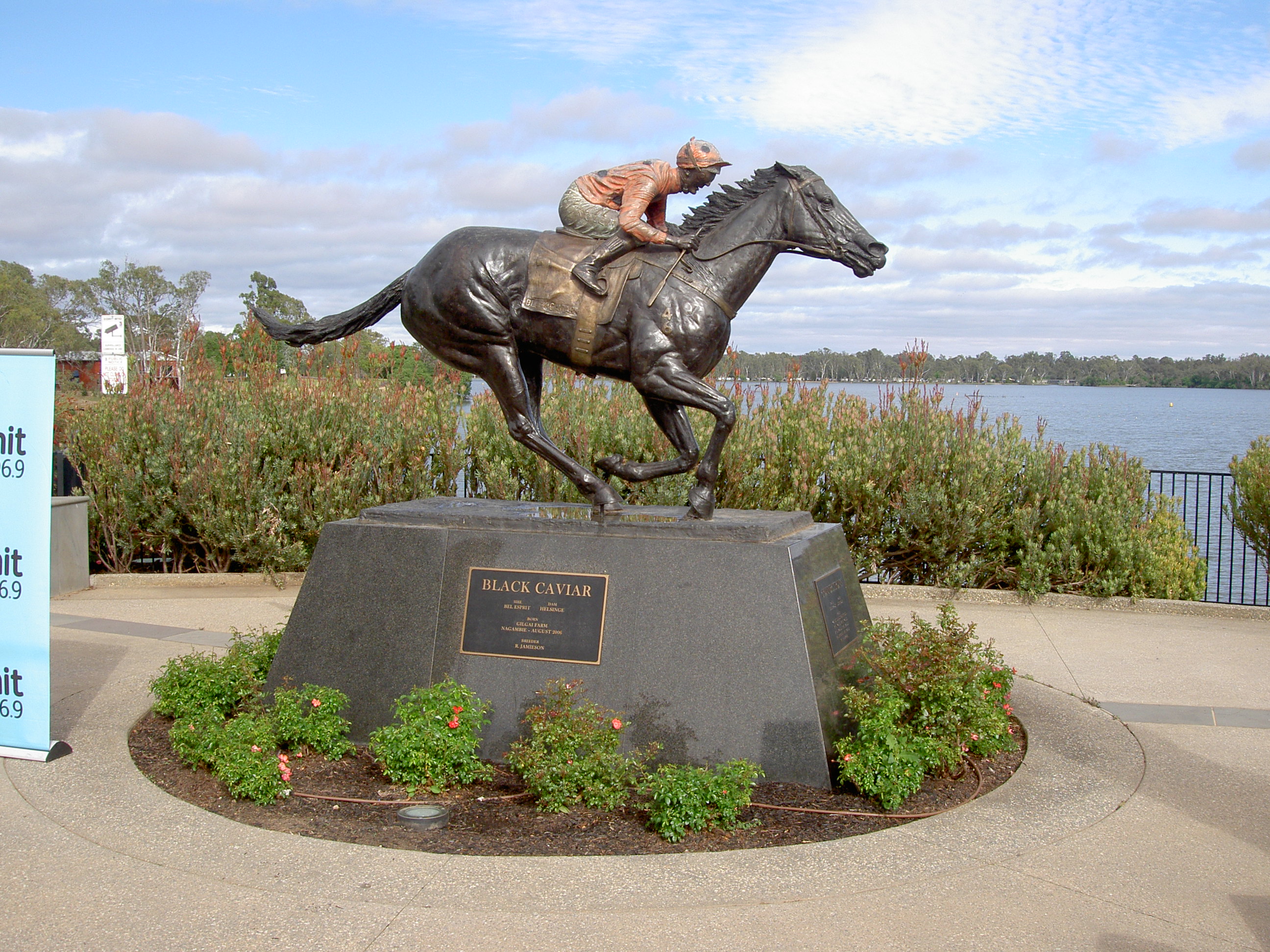
Every town needs its hero, something to look up to, to make the town different from other towns. For the 1,860 or so people who live in Nagambie, their hero is the race horse Black Caviar. Born in 2006 at a stud somewhere around the Nagambie district, Black Caviar was undefeated in 25 races, including 15 Group One wins. Her honours included being named WTRR World Champion Sprinter in 2010, 2011, 2012 and 2013, and she earned her connections nearly $8 million before her retirement on April 17, 2013. Black Caviar is now honoured with a life-sized statue erected, just 6 months after her retirement, on the bank of Lake Nagambie near the centre of the town.
The Nagambie district was first settled in the early 1830s, as it provided a suitable crossing point on the Goulburn River. Among the first buildings were of course a public house, a church, and a post office, all built in 1837. The church was nicely positioned near the bank of the Goulburn, and remained in use until June 2003, when a heavily loaded truck veered off the road and demolished it; fortunately, being a Monday, there was no-one in the church, and no-one was injured. There is a memorial plaque 30 metres to the left of the spot where the church once stood.
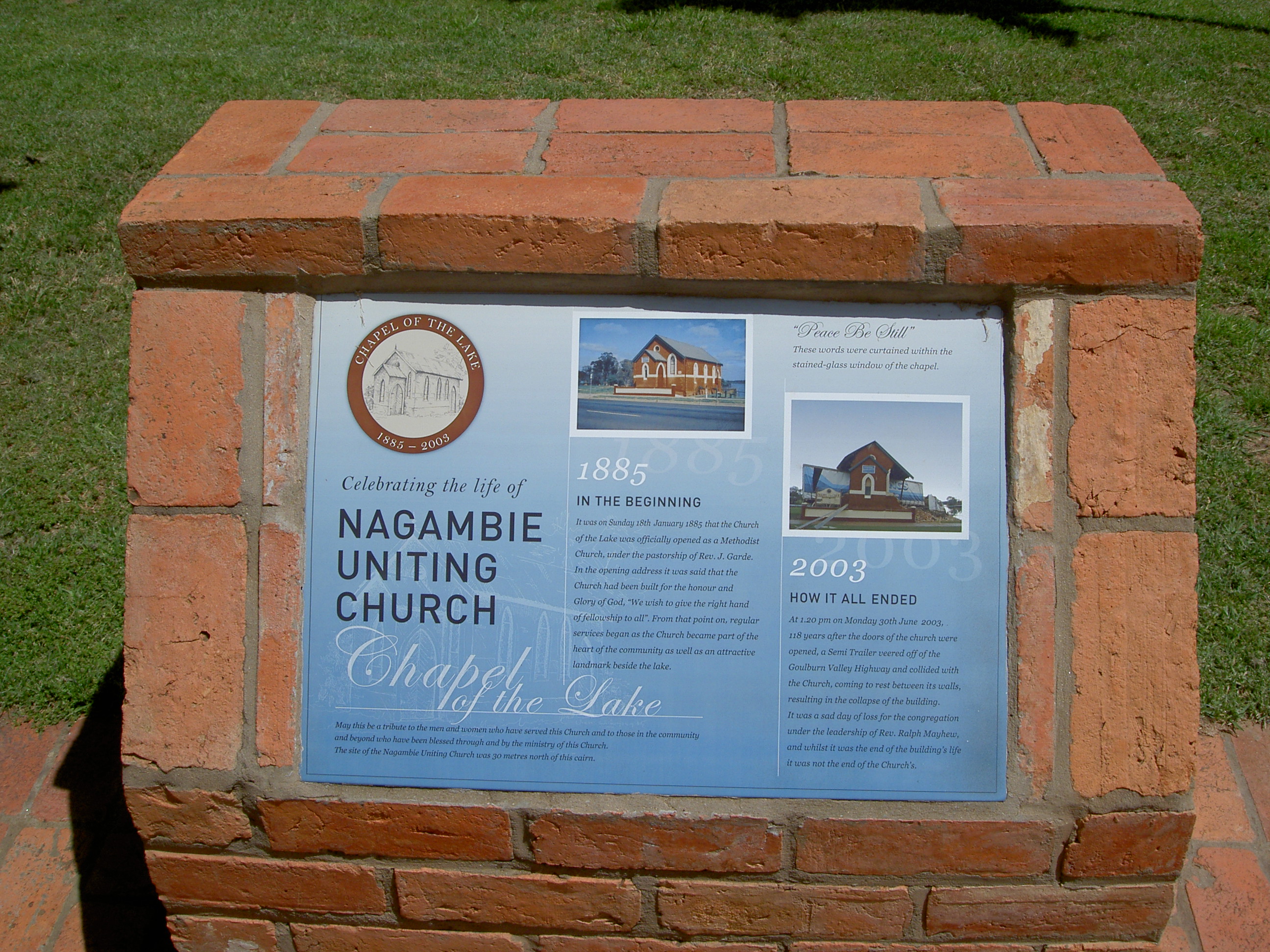
The Black Caviar statue now holds pride of place on the very spot once occupied by the church, 30 metres to the right of this monument, giving an indication of the God-like status that the horse holds in the town. Apparently breeding thoroughbred horses is still an important part of the local economy, but the only equine flesh we saw comprised an aging donkey and a couple of ponies with a physique more Thelwellian than that of a champion thoroughbred racehorse.
As well as horse breeding, major agricultural activities include vineyards and grain crops. There was an old saying, ‘Never mix the grape and the grain’, but in the Nagambie district, both products are produced and seem to co-exist quite happily. There are a couple of old, very well established wineries, Chateau Tahbilk, and Mitchelton. Both are open to the public, and both are important parts of the tourist industry with their wine sales, tours and restaurants. And of course they are major employers of both permanent and casual seasonal staff. In addition there are several other vineyards which would also be worth visiting.
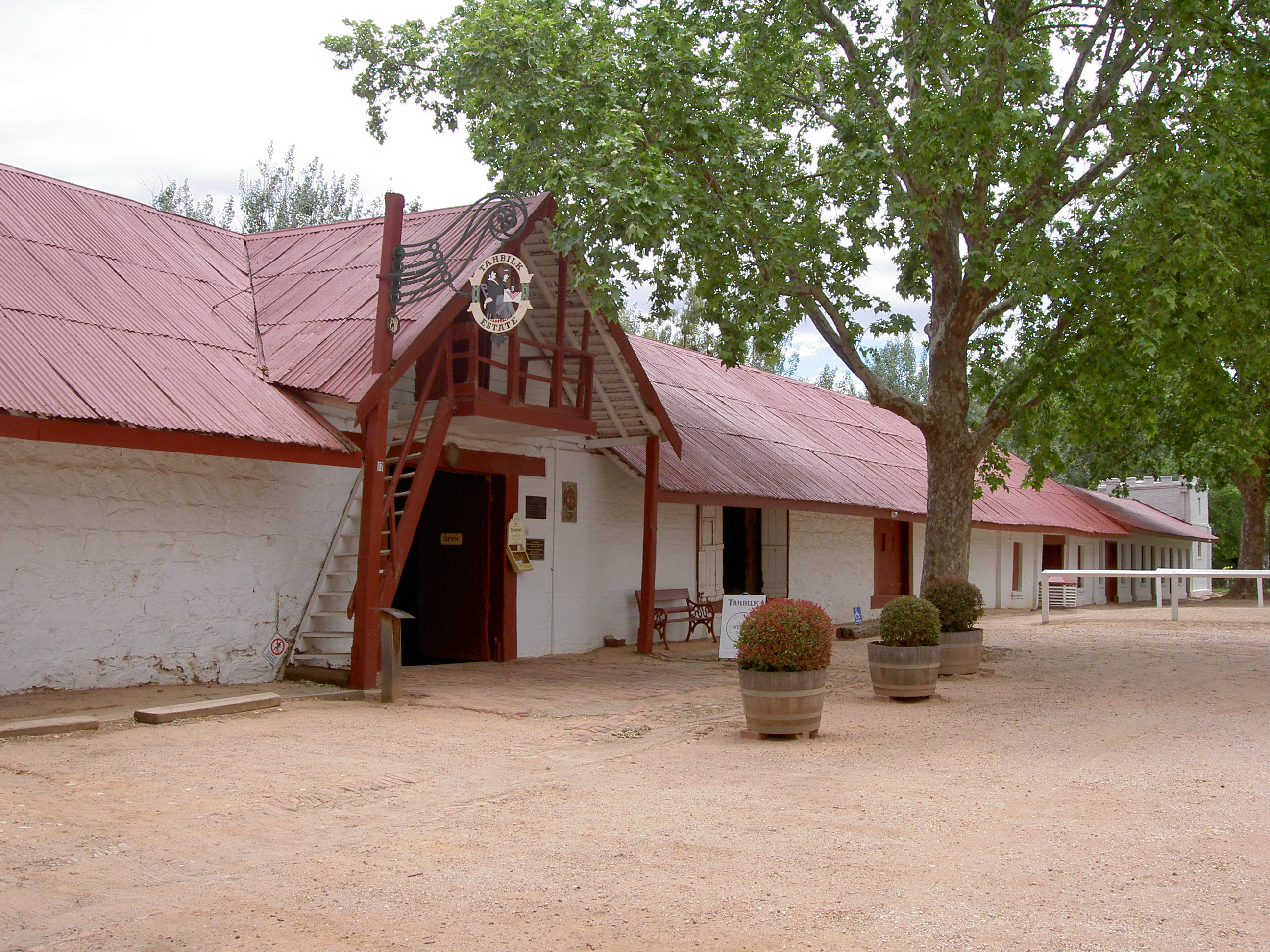
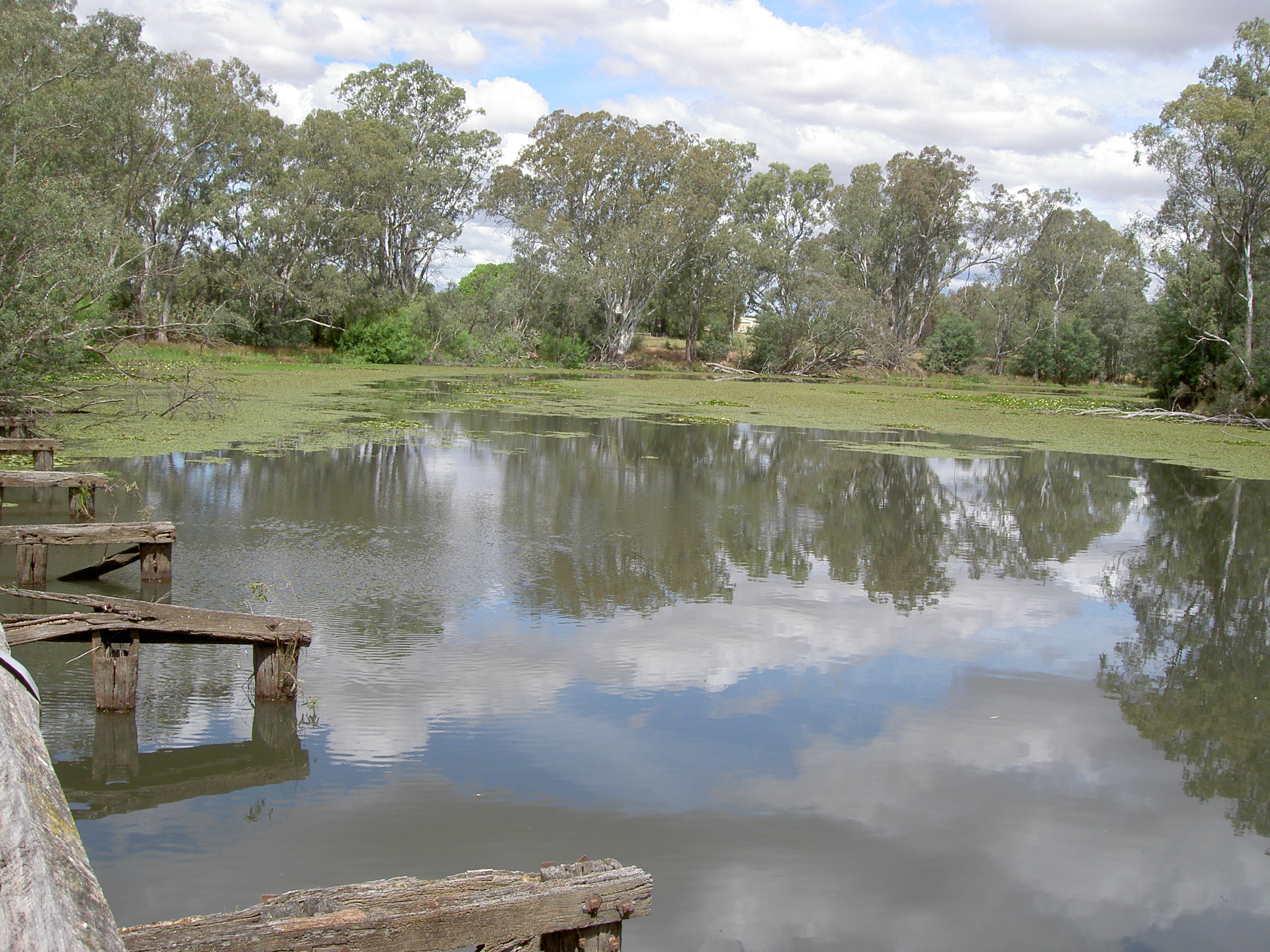
Having a limited time available to us, we managed to visit only one of the wineries, and chose Tahbilk as it was marginally closer. Established in 1860, it was purchased by Reginald Purbrick in 1925, and is still family-owned. Since buying the vineyards, five generations of Purbricks have been involved, with the latest three generations still very active. The original buildings, including extensive underground cellars, are still in use, and are classified by the National Trust. The grounds are very extensive, and include some large wetland reserves important for the local native flora and fauna. Whilst we were at this billabong we met some wild-life officers who had just installed several cameras as part of the survey of the populations of endangered species.
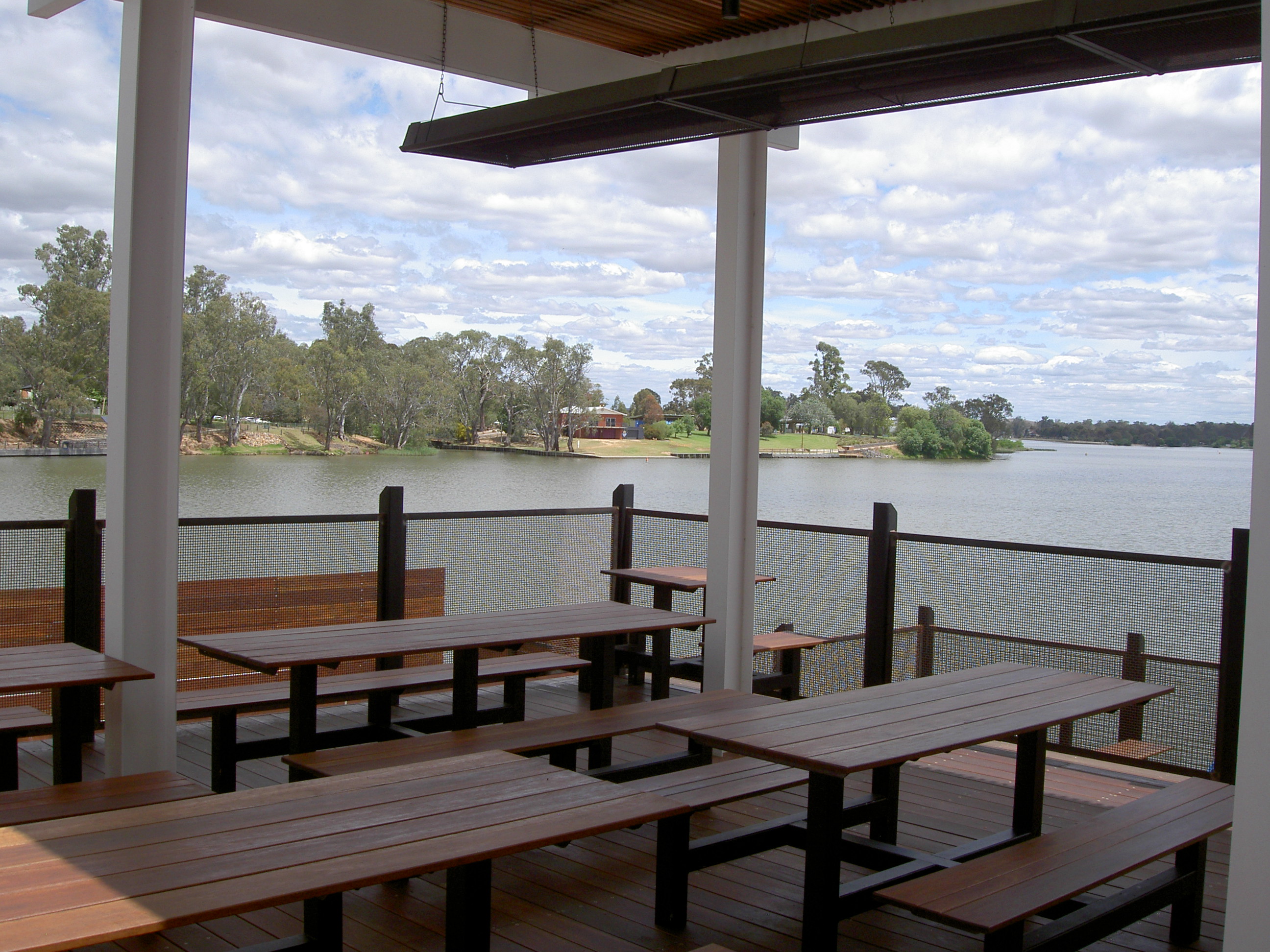
In addition to all the wineries, beer drinkers are also catered for by a new brewery recently opened in the centre of the town. Built adjacent to the site of the original 1870 Police Court and camp, it not only makes a very nice beer, it also has a nice deck, which is an extension of the restaurant overlooking the lake, where one may sit and taste the fruits of the brewer’s labours.
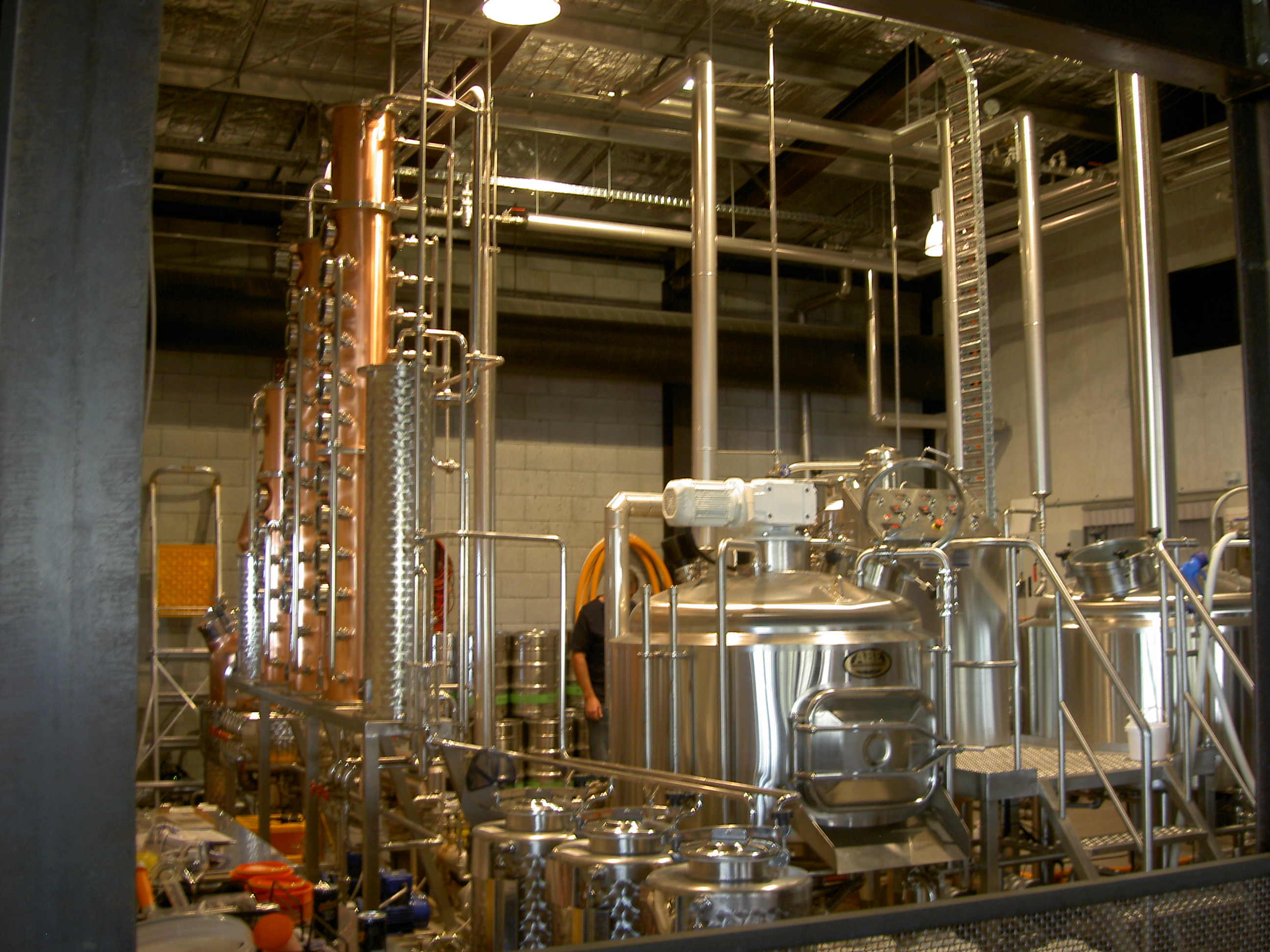
We understand that the brewery also includes a distillery, and is planning to produce a gin in the near future.
Lake Nagambie is the result of damming the Goulburn River in the 1880s. Just one dam wall across the Goulburn created a number of lakes and connecting waterways, which look, on the map, like the entrails of an eviscerated mythical monster.
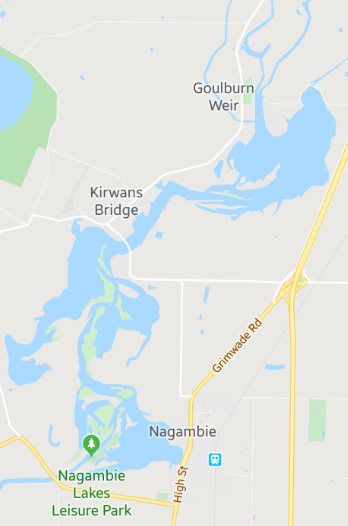
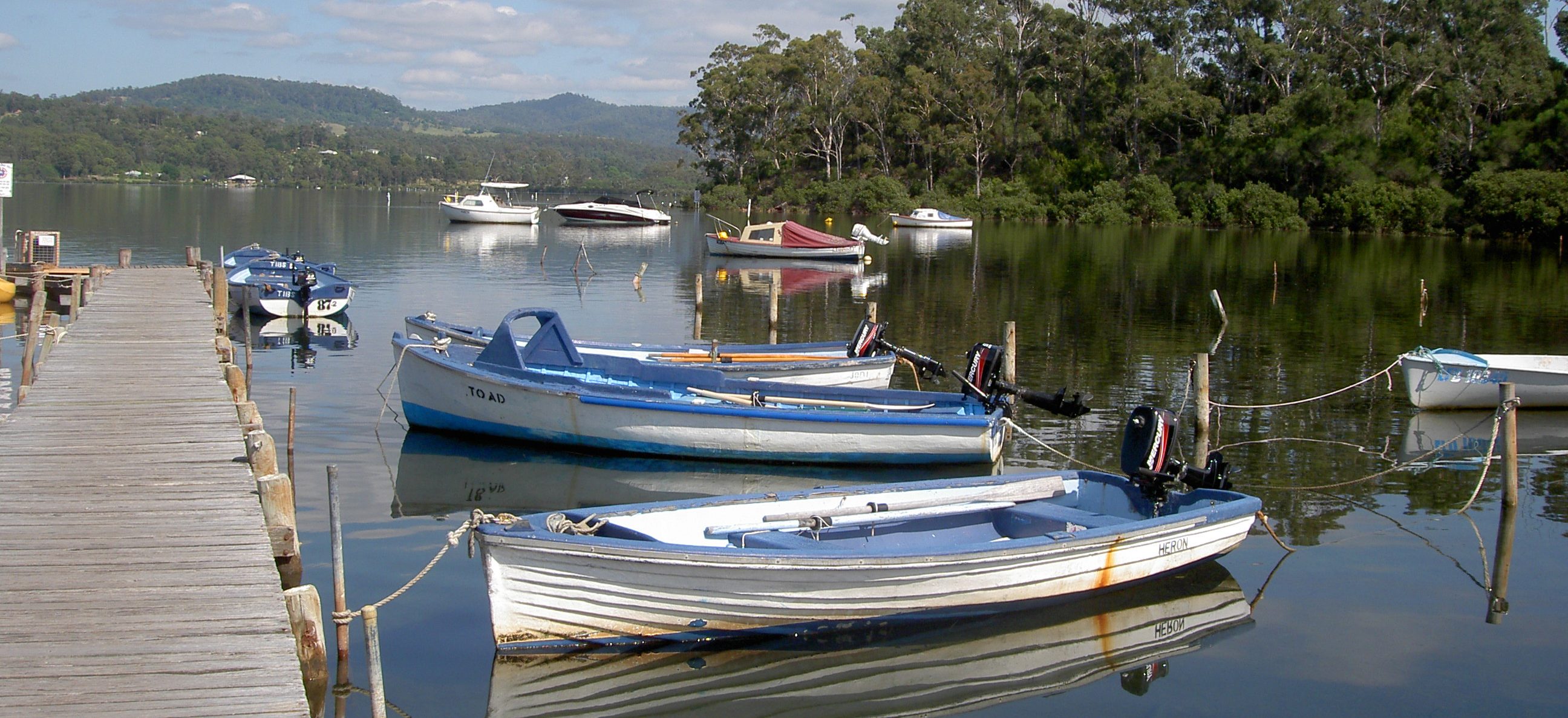
These lakes and waterways have become a boatie’s paradise, and in addition to the primary reason for damming the Goulburn, which of course was irrigation, they are a huge part of the tourist industry. Water activities include an eight-lane two kilometre stretch exclusively for rowing, and a large area exclusively for power boats and water skiing; and of course, fishing. Speed limits on the water appear to be enforced, and even though we are not interested in power boats and jet skis, we have to admit they were not too intrusive. We were staying in a cabin at the Nagambie Lakes Leisure Park, which park, despite being full almost to capacity, still provided a very peaceful and tranquil place to stay for a few days.
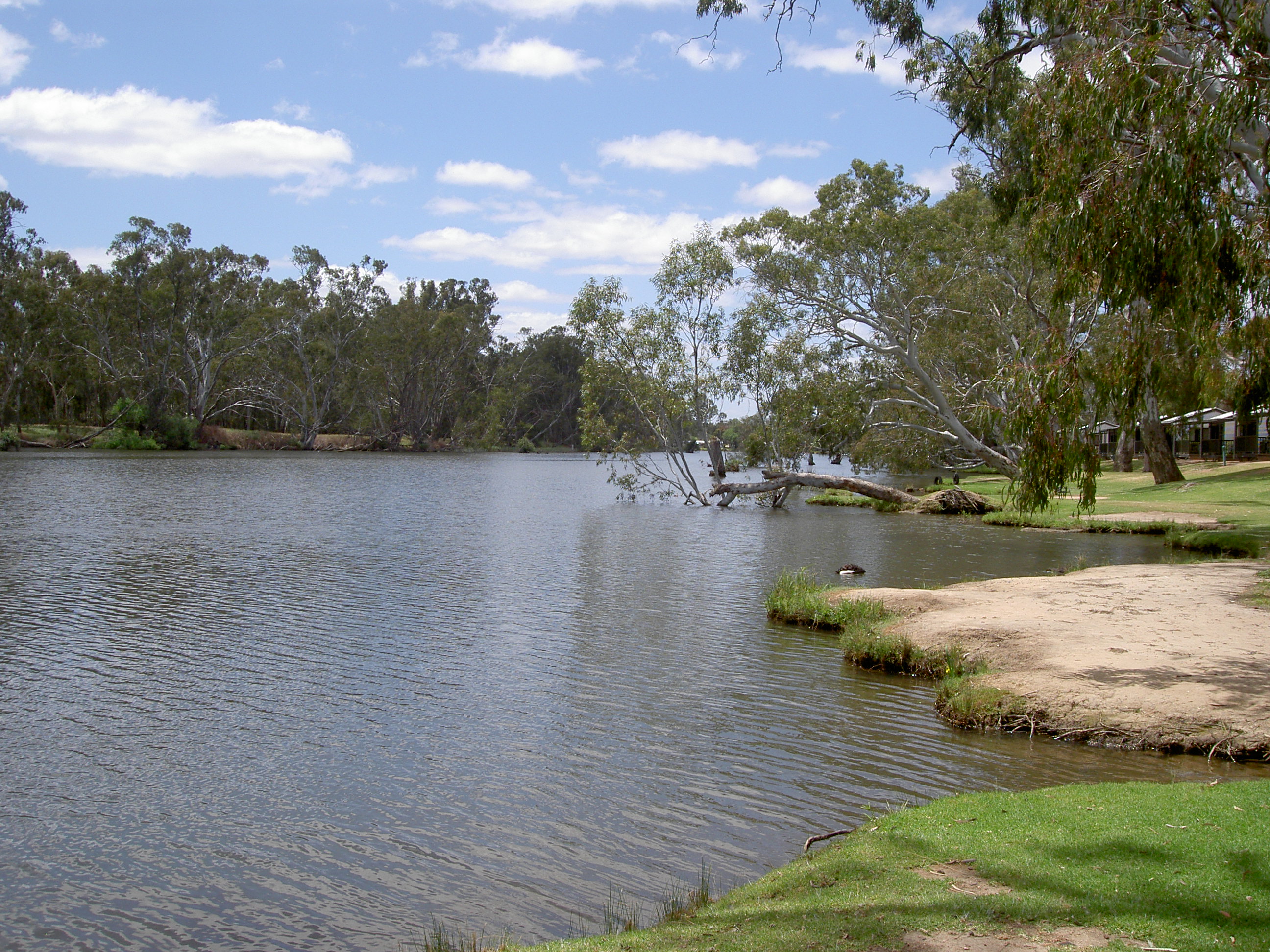
The town itself is quite small and compact, and sits right on the bank of the lake. With a resident population of some 1,860 people, it has one main street with shops, three pubs, a motel or two, a post office, several cafés, a butcher, a newsagent, and other miscellaneous commercial properties spread along it. There is a Mechanics Institute dating from 1873, a Historical Society dating from 1871, and a large modern supermarket. The main street, which has a nice tree-lined median strip, was the original route to Shepparton, but the town now has a major freeway by-pass, so there is little heavy traffic lumbering through; and car parking is not a problem.
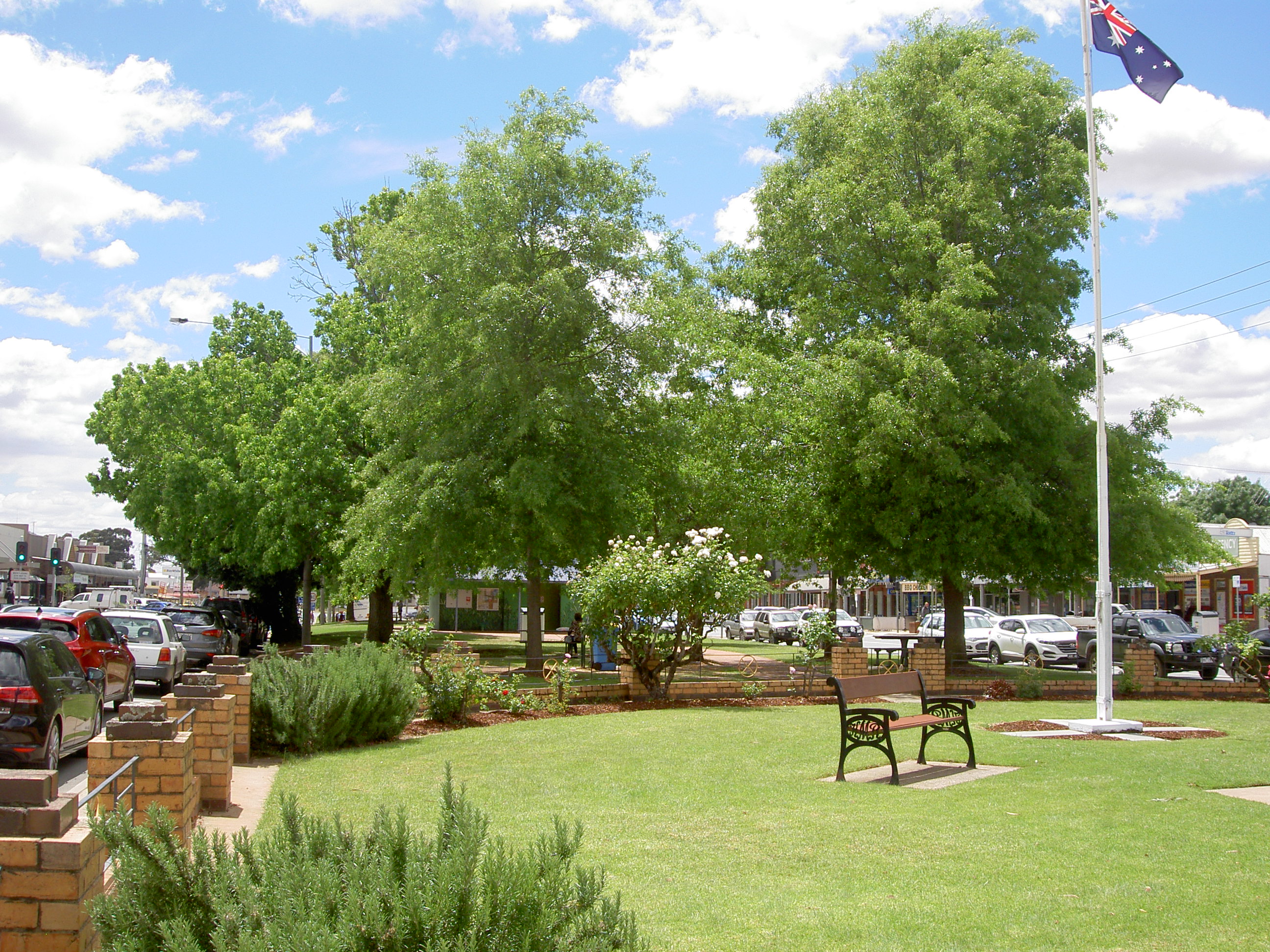
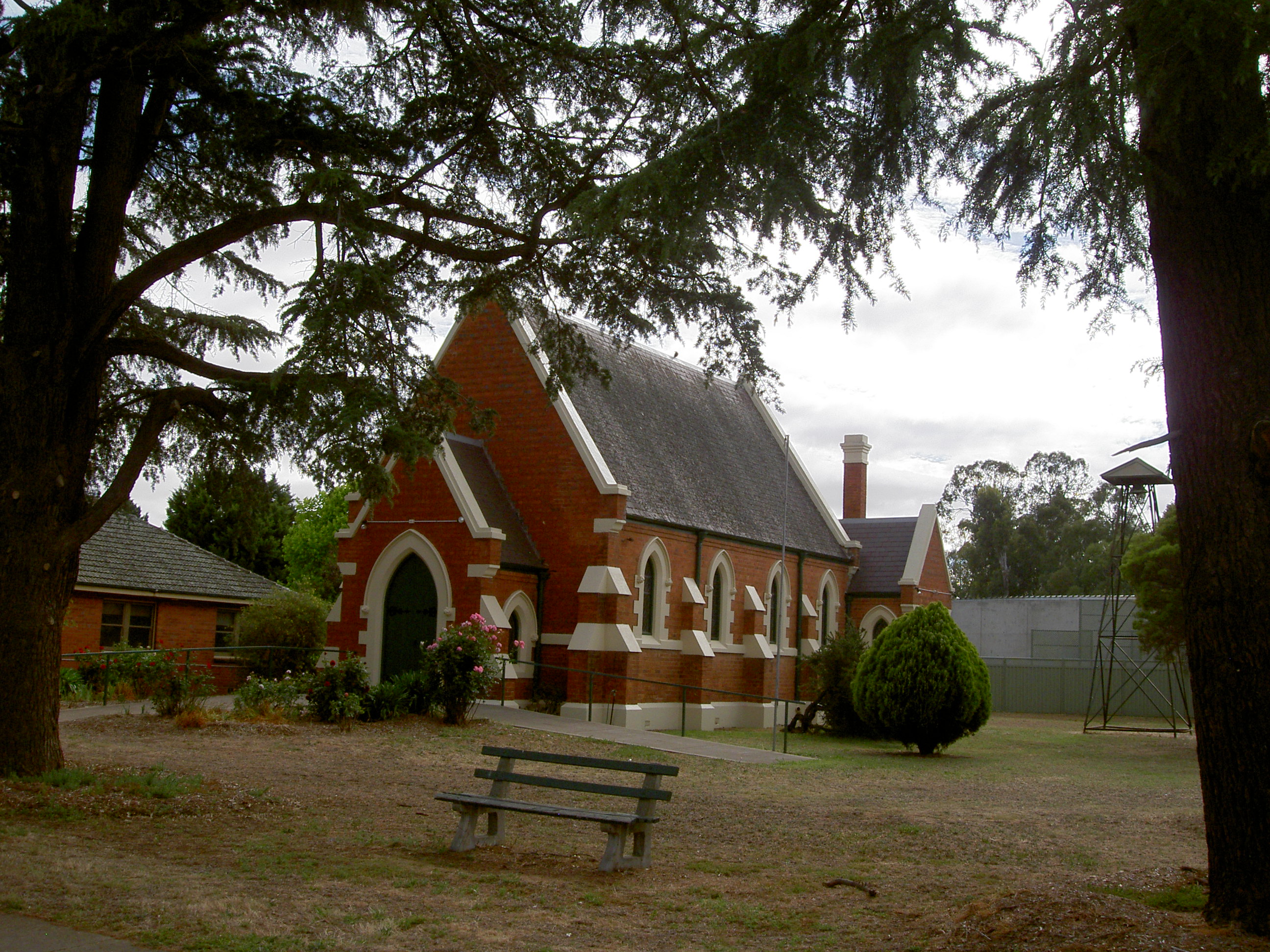
When the town was initially bypassed, it fell into a decline for a few years, but is now reviving itself as a major tourist area, and its small size makes it a delightful place to visit. There are three churches remaining, all dating from the late 19th century, and all built of red bricks, and all much the same size—small.
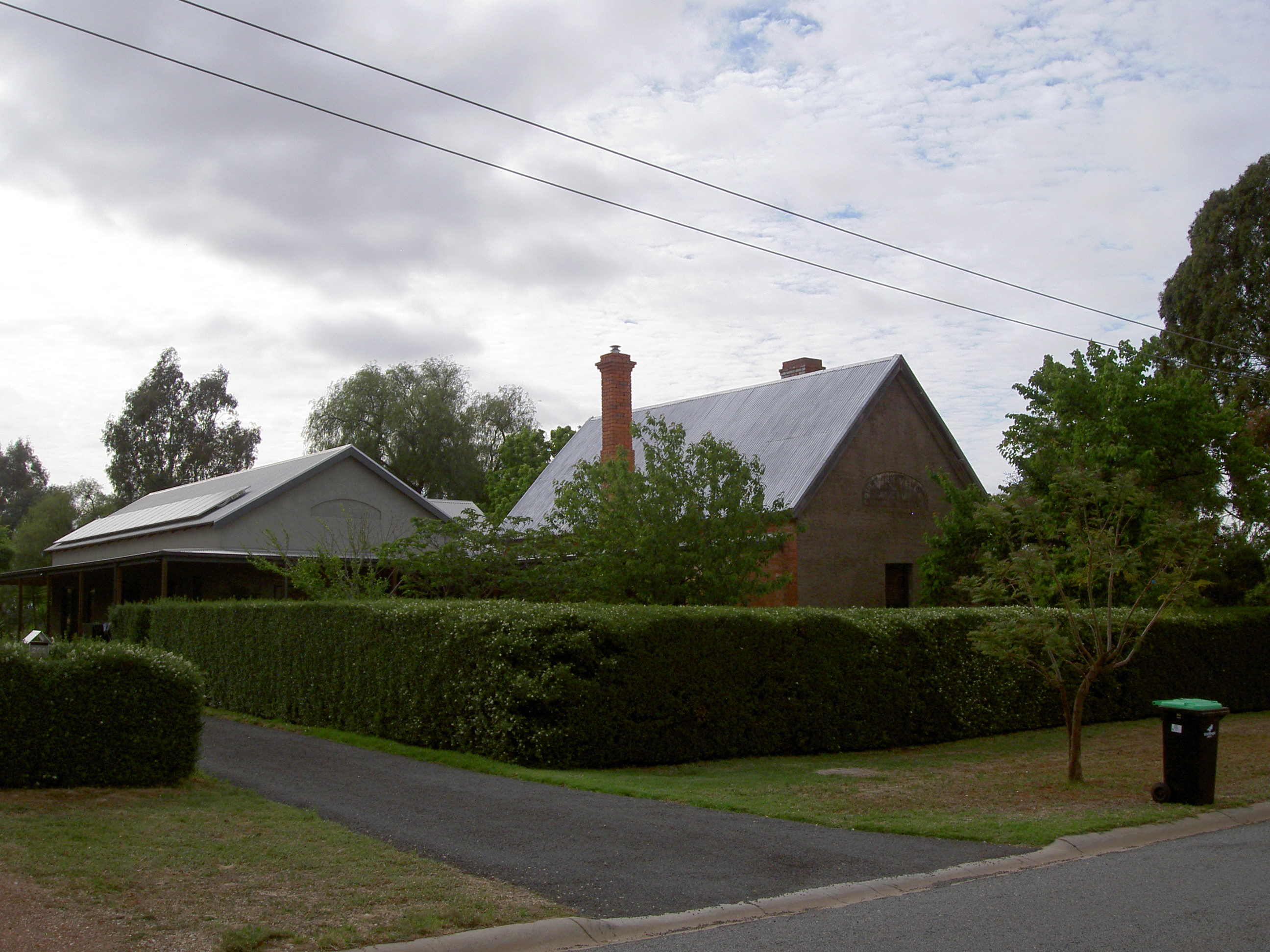
There are two Primary Schools in the town, one being a Catholic School, the other being a secular State School. Both schools appear to be well maintained. There was a ‘Cottage School’ in the late 19th century, but that now appears to be a private dwelling.
There is no Secondary or High School in the town, the nearest being in Shepparton, which can be easily reached by way of the V-Line train service which passes through Nagambie. Seymour, also on the V-Line route has a High School, but that is a little further to travel.
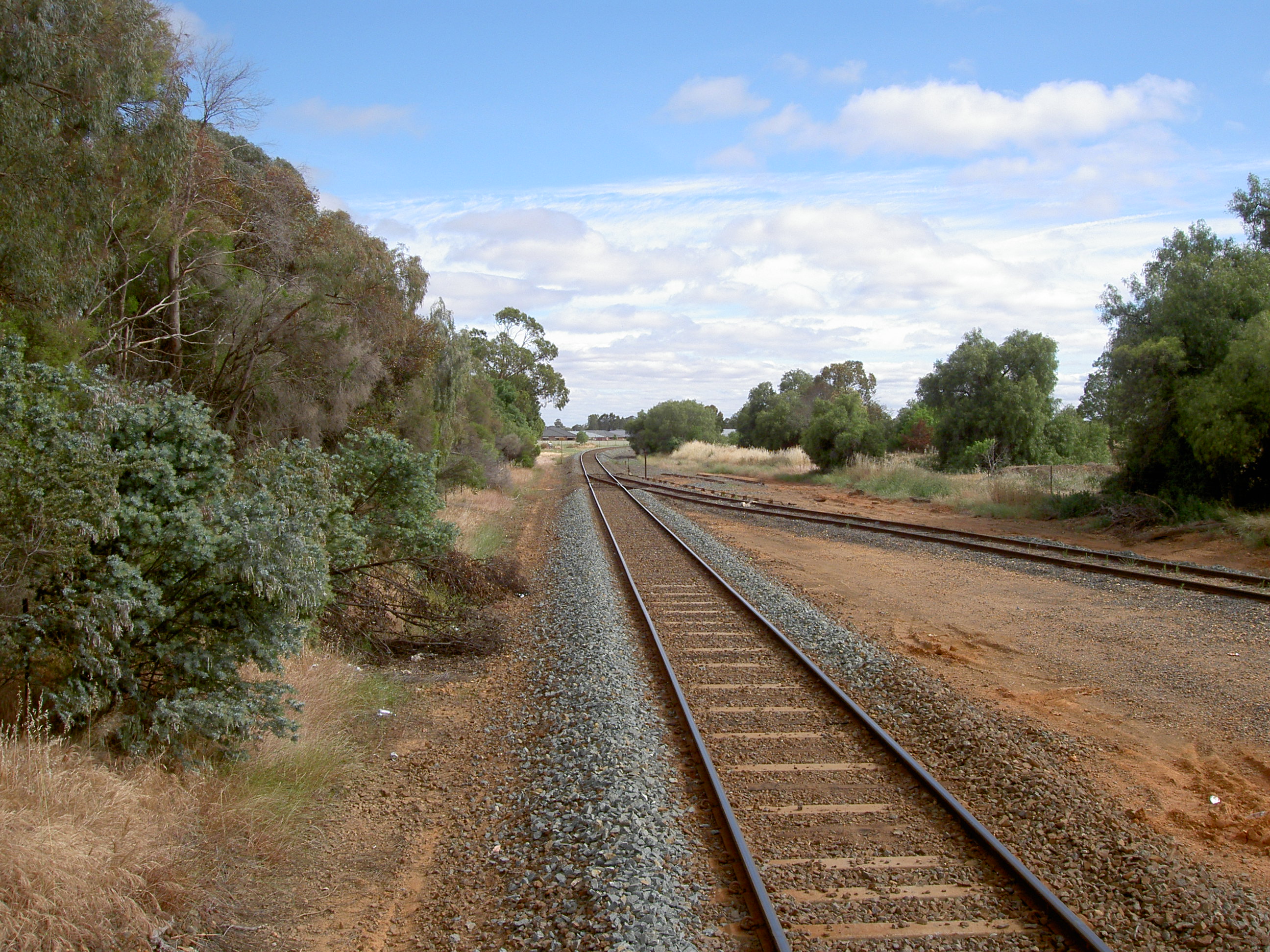
There are some very pleasant older-style houses scattered around the residential streets, and several new housing estates are in the process of being developed. Whilst it is probably not a daily commutable distance from Melbourne, it is by no means isolated, with Melbourne only about 90 minute drive away along the Hume Freeway.
The surrounding area is very nice, and a drive of about 20 minutes will take you through some pleasant undulating country, through several vineyards, and over the very rickety, but perfectly safe Kirwans Bridge, to the Goulburn Weir.
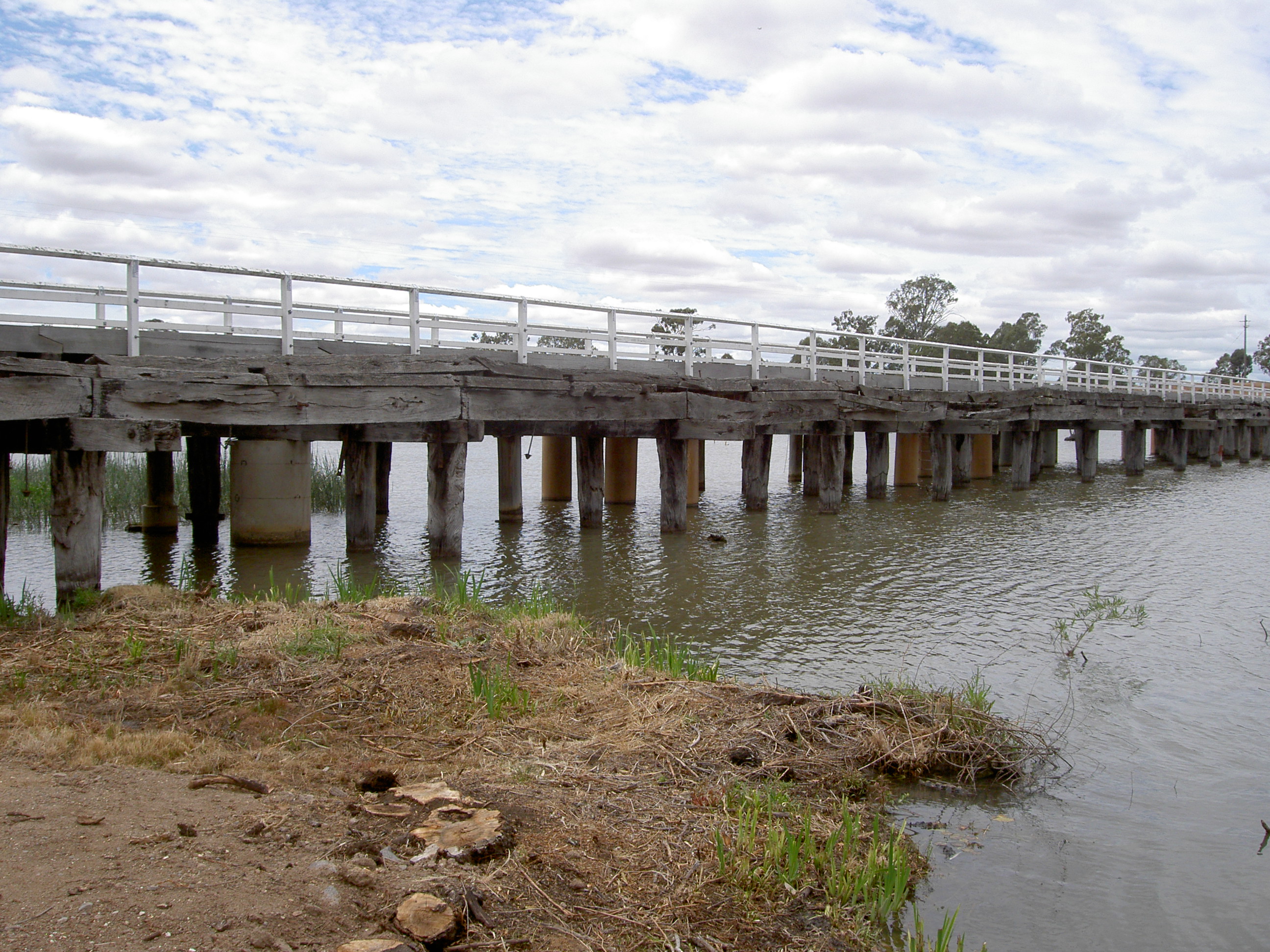
Originally constructed in 1890 when flooding of the Goulburn valley due to construction of the weir submerged an earlier bridge, the 310 metre long Kirwans Bridge is the longest timber bridge in Victoria. Linking two Shires, it has had a chequered history, and there were frequent arguments between the Shire Councils at either end of the bridge on matters such as maintenance and repairs. A proposed second lane was abandoned in the 1950’s, leaving only two small bays on the bridge to allow for passing vehicles. Over the years it has been closed several times, the most recent closure being in 2010 for repairs initially estimated at $1.2M. At that price, it might well have remained closed forever, but a ‘second opinion’ was sought by the Kirwans Bridge Action Group, which resulted in the repairs being carried out over the ensuing 12 months for a mere $100,000. The bridge was reopened in 2011, with the ribbon being ceremoniously cut by the 88 year old local resident, Alice Thomas, from her motorised mobility scooter.
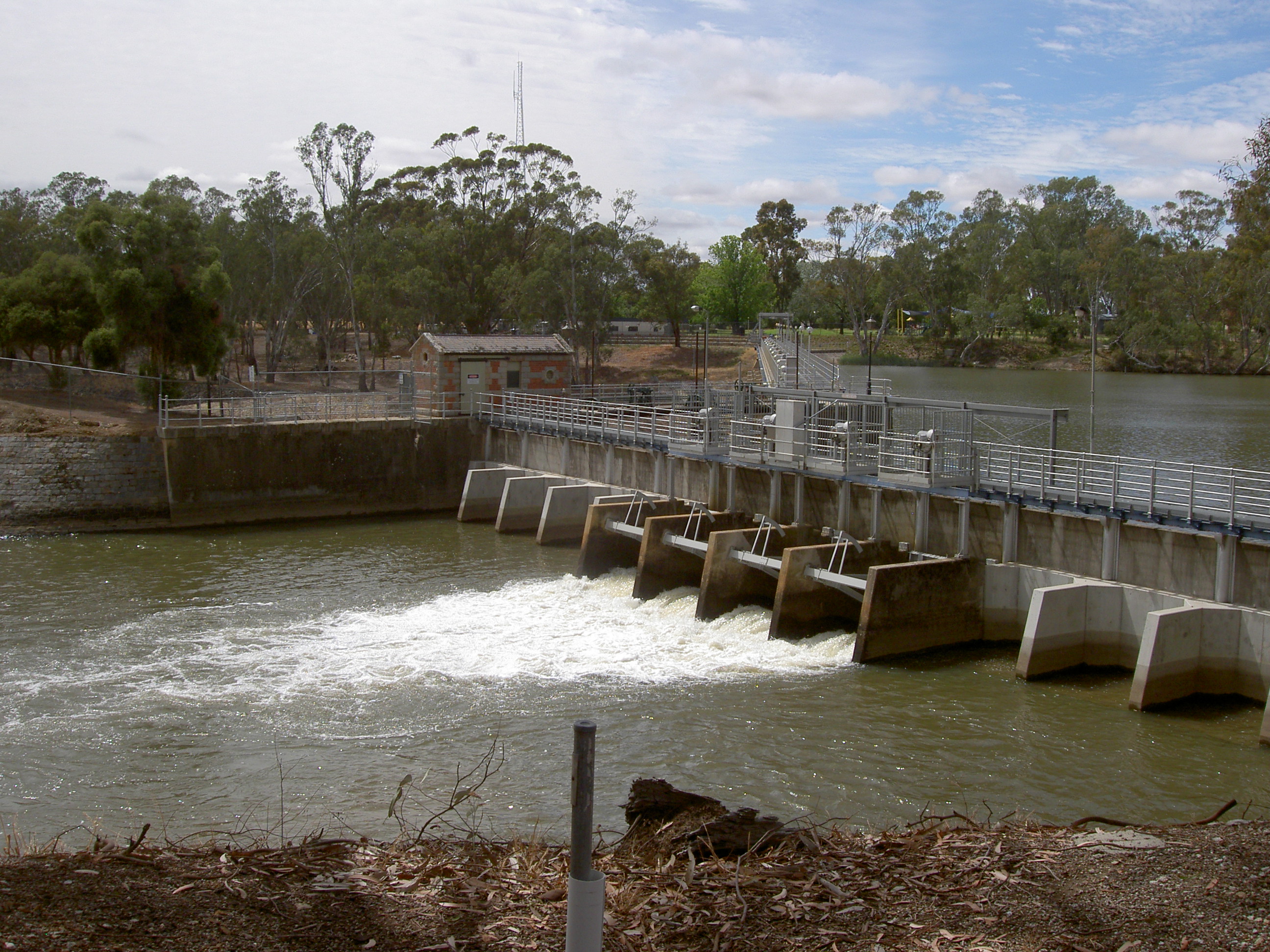
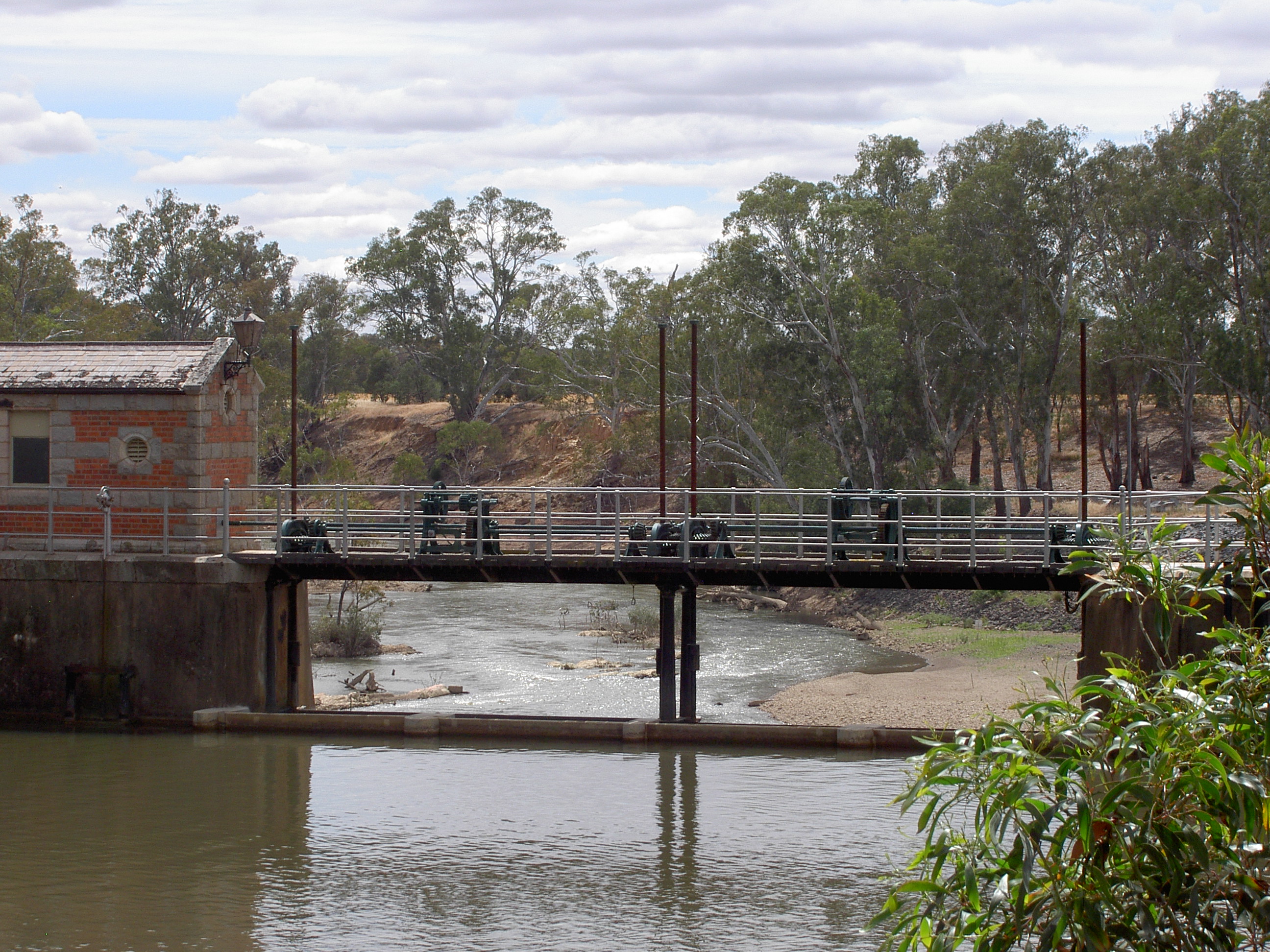
The Goulburn Weir, the oldest in Australia, immediately became a tourist attraction, as it was illuminated at night using hydroelectric power generated by a turbine in the outfall pipe. However, its raison d’être was as an important part of the irrigation system for the lower Goulburn valley. On average, 98% of the water released from Lake Eildon on the Upper Goulburn is diverted into the irrigation channels, leaving only the barest minimum stream flow in the river itself.
Further downstream from the weir, lies the even smaller town of Murchison. Settled at about the same time as Nagambie, and for the same reason—a suitable crossing place, Murchison now has a population of the order of 950, a little over half that of Nagambie.
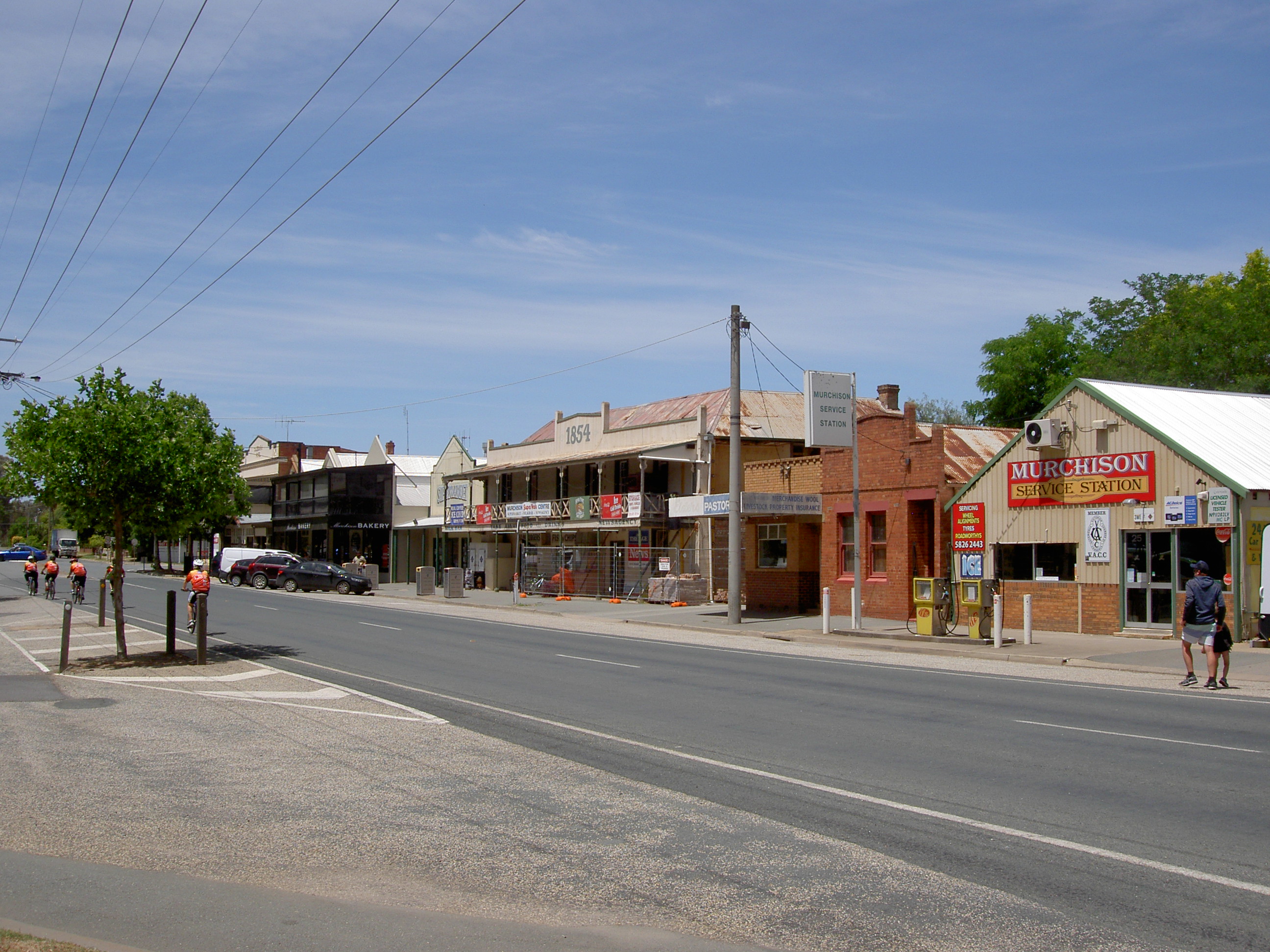
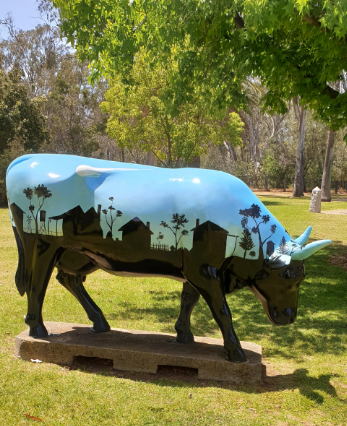
This photograph comprises almost all of the shops that are in the main street of Murchison. Opposite the shops on the bank of the river are some very nice town gardens with half a dozen or so unusual sculptures, of which this is a typical example.
At this part, the river bed is some 9 or 10 metres below the town.
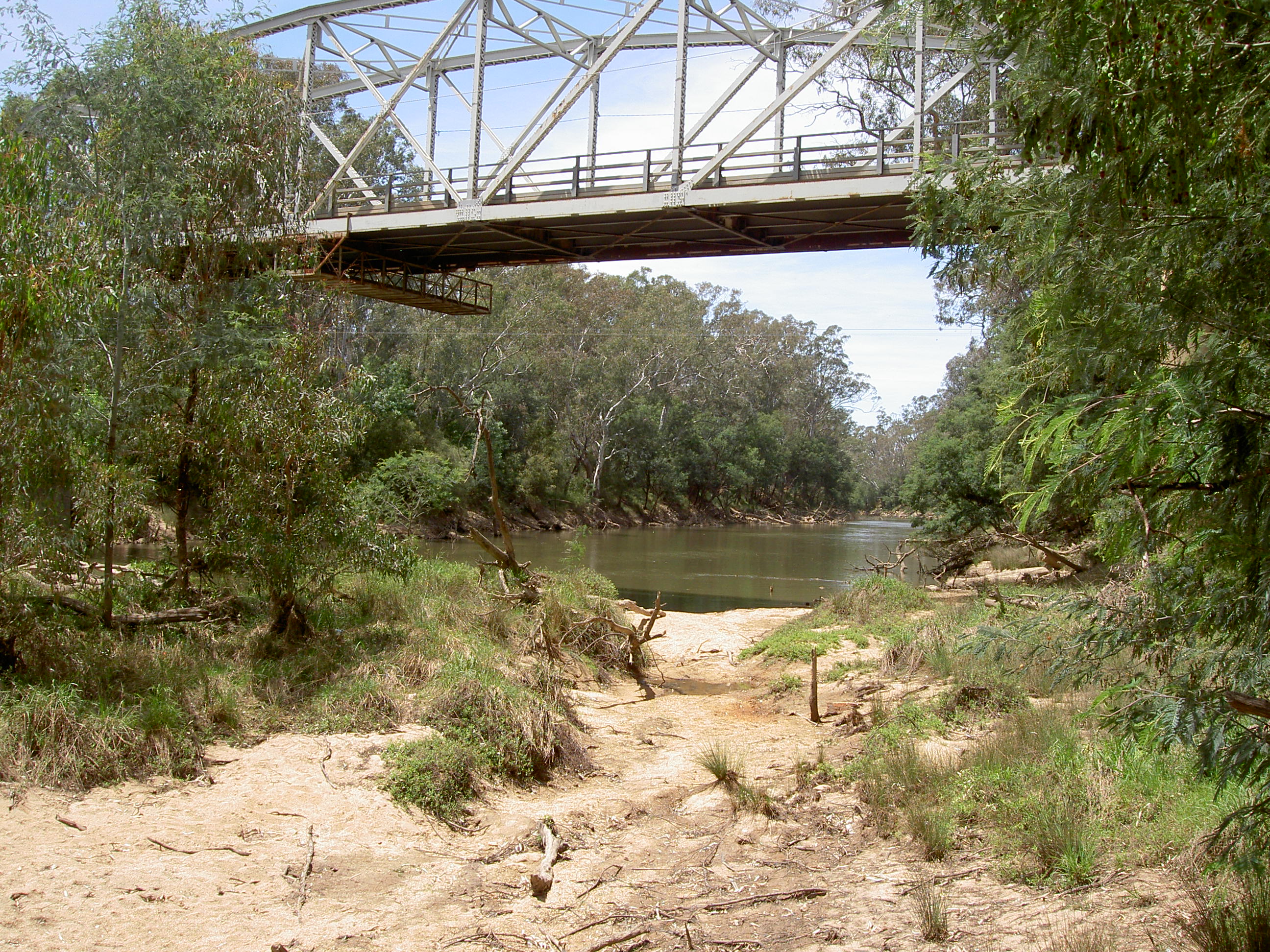
Due to the weir, very little water now flows along the Goulburn River for most of the year. However, flood markers indicate that at times of exceptionally high rainfall, the weir probably saves the town from inundation.
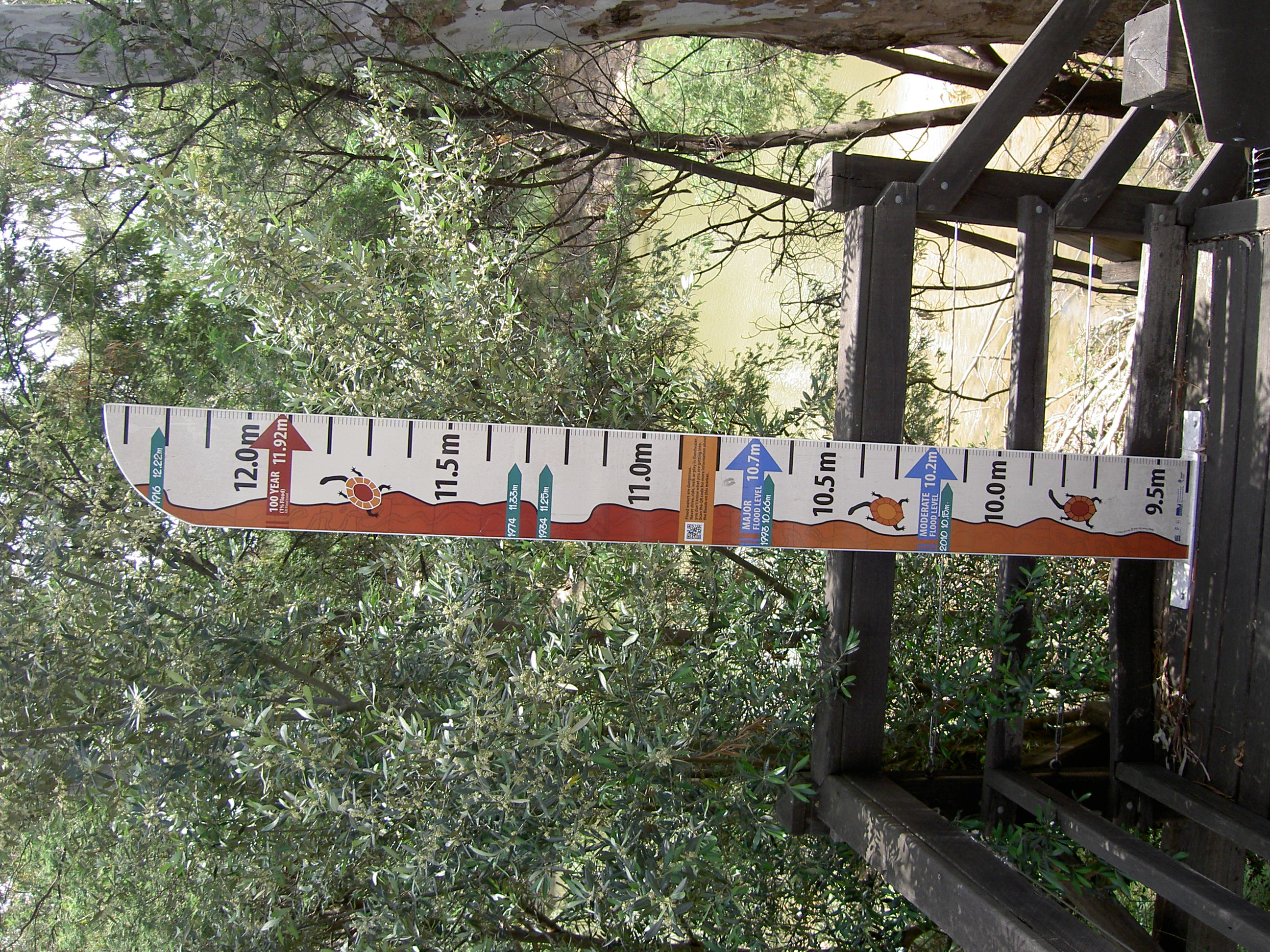
The worst flood was in 1916, at just over 12.2 metres; the most recent being 2010 at 10.15 metres.
In the 1870’s, there were six hotels, a couple of flour mills, and the town was pretty lively with other stores and services. But it couldn’t last forever, and it didn’t last for long. Prior to the construction of the weir, paddle steamers from the Murray River could reach Murchison, but the weir put an end to that, and the town soon declined in importance. However, it had a bit of resurgence in the 1940’s with the establishment of Prisoner of War camps holding approximately 4000 Italian, German and Japanese prisoners. The camps employed about 675 people, and the Italian and Japanese prisoners, but not the German, worked as fruit pickers on local farms. After the camps closed in 1947, one, Dhurringle, became a low-security prison. The Murchison Cemetery holds the remains of 130 Italian soldiers and civilians who died while interned in Australia.
Just as Nagambie has Black Caviar as its hero, Murchison has the Murchison Meteorite! On September 28, 1969, a meteorite shower fell to earth just south of Murchison. Hundreds of fragments of the meteorite have been found spread over a 35 square kilometre area, the largest fragment weighing in at about 7kg; a total weight of the order of 100kg has been found. However, most of the meteorite fragments are now in research facilities and museums across the world, and there is very little to see in Murchison.
The Murchison Meteorite has made a significant contribution to our understanding of extra-terrestrial chemistry. The meteorite belongs to the category known as carbonaceous chondrite, containing water and many organic chemicals, rather than just being rocky. The Murchison fragments contained 8% water, and traces of over 70 different amino acids (the building blocks of proteins). Of the 70 or so amino acids isolated from the meteorite fragments, only 19 are found naturally on earth. What is significant about these molecules is that they demonstrate that the simple chemical building blocks necessary for life on Earth, seem to form quite readily in other parts of the Universe.
A ‘Meteorite Park’ in the town centre celebrates this discovery; and there is a Historical Museum on the river bank which probably has a fragment or two. But we can’t be certain of that, as we didn’t actually manage to get into the museum. We believe the lady in charge at the museum spotted us as we approached with about 10 minutes to go before closing time. We saw her nip out and retrieve the “Now Open” sign, and very smartly nip back in and lock the door, possibly so that we would not delay her leaving for the afternoon by asking endless questions about their heroic meteorite.
If you have two or three days to spare, and do not want to spend too much time travelling very far from Melbourne, Nagambie and the surrounding area is a very handy and interesting place to visit.
 Slingsby's Miscellany
Must be about 30 years since we have been there but the winery looks exactly the same! It was unusual in that their biggest wine output was marsanne and they were one of the major Australian wineries used to restock Europe after the Phylloxera outbreak. Colin.
On Tue, 3 Dec 2019 at 15:41, Slingsby’s Miscellany wrote:
> slingsbybrowning posted: “Every town needs its hero, something to look up > to, to make the town different from other towns. For the 1,860 or so people > who live in Nagambie, their hero is the race horse Black Caviar. Born in > 2006 at a stud somewhere around the Nagambie district, Bla” >