Cranleigh and the West

And so we said farewell to Whitstable and headed off on the A2, M2, M20 and several other roads, toward the village of Cranleigh in the county of Surrey, where we would stay the night with our niece and nephew. Cranleigh claims to be the largest village in England, with its population of about 11,000. At the other extreme, Fordwich, which we visited a few days ago, is the smallest town, and also has the smallest town hall in the country. Fordwich has a population of about 380.  Quite what the difference in the definitions of ‘village’ and ‘town’ is, that enables such a huge place like Cranleigh to claim to be a village, and such a tiny place like Fordwich to claim the be a town, I am not sure. But I guess that everywhere can lay claim to being a ‘something’ to differentiate it from other places. Having said all that, Cranleigh is not a particularly picturesque village; it was severely bombed during the last war, and many of its buildings date from the late 1940’s. This re-building enabled a bit more planning than had gone into much older and smaller villages, and consequently it has a very pleasant wide main street lined with some very nice shops, plenty of trees, and open spaces.
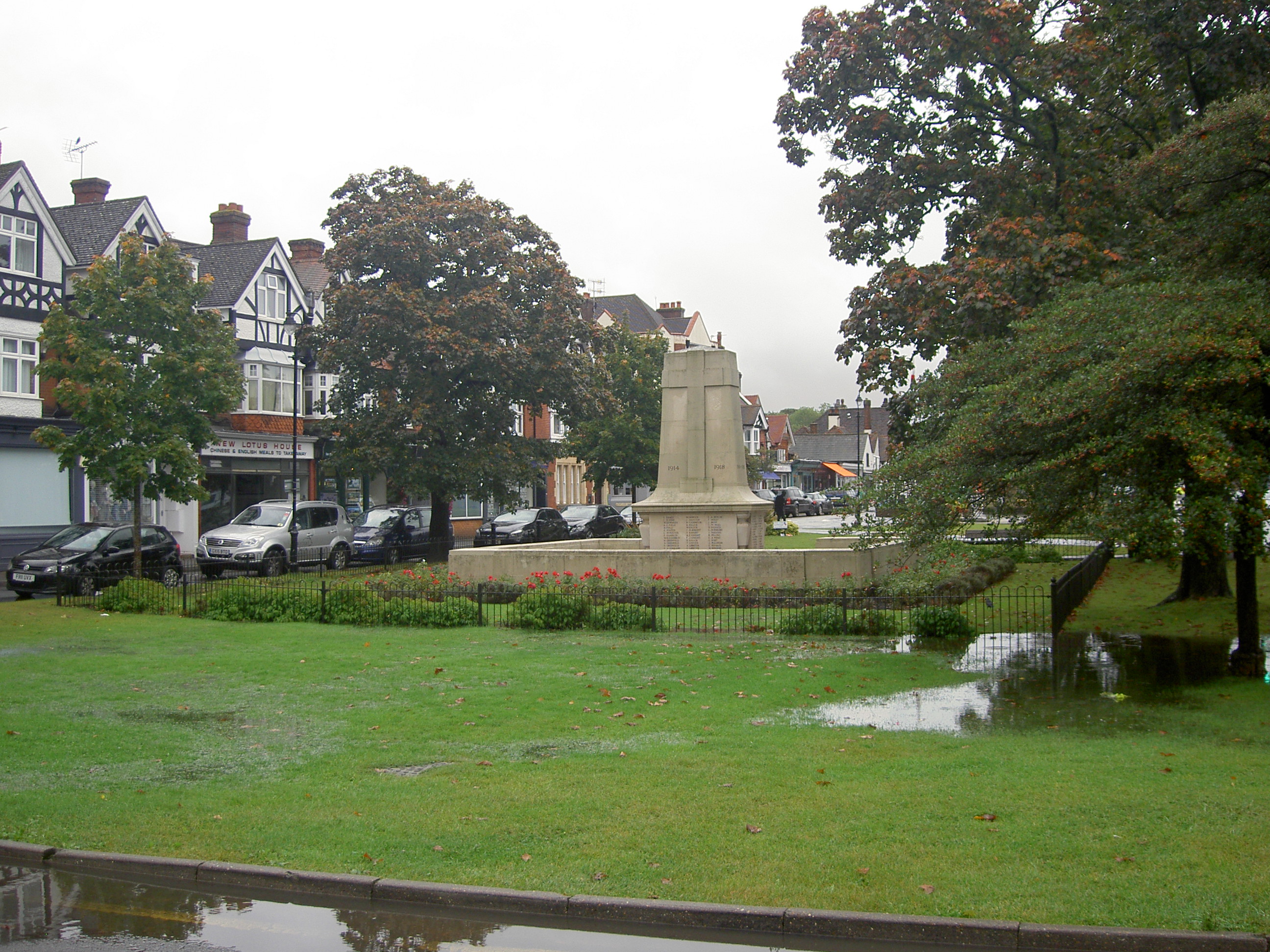
Cranleigh

There are remnants of the old village; including, but not limited to, one of the three village pubs, an old building next door accommodating a health service, and a nice old church and Rectory. Maybe it was the proximity of the pub to the church that saved it from the destruction that much of the village suffered.
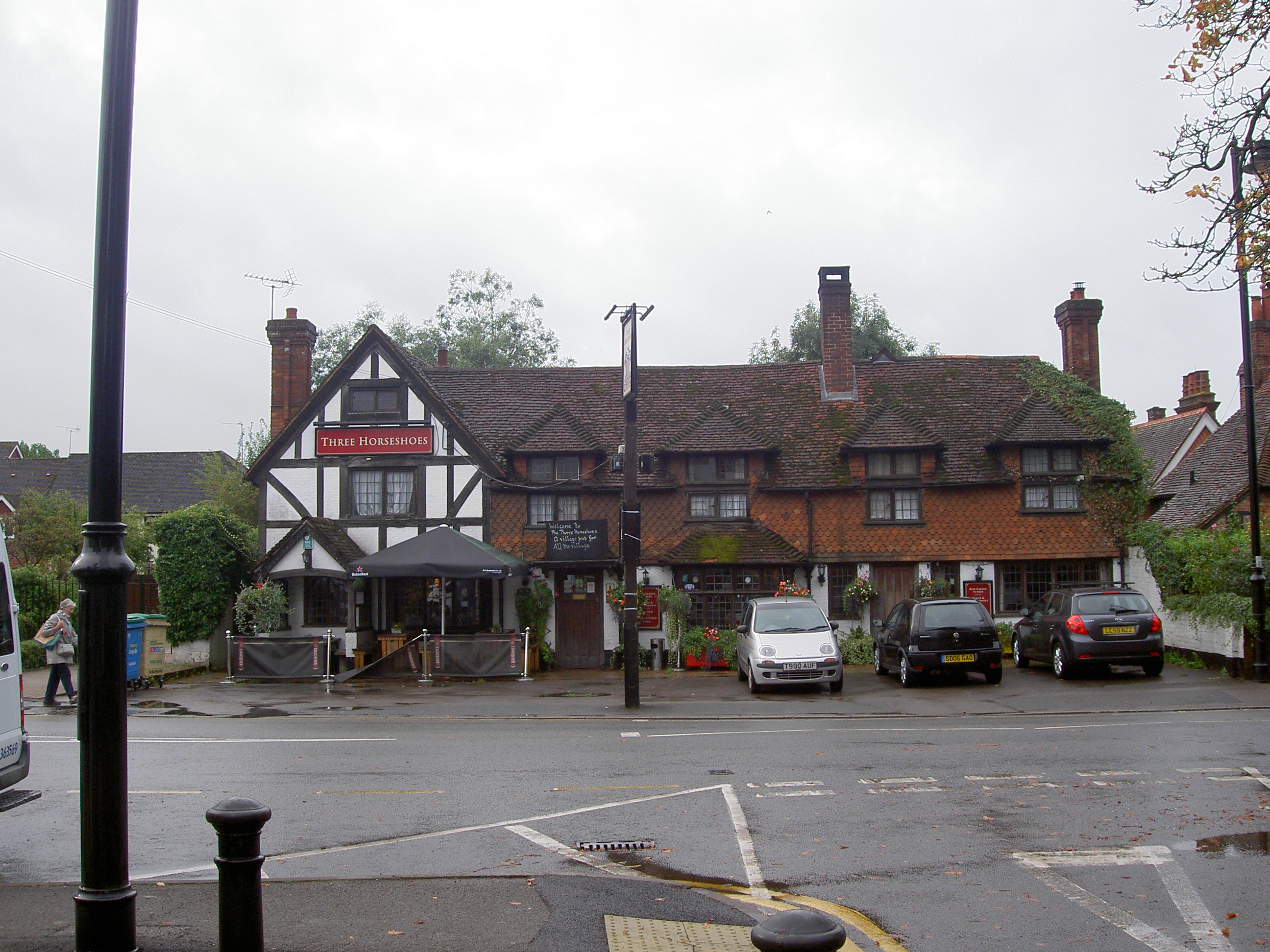
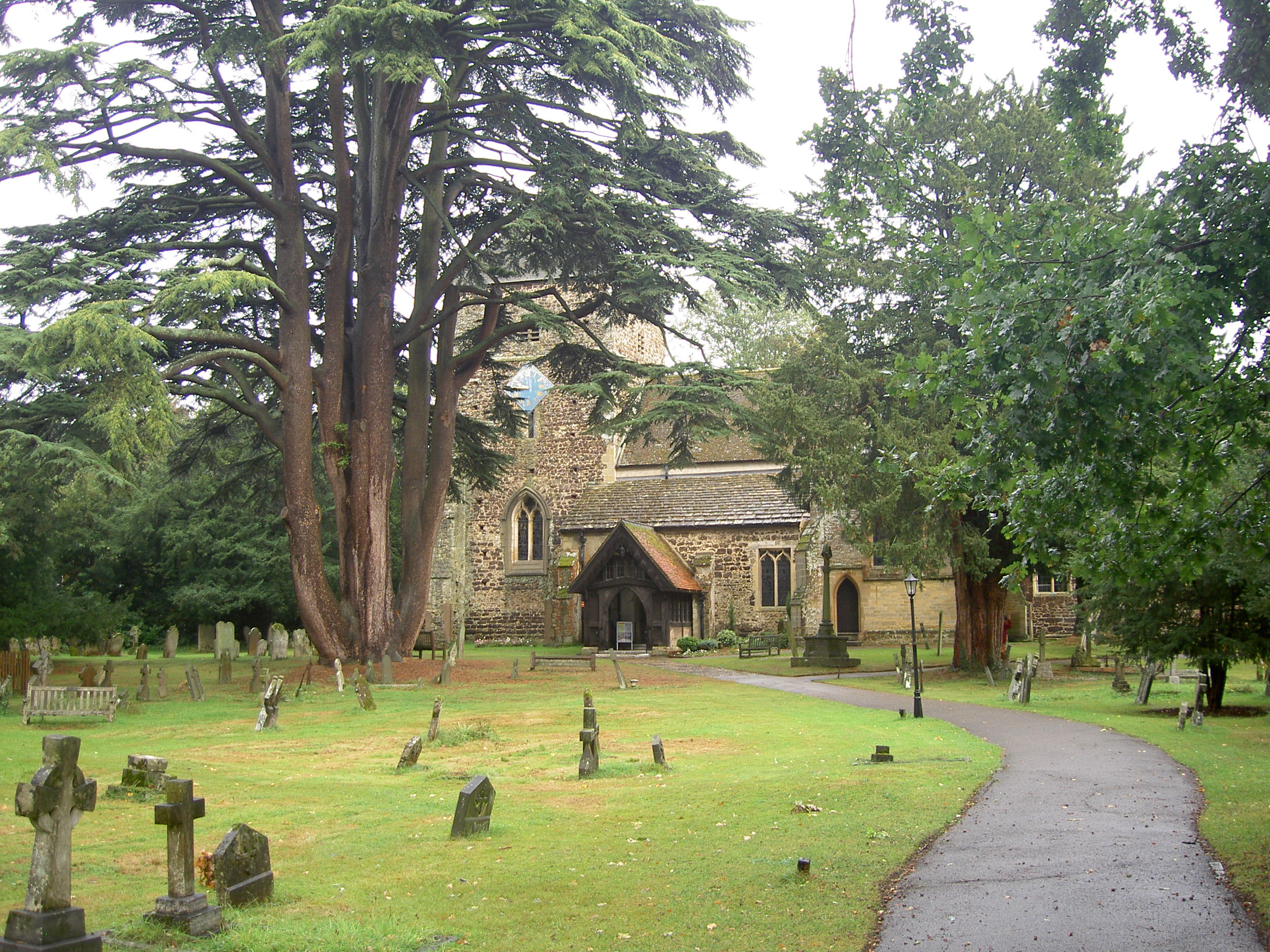
Vestiges of Old Cranleigh
Cranleigh Church

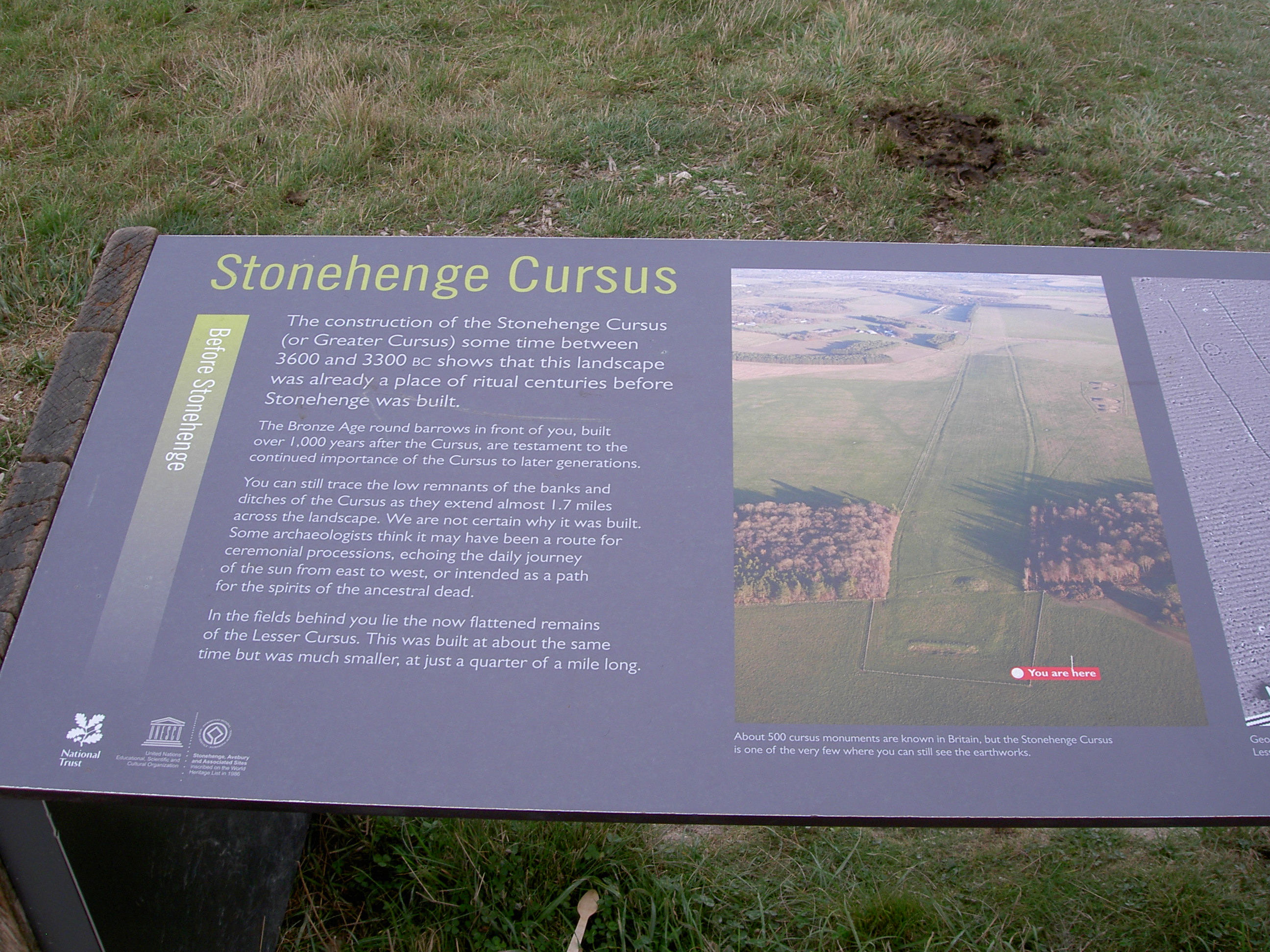
After spending the night here, we turned our car in the direction of the Salisbury Plains and Stonehenge. We had visited this old pile of stones before, but as Phil and Helen had not, it was very worthwhile making the detour, and they were very impressed. Since we were last there, a whole new visitor centre and car park has been developed about one kilometre from the actual henge, and whilst H and P walked all the way to the henge, I walked part of the way through pleasant countryside, noting ancient burial mounds (barrows), and other pre-historic earthworks including the cursus which predates the henge by several centuries.
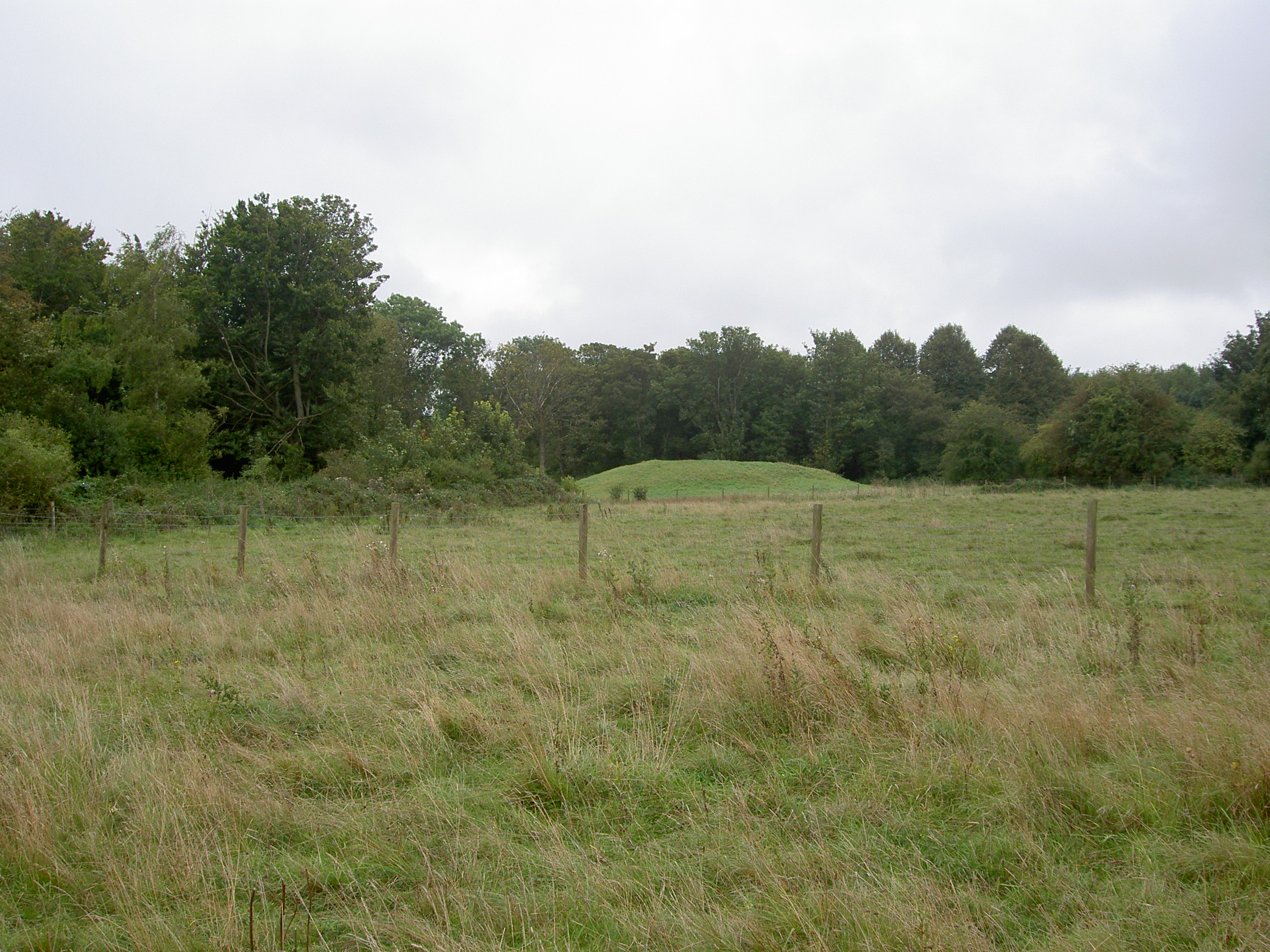
Barrow, (burial mound)
Information board for Cursus

We left Stonehenge, and the ancient dead in their barrows, and went on to Salisbury. I would have liked to visit the old settlement of Sarum, but unfortunately time did not permit that luxury. We found our accommodation with no problems, and set off for a walk to find somewhere for dinner. I can highly recommend The Pheasant as a place to eat should you find yourself in Salisbury. It is a pretty ancient pub, but the staff are all young and very pleasant. The food was really excellent, and it made a nice finish to a busy day. The pub EFTPOS terminal had broken and we had to find an ATM to get some cash, and that gave us a further opportunity to explore the area, including the pedestrianised centre of the town. The local Council has plans to extend the pedestrian precinct quite considerably, as it is very congested, and the air quality very poor.
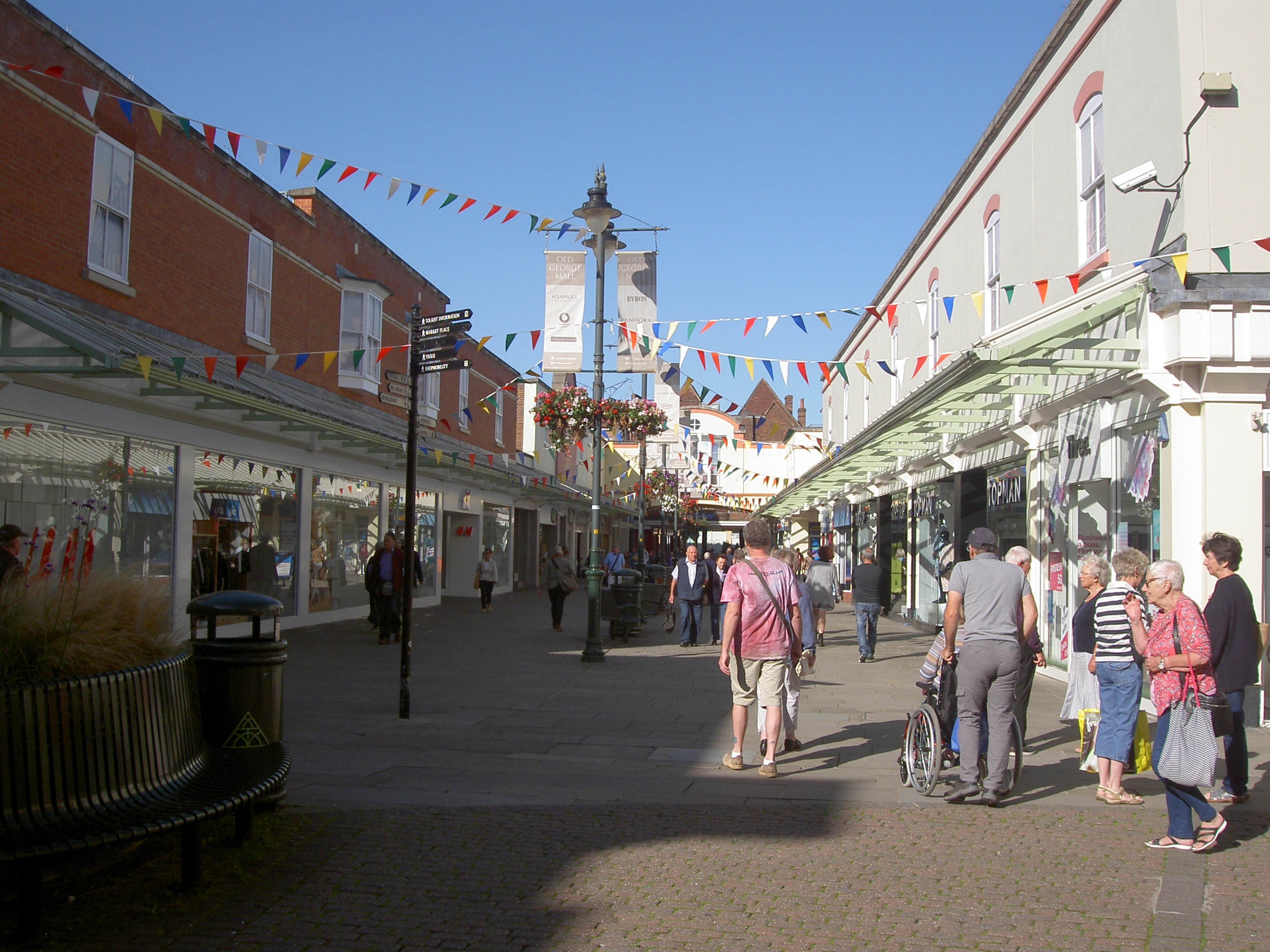
Pedestrian Centre of Salisbury

Next morning we packed up and drove to the magnificent cathedral, which is well worth a visit. Construction began in 1220, with the spire, the tallest in England, being added in 1549. The clock, dating from about 1386 and restored to working order in 1956, is said to be the oldest working clock in England, but that claim has also been made for other clocks. But what I am sure about is that the cathedral houses the best preserved copy of the Magna Carta. There are only four copies surviving of approximately 40 that were written, and the Salisbury copy is superb. It’s all in Latin, so I couldn’t read it, but there are of course English translations on display. Many of the rights and responsibilities enshrined in the Magna Carta are now well established in many ‘western’ democratic constitutions, including of course Australia.
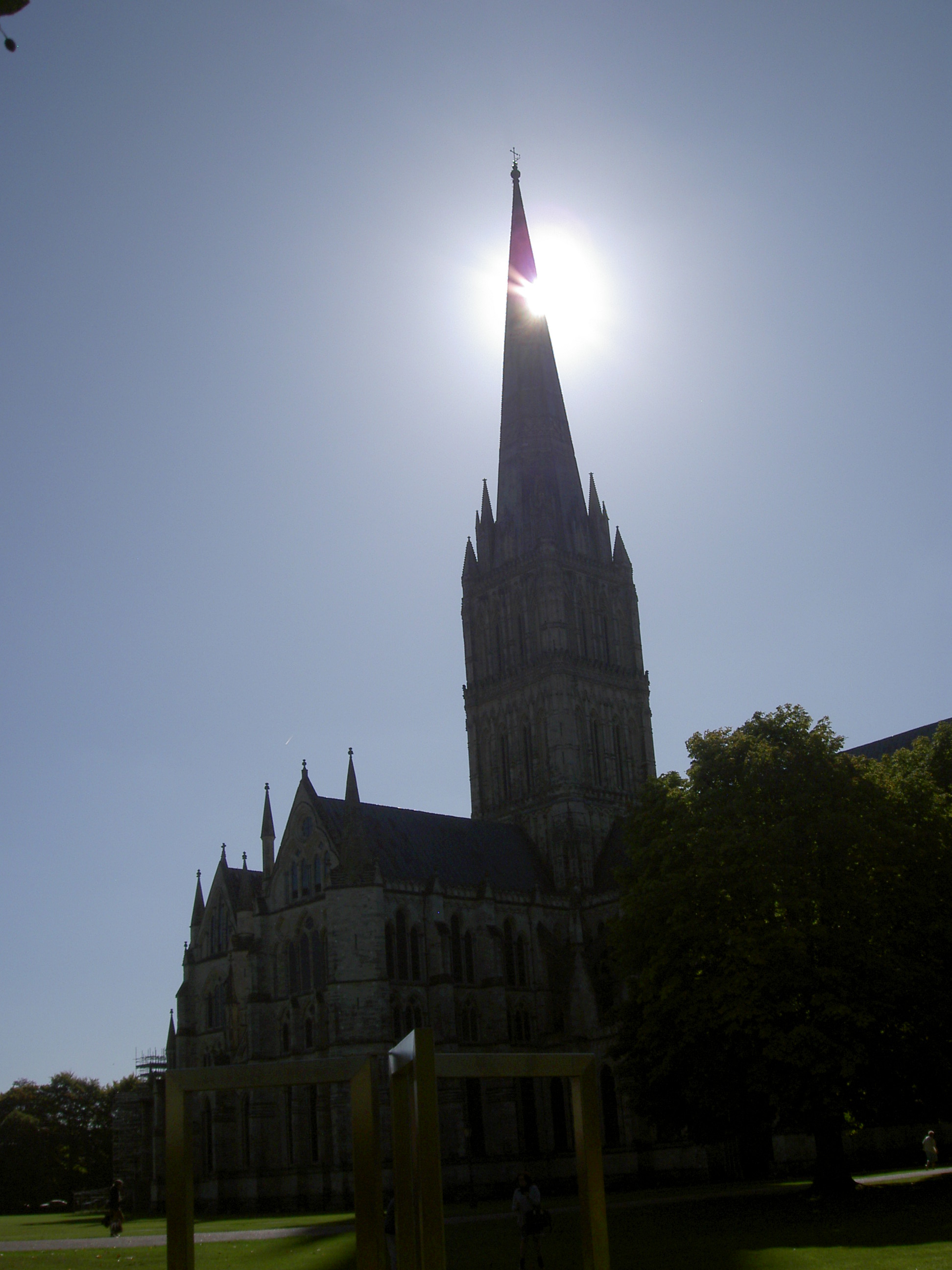
Salisbury Cathedral
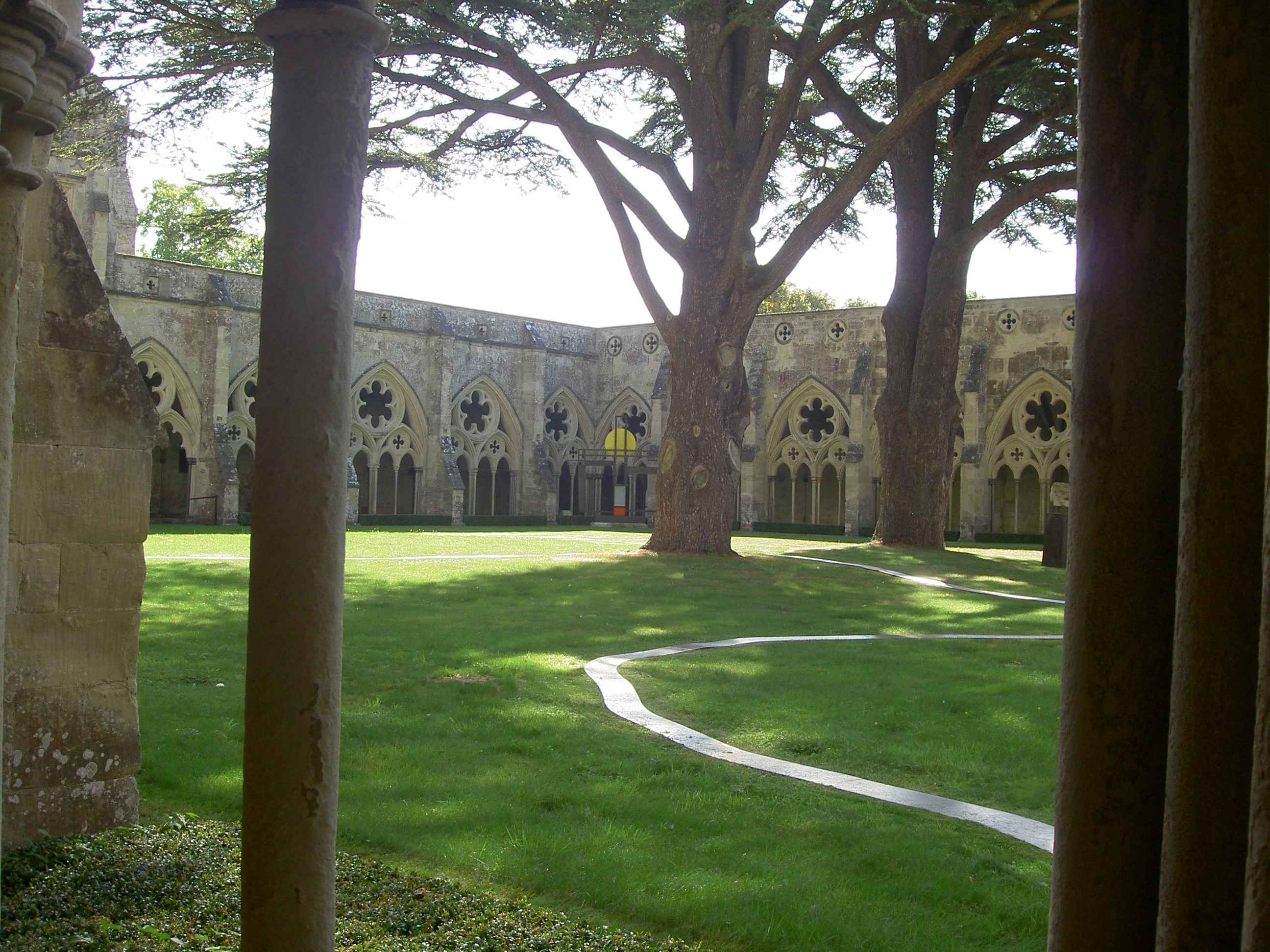
Cloistered courtyard, Salisbury Cathedral

The cathedral itself is, of course, a magnificent building, and really demanded more time than we were able to devote to it before we left and headed further west to Mylor Bridge, Cornwall. We took the route in accordance with the sat-nav, and it was pretty easy, except that when one follows major routes, the only places for eating are the dreadfully impersonal and boring “services”. So we disobeyed the sat-nav voice, much to her chagrin, and found a lovely little pub at a village called Seavington St Michael. I’m not sure we could find it again, but the lady behind the bar was charming, the food was excellent and the beer just what I needed. Then we continued uneventfully to Mylor Bridge

Our accommodation here was a stone cottage derived from the stables of a working farm. There were several such converted dwellings surrounding the main farmhouse wherein the owners lived. It was charming, quiet and comfortable, with a well-appointed kitchen, (including a balloon whisk) and a good BBQ in its own little courtyard. Our hosts were delightful, and made us very welcome.
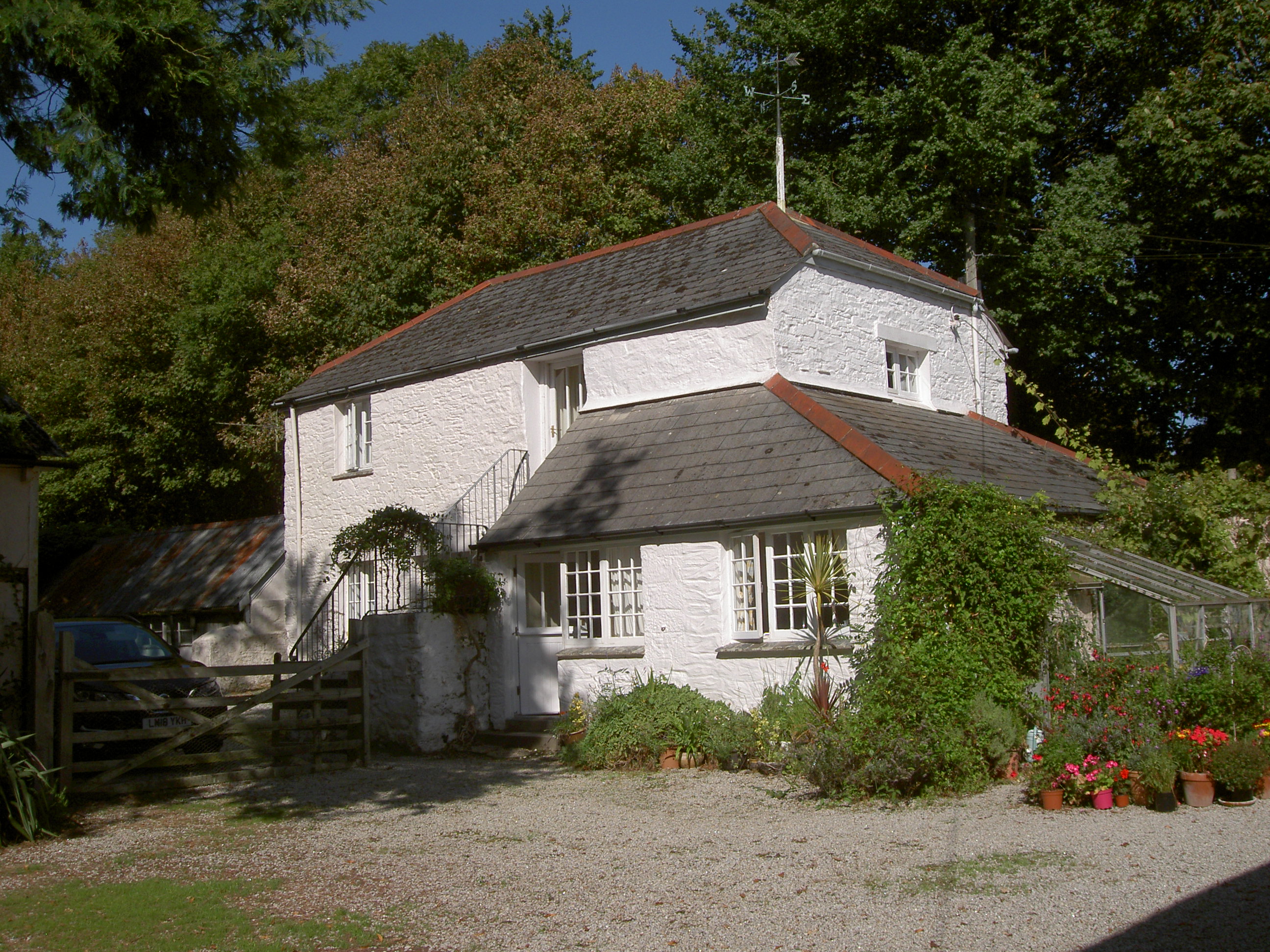
Our farmhouse accommodation, Mylor Bridge, Cornwall

The following morning, 25% of our party took the car to visit relatives of a friend nearby. Without the car, the rest of us walked around, exploring what Mylor Bridge had to offer.

Mylor Bridge village itself, about a 15 minute walk away from our farmhouse, is quite tiny. There is a good pub, The lemon Arms, a village store that sold everything you could ever need, a village butcher and a village fishmonger. There is also a post office, and a couple of hairdressing salons. It is on the upper reaches of a tidal creek, so the village itself has no beach or sailing facilities; but a kilometre or so downstream the creek widens out, and it provided a safe harbour for smaller yachts, and a bit of a boat repair industry.
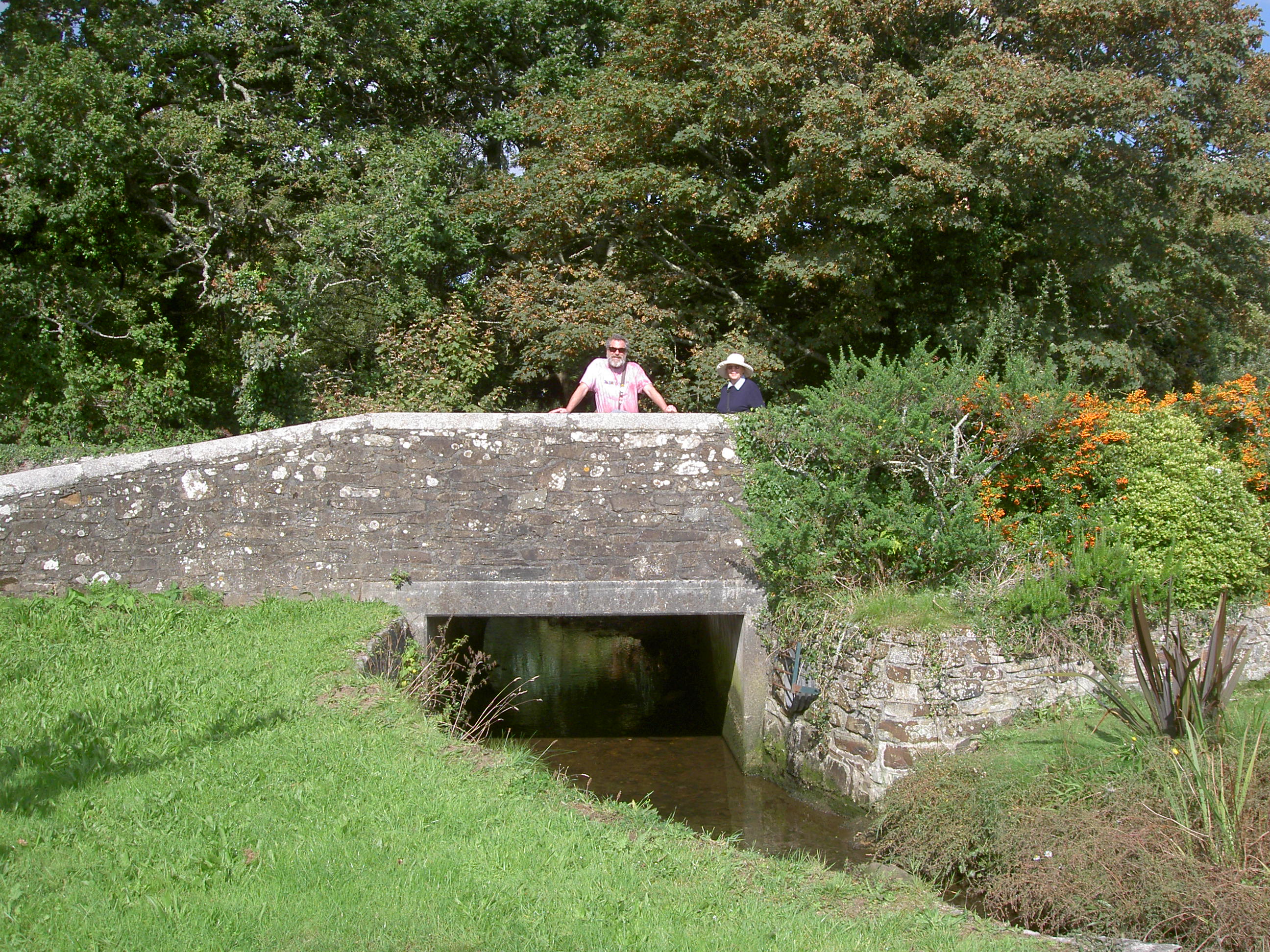
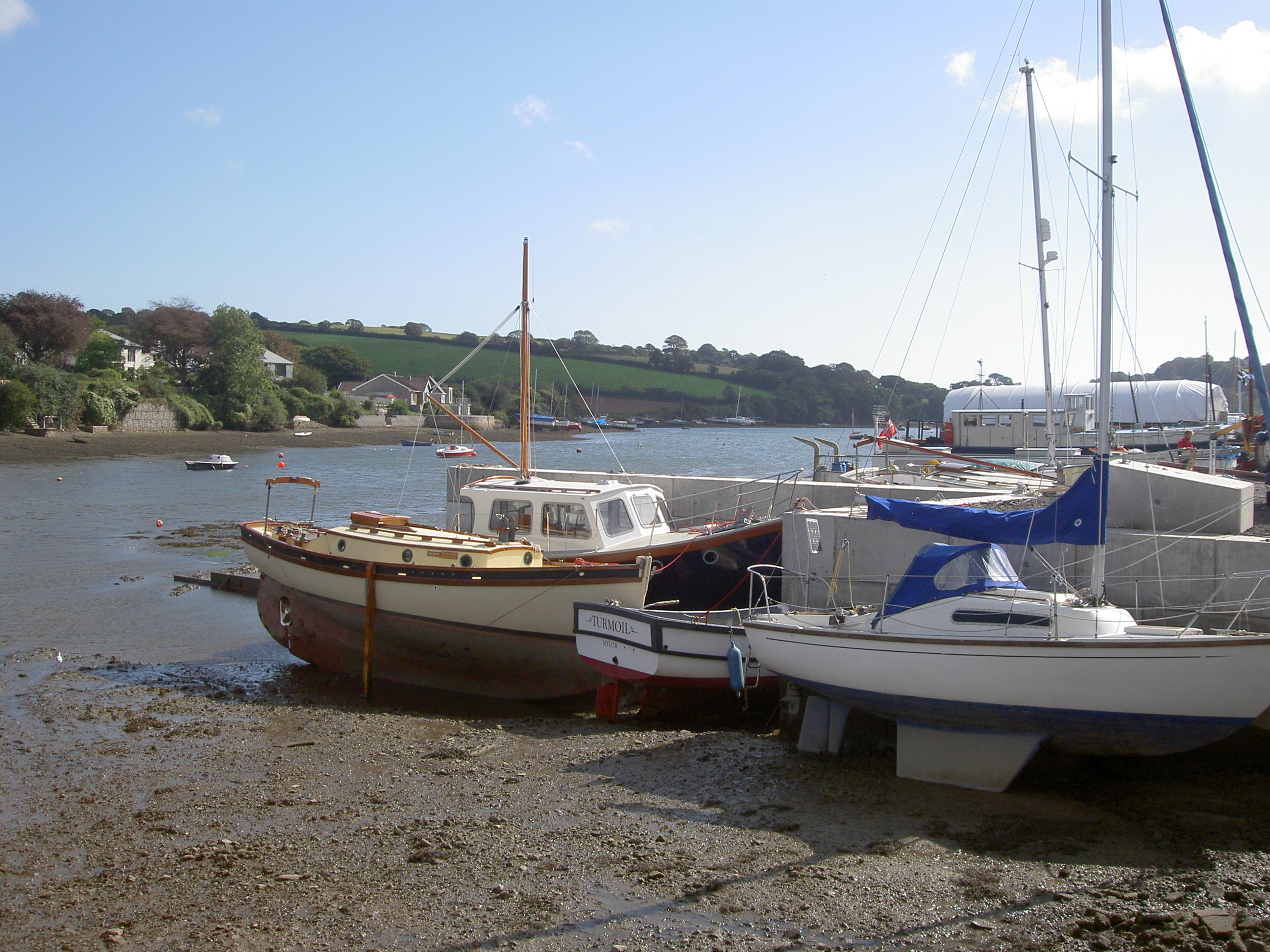
Mylor Bridge
Mylor Bridge boat industry

Not far from Mylor Bridge, is another pub, The Pandora Inn, which is much more ‘touristy’. It has frontage onto much deeper water, and the greater part of the drinking and eating area is on a floating pontoon. Quite delightful; and many of the patrons actually arrived in small water crafts, which was not only picturesque, but also very sensible as car parking was a nightmare! We dined that evening on the pontoon, and it was lovely, warm evening.
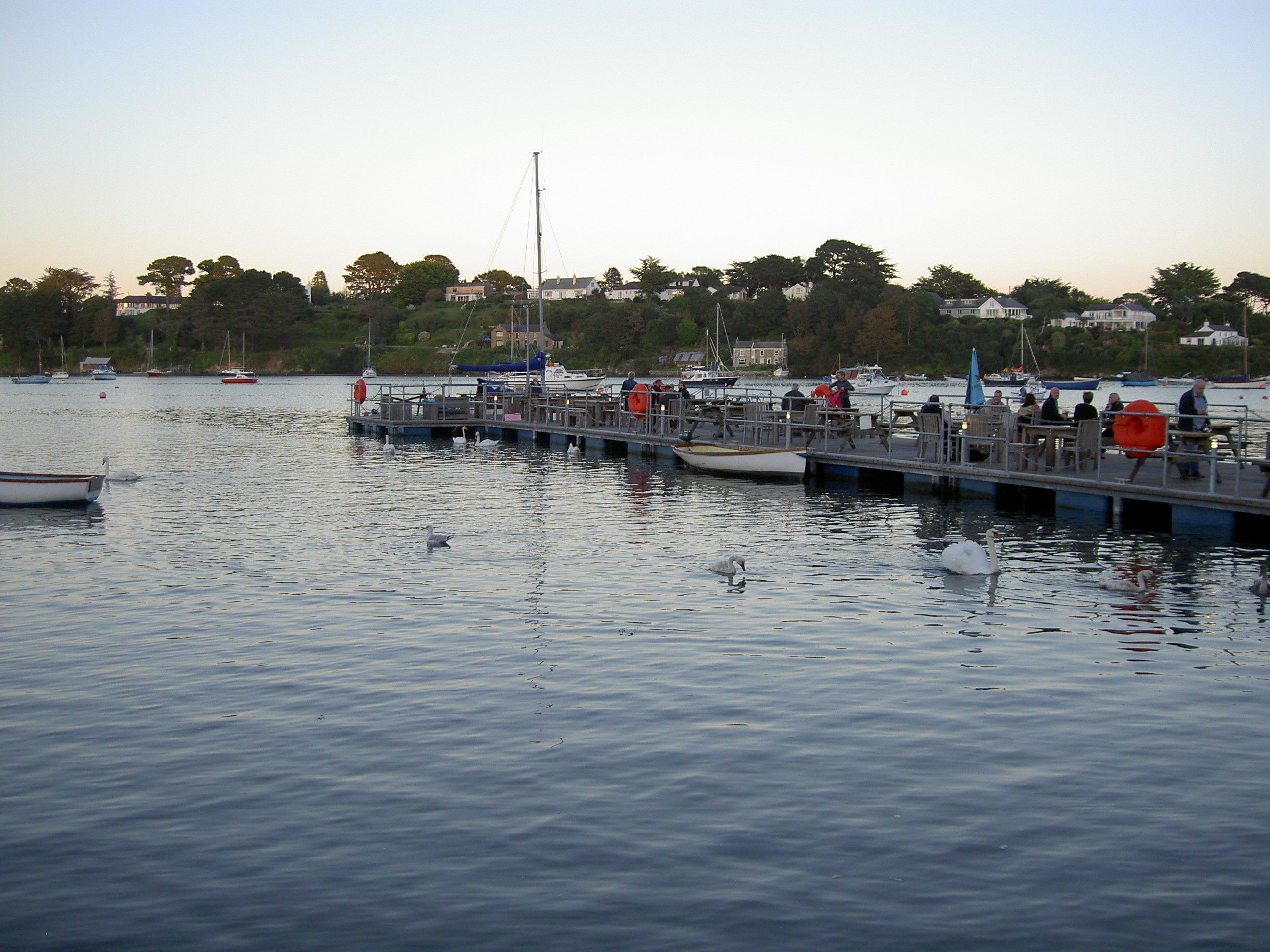
Pontoon of Pandora Inn

The next day, half of our party took the car and drove to the north coast of Cornwall to Tintagel and its environs. That left us with the opportunity to catch a bus to nearby Falmouth. We thought of going to Truro, but decided on Falmouth when we learned there are no busses to Truro. Our first surprise as we approached the bus stop was to be asked if this was indeed the stop for the Falmouth bus. I had intended asking that same question of the young woman who had asked us. We then discovered that the young woman was visiting from Perth (WA). So, on the bus to Falmouth, three of the five passengers were from Australia!

Falmouth as a town does not have a lot to recommend it. However, if you are interested in sailing, it is pretty much the place to go. It has a very sheltered deep water harbour and there were countless boats, large and small, bobbing on the water. Not being ‘boaties’ ourselves, there was not a lot to interest us.
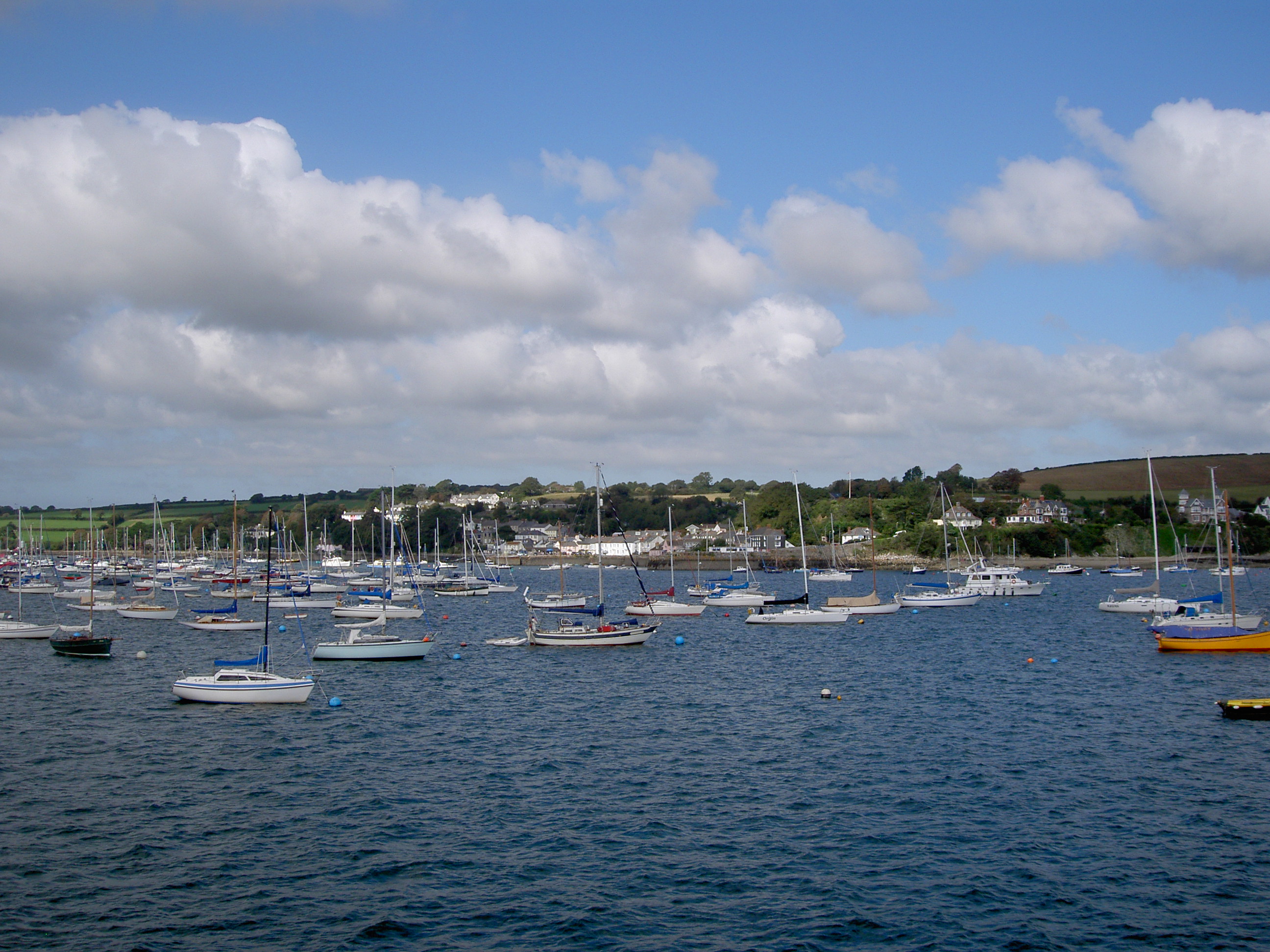
Falmouth small boat harbour

There is a rather nice old castle, Pendennis Castle, built in about 1540. Set on a headland projecting into the sea, it is one of Henry V111’s finest coastal fortresses,. It looked great in the aerial photographs on display in the town, so I thought I would take the half-hour walk to see it. I also thought the headland would provide some rather nice views of the coast. The castle is managed by the English Heritage, and of course there was a fairly pricey admission charge. I had so very little time to spare—the last bus back to Mylor Bridge being due in about one hour, and I still having a half hour walk back to town, I asked if I could just have a peep at the keep.  But no. I immediately discovered that the uniformed officers of the English Heritage were every bit as efficient at keeping people out as were the officers of Henry V111’s army! I was allowed to walk around the castle beyond its surrounding moat, and I did not manage to get even the smallest glimpse of the castle itself which is hidden behind the high grassy wall on the right of the photo below.
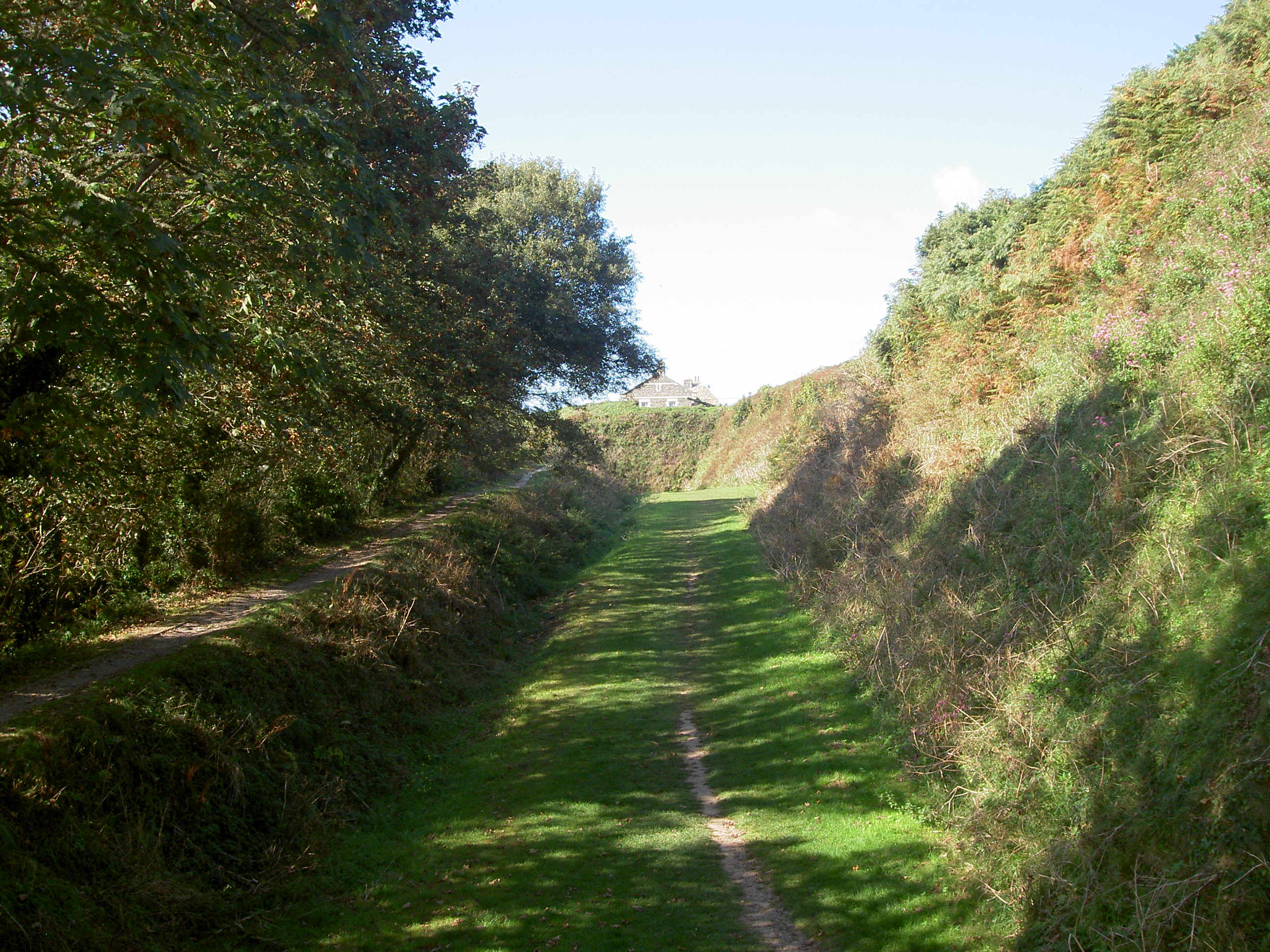
Moat of Pendennis Castle

Falmouth does have several claims to fame associated with military and nautical activities. One of these is that in 1805, following the Battle of Trafalgar, the news of the victory and of the death of Admiral Nelson reached England through Falmouth. Lt. John Richards Lapenotière disembarked from the schooner Pickle at Falmouth, and immediately set off to London—a journey ordinarily taking several days. By riding non-stop, and changing his horses 21 times, it took him just 37 hours, arriving at 1.00am on November 6.

Another claim to fame is that on October 2, 1836, HMS Beagle anchored at Falmouth at the end of her journey of discovery around the world, and Charles Darwin disembarked and took the mail coach to his family home at Shrewsbury.

There are of course book-loads of other events, but these two are sufficient for this blog!

After our three very enjoyable days at Mylor Bridge, we turned the car toward the east, and set off to Southampton, from where we would fly to Guernsey.


Sketches around Whitstable

Final day in Whitstable

We are now into our last couple of days at Whitstable, the weather is still perfect, and one half of our party has gone to Canterbury to collect the hire car for the next leg. It is amazing how time has got away from us, as we consider we still have more we would like to achieve here.

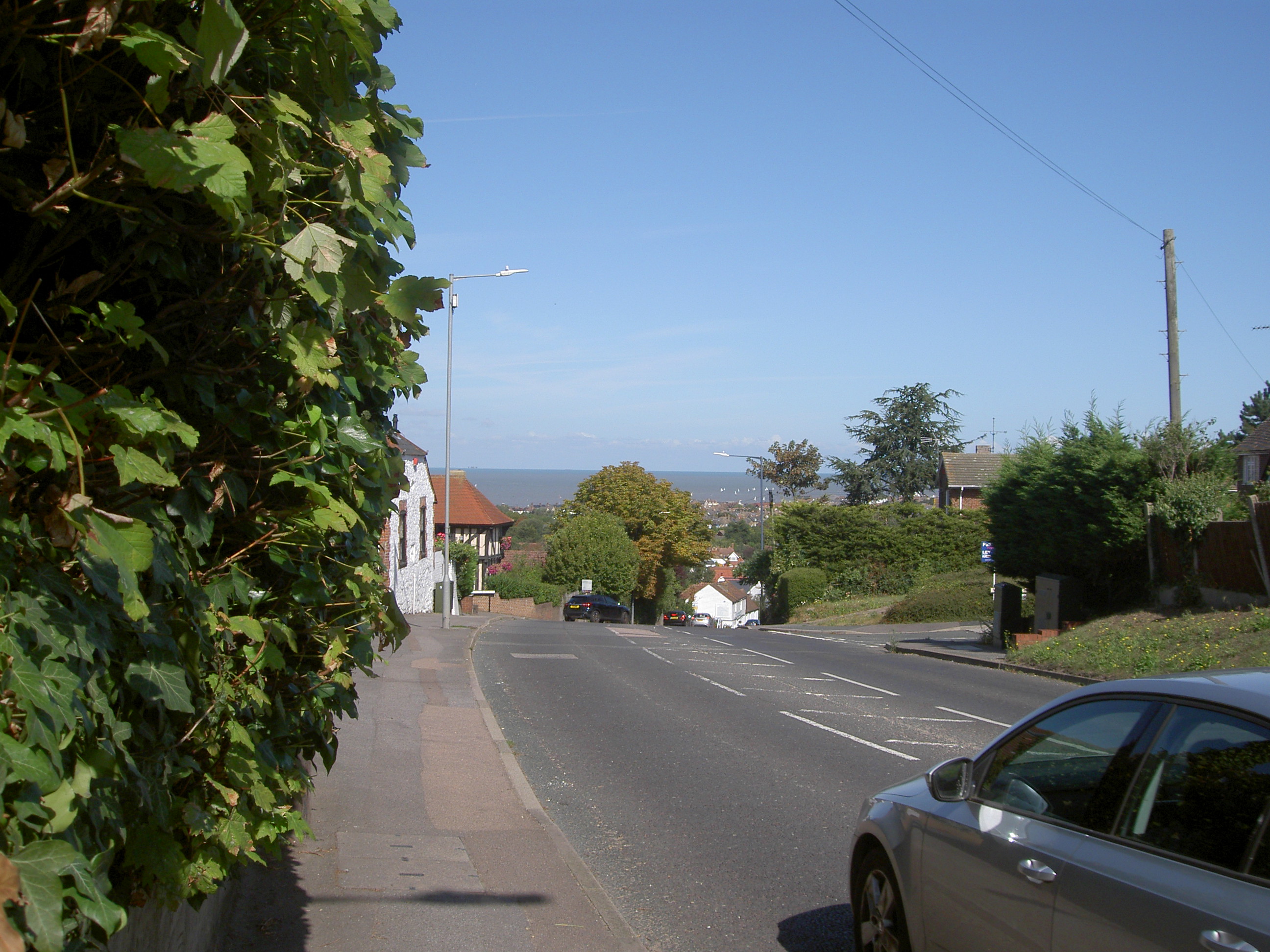
We made a trip to Gatwick Airport to collect our Granddaughter who had flown in from Melbourne via London and Italy, and the following day walked to the top of Borstal Hill on the outskirts of Whitstable to meet our daughter who arrived direct from Melbourne.

View across Whitstable from Borstal Hill

We were now the complete family party for the first time ever in the UK; we have all been in the UK at separate times over the past 30 years, but it was very nice this time to all be together—even if only for one week!

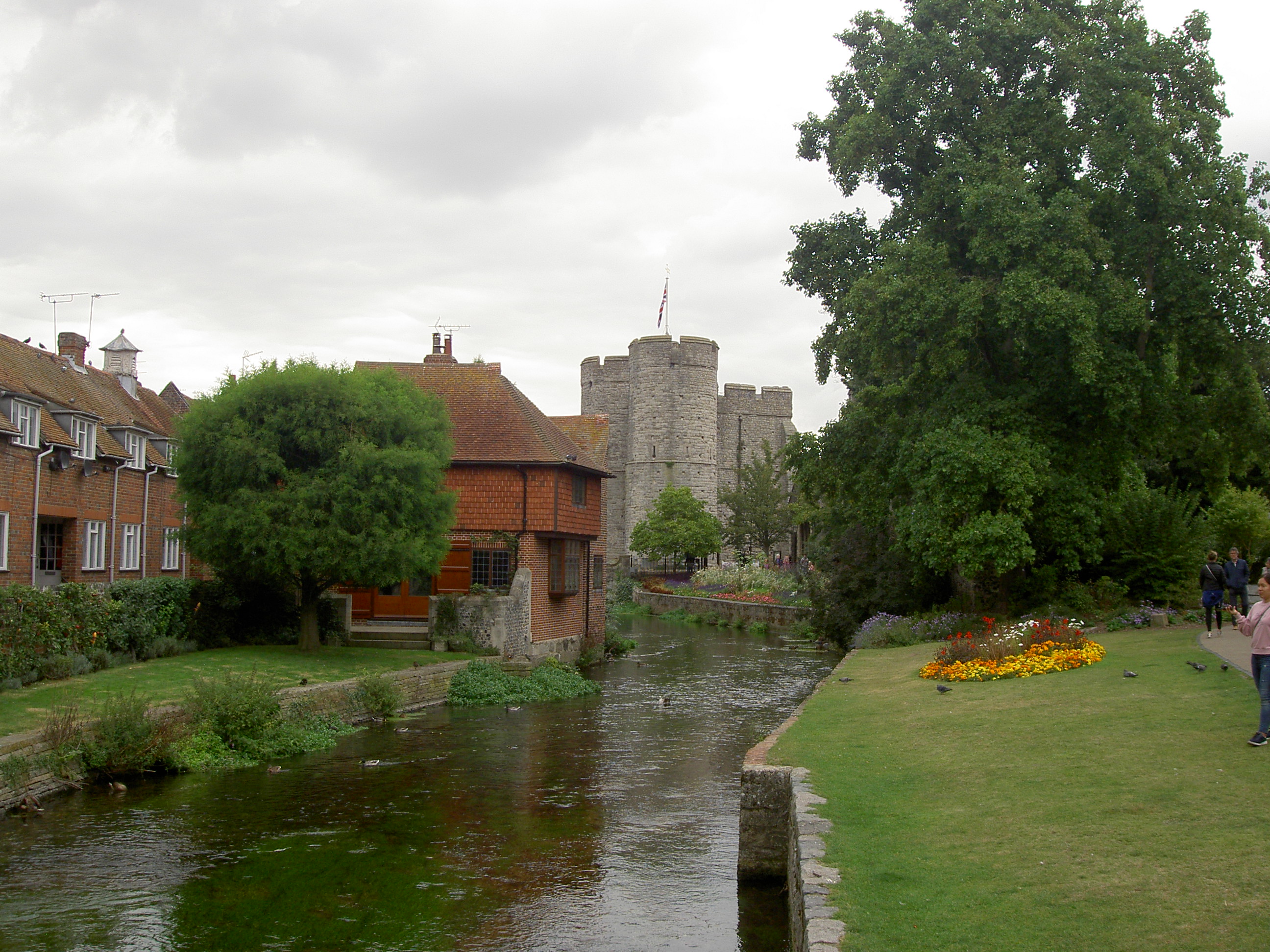
We have been to Canterbury a few times, and caught up with old friends and not so old nephews and nieces there. We have walked past the West Gate of the old city wall, and through delightful gardens along the river Stour.

Westgate tower and gardens

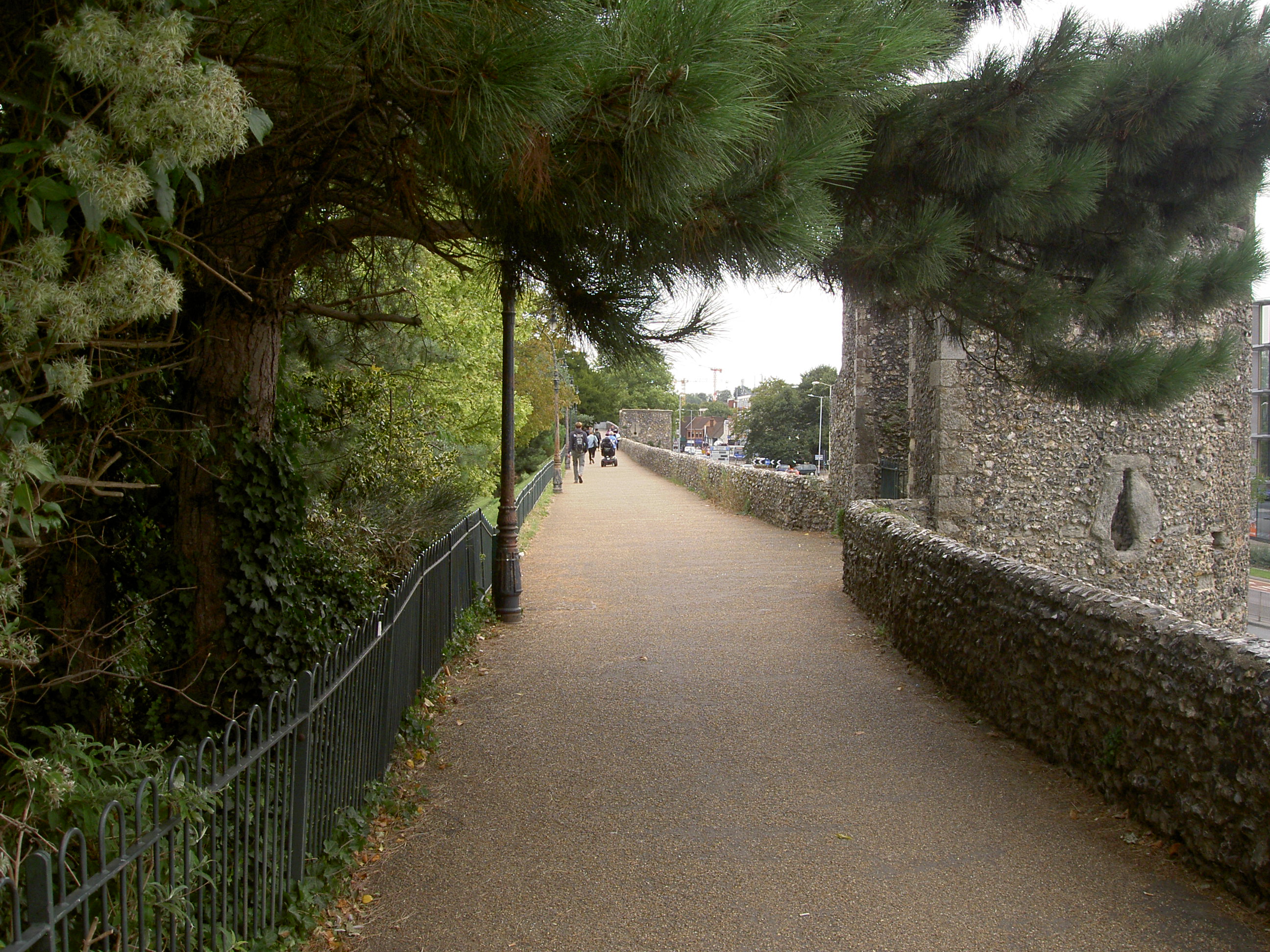
We have wandered along the remnants of the old city wall, now only a few hundred metres remaining, the rest having been demolished long long ago.

Old city wall

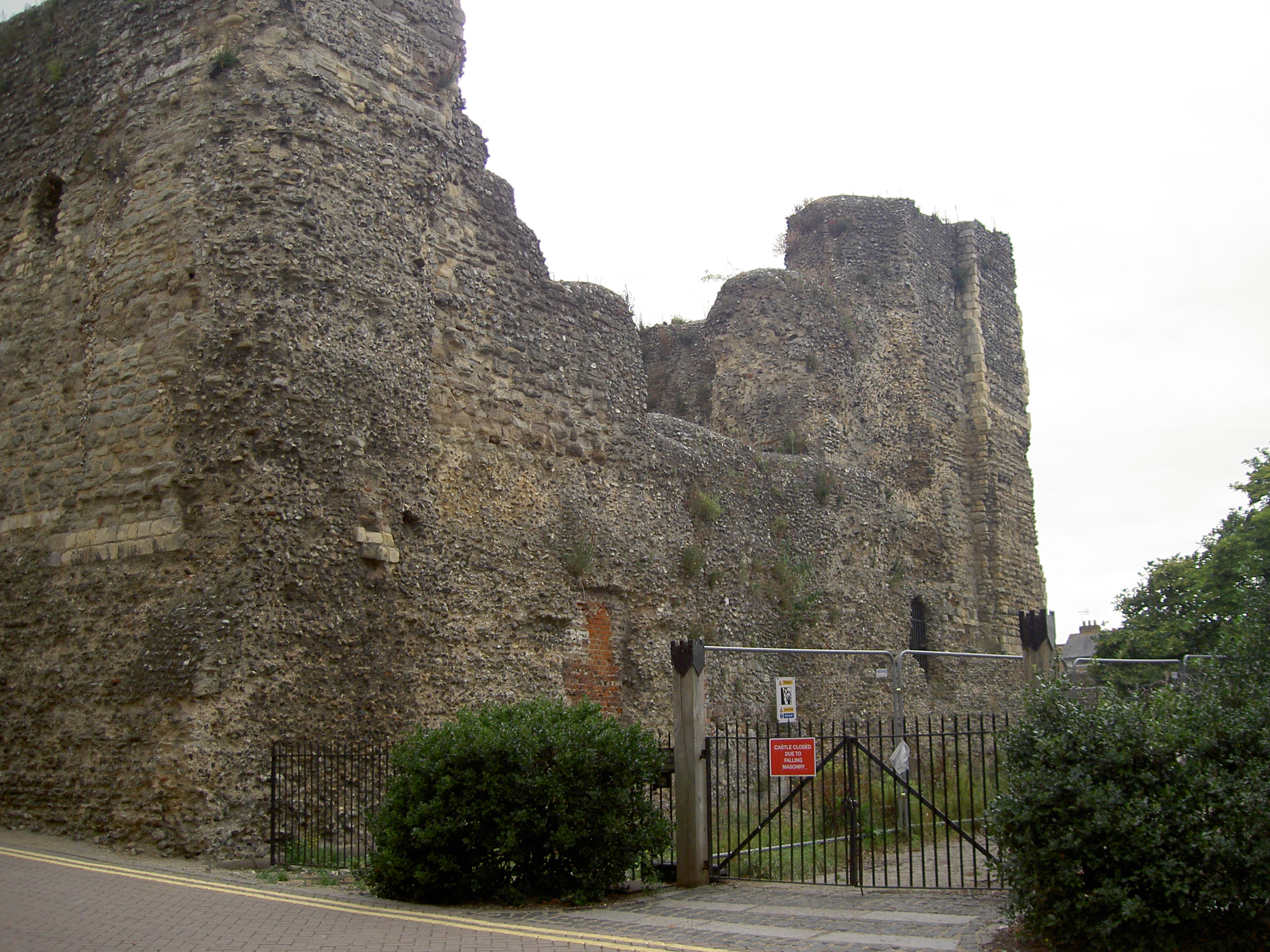
We passed the ruined castle, originally built soon after the Battle of Hastings (1066), and now closed to visitors as the structure has become unsafe with the risk of falling masonry;

Canterbury Norman castle

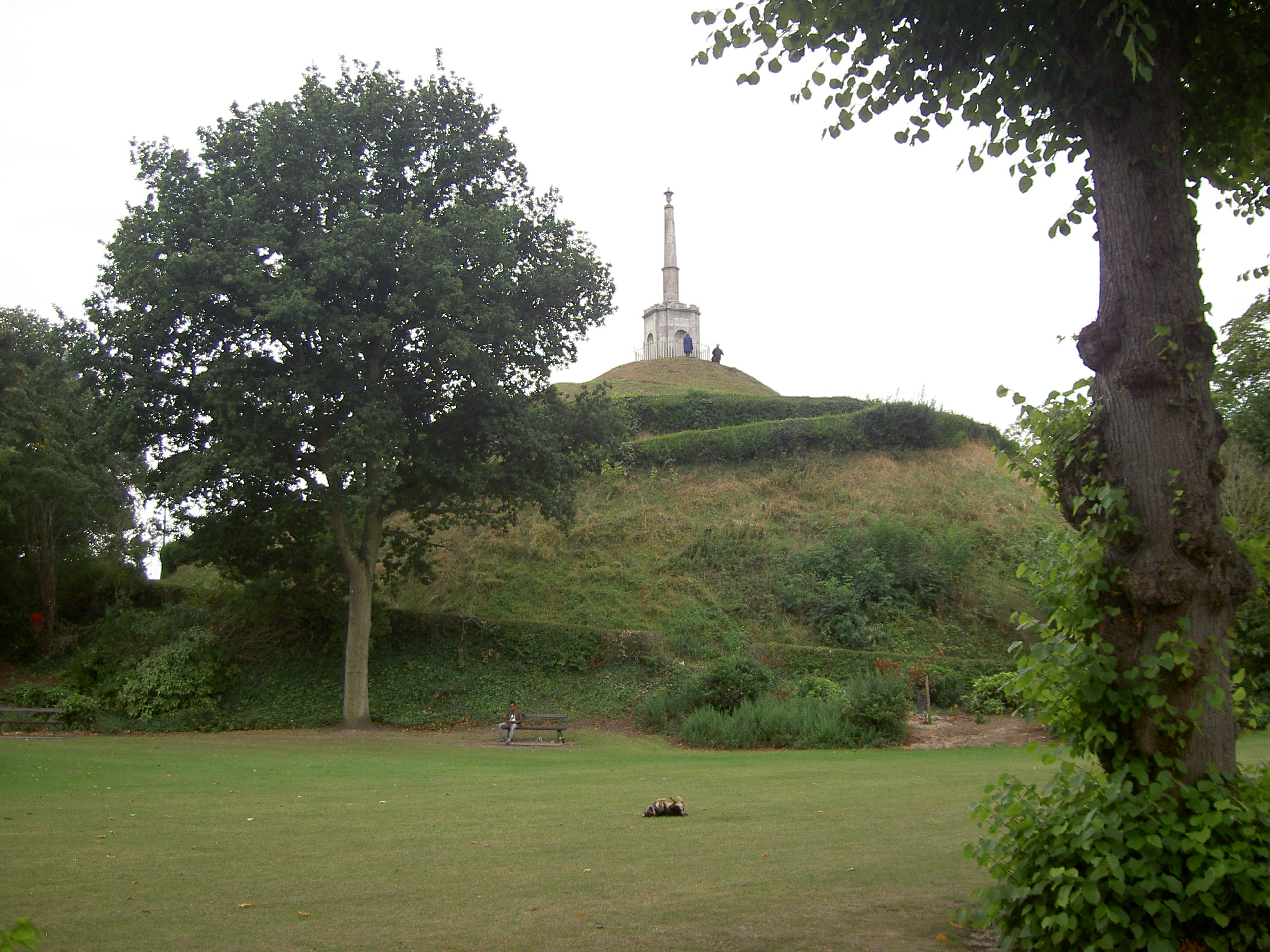
and the Dane John, believed to be a 2nd century burial  mound.

Dane John

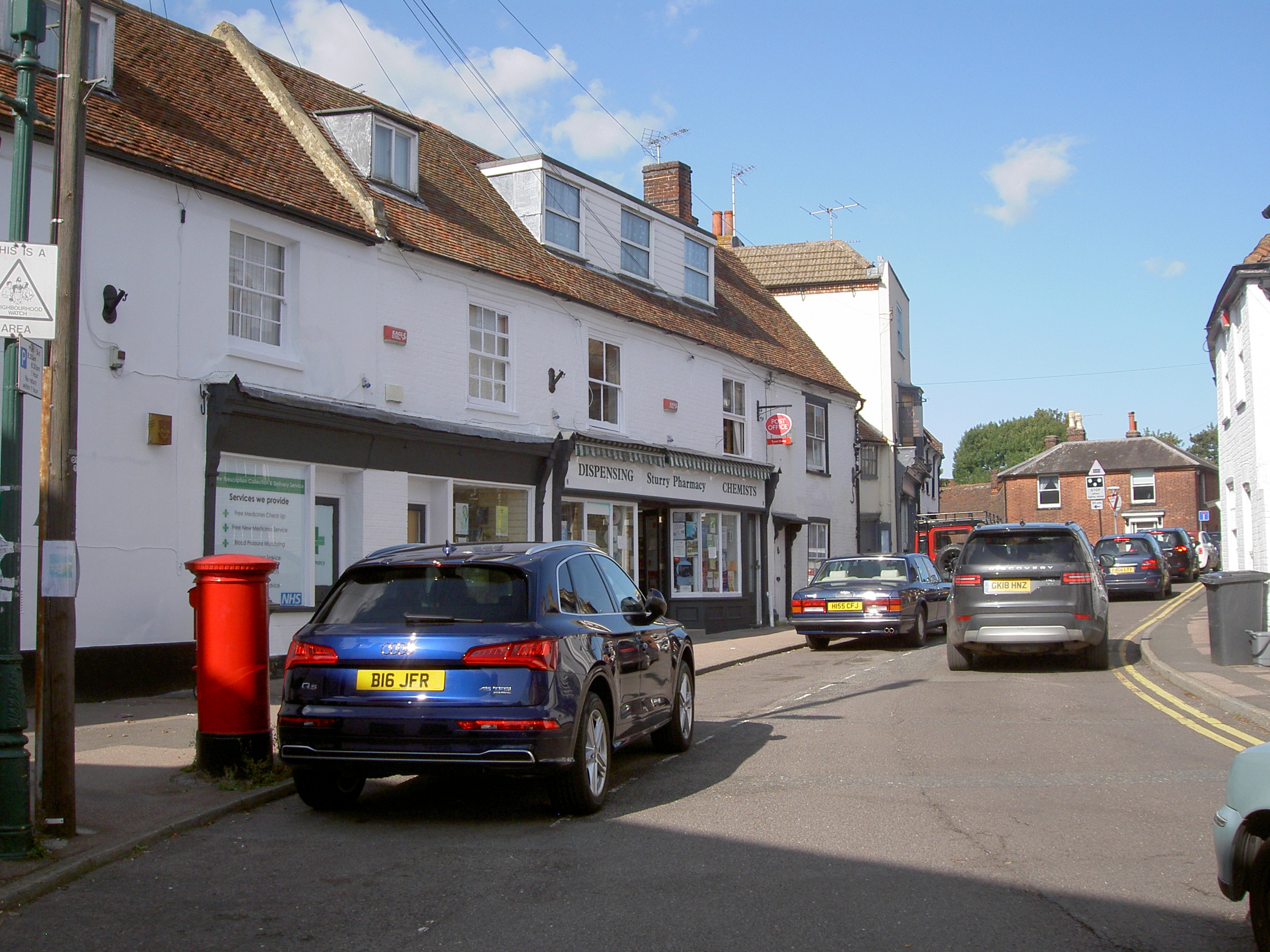
We caught the bus to Sturry, and asked the driver if he stopped near The Welsh Harp Inn, from which we could walk to Fordwich. The driver was much younger than we, and had no idea that the pub now called The Middle of the Road was once The Welsh Harp! Anyway, the bus did stop where we wanted it to, irrespective of the name change, and we wandered through the village of Sturry where my maternal grandparents lived. We visited the old post office where an aunt worked when I was a child,

Sturry High Street, showing the chemist/post office

and we strolled through the churchyard to the Sturry mill pond.

Sturry mill pond

The mill had burned down many years ago. As a student of the Sturry primary school, long ago demolished and now a housing estate, I used to catch elvers (baby eels) like strands of black cotton, in the shallows of the pool as they returned from the eel breeding grounds in the Sargasso Sea.

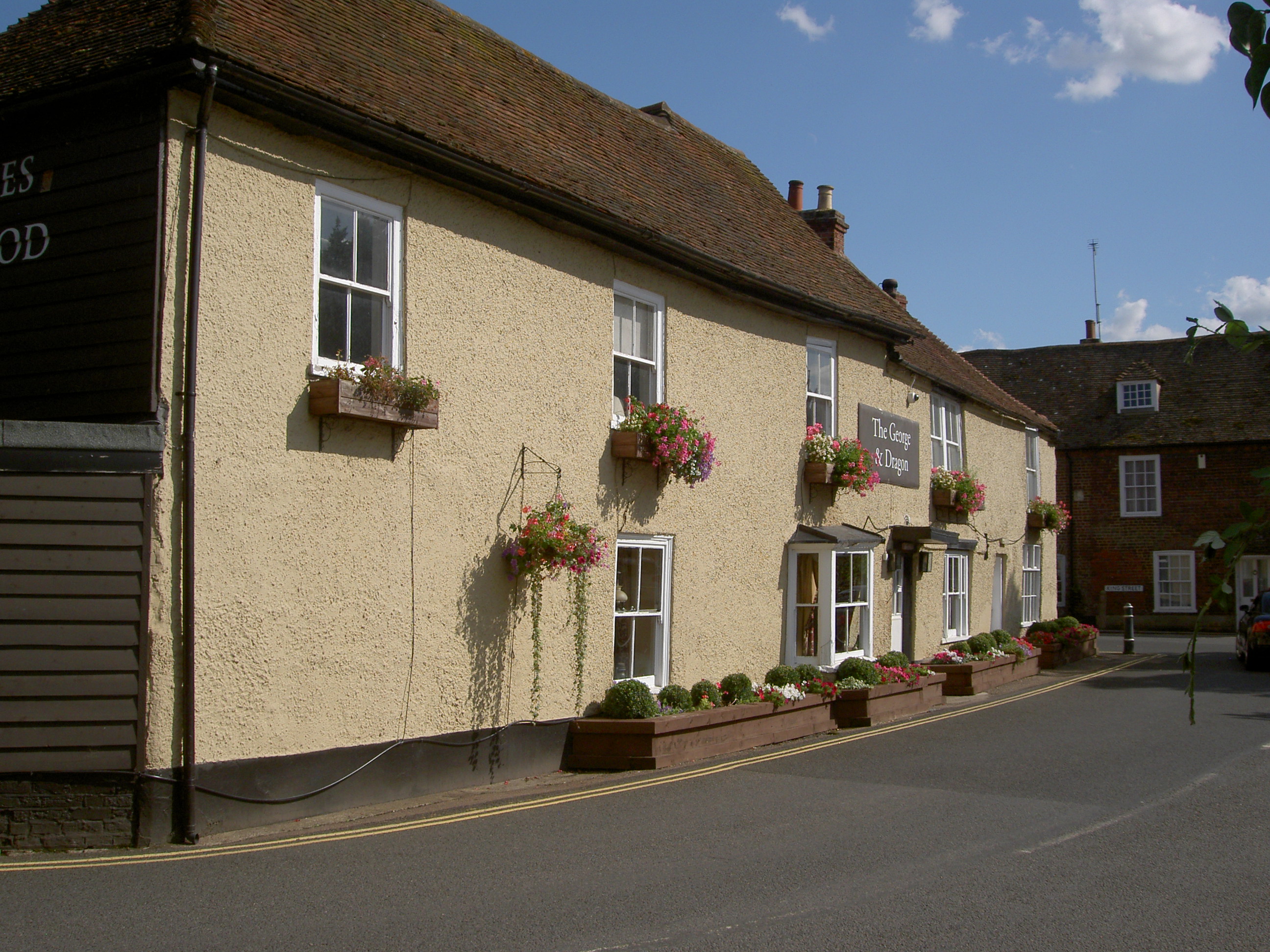
We walked to Fordwich, and enjoyed couple of pints and a splendid meal at the George and Dragon. More than 50 years ago I had my 21st birthday dinner at the George and Dragon, and the old pub was exactly as I remembered it!

The George and Dragon, Fordwich

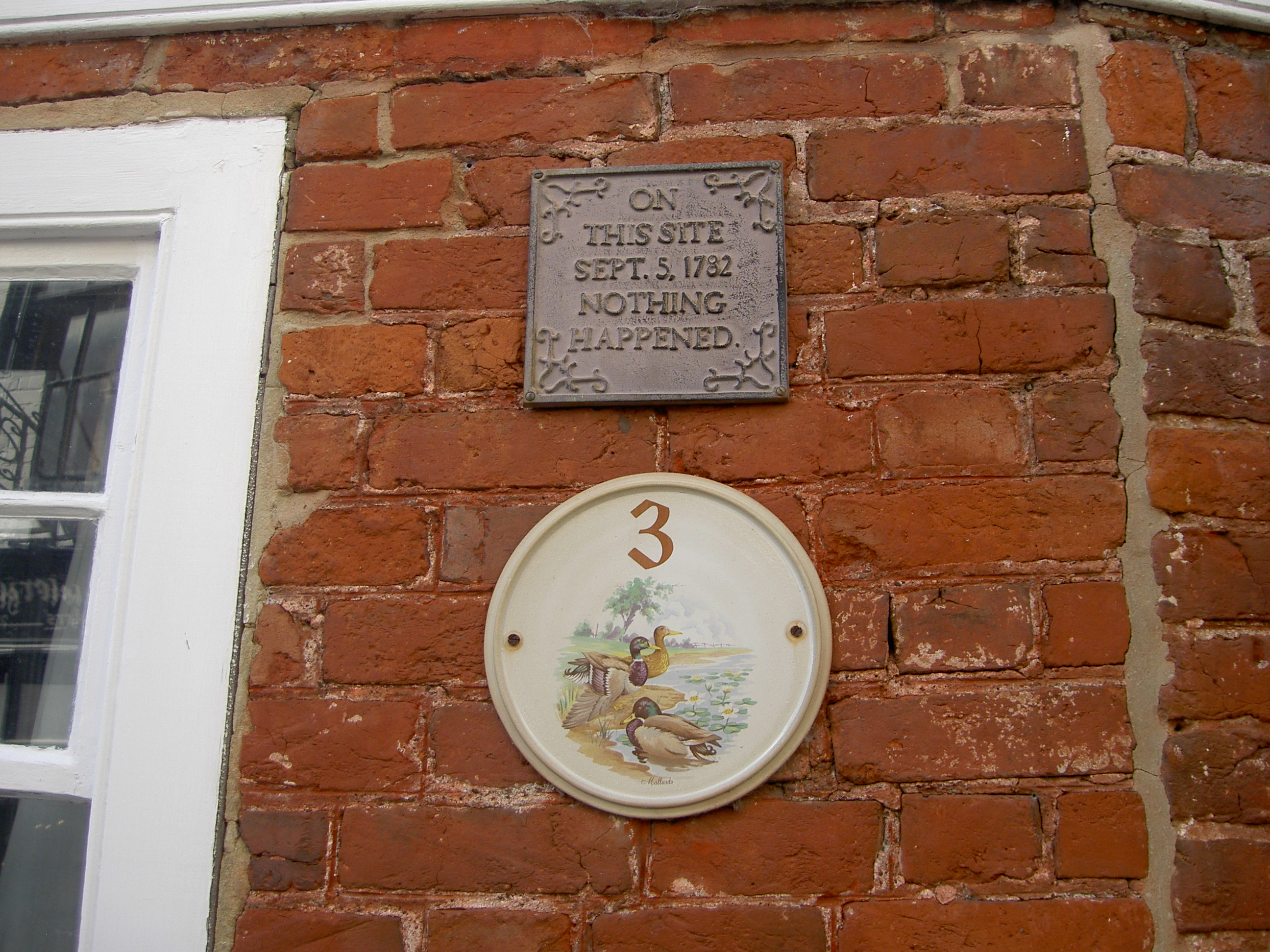
Our roving bus ticket also took us to Sandwich one afternoon, but as we left late in the day, we only had time for one beer before getting on the bus back to Canterbury. Whilst Sandwich was a very significant port in the old days, it appears that on September 5, 1782 nothing worth commemorating happened!
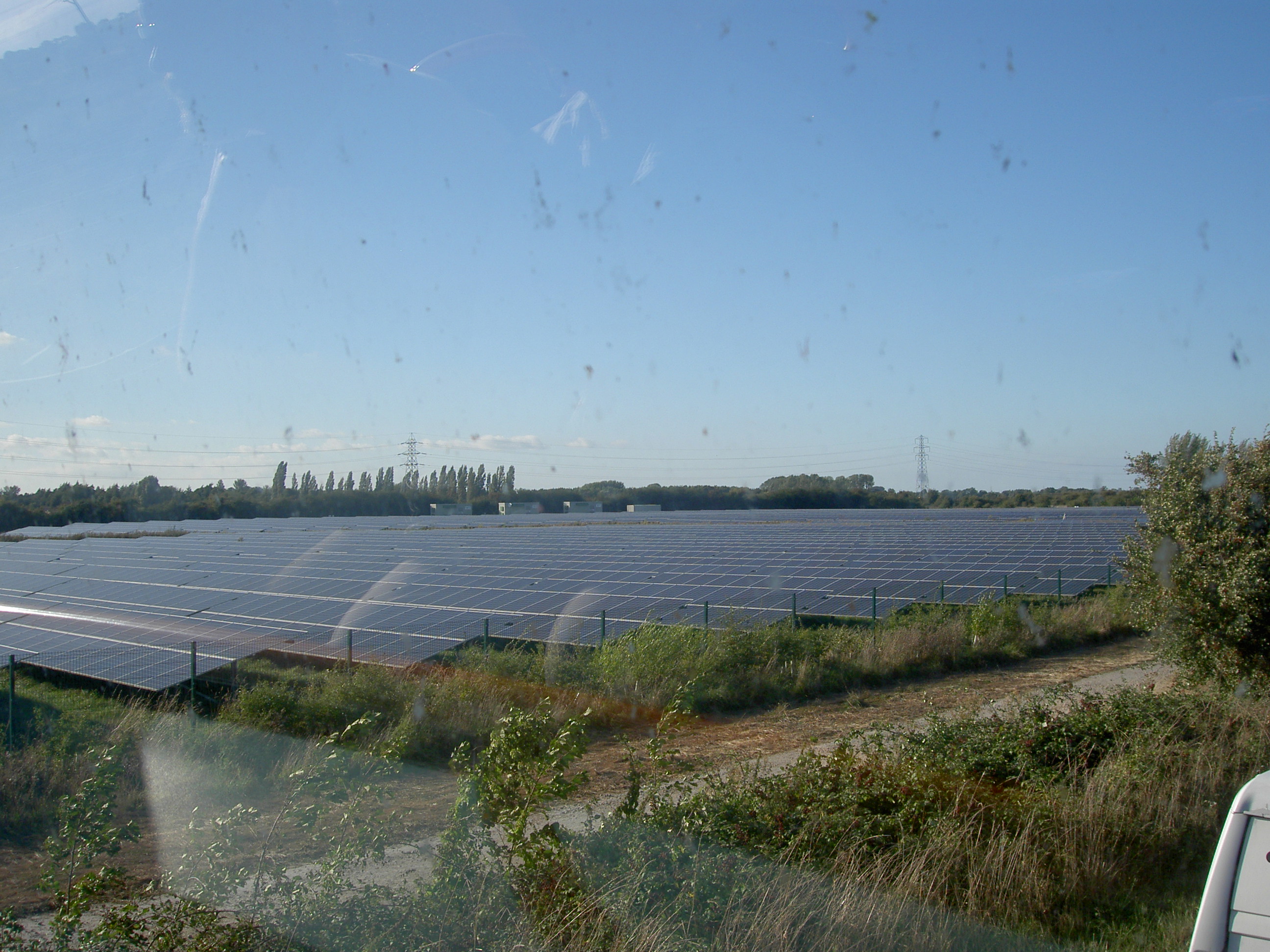
But what we did see at Sandwich, through the windows of the bus, was a huge solar power plant.
Solar power plant, Sandwich

This is one of many such arrays that we have seen, and is what we should be doing in Australia, rather than subsidising wealthy people to put half a dozen panels on their roof tops!

We also made a nostalgic trip to Faversham, where I went to school.

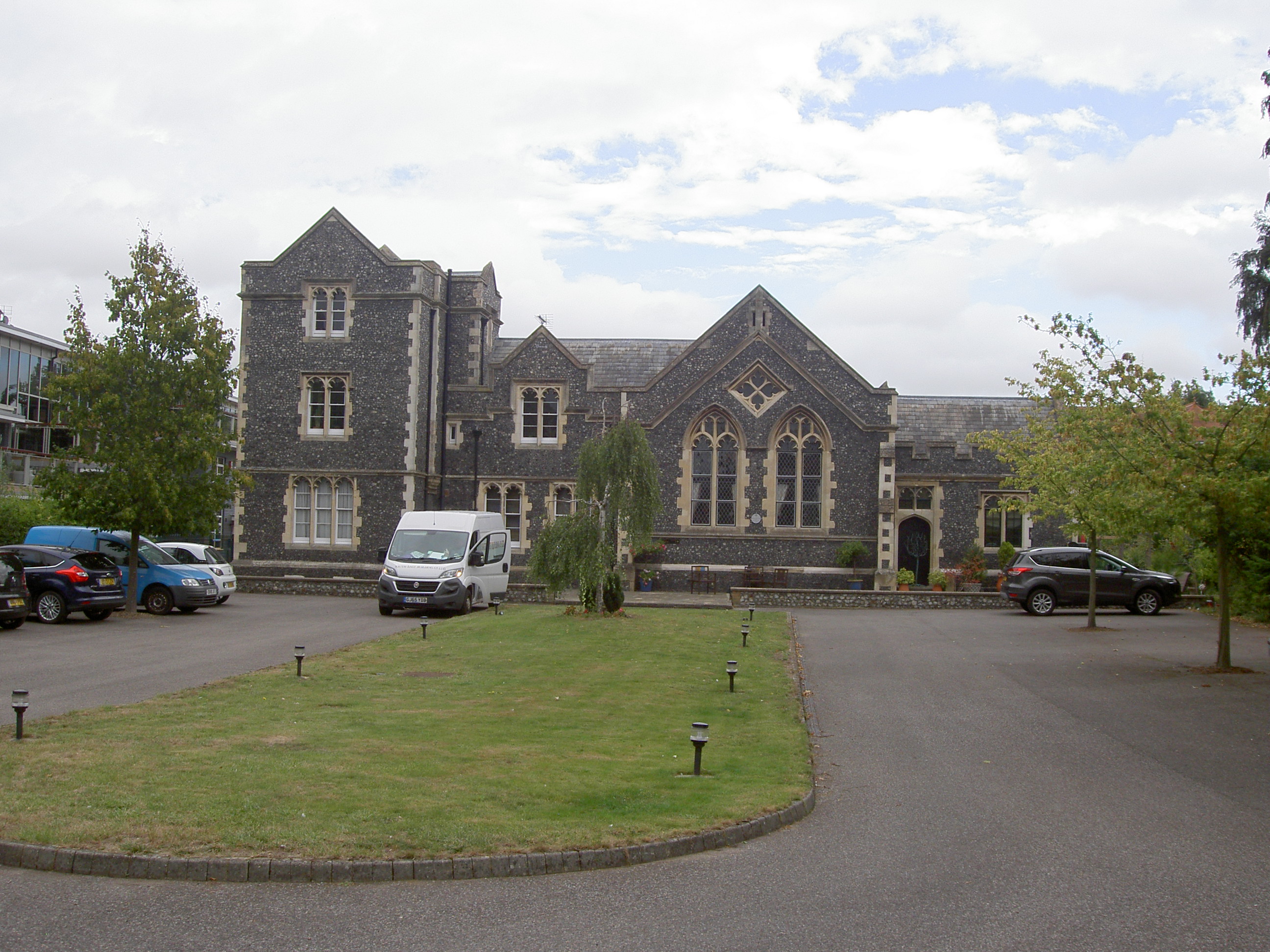
Queen Elizabeth Grammar School for Boys, Faversham. Now an office block.

I even managed to provide the ladies in the Information Office with some more accurate information on the location of the old school, which has since been redeveloped on a new site beyond the church. We found the house of Thomas Arden, the quondam mayor of Faversham who was murdered by his wife’s lover in 1551. His story has been told in the (probably) Shakespeare play, Arden of Faversham; and we enjoyed a pint in a pub on the bank of Faversham Creek.

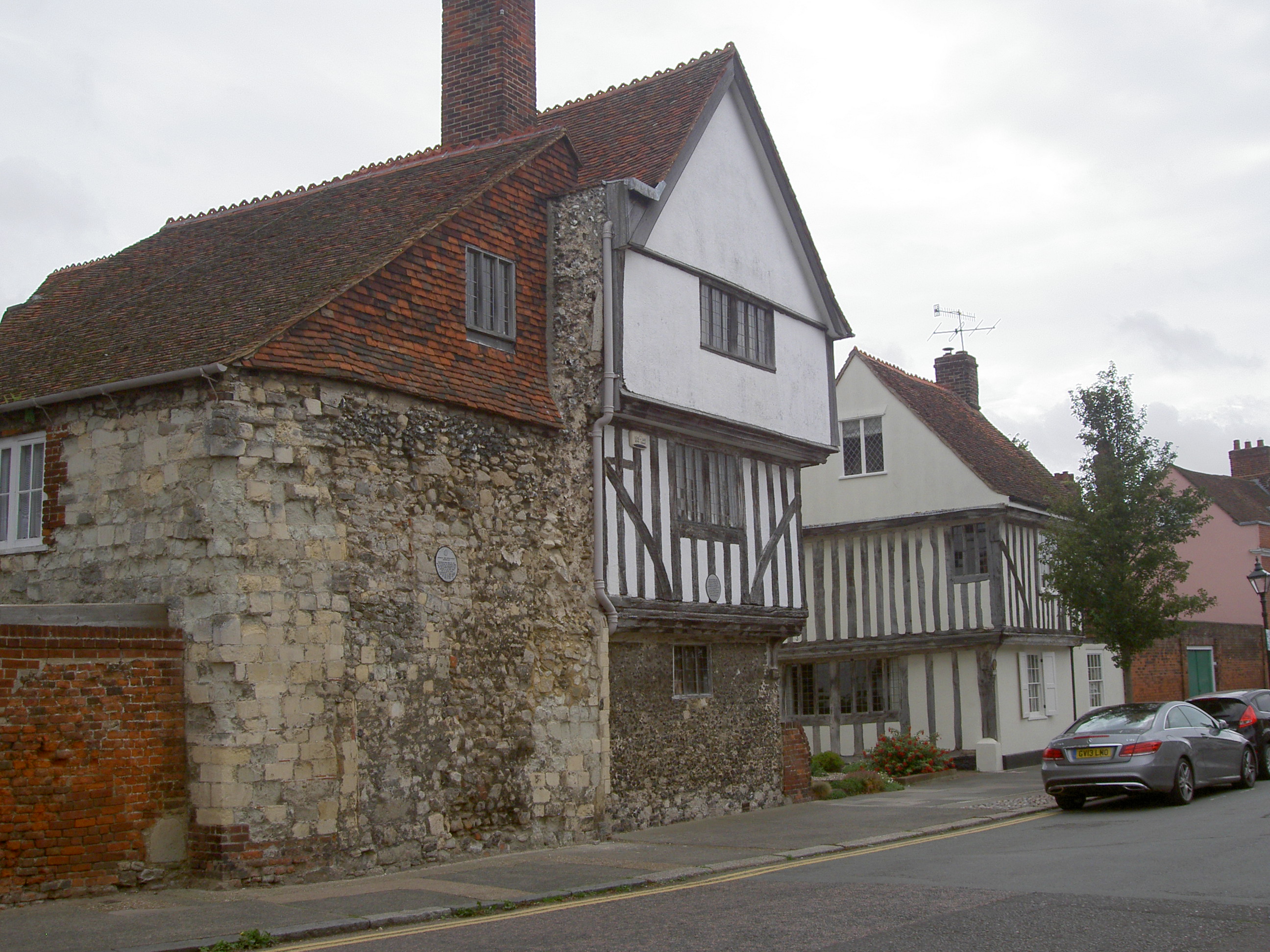
Arden’s House

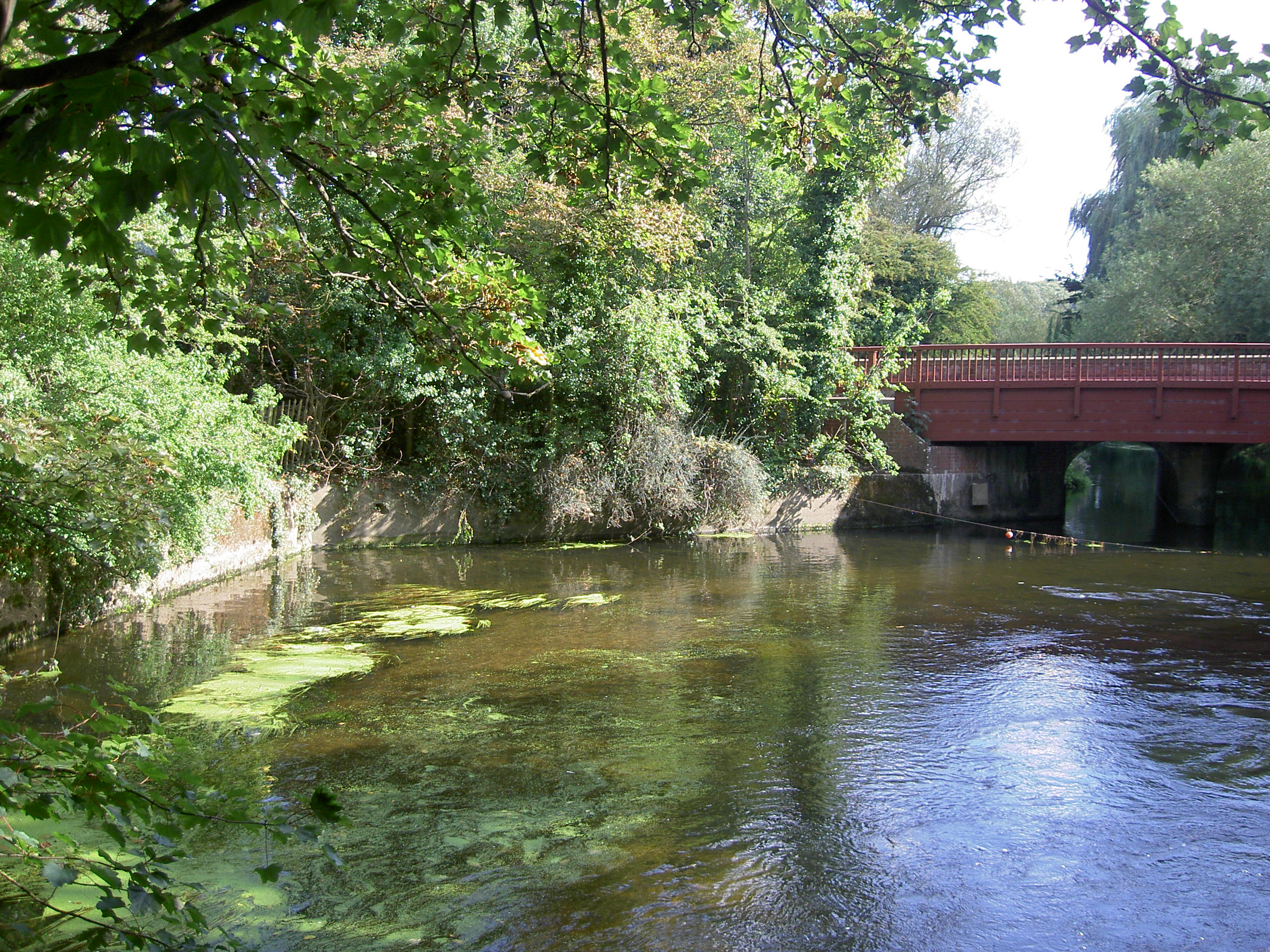
Between Canterbury and Margate we went across the Wantsum Channel, less than 2000 years ago a three kilometre wide navigable waterway, now reduced to a two meter wide marshy stream. This accounts for the fact that the village of Stourmouth is nowhere near the sea, but in the middle of the East Kent Marshes.

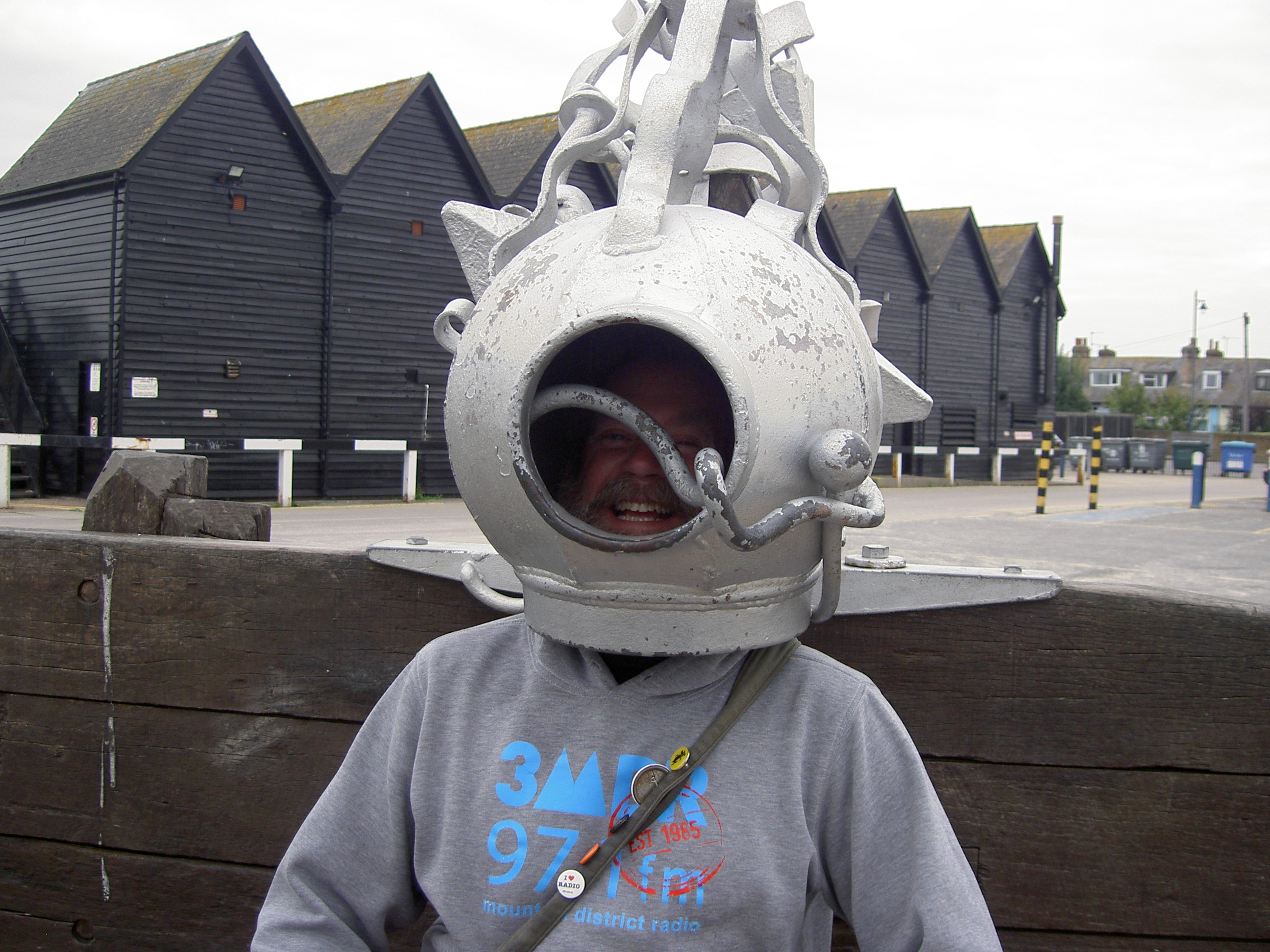
Another of Whitstable’s claim to fame is that the diving helmet was invented here! It was not clear to me how many people might have drowned testing the invention before a successful helmet was produced, but there is a memorial to the achievement close to the harbour.

Monument to the invention of the diving helmet

We really enjoyed our sojourn at Whitstable, even though we were contributing to the number of visitors which seem to be upsetting some of the older local residents! It has become rather gentrified in recent years, with people referred to as the DFLs (the Down from London) buying in and thereby increasing the cost of housing for the younger locals—-who are increasingly leaving the area to seek work in London!

The next episode will be our trip to the West Country and the Channel Islands.


Sketches of Whitstable 2

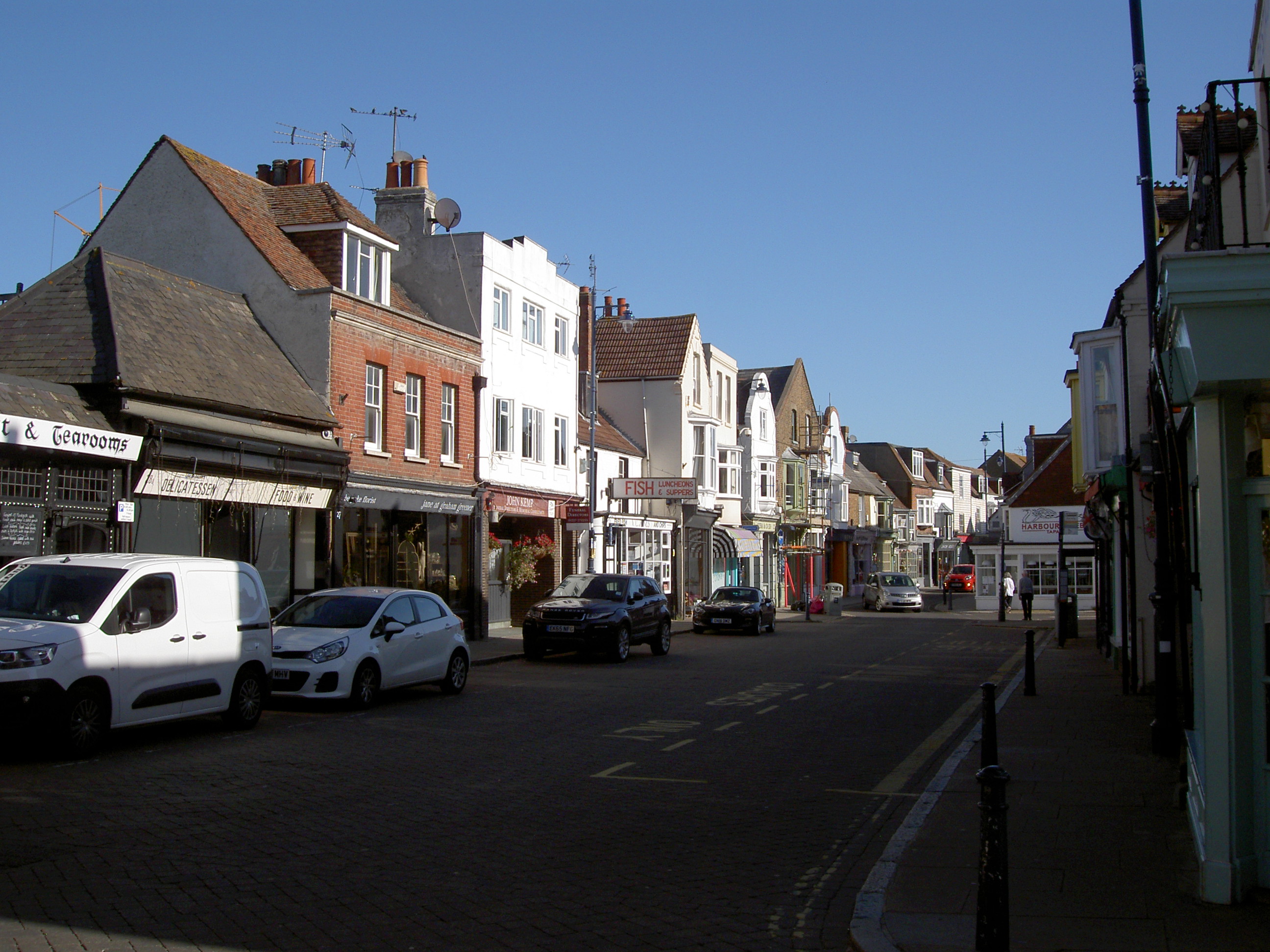
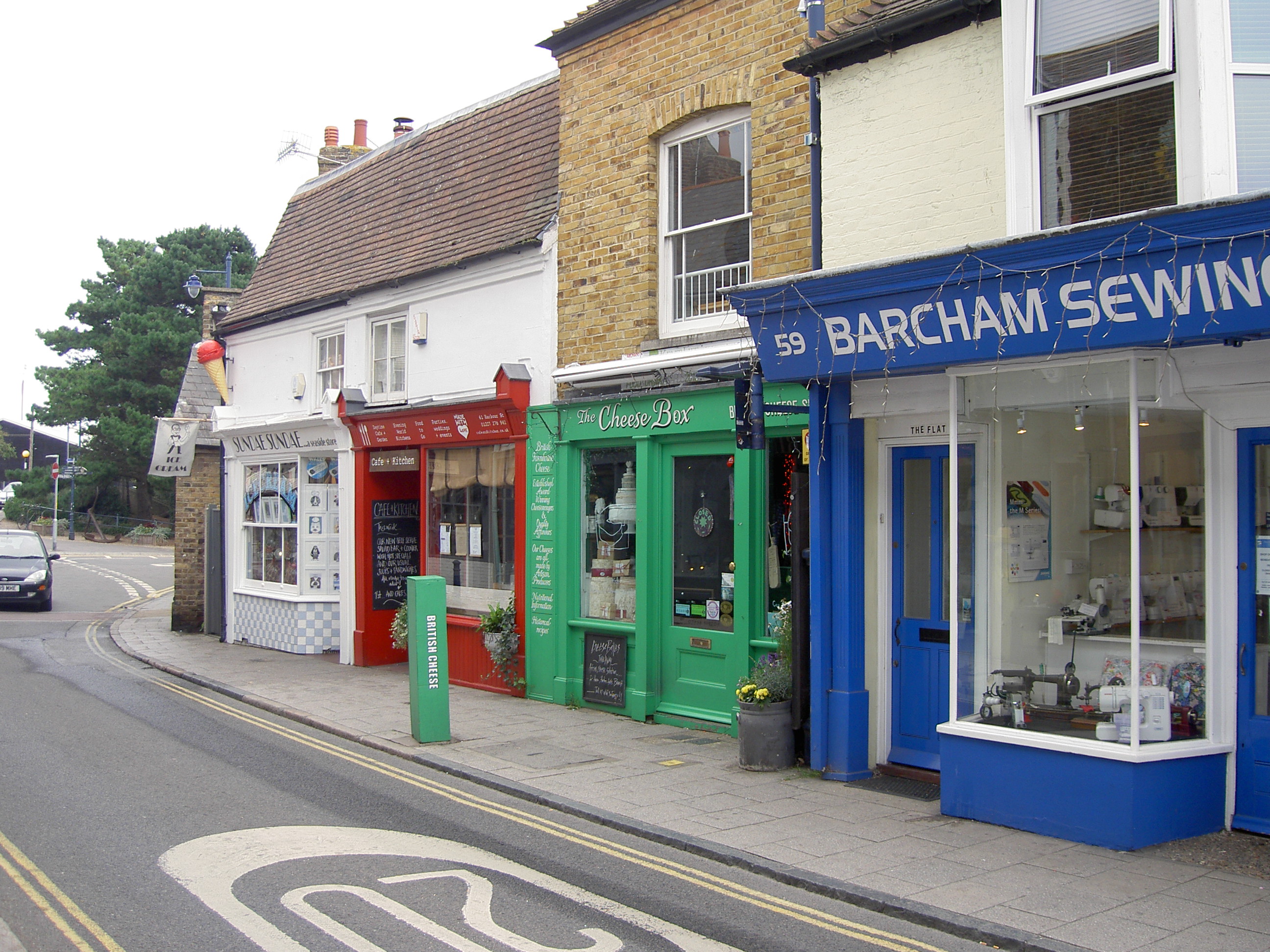
The winding main street of Whitstable is not very wide at best, and very narrow indeed in some parts. The footpaths are similarly of varying widths, and with the throngs of mostly tourists, people ‘down from London’, a few local residents moving around, and too many cars for comfort, walking around was necessarily slow.

Oxford Street, early morning

This photo was taken early morning while it was possible to get a picture without all the people. There are some nice shops, including some very good ‘Charity shops’, in one of which I bought a nice bed sheet so that I could dispense with the dreaded doona—an item of bedding I cannot get on with at all! I shall donate it back before we leave England.

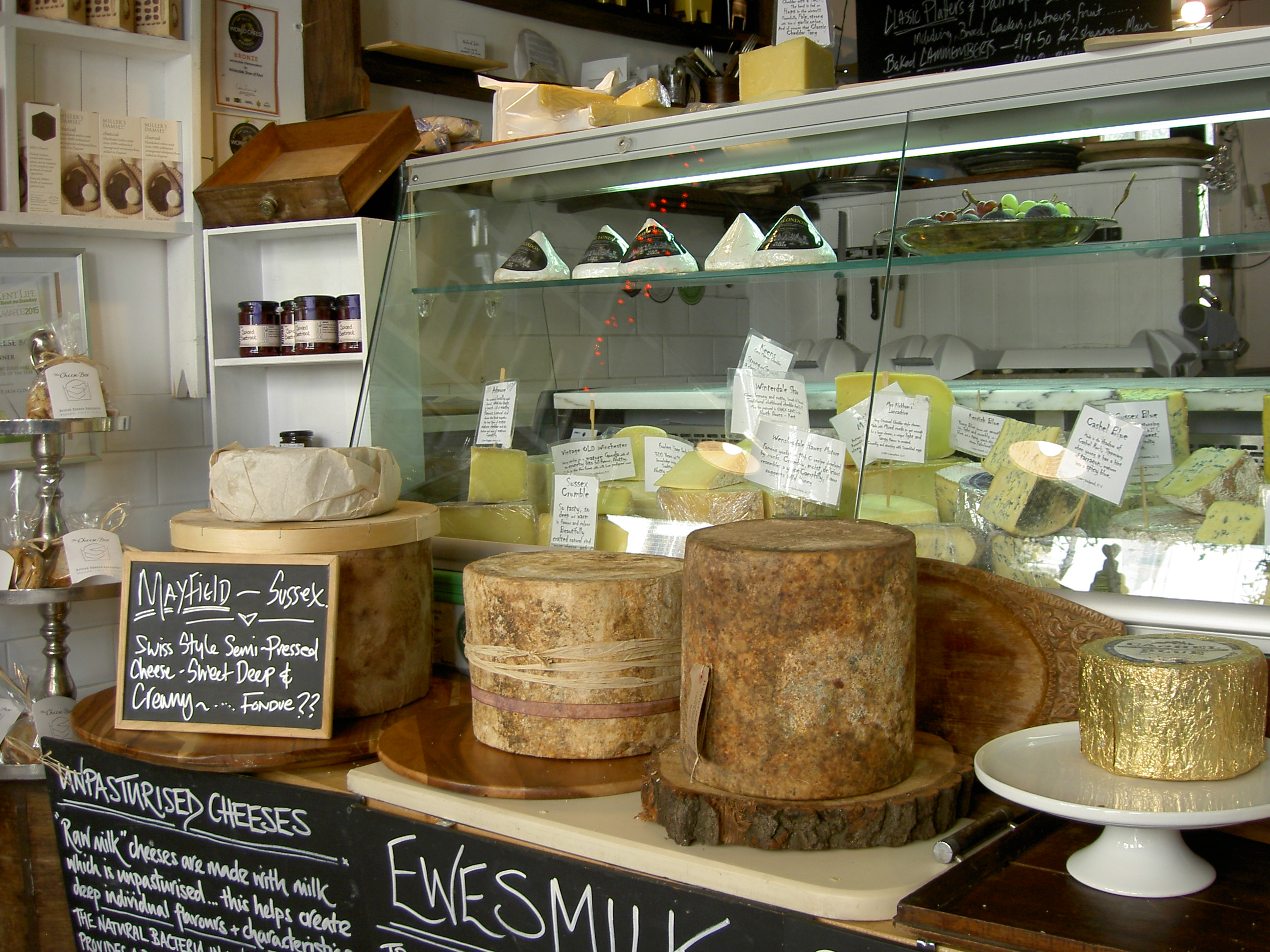
There is also The Cheese Box, which as its name implies, has a wonderful range of cheeses from all over Britain.

The Cheese Box
Inside The Cheese Box


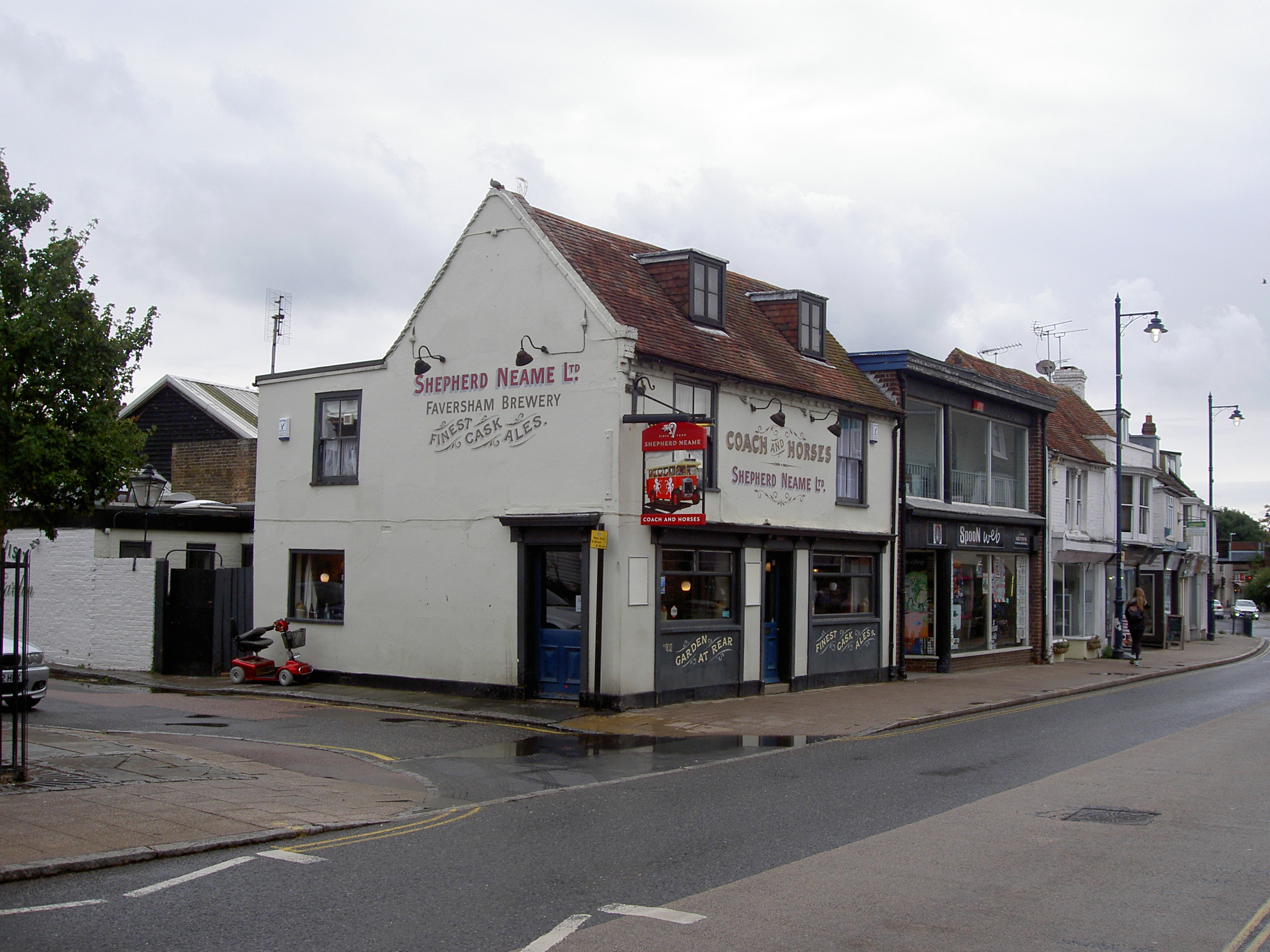
The baker’s shop makes the best Eccles cakes I have had, and, twice a week, has traditional English tea-cakes – a sort of soft round raisin bread-like flat bun. And interspersed between all the shops are pubs, large and small. I am not sure how many pubs there are in Whitstable, but we have enjoyed a pint or two in many of them, including the Coach and Horses, a pub in which we consider ourselves to have some sort of proprietorial right. My Great Grandfather was the licensee from about 1884 to 1898, and my Grandfather was actually born in the pub. One night we had old Frederick’s great grandson (me), a great great grandson, three great great granddaughters, and two great great great granddaughters all in the pub at the same time. We must have at least tripled the night’s takings, as we outnumbered the regulars by several orders of magnitude. I hope old Frederick would have been proud of his descendants!

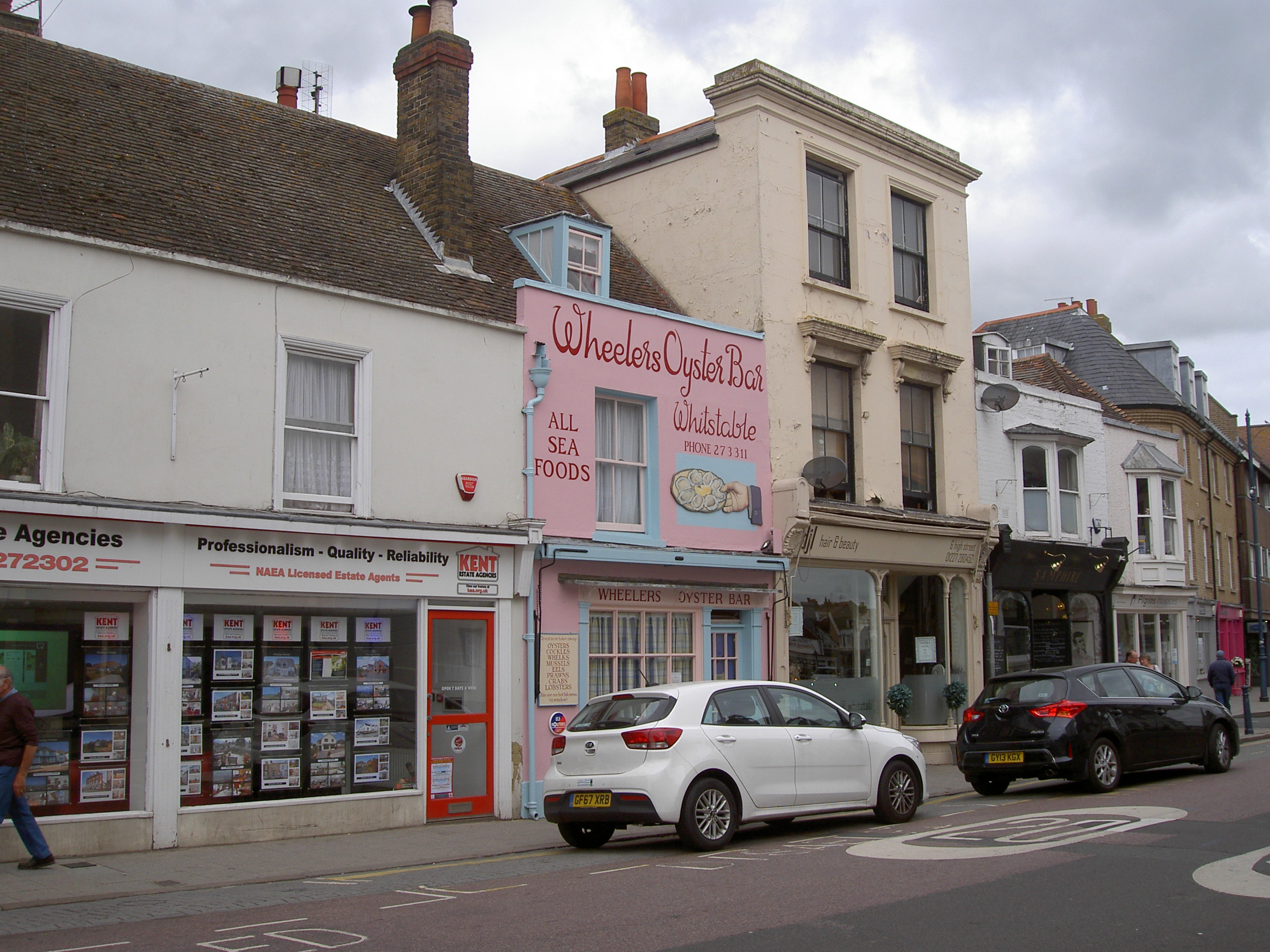
I did pop into Wheeler’s Oyster Bar, but bought some cockles rather than oysters. I was saving the oyster treat to share with our granddaughter, but as Murphy’s law would have it, we didn’t manage to fit that in during the short time she was with us at Whitstable.

Wheeler’s Oyster Bar

As I mentioned in the previous blog, oysters have been harvested here since at least Roman times, and probably a lot longer as there is evidence of habitation in the Paleolithic era, the  Bronze Age and the Iron Age. The Romans exported the oysters back to Rome, and it appears that a couple of Roman trading galleys, possibly collecting a cargo of oysters, sunk off the coast of Whitstable about 1800 years ago. Earthenware pots from the galleys are still occasionally found to this day.

In the years following the end of the Roman period, it seems that oyster harvesting was a bit of a free-for-all until about the middle of the 16th century when the right to harvest oysters was given by a Royal Patent granted in 1574 to the Minter family, the then owners of the Whitstable Manor.  In 1790 the Manor was sold to private landowners, and three years later the rights to harvest the oyster beds were bought by the newly established Company of Free Fishers and Dredgers of Whitstable. By the early 20th century, the Oyster Company of Free Fishers and Dredgers had become the Whitstable Oyster Fishery Company.

In the mid-19th century oyster harvesting had reached such a peak that about 80 million native oysters (Ostrea edulis) were shipped to London every year, where they became a food of the poor! Several of Dickens’s novels refer the poorer people enjoying oysters and beer. Harvesting of the native oyster then drastically declined in the first half of the 20th century and eventually ceased altogether due to pollution, disease, bad weather, and two wars. Farming the faster growing Pacific Oysters (Crassostrea gigas) on the foreshore was initiated about five years ago with great success, and now the native oysters account for only 20% of the harvest. However, not everyone is thrilled about the ever-expanding oyster beds. Local residents have for years been able to swim, canoe, windsurf and sail in Whitstable Bay; the oyster dredging was well off-shore and posed no threat to other users of the water. But now, the expansion of the racks in the inter-tidal zone on which the Pacific oysters are grown, has significantly impacted on the recreational activities in the bay. It appears that oyster farming at Whitstable is currently the subject of an investigation by the Marine Management Organisation after allegations about the racks causing safety issues and blocking navigation for watercraft and swimmers. So not all is well back on the farm!

The next blog will be more about our visits to places other than Whitstable.


Sketches of Whitstable


So here we are in Whitstable, which, for those who are not familiar with this part of England, is on the north coast of Kent, at the extremity of the Thames estuary. It is readily accessible from London by rail, which passes through the Medway towns of Chatham and Rochester, well known to the fans of Charles Dickens. From the Medway towns, the train passes through Sittingbourne and Faversham before it reaches Whitstable, and then continues through Herne Bay, Birchington, Westgate, Margate, and Broadstairs before terminating at Ramsgate. We will be visiting some of these towns, and I shall write a little about them, but if you scroll back through the Blogs from 2012 and 2016, many of them get a mention there.

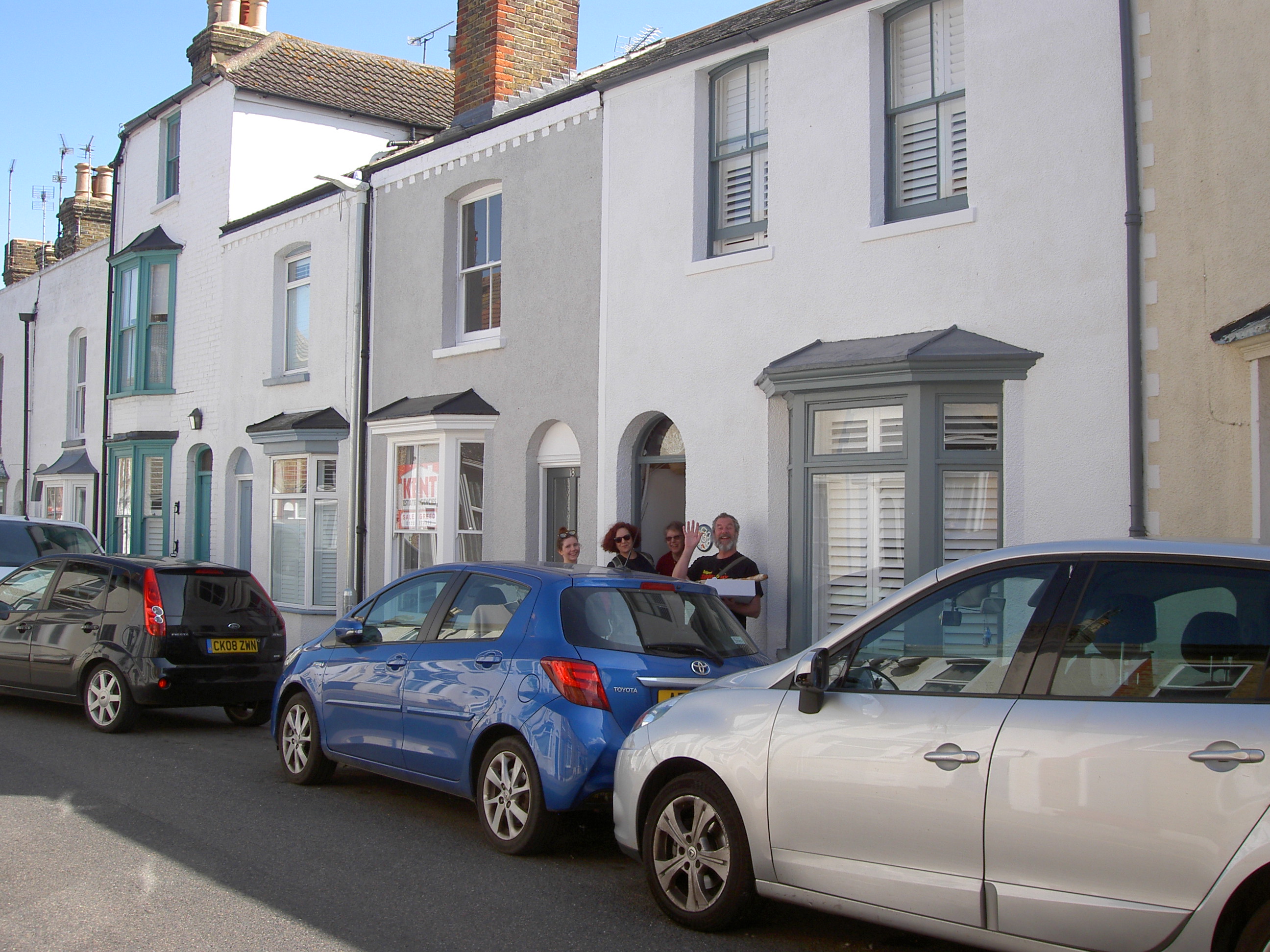
But this particular Blog will concentrate on Whitstable, and first I must mention our accommodation here. It is in Argyle Road, and just a stone throw from the main shopping street, Oxford Street. The house next door but one has a plaque on the wall with the date 1866, and it would not be unreasonable to assume that our house is about the same age, as all the houses make up a complete terrace of very similarly designed dwellings.

Argyle Road


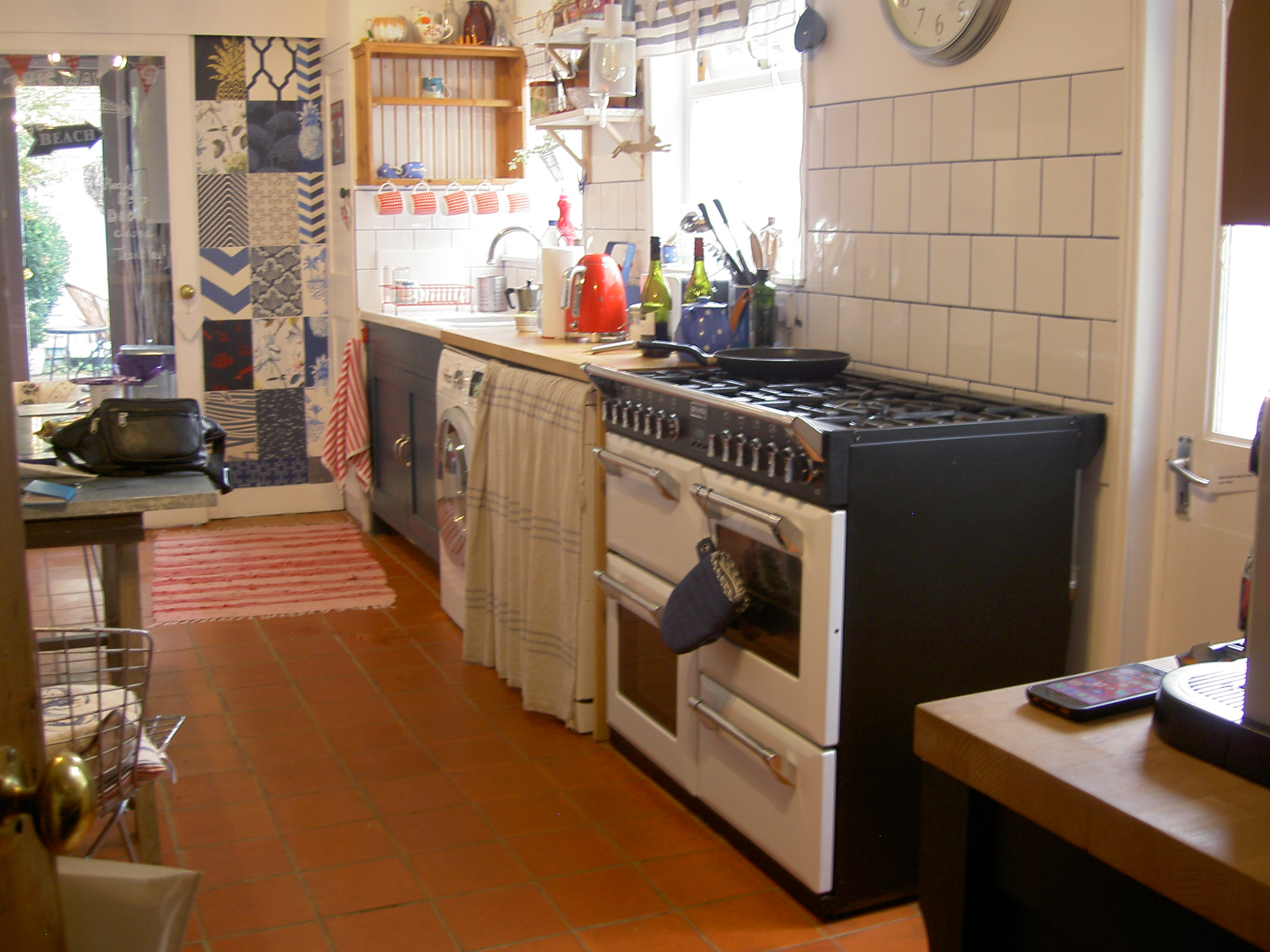
The house is basically one room wide, and three rooms long, with a sitting room at the front, then what would have been a separate dining room, (now with the partition wall removed to make one larger sitting room), and lastly the kitchen. Upstairs we have three bedrooms and a bathroom. There is a nice courtyard garden at the rear of the property, accessible from the kitchen. It is a quaint and cosy house, very well positioned close to all the town amenities. The furnishings are a charming mixture of odd items, and the kitchen facilities are amazingly good. In fact I don’t think we have ever had such a well-appointed kitchen in any of the many rental holiday accommodations we have used. The cookware includes several Le Creuset items, and the kitchen knives are of top quality. The stove has 7 gas hobs, and two electric ovens. I have so far cooked three dinners, and have enjoyed every moment pottering in the kitchen. Whilst on holiday, others might like to laze their time away on the beach, but I am quite content to roll up my sleeves and get into a kitchen—–and this has been the best ever! There are even two balloon whisks!

The Kitchen

Nothing is lacking, except for a pastry rolling pin, for which an empty beer bottle made a readily available and very effective substitute. But really, who would need to make pastry whilst on a seaside holiday?

But enough of the domestic arrangements; let us now have a look at Whitstable as a town.

Car parking is a major problem, so we have not hired a car for this part of our holiday. And with the so-called “Triangle Bus”, which runs every 15 minutes in both directions on the triangular route joining Whitstable, Herne bay and Canterbury, and links every 15 minutes from Canterbury to most of the other places we wish to visit, a car is not really necessary.

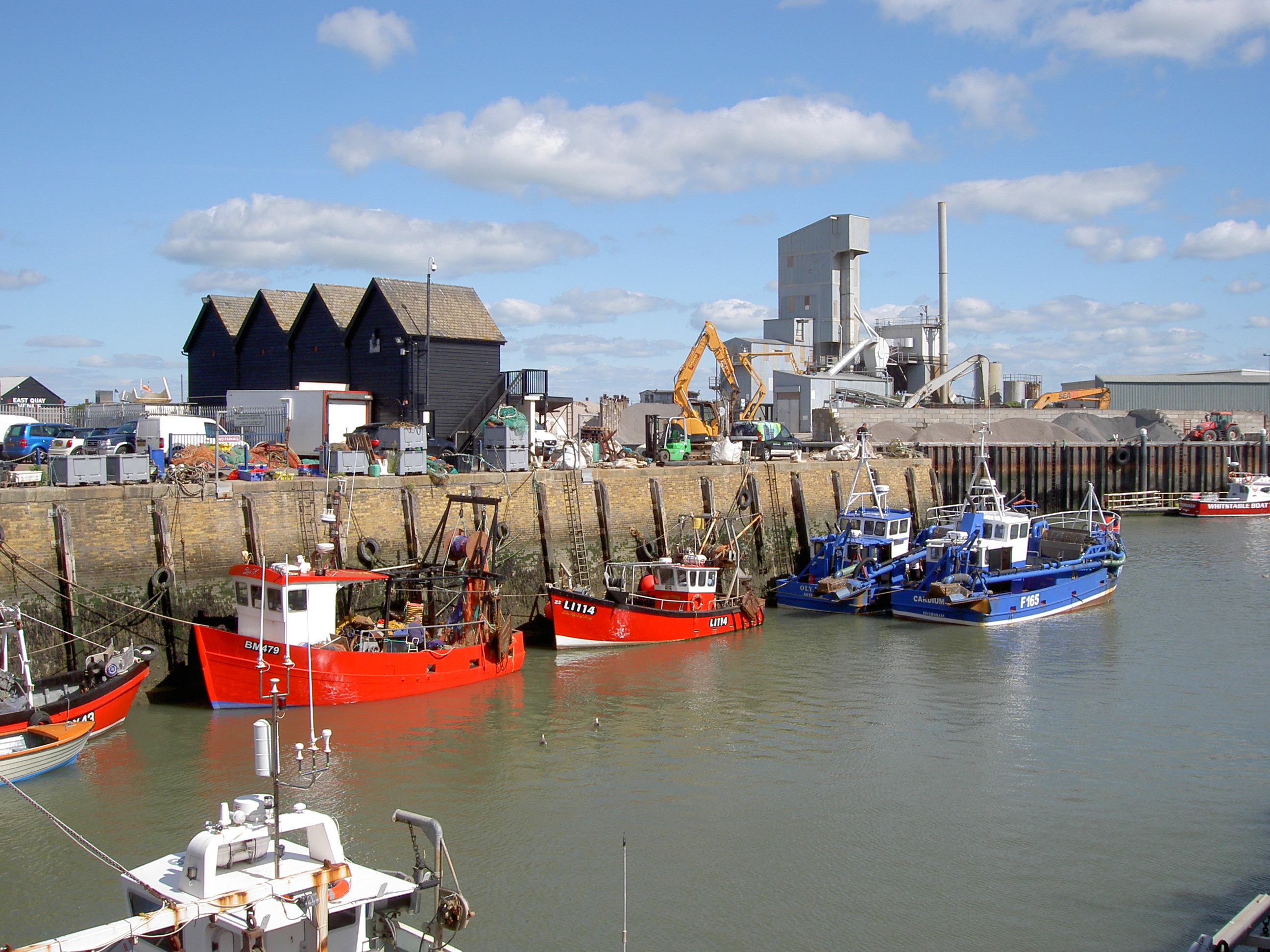
Whitstable is an old town, with a lovely deep-water harbour.

Whitstable Harbour, Low tide

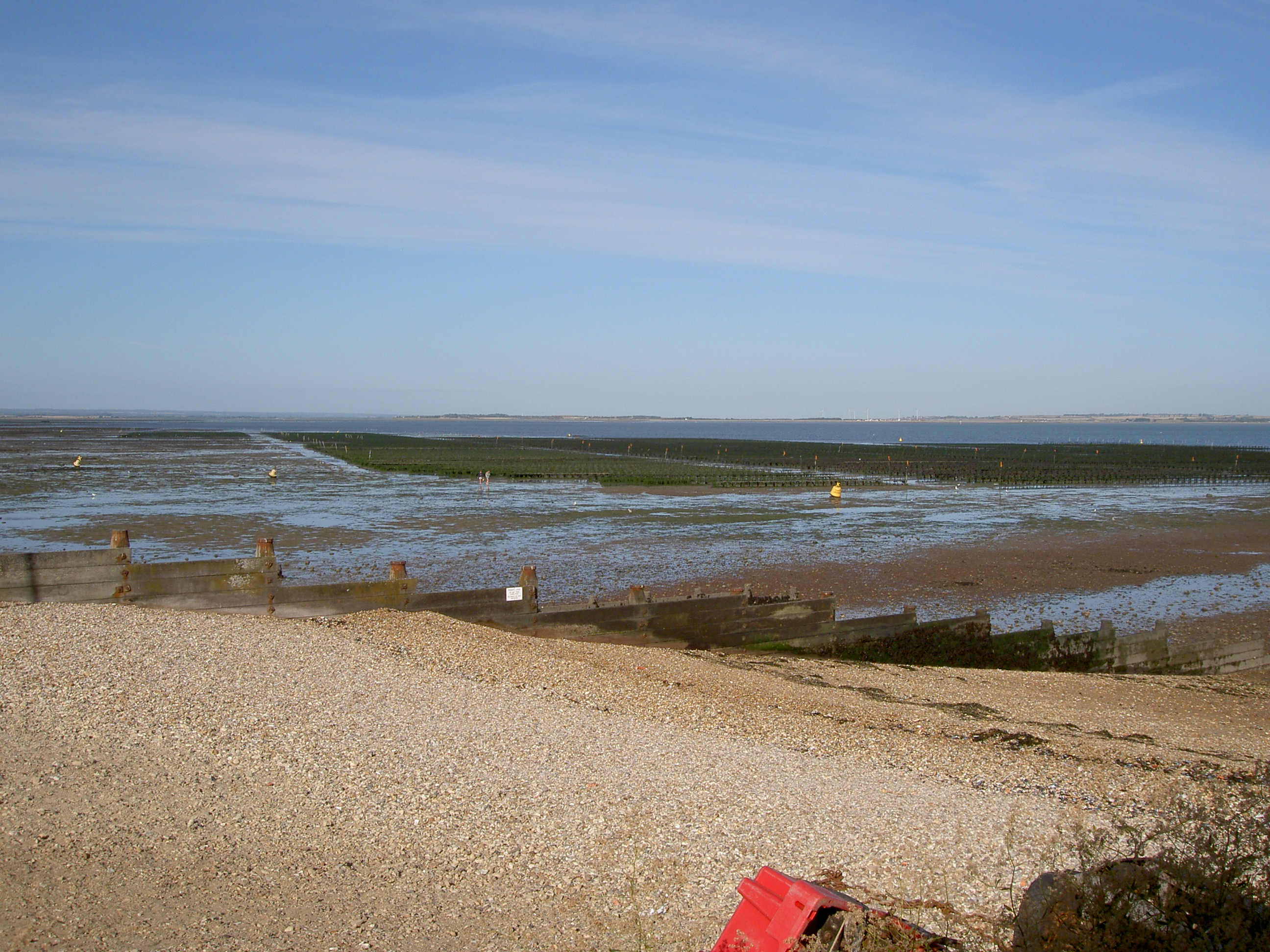
Well, it is deep when the tide is in, but empty when the tide is out. Being a frequent user of the gently sloping pebbly beach at nearby Herne Bay as a child, I had not realised that there is about a five meter tide in these waters! Through the 19th century Whitstable harbour was an important part of the local industry, in that coal from the mines in the midlands was brought in by ship. Fishing is also very important, and Whitstable was, and still is, famous for its oysters which have been harvested here since the Roman days. Oyster harvesting became commercialised late in the 18th century with the establishment in 1793 of the Free Fishers and Dredgers of Whitstable. The harvesting industry reached its heyday in the mid 19th century, and is still very important, but with oysters now being actively farmed by the Whitstable Oyster Fishery Company, rather than simply harvested.

Whitstable oyster farm

The local native oyster, Ostrea edulis, is a mud-dwelling, free living species. But Pacific oysters, Crassostrea gigas now make up about 80% of the crop. The native oysters, which take about three years to reach market size, currently retail at about £2.50 each, whilst the faster-growing pacific oysters are only about £1.00. The history of oysters at Whitstable is quite convoluted, and maybe, if I can sort it out a bit, I might write a bit more sometime.

Interestingly, at Merimbula, our favourite sea-food restaurant is Wheelers Oysters. Here in Whitstable there is a Wheelers Oyster Bar, but they assure me they are in no way related—pure coincidence!

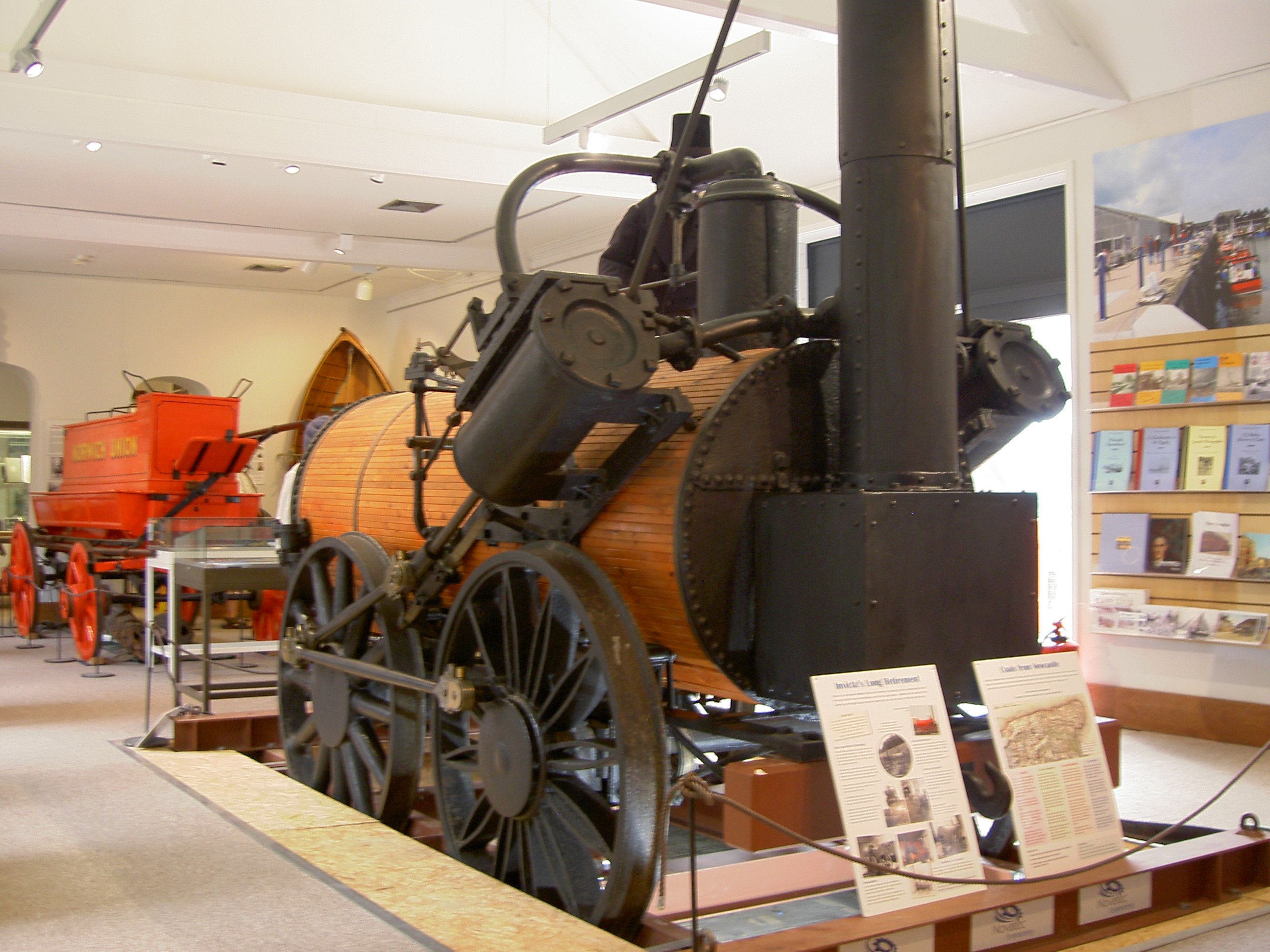
As a port for the delivery of coal through the 19th century, Whitstable was at the forefront of rail transport. After building the famous “Rocket” in 1829, Stephenson immediately went on to build his next steam engine, the “Invicta”, which was used to haul wagons of coal on the first part of the 6-mile journey from Whitstable to Canterbury. It could not go the whole way, as it couldn’t get up hills, and a stationary engine was placed on top of the hill, and with two miles of rope, pulled the wagons up. They were then let to free-wheel down the other side to Canterbury!

Stephenson’s “Invicta”

A tunnel was built, but Invicta’s chimney was too tall, and it could not get through. As well as coal, this railway was the first in the UK to take passengers, and also the first to offer ‘season tickets’ to regular commuters. However, the opening of the Kent coal fields at the end of the 19th century spelled the end of what had become known as The Crab and Winkle Line. Invicta was retired, and for many years was on display at a site just outside the Canterbury city wall, before being painted bright red and set up as a climbing frame for children in a public garden just inside the city wall. In 2018 it was removed and restored, and in June of this year, was relocated to the museum in Whitstable where it is preserved on public display. Also relocated to the museum, but not yet restored, is the old stationary engine that pulled the wagons up the hill. Today, in addition to the fishing and tourist boats, the harbour still has a role to play in the importation of aggregates for building and road construction.

Whitstable is now quite a thriving tourist destination, and the old Crab and Winkle rail line is a well-maintained and popular walking and cycling track. Around the harbour there are several new developments of restaurants and apartments under construction, and many of the old traditional fishermen’s huts have been gentrified and may now be rented through any of the accommodation on-line booking services. Similarly, many of the old pubs around the harbour end of the town have become the haunts of tourists and the ‘newcomers from London’, to the chagrin of many older locals. However, there are still a few old pubs which have not made an effort to seduce the tourists, and which retain their ‘local pub’ ambiance. One of these, The Coach and Horses, established in about 1805, and managed by my great grandfather from about 1884 to 1898, is still very much a ‘local’ pub.

The Coach and Horses

I called in for a mid -afternoon pint to find just four older men sitting on stools at the bar; probably the same stools they sat on yesterday, and will be sitting on again tomorrow. Just how long these last few ‘local pubs’ can survive has yet to be discovered.

Incidentally, the Kent coal fields which put an end to the Crab and Winkle Line were discovered during the very first attempt to build a tunnel under the English Channel to France late in the 19th century. A tunnel was first proposed in 1802, but no attempt at construction was made until the end of the 19th Century. That try went nowhere, and the currently operating tunnel was commenced in 1988 and opened in 1994.

There will be a bit more on Whitstable in the next blog.


Back in Blighty 2019


Well, here we are, back in England! At one stage we thought that we might actually miss the flight when we were trapped on our way to the airport by a B-Double that had jack-knifed trying to make a u-turn in a road that was far too small for it! The last time we witnessed such an event was in France, and on that occasion it took more than three hours to extricate the vehicle. Fortunately the owners of a couple of cars parked in the street were found, and they moved their cars to enable those of us, trapped the wrong side of the B-Double, to escape. We didn’t stay to see how long it took the B-Double driver to get his vehicle out—-he might still be there for all we know.

Following that shaky start, we had a very smooth, boring flight from Melbourne, travelling Royal Brunei business class. We could not fault it at all. Check-in at Melbourne was courteous and cheerful, but complicated slightly by our using brand new Australian Passports. It seems that computers have good memories, but are lacking in staying up to date with what has been happening to people. It didn’t like our ‘New Australian’ passports because it remembered that we last entered Australia, more than two years ago, on British passports, and wanted to know why we were now trying to leave on Australian passports. A second check-in lady came to the rescue and soon got it sorted to the satisfaction both of  us and of the computer. Then it was to the departure doors—-now controlled by another set of computers rather than people, and we got through that well enough. The baggage check was ok, apart from having to hang on to my pants to stop them concertinaing around my ankles when I took my belt off so that the buckle wouldn’t raise the alarm. And then I had trouble with the automatic passport reader which simply refused to open the barrier. But at least I got to speak with a human being who not only opened the gate, but went above and beyond the call of duty by wishing me a pleasant flight—-which is a lot more than any of the computers had managed.

I must say that having access to the Brunei lounge was terrific, and got us off to a nice relaxed start. It also helped resolve the problem of Ann losing her boarding pass for the second leg from Brunei, as the young lady behind the counter quickly printed off a new one! As already mentioned, the flight was very smooth and the food very good; and we didn’t even miss having a drink. I think the two days of non-drinking practice just before we left probably helped there. Arrival at Heathrow was pretty standard, and it was easy to find the underground station. What was not so easy was to find a human who could explain the Oyster Card ticketing system to us. That being at last achieved, we boarded the train on the line that would take us to Charing Cross, where we would change to the line that would take us to Old Street. Considering it was about 7.45am, I expected the train to be jam packed with commuters, but in fact there was plenty of room, and most passengers stayed on for only a station or two. However, when we got to the platform for the Old Street train at Charing Cross, it was an entirely different set of circumstances, and the trains were packed like the proverbial sardine cans. At this point we abandoned the underground and went for a taxi! An unexpected market provided some rather nice Chelsea buns, pain au chocolat, and coffee, and whilst Phil and Ann sat in the sun, I found a stall where I could get a UK sim installed in an old phone we had with us. This was a necessary task, as we had to phone the agent for the apartment before we could get the code to get in. Then on we went by a proper London taxi to the apartment in Hoxton. And what a find! Huge! Two bedrooms, both with en-suite facilities, a large kitchen/living area, and a roof-top garden!

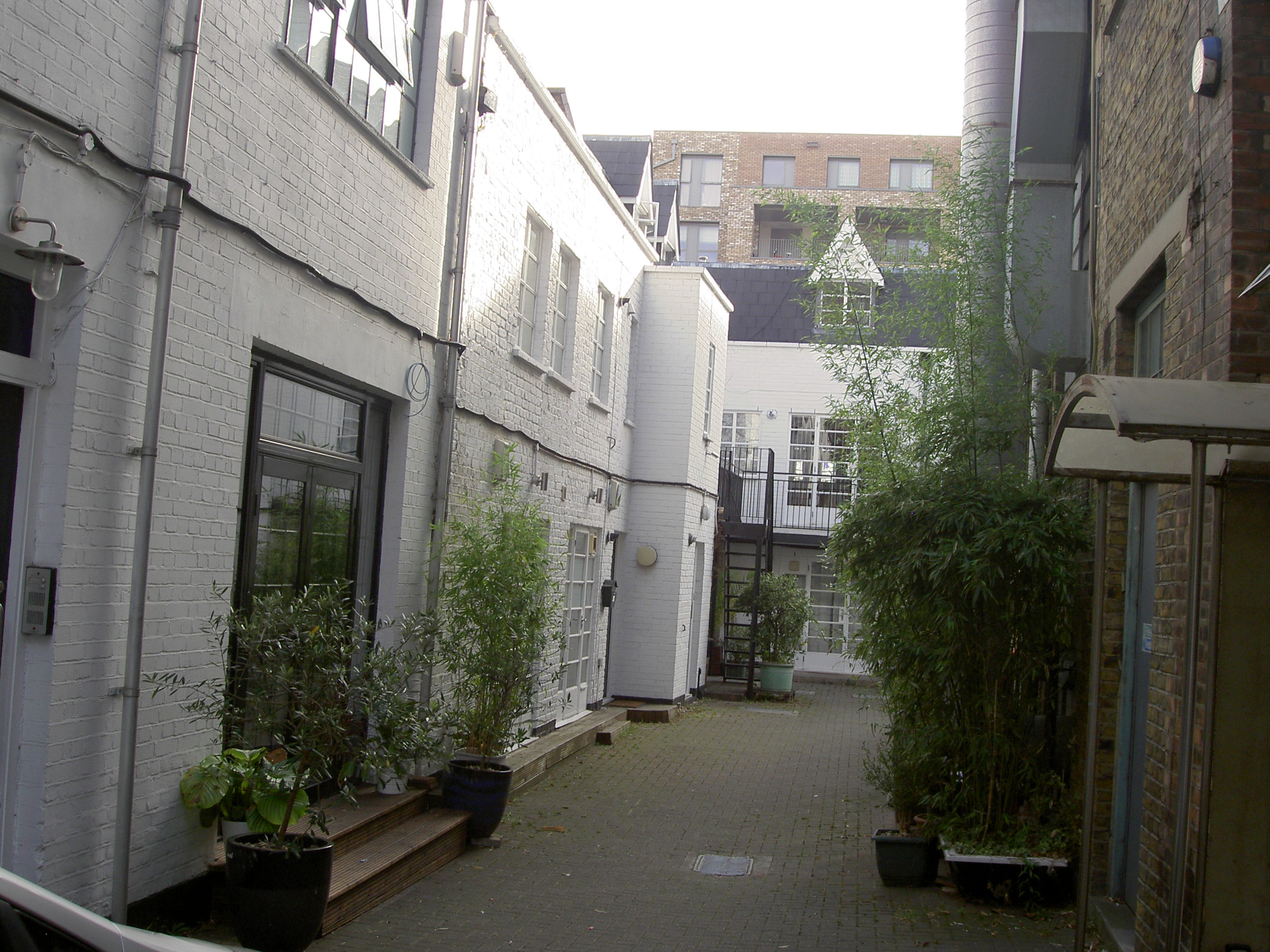
Apartment in Fullwood Mews

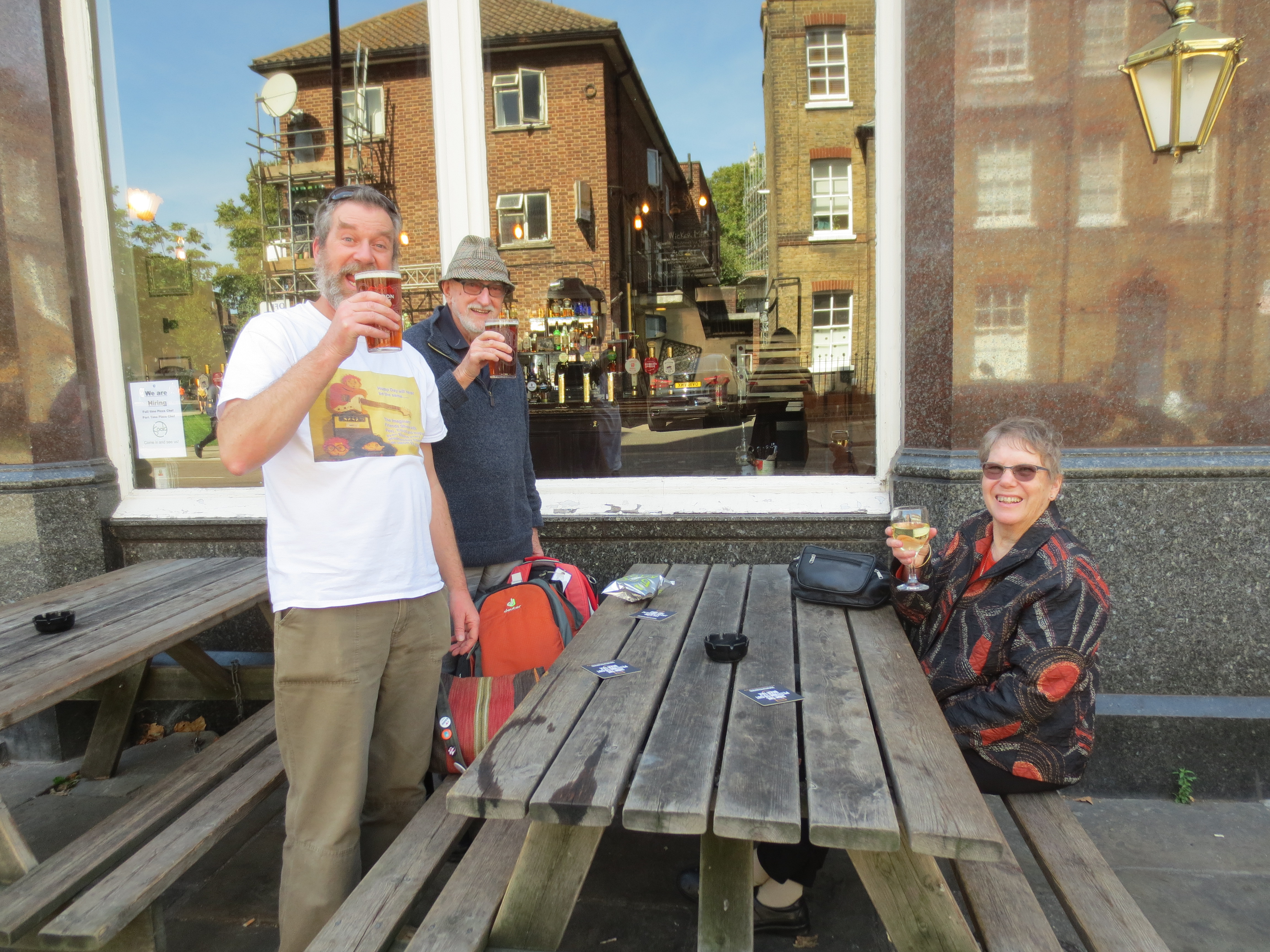
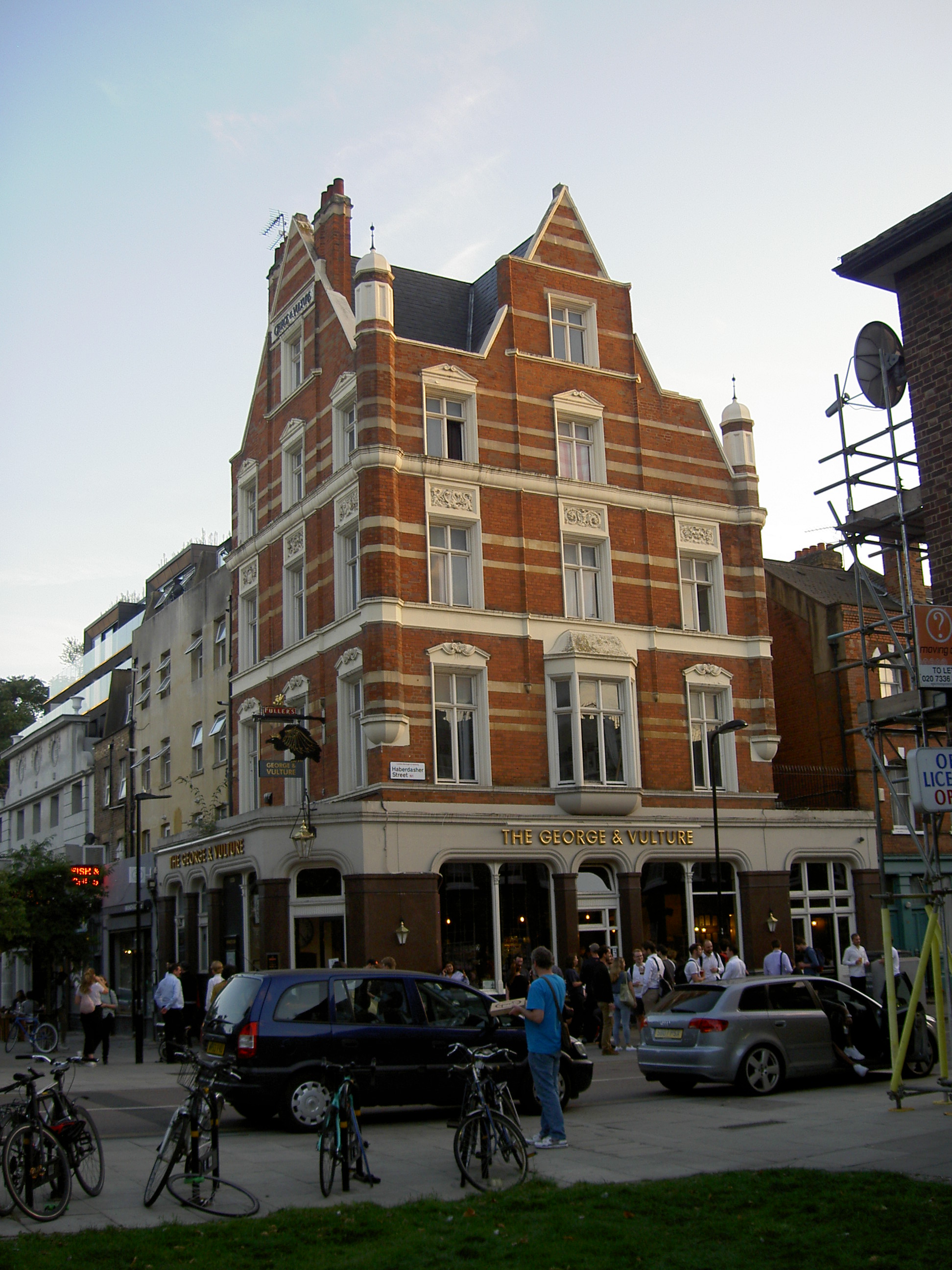
It is one of several apartments in a quaint little mews, protected by a coded gate. It was very clean, had a nice ‘feel’, and was beautifully quiet. There was even a balloon whisk in a kitchen drawer. Not only that, it was just 5 mins walk to a nice little park, and even less to really great pub, The George and Vulture, where we enjoyed our long-awaited pints of English beer!

First beer; The George and Vulture, Hoxton

The pub had a wood-fired pizza oven so we decided to eat there that evening, thinking it would be a nice quiet place to go after the hustle and bustle of 28 hours of flying and under-grounding. The very pleasant young lady at the bar, who took the above photo of us, offered to reserve a table for us which was very fortunate, as when we got there the place was heaving! There were at least 50 people spilling out onto the pavement outside — it was a beautiful evening — and every conceivable nook and cranny inside was crammed with people—except for our table sporting its “reserved” notice! We squeezed in with our beers, and the waiter squeezed over to us with our excellent pizzas. What was very interesting was that there was no TV screen to be seen, no music of any sort, no swearing or profanities. There was just the babble and laughter of happy good natured people enjoying a Thursday after-work drink. Nobody drank too much. In fact very few people, who were mostly in their late 20’s to 40’s, even went back to the bar for another glass. In contrast to all the noisy youngsters in the bar, an elderly gentleman with a small dog on a leash sat quietly at a single small table in a corner near the door. He finished his pint, called to his dog, and quietly left. My guess is that he did this every night. It would have been good to have had a chat with him, but the crush and the babble would have made that a bit difficult. The George and Vulture claims to be the tallest pub in London. There are a couple higher, by being on the upper floors of taller buildings. But The George and Vulture is the entire building.

The George and vulture, Hoxton

After an excellent night’s sleep it was time to walk to Old Street station for the tube to Victoria Station via Moorgate. In 1975, Moorgate Station was the scene of the worst ever crash on the Underground, when a train ran at full speed into the solid end of a no-through tunnel killing 43 people and injuring 74. But we had no trouble, and arrived at Victoria Station in time for a coffee before catching the train to our destination, Whitstable.


Sketches of Cobram

Cobram is a fair resting-place, in right of its nearness to the river, and the little paddle boat that comes and goes upon it: which make up a pleasant and refreshing scene, after the dusty roads. But, unless you would like to dwell on an enormous plain, with jagged rows of irregular gumtrees on it, that look in the distance like so many combs with broken teeth: and unless you would like to pass your life without the possibility of going up-hill, or going up anything but stairs: you would hardly approve of Cobram as a place of residence. (Borrowed from Charles Dickens’s description of Chalons-sur-Saône in Pictures from Italy).

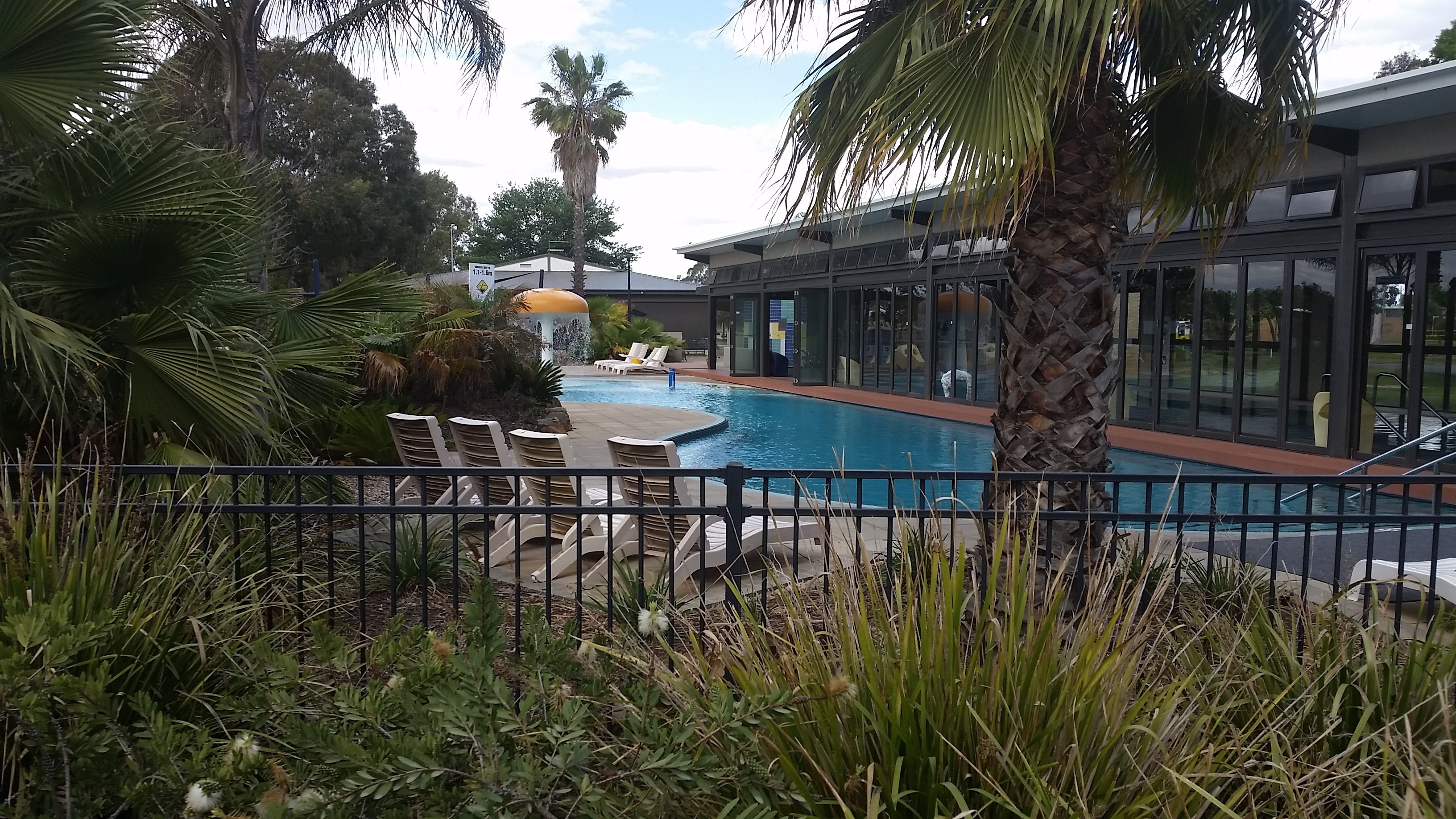
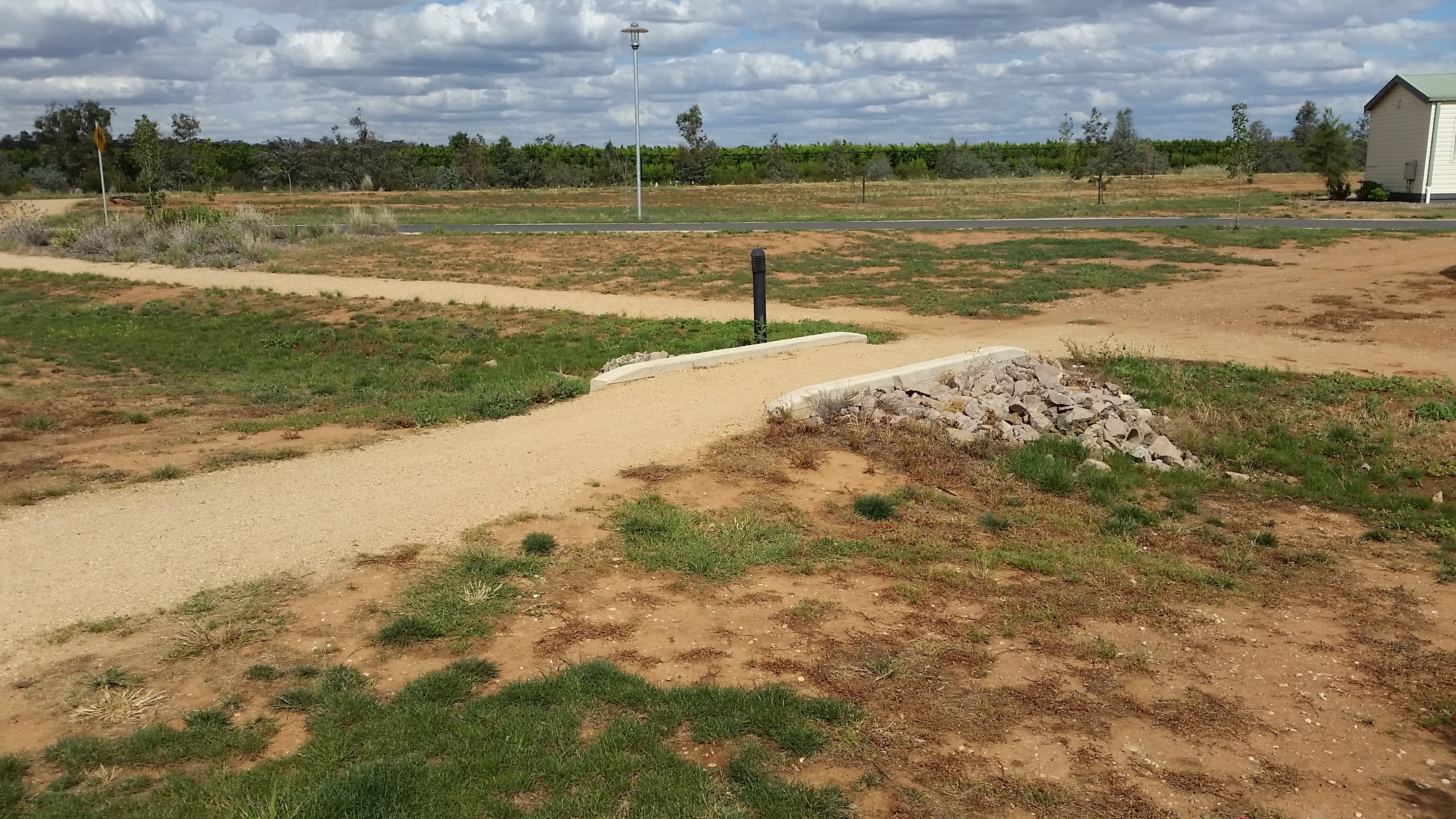
We are once again away for a few days with our ‘camper group’ of friends, staying at the RACV resort at Cobram, a 30 minute walk from the centre of the town. The resort is splendid enough as you arrive at the reception office. There is an impressive irregular-shaped outdoor swimming pool with various water features to amuse the bathers, surrounded by mature palm trees and other vegetation. Adjacent to the out-door pool is a large indoor pool and spa, a well-equipped gym and a games room. There is a café which makes very drinkable coffee. As you progress a little into the resort, the cabins and individual camping sites nestle amongst mature trees and shrubs, and are very pleasant to behold. But as you move further in toward the boondocks where the cabin allocated to us is located, the vegetation disappears and the newer cabins and camp sites are plonked on very bare red sandstone gravel, with here and there a sickly sapling and a few isolated tufts of grass.  It will be many years, if ever, before any of this area bears lush grass lawns and trees large enough to be capable of providing any shade.

The newer part of the resort

My feeling about this resort is that it is the ‘also ran’ in the RACV stable of resorts. Having said that, the cabin itself is quite new, spotlessly clean and very well appointed; there is even a proper wire balloon whisk in one of the kitchen drawers! All the staff we met were very pleasant and very helpful.

Cobram itself is a fairly typical small country town. It has a population of the order of 6000, and has all the amenities usually found in such places. These include four bakeries, three pubs, numerous cafes, two supermarkets, a couple of pharmacies, and so on.

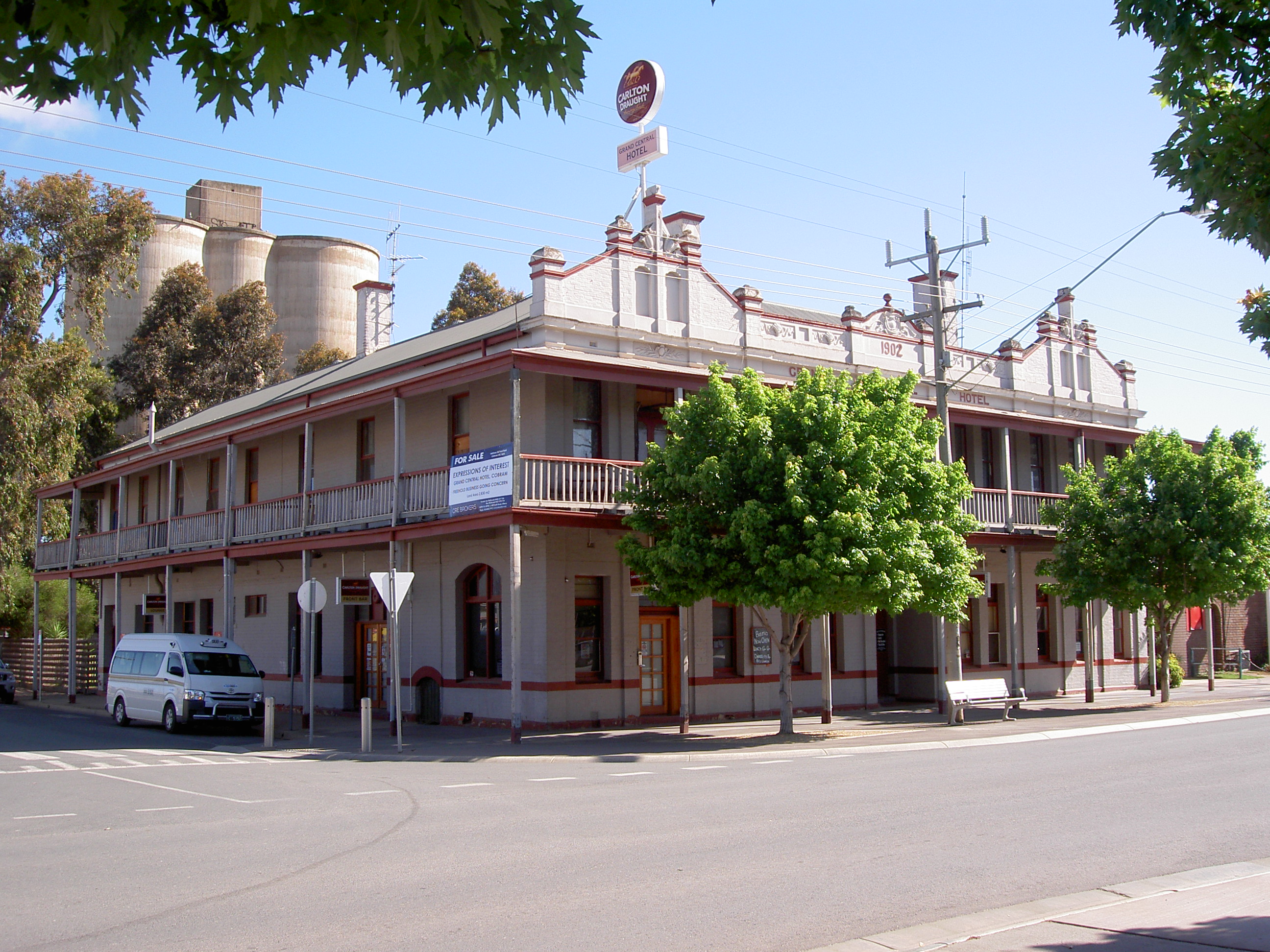
One of three pubs at Cobram

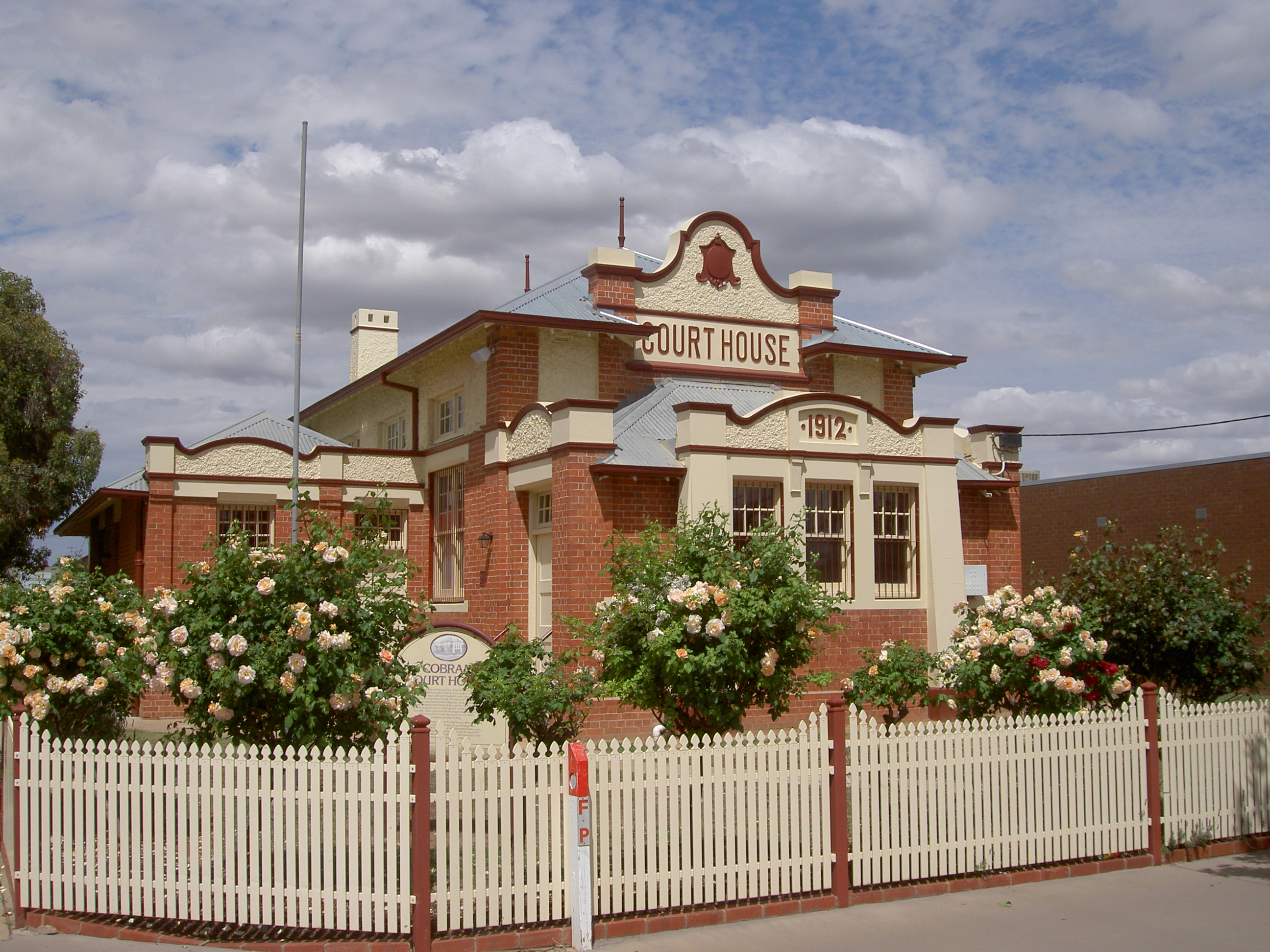
There is a large sports complex providing facilities for both indoor and outdoor sports, a modern public library and a couple of churches.  The original town plan was drawn up in 1888, with the first pub, The Royal Victoria, being built in that year. Also in that year the first policeman was appointed, the first doctor moved to the area, and the Cobram Football Club played its first match. A second pub was built in 1892, the State School in 1893, the third pub in 1902, and the Anglican Church was built in 1906, which I guess indicates the priorities of the early settlers! The Court House, a splendid red-brick building, constructed in 1913, was severely damaged by a fire, deemed “suspicious”, in 2016. It was subsequently restored and re-opened for business in 2017.

Courthouse, Cobram

Cobram built a 9-hole golf course in 1925, but three years later it combined with Barooga on the NSW side of the Murray River and built a new course there. I suspect this had more to do with the gaming laws in NSW than it had to do with anything else! That course is now recognised as one of the best courses along the Murray. It has a very nice club house, which, we understand serves very good food. We booked the ‘courtesy bus’ to take us there for dinner, but forgot to book a table in the restaurant—-which turned out to be fully booked. However, the ‘courtesy bus’ driver was sufficiently courteous to take us back to Cobram in time to secure a table in one of the old pubs there. So be warned—if you wish to eat at the Cobram-Barooga Golf Club, book a table as well as the bus!

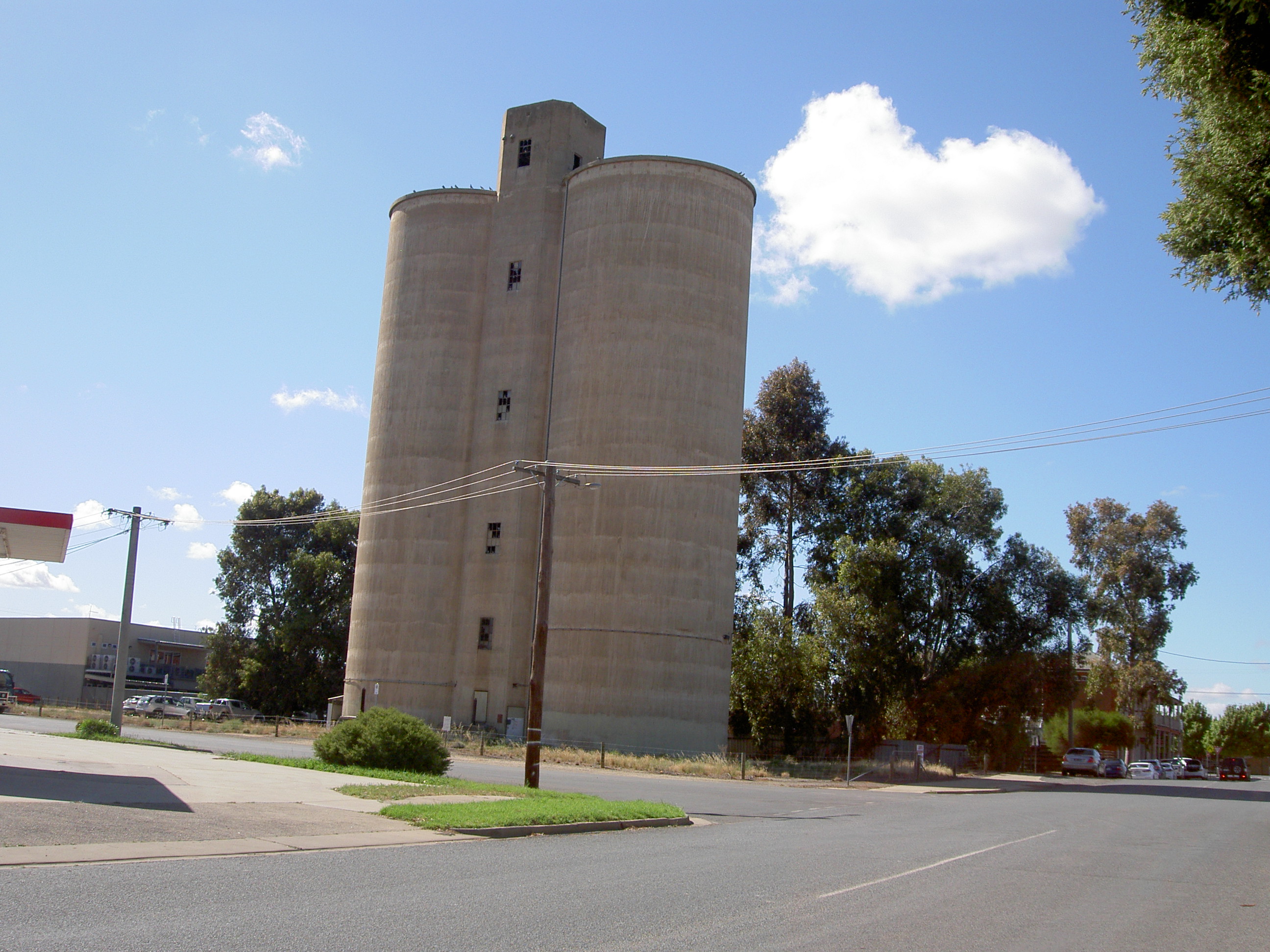
There are a couple of huge, redundant silos in the middle of the town, with some vestiges of the original rail track that served the town.

Cobram Silos

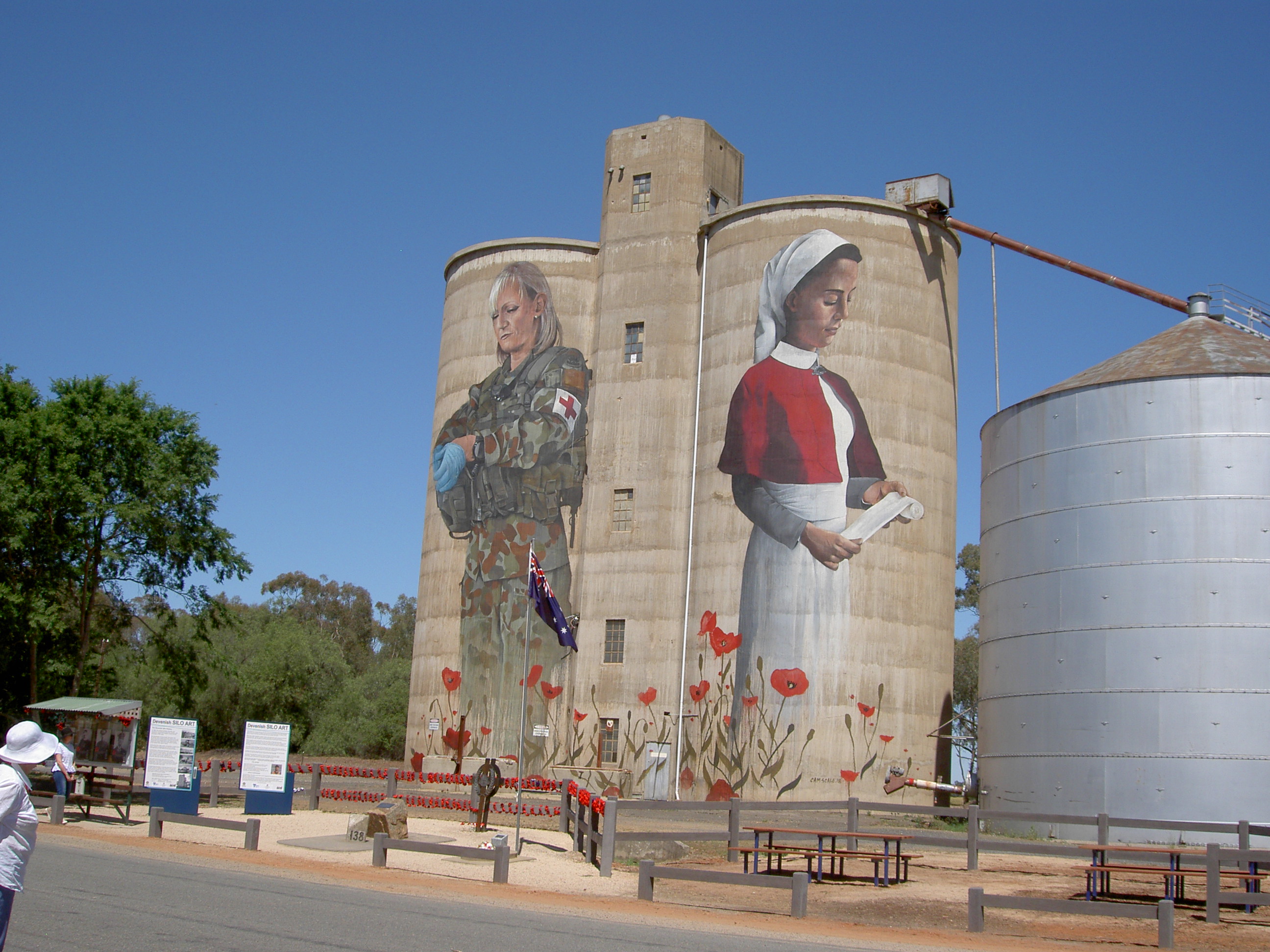
There no longer is a rail service, but one can catch the V-Line bus at the original train station. I suppose it is possible that one day the silos might join the other silos in the area and become part of the Silo Art Trail.

Devenish Silos. Part of a trend in Silo Art

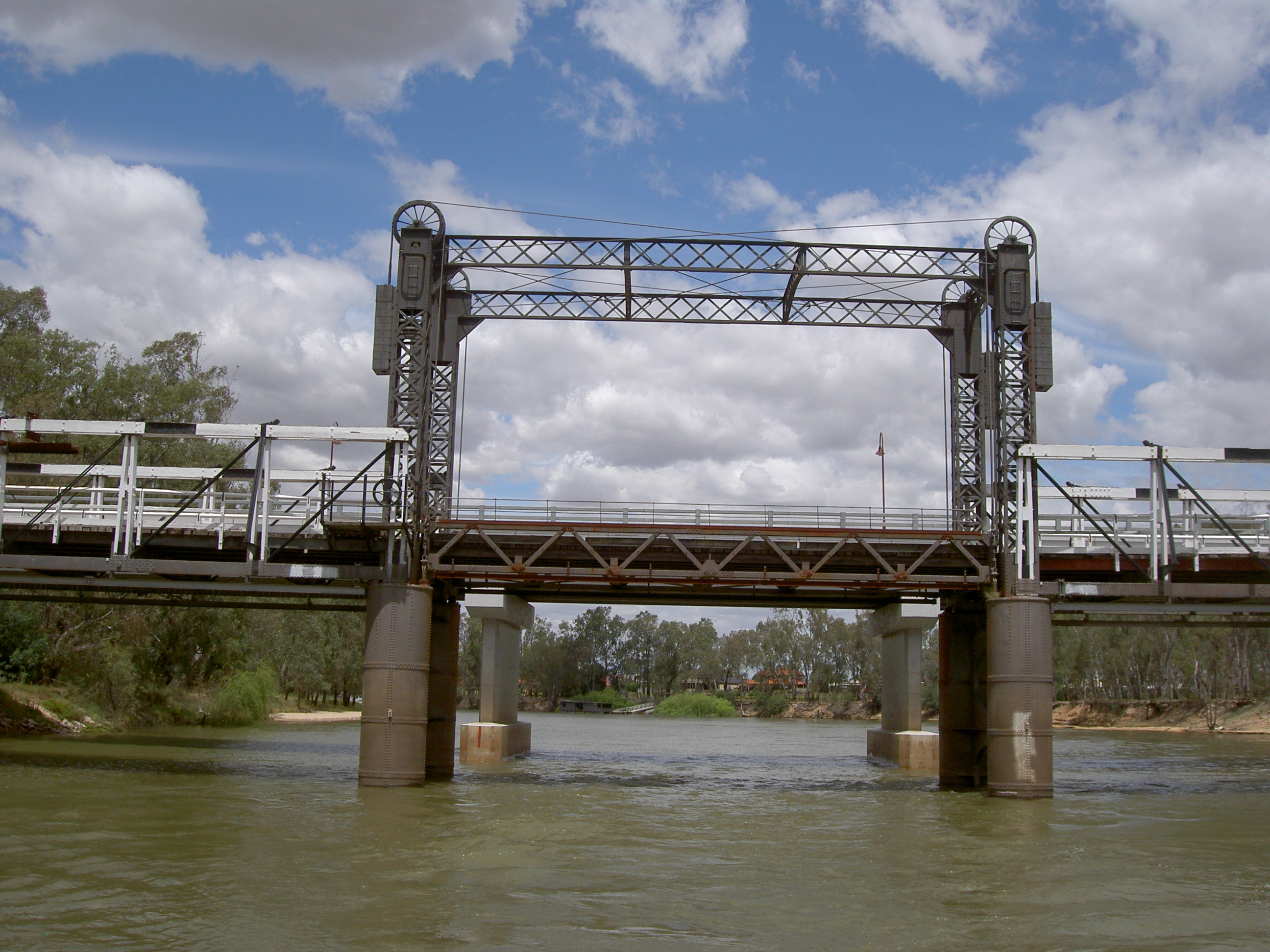
Crossing the river was difficult in the early days. In summer the river was shallow enough to drive the Cobb and Co coaches across. As the water level rose after rain, one could cross by means of the cable-operated punt. Then, in 1902, a De Burgh Truss bridge was built, with a central span that could be raised by hand, to permit larger paddle steamers to pass underneath. This continued in use until the new concrete bridge was completed in 2006.

De Burgh Trestle Bridge

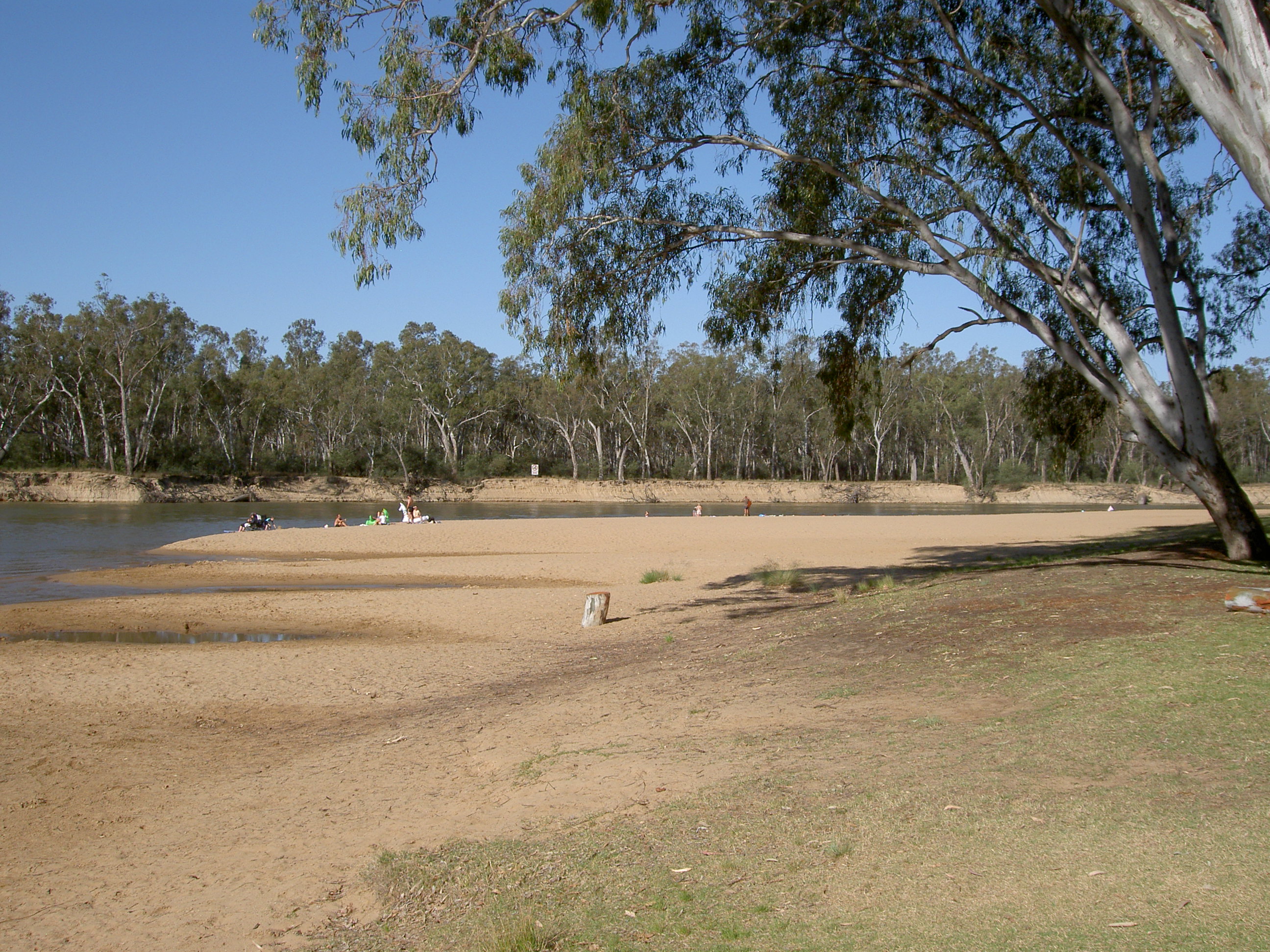
Driving toward Barooga from Cobram, just before you reach the bridge, you can drive off to the left and park at Thompson’s Beach. This has the distinction of being ‘the largest inland beach in Australia”. It is a couple of hundred meters long, and about 30 meters wide at it widest, and is a very popular bathing spot.

Thompson’s Beach

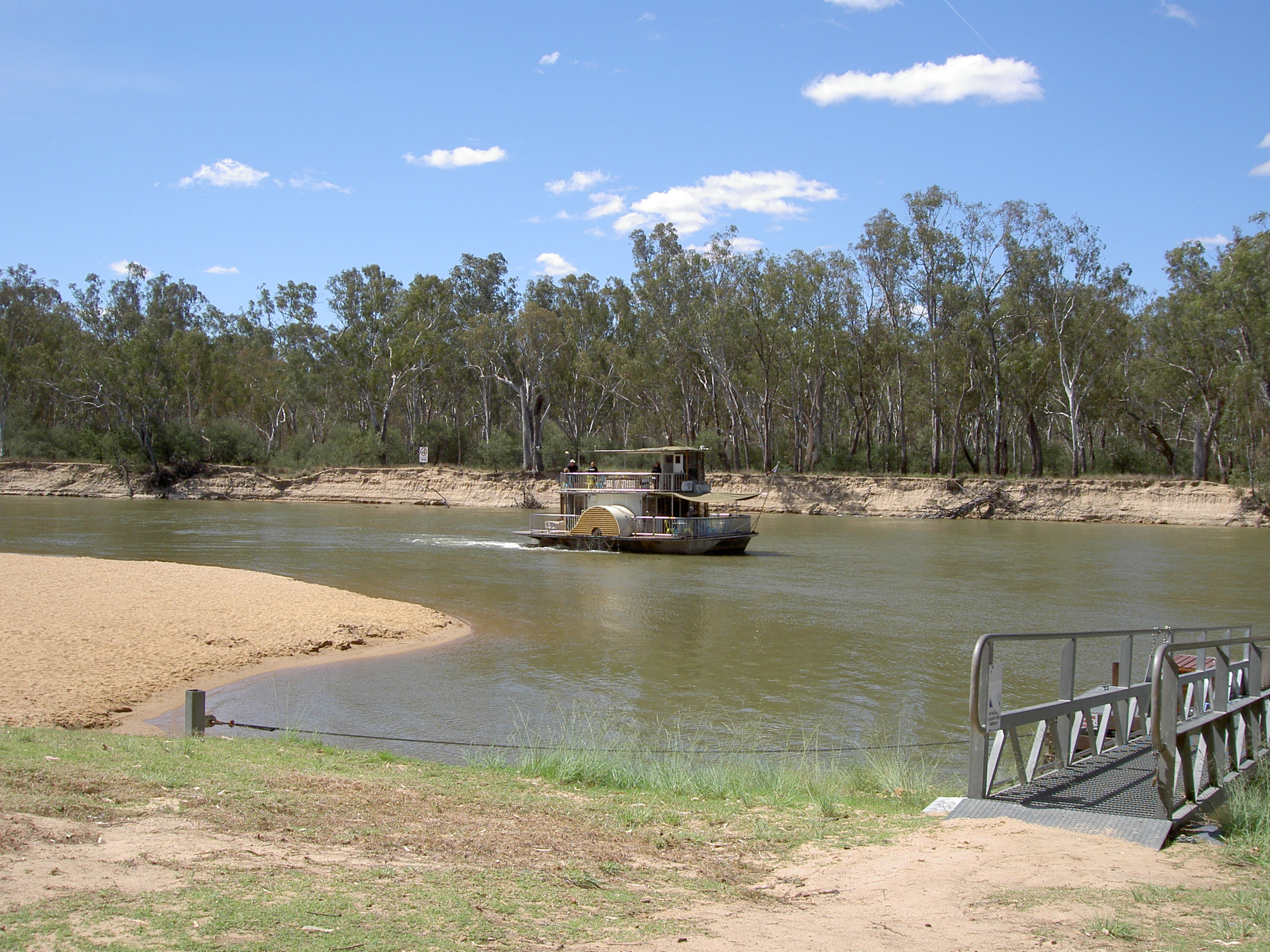
There is a beach-side café, serving light meals, coffee etc; and it is from this beach that you can board The Cobba paddle boat. It costs about $20 for an hour and a half trip up and down stream, during which time you will probably spot some koalas huddled in the trees of the Quinn’s Island nature sanctuary. Some passengers on the boat claimed to have spotted eight koalas, I saw only four. There is a bar on-board The Cobba; maybe some of the passengers had had a bit more wine than I did! Or maybe they saw them whilst I was in the bar.  But I did see a turtle sunbathing on a log!

The Cobba

Quinn’s Island is formed by a break-away anabranch, Scott’s Creek, cutting a direct route across one of the large bends in the river. There is a bridge across the creek and a very well graded walking path around the perimeter of the island. For the more adventurous, there are some lovely free-camping sites along the NSW bank of the river.

In 1914, an electricity generator was built by the local council; its first connection was to provide electric street lighting in the middle of the town. The original power station was damaged by fire in 1924, and the SEC took over the generator and continued to provide the power locally. In 1935 the town was connected to the national grid, and in 1994 the old buildings were demolished, and the site turned into a very useful car park, not unsurprisingly named the Power House Car Park !

Cobram is a major centre of agricultural business. Murray Goulburn Cooperative was started here, and today milk processing, orange juice production, fruit growing and an abattoir are the main employers—though we saw very little of the industrial activities apart from a huge peach orchard adjacent to the RACV resort. All in all, our trip was a pleasant stay in a very clean and tidy town; Cobram has been the winner of the “Tidy Town” competition on more than one occasion. The shops seem prosperous; some recently retired new residents we spoke with, who had relocated from Geelong, were very happy with their decision to move there; and the fact that there are at least three jewellery shops in such a small town would indicate a reasonable amount of disposable wealth! There are quite large areas of new housing, and the gardens of both the new and the old were resplendent with all colours of roses, which seem to do particularly well in this part of the State.

We stayed at Cobram for just 4 nights, which was just sufficient to take in most of what is on offer. One could visit wineries, olive farms and cactus gardens to name just a few “touristy things”, or one could play golf on a course which is far better than my golf is. We chose to do none of those things, but just enjoyed ourselves doing nothing much at all!

Sketches of Mansfield (Two)


I know it has been a long time since the last blog was posted, but I am determined to complete the Mansfield series this time. Actually, as I write this, I am sitting on the balcony of the apartment at Merimbula which has featured in earlier blogs, and to which we have returned with the specific intention of catching up with my writing which has been resting on the back-burner for about 6 months.

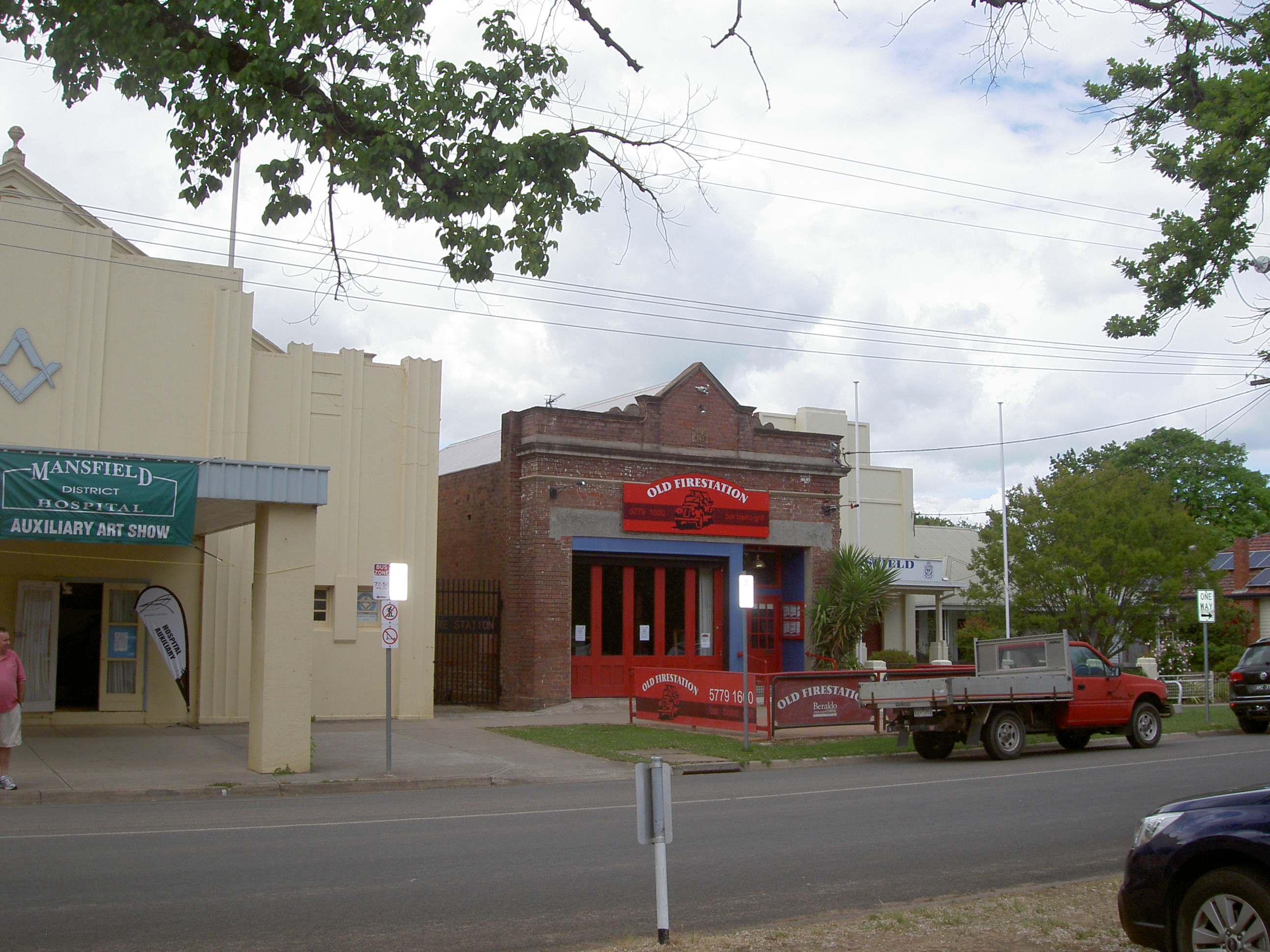
In the first Mansfield blog I mentioned the inconvenient distance to the nearest coffee shop, but having driven into town, there were plenty to choose from. The Old Fire Station café was our first choice, and we were not disappointed.

Old Fire Station Café

The coffee was good, and they did not object to our friend bringing her own half-strength-soy cappuccino, which was not part of their offerings. There are some nice shops in the town, and, even though shopping for clothes is not one of my favourite occupations, I could not resist buying a couple of very nice shirts and pair of pants from one of the shops. I also found the young lad in the fishing tackle shop extremely knowledgeable and very helpful when it came to discussing why I had not managed to catch any trout in the near-by Delatite River this time. The river flows from the granite slopes of Mt Buller, and the trout from there are the best tasting of any I have caught in Victoria. But we were a tad early, and the fish were not rising to the dry fly yet. The lad in the shop advised me to use a nymph, with a bright yellow floater (so that I could see it!). However, I did not have time to return to the river for a second try, but I’ll bear the advice in mind next time I go to the Delatite! I got back to the water at the small township of Jamieson, a very small hamlet about 40 k from Mansfield, and located on a bend of the Jamieson River near its confluence with the Goulburn River.

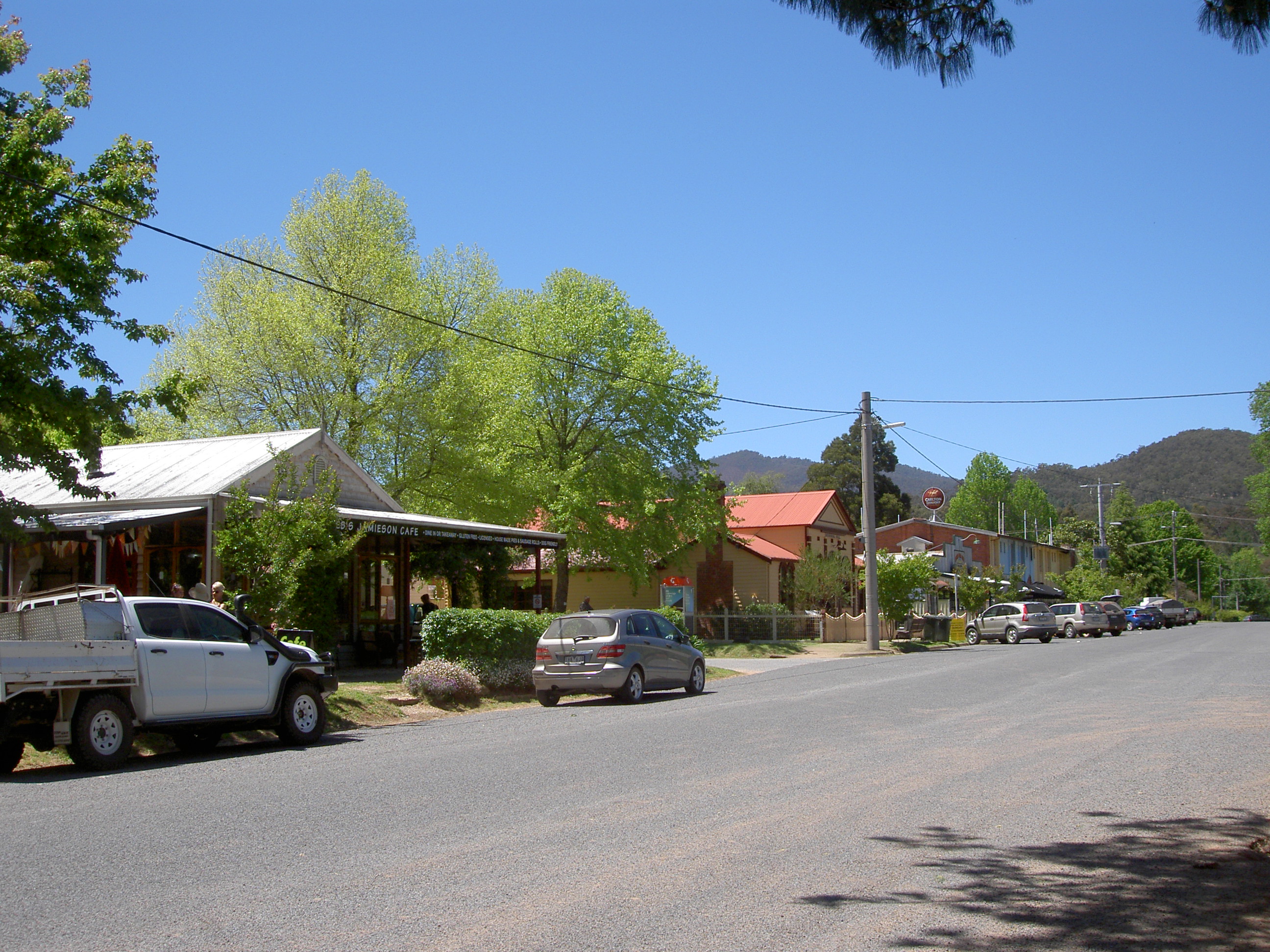
Main Street of Jamieson

The population today is about 380, of which there are less than 100 actually living in the township. The rest are scattered around the surrounding area. There is one pub, a general store, and a café, and when we were there, about 50% of the population appeared to be enjoying coffee in the shade of a magnificent tree in the café garden. There are a couple of churches, and a museum accommodated in the now-redundant courthouse. But in its heyday as a supply town to nearby goldfields in the late 19th century, there were 5 mine offices, 22 stores, 8 hotels, 2 breweries, 3 restaurants, a theatre, a police station and lock-up. There were 3 doctors, a chemist, a registrar of births, marriages and deaths, 4 blacksmiths, 2 saddlers, numerous people associated with the building industry, a cabinet maker and so forth. A really thriving town! But it couldn’t last forever, and it didn’t last for long—about 50 years. The gold ran out, the First World War came, the depression of the 1930’s and then the Second World War hit it hard, and the population declined to its few hundred of today. But, tourism came, and it is now a delightfully tranquil spot. All the buildings are well maintained, the streets neat and tidy, and the park on the bank of the crystal-clear river, where we enjoyed our picnic lunch, is delightful.


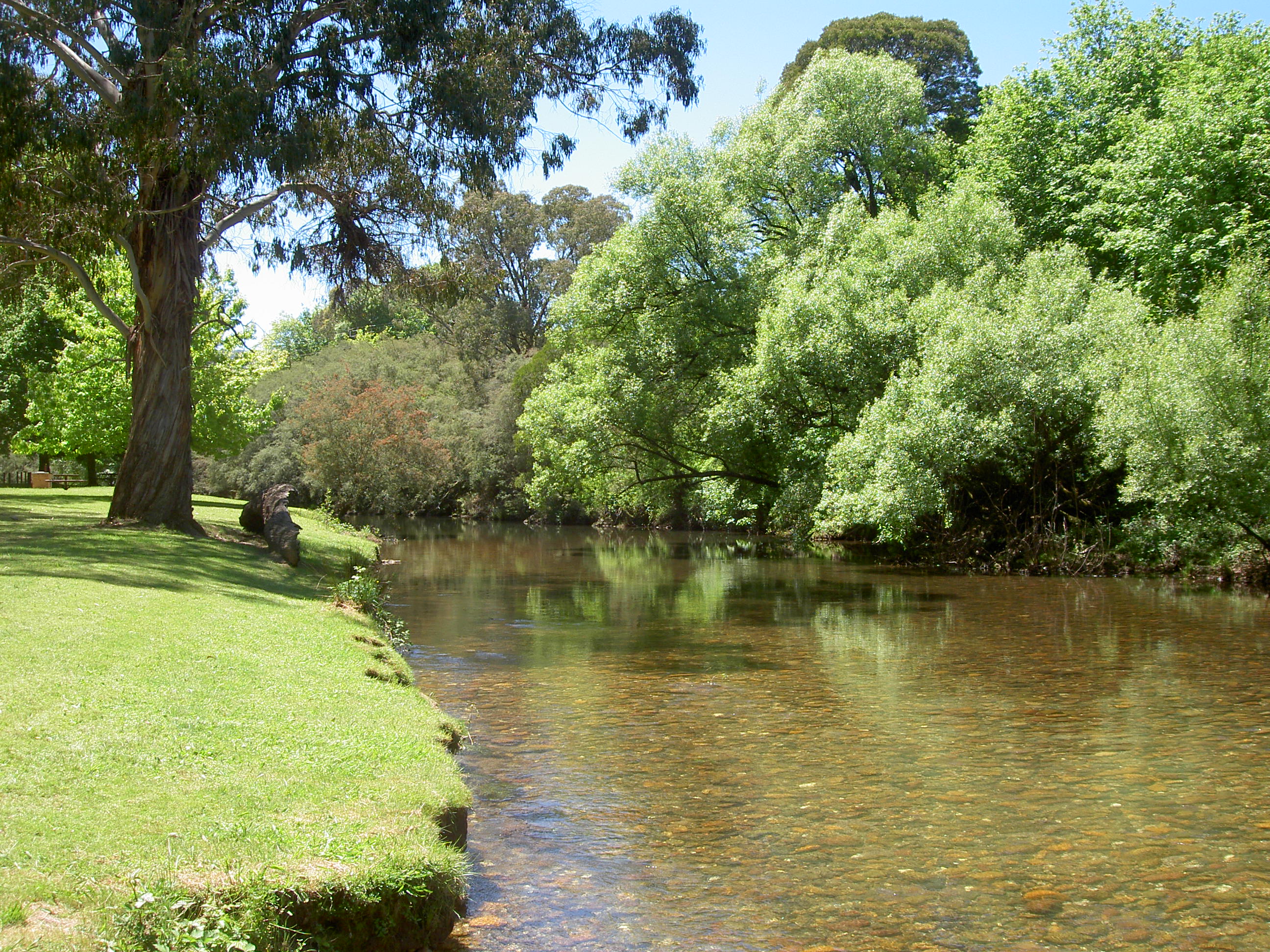
Jamieson River

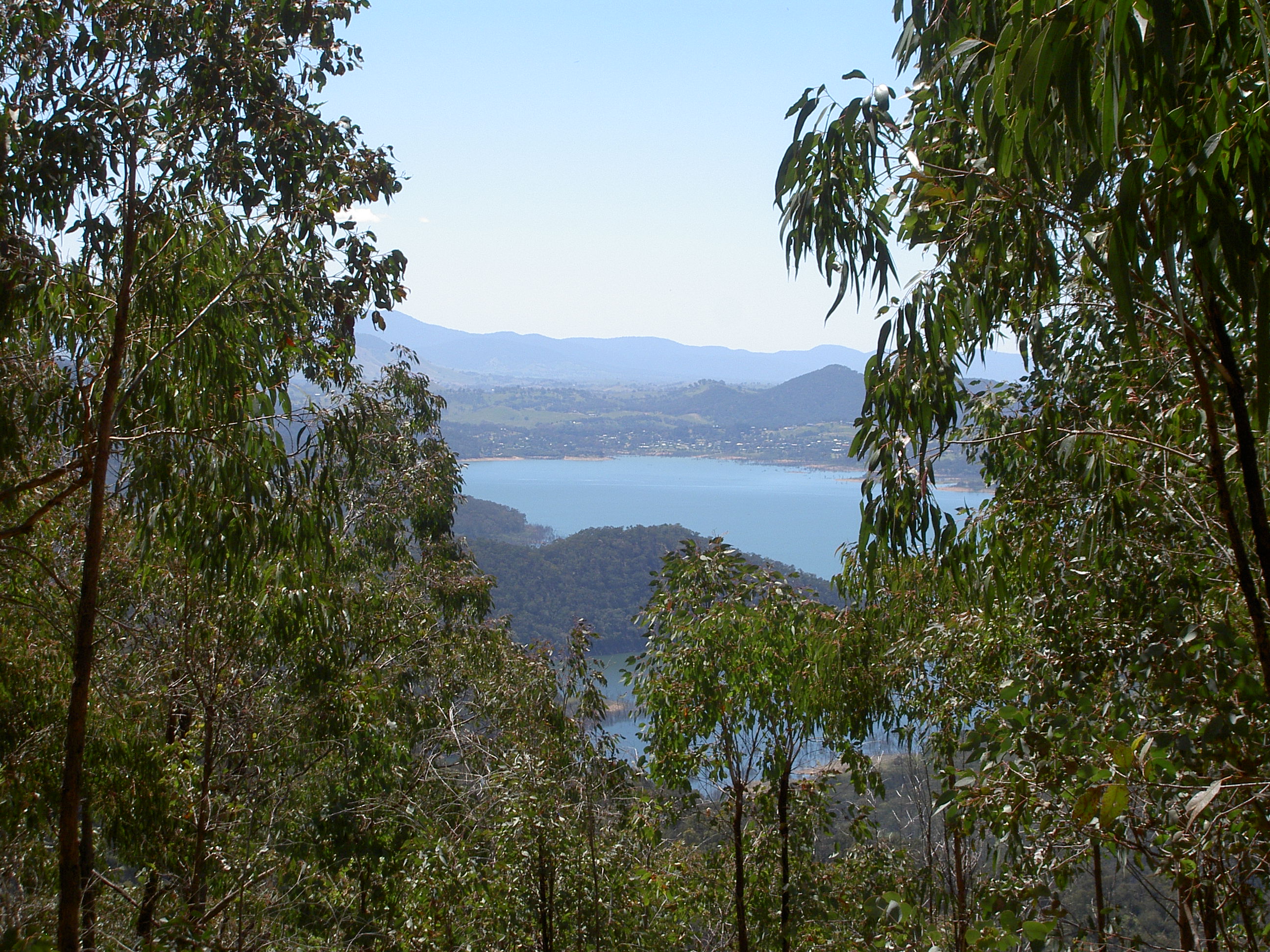
A new ‘micro-brewery’ has been established just outside the village, and whilst it was not open at the time we were there, we managed to buy some of their rather nice beer from a shop in Mansfield. The brewery is on a road that ends up somewhere in the hills and we drove to a very good look-out spot a couple of Ks past the brewery which offered some great views of Lake Eildon.

Lake Eildon from above Jamieson

Jamieson is also noted for its ‘significant trees’, and there is a self-guided walk one can take. Many of these trees are deciduous, and the colours in autumn would be spectacular, I think.

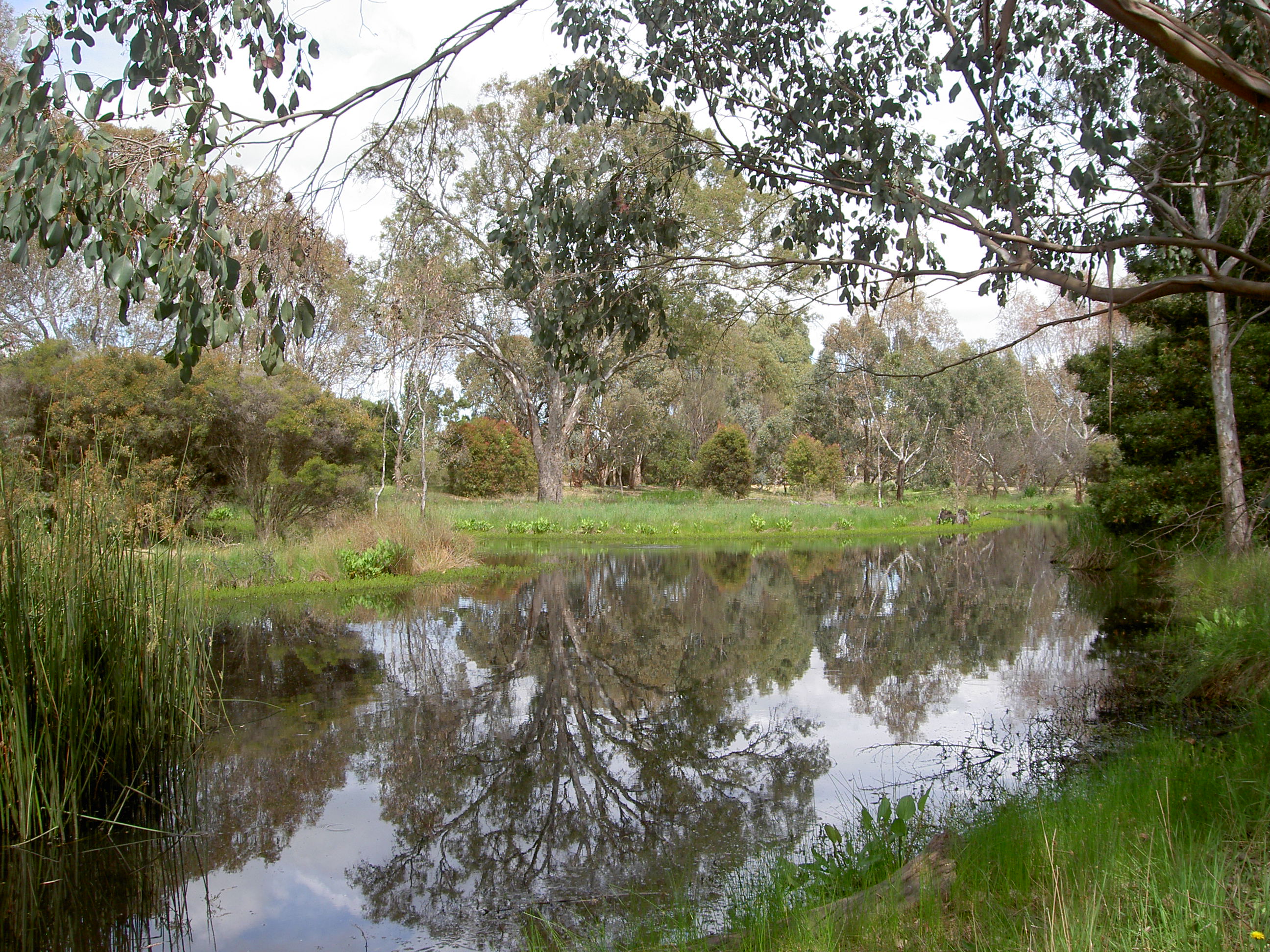
Back in Mansfield the next day, we strolled around the Mansfield Wetlands, with the track starting at the old railway station, and following the rail track for much of the way. This is offered as a ‘guided walk’ on some days, but unfortunately the day we were there was not one of the days! But even though we did not learn much, being on our own, it was a very pleasant walk.

Mansfield wetlands

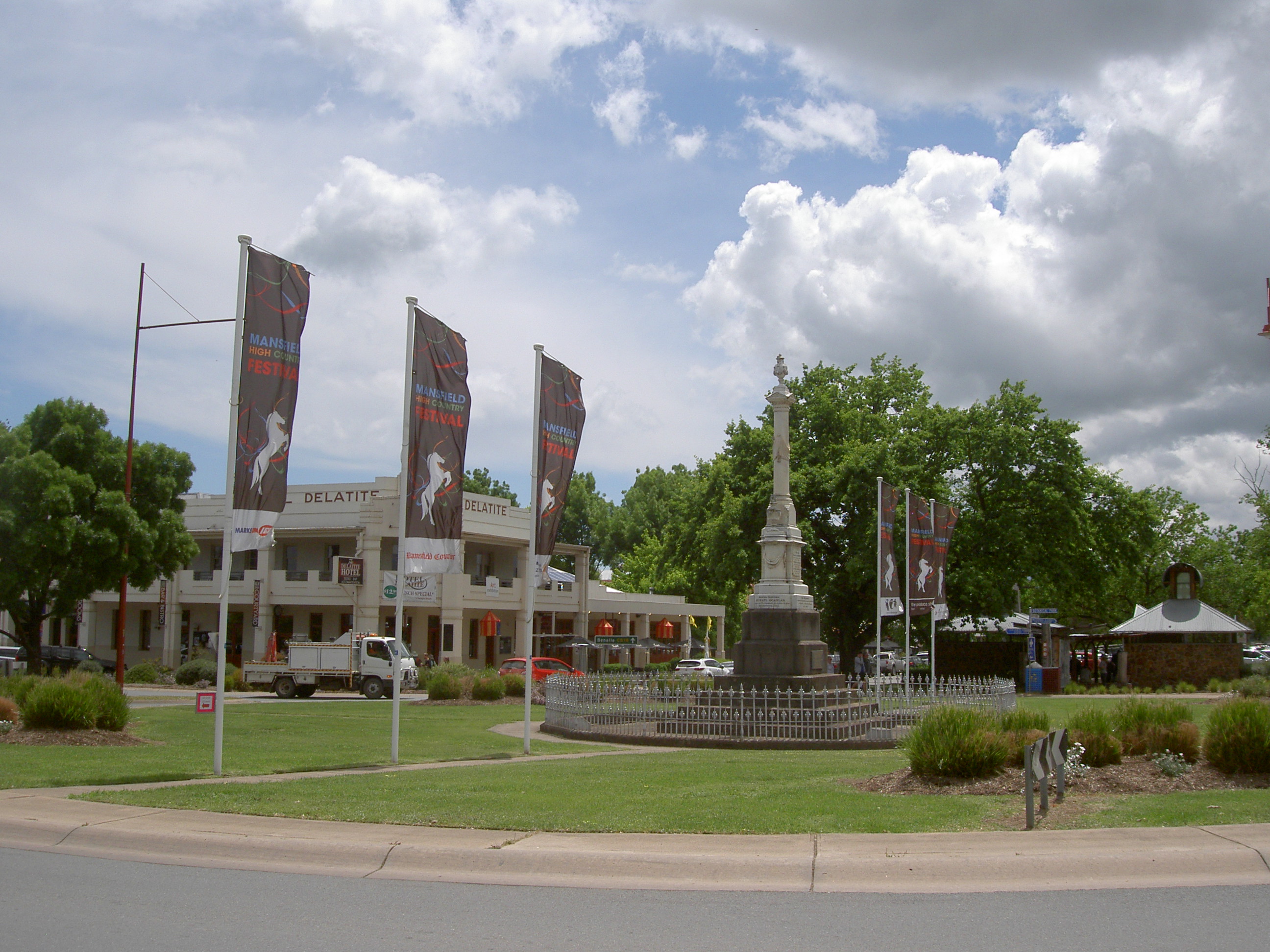
There is a brewery in Mansfield, which makes a very nice drop, and I did enjoy a glass whilst sitting outside one of the pubs by the Police Memorial roundabout in town waiting for some of our party to finish their shopping. The memorial is to the three police officers killed by the Kelly gang at Stringybark Creek in 1878, and was erected only two years later in 1880, funded entirely by public donations exceeding a total of £800. The officers are interred in the local Mansfield cemetery.

Delatite Hotel and Police Memorial

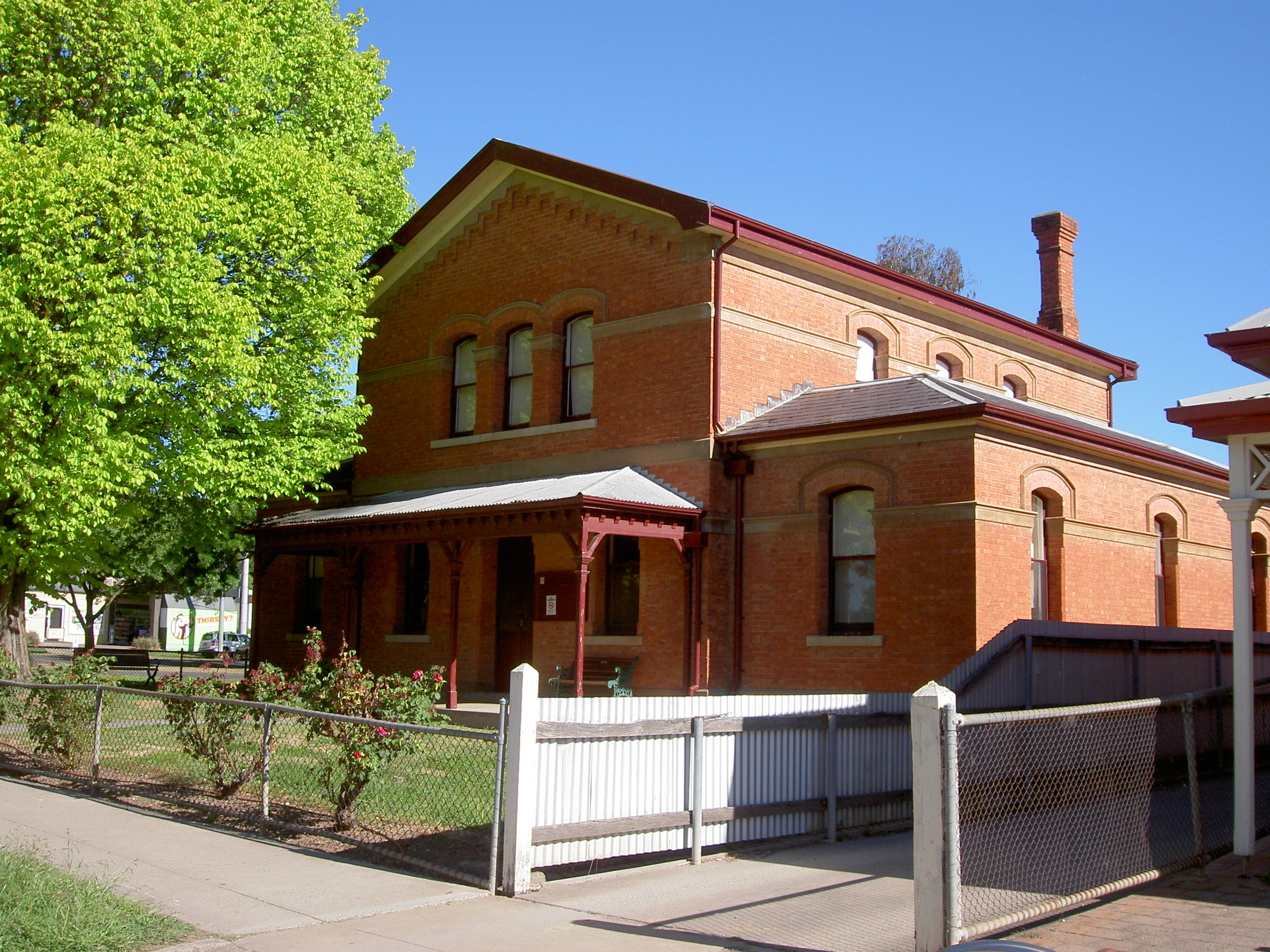
There are two pubs diametrically opposite each other at this roundabout, and on another corner is the Courthouse. When I first arrived at the pub, I had intended taking a photo of the courthouse, but in light of the collection of individuals milling around its doors, mostly in the company of suited brief-case-carrying gentlemen looking rather like those of the legal fraternity, I  decided to postpone my photography until the place was deserted!

Mansfield Courthouse

The Courthouse was built in 1868, and enlarged in 1870. Following the killing of the police officers by the Kelly gang in 1878, the gang was ordered to appear at this courthouse by November 12 of that year. The Courthouse remained open for the full 24 hours of that day, but they failed to arrive, and accordingly were declared to be ‘outlaws’, meaning, under the Felon’s Act, they could be killed without notice or challenge. Ned was eventually captured at Glenrowan in June 1880, and on November 11 of that year, was executed in the Old Melbourne Goal.

Well, so much for our trip to Mansfield and the surrounding area. All in all, it was a very enjoyable little trip, in the company of or ‘camping’ friends.

The next blog will be a quick look around the NE Victorian town of Bright.

Sketches of Mansfield

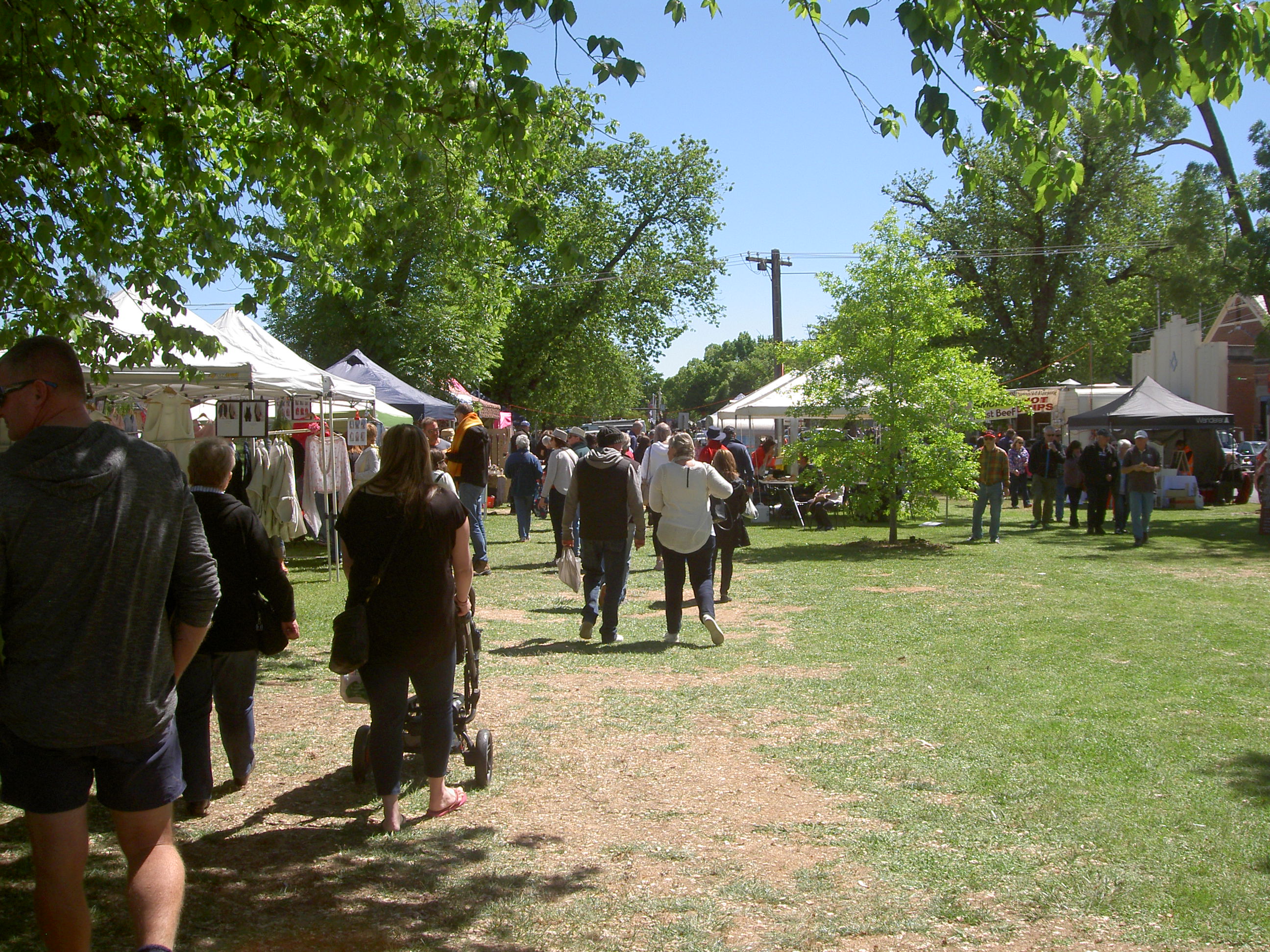
Mansfield is a small town in North Eastern Victoria, about 180 km from Melbourne, and 30 or so km from the popular ski resort of Mt Buller. It has a resident population of the order of 4,400, but during the summer holiday period, and during the winter ski season, the population increases markedly. Originally important as a logging and farming area, together with a little gold mining, it is now heavily dependent on tourism, which is reflected in the abundance of accommodation. The town has an excellent “Bush Market” which had an amazing collection of stalls with a wide variety of hand-made goods, and which alternates each Saturday with the “Farmer’s Market”.

Bush Market

The main streets of Mansfield are very wide, with substantial, tree-lined median strips, which accommodate the markets, and it appears to have a lot to offer tourists and the local population.

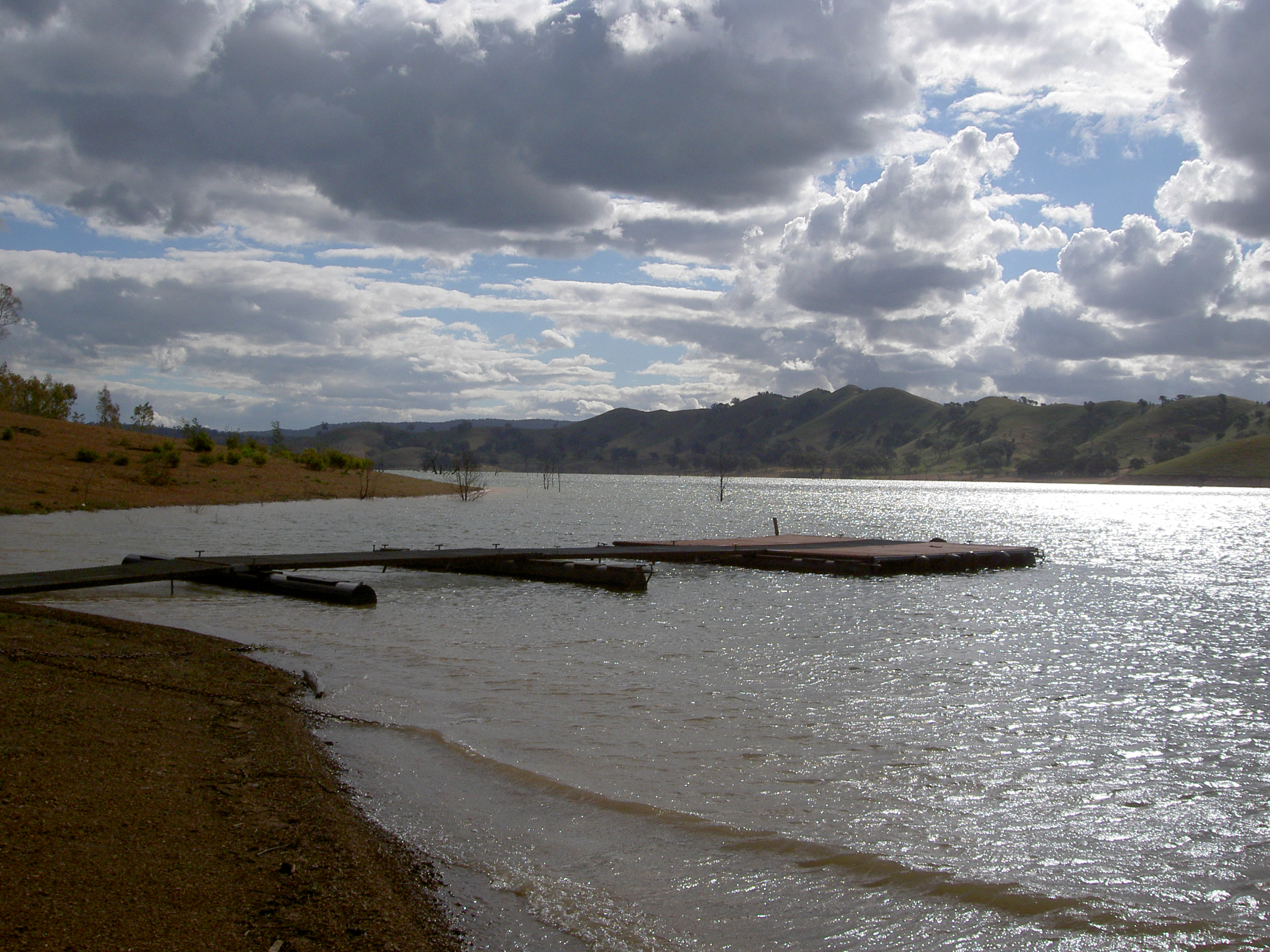
This weekend (Melbourne Cup Weekend) there is a charity “Fun Run” which attracts nearly a thousand participants, and which last year generated over $23,000 for local charities. There are plenty of cafes, and there is a very nice golf course in the town; and it is not far from Lake Eildon, which is a very popular fishing and boating venue.


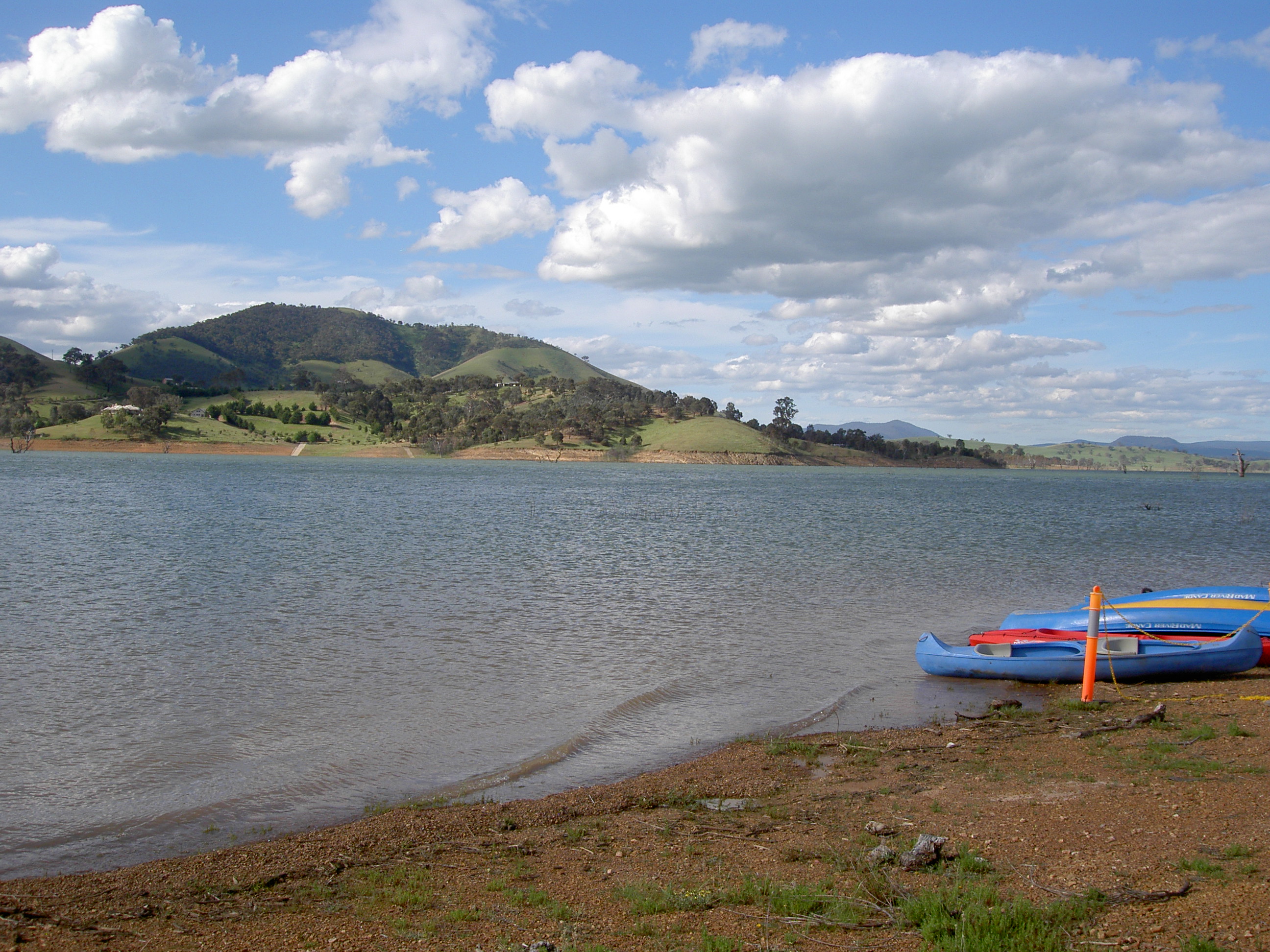
Lake Eildon


Lake Eildon

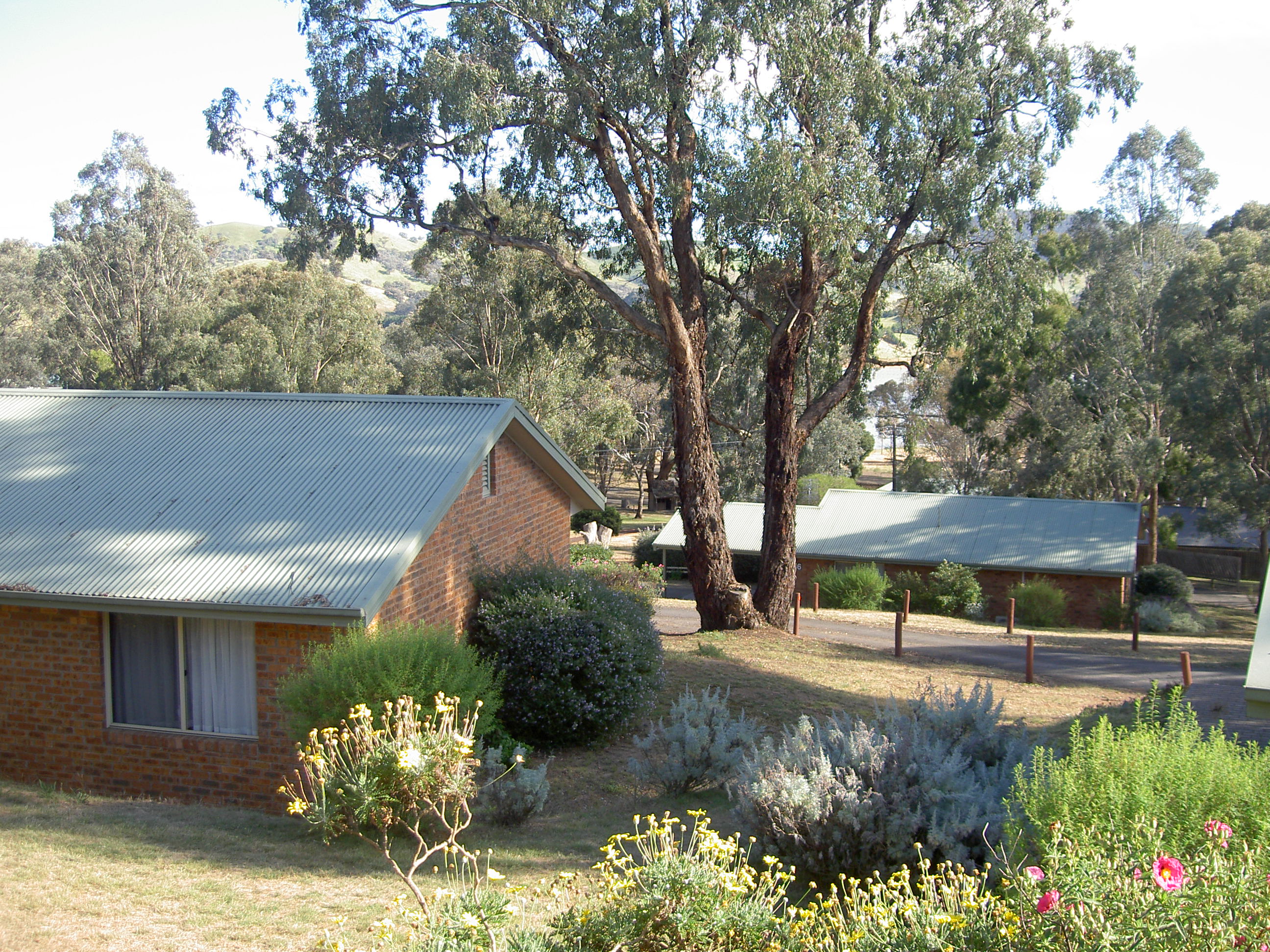
It is on the shore of Lake Eildon that we are currently staying at the Mansfield Resort. There is something of the order of 45 very nice two-bedroom units, all of which are spread up the slopes away from the lake, thereby affording each unit some nice views.


View From Our Unit

They are well spread out in the well-tended bushy gardens, so each feels very private and quiet. Our unit is very well furnished, with a double bed in one room, and two single beds in the other. The double-bed room has an en-suite bathroom facility, the other room using a separate bathroom facility. There is a small laundry room with a clothes washer. The kitchen is well-appointed, but I regret to say there is not a balloon whisk.

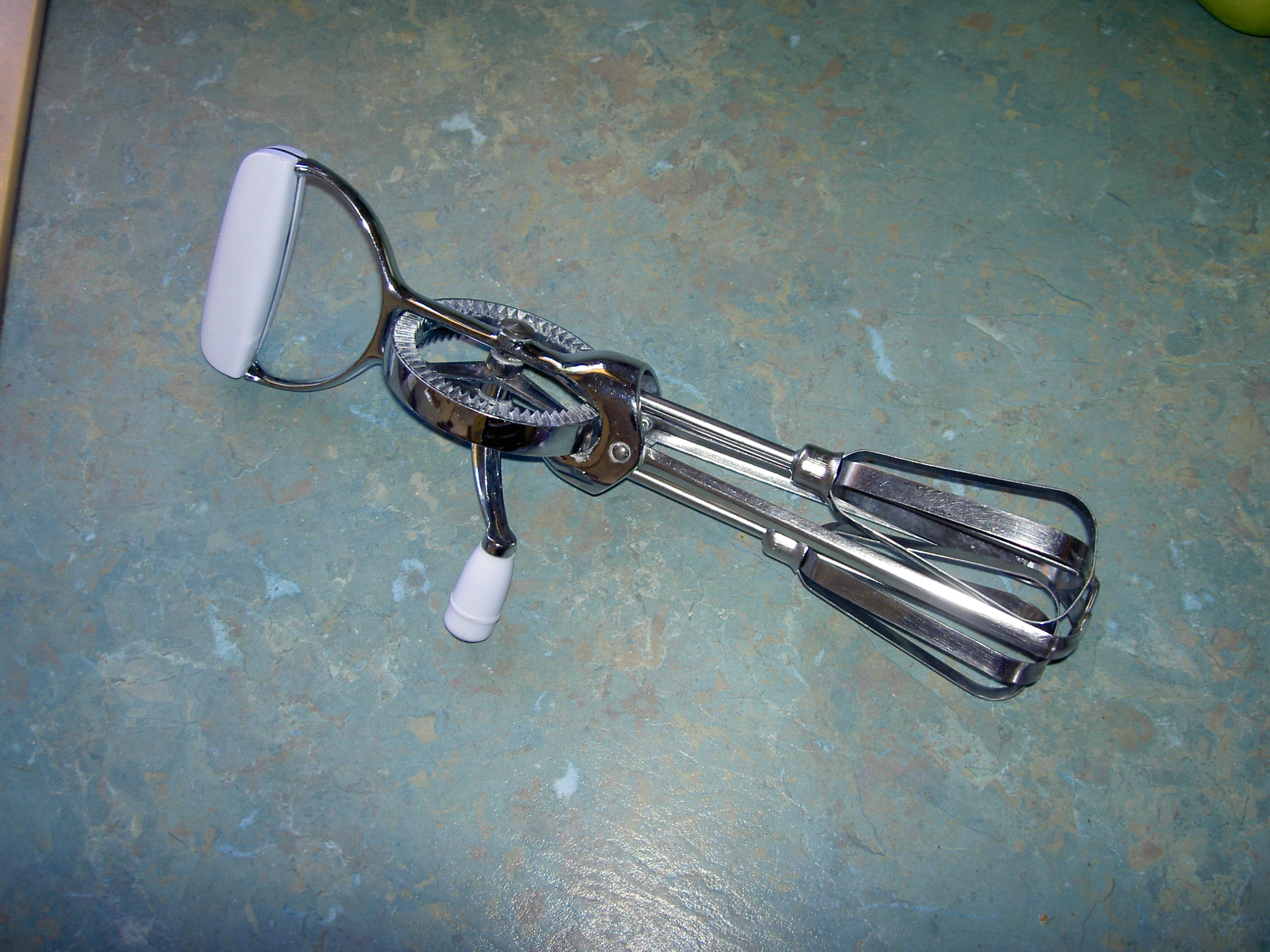
But we are not totally whisk-less, as we do have a very old-fashioned mechanical egg beater! There is a small veranda on two sides of the unit, and a generous car-port—-but not quite generous enough to accommodate two cars. The resort has an outdoor swimming pool, and indoor spa, a games room, and an adults-only child-free lounge with comfortable arm-chairs, squash court, and the like. There are 4 tennis courts, and a full length golf driving range. However, the grass could be cut a little shorter, as it was pretty difficult to locate the balls! The only complaint I would make so far, has been the noise of the infernal jet-skis, whose brainless owners zoom around the lake for hours on end, going nowhere, but shattering the peace and tranquillity that should be sacrosanct. In these days of anthropomorphic global climate disruption through too much in the way of carbon emissions from fossil fuels, these jet-skis should be totally banned as useless, unproductive machines that turn petrol into noise.

One drawback of the Resort, is that it is some 12k from the town, which means getting into the car and driving to get a coffee, rather than walking.

More Sketches of Mansfield when I have had time to explore more of the area, including getting into the nearby Delatite River for  spot of fly-fishing!.


Sketches of Lorne

Sketches of Lorne, Two

June 27, 2017

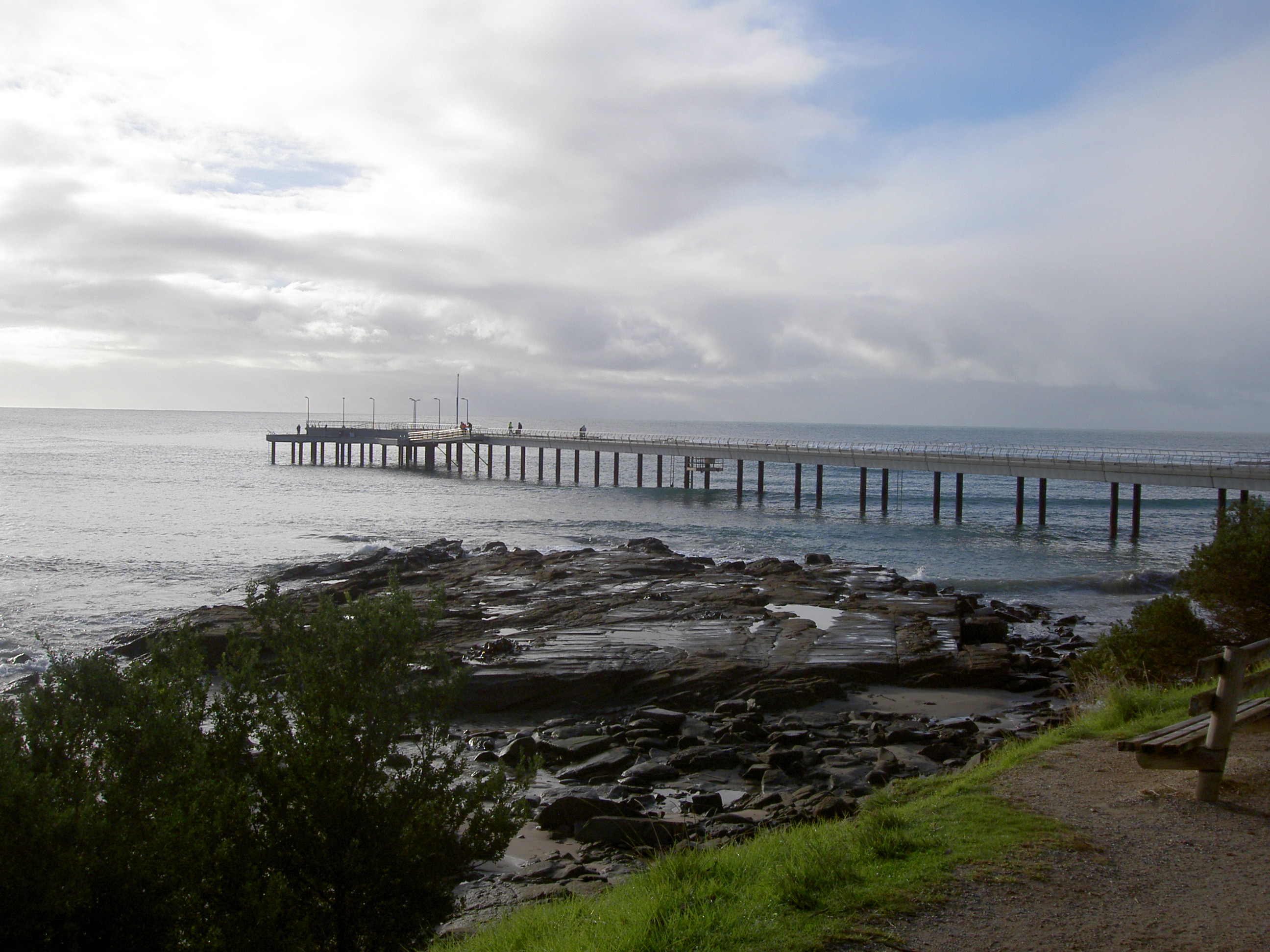
Our walk to the main centre of Lorne starts as we join a walking track that passes the Lorne Pier. Where the path actually starts, I have no idea, but it is somewhere off to the west, maybe even as far west as Portland. But we join it at the pier.

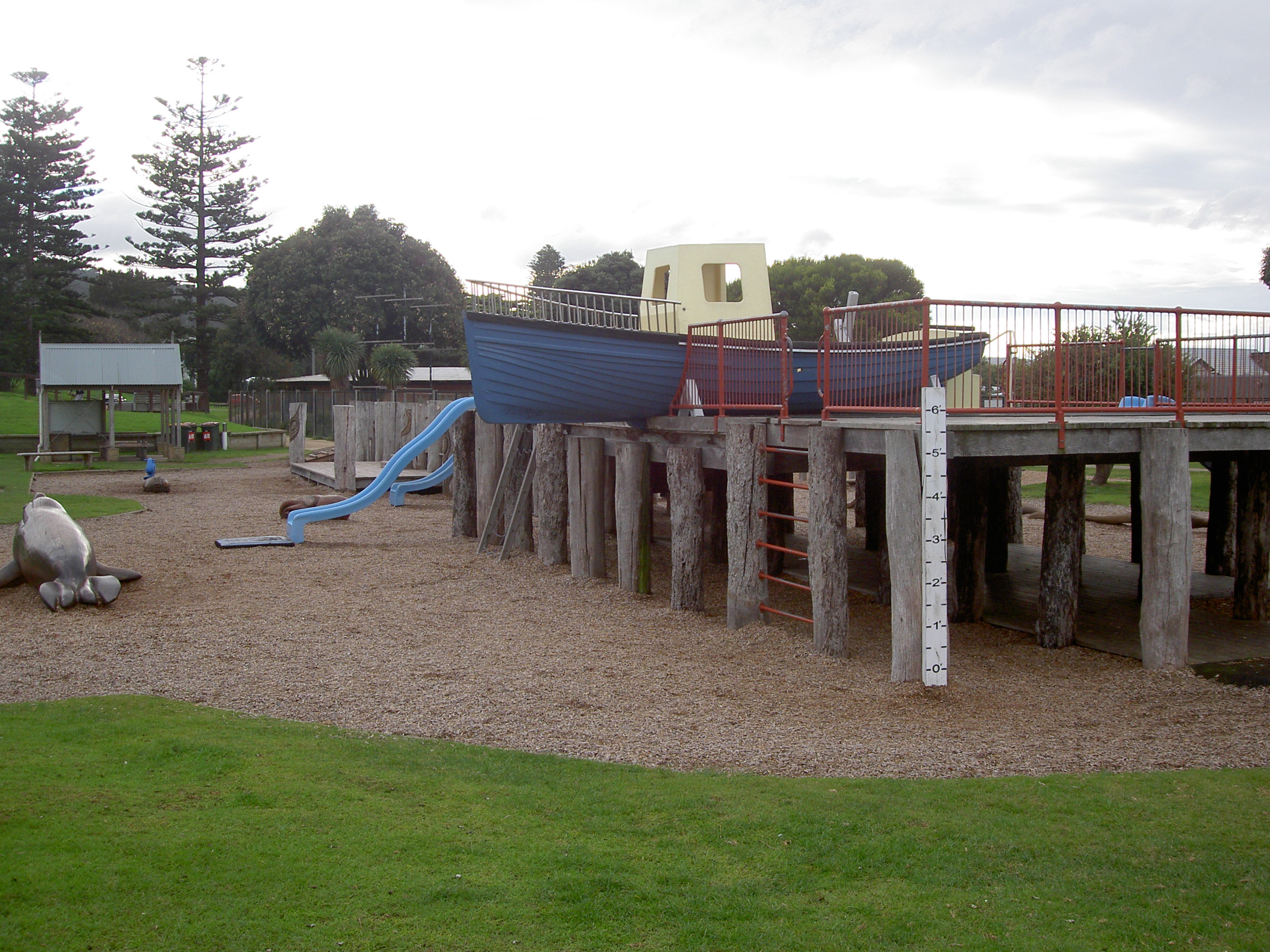
Lorne now has a new pier completed in April 2007, following some 127 years of construction, strengthening, and partial rebuilds of the old pier, now straight, now L-shaped and at one time triangular. Of the old pier, there is very little remaining, and it scarcely reaches the water today. Many of its old piles were relocated and used in the construction of the adventure playground on the foreshore in town; and all of the old cranes that were used to lift the fishing boats out of the water (as it was not safe to leave them simply moored to the pier overnight), have gone along with the fishing fleet which no longer exists.

Old Pier, now a playground
New Pier, Lorne

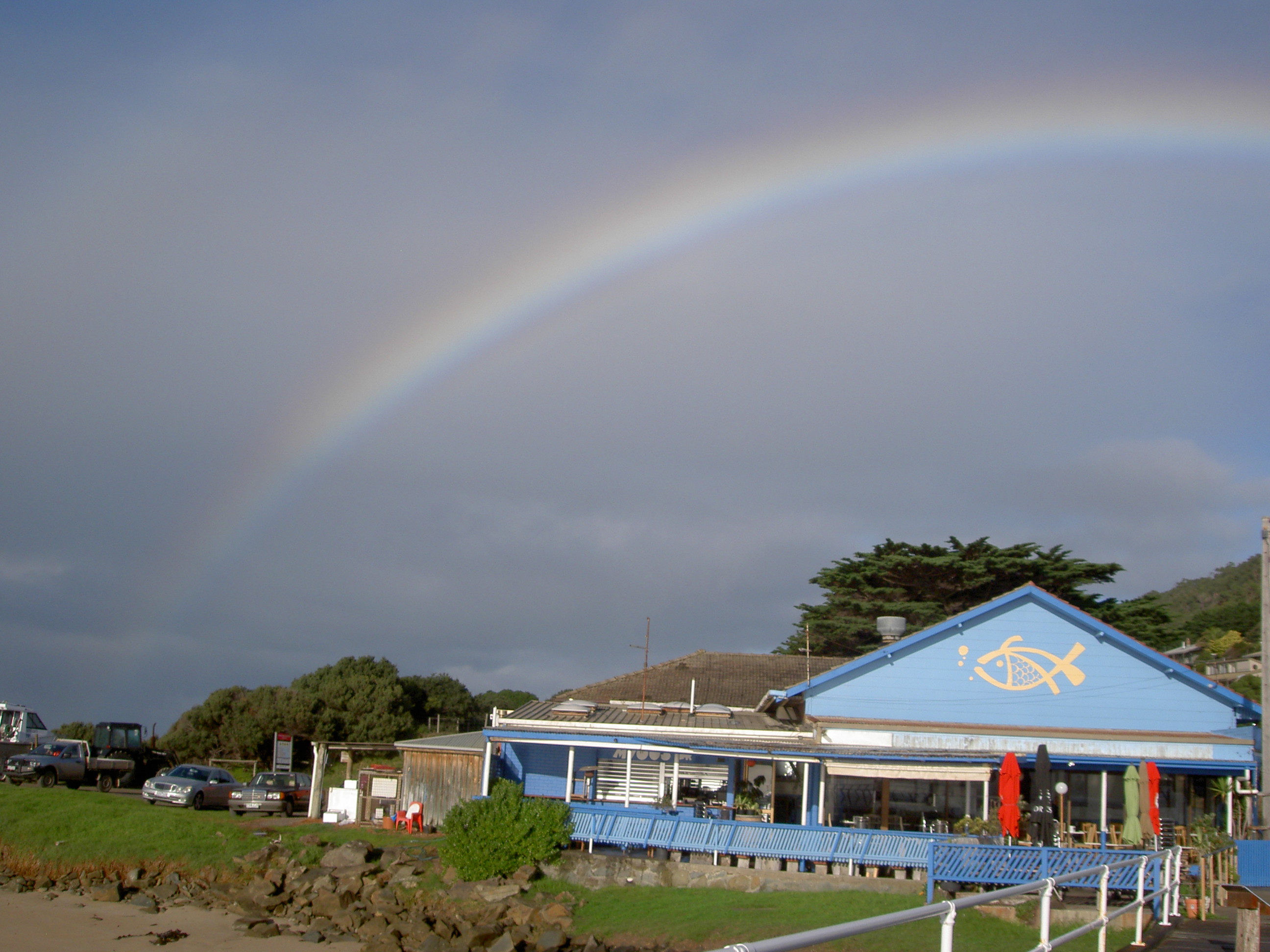
Now the new pier is used mostly for recreational fishing, and as the jumping off point for the annual ‘Pier to Pub’ swimming race. There were about six or seven weather-beaten locals fishing from the pier as we arrived, and as usual, the number of people trying to catch fish was greater than the number of fish actually caught. Whether this lack of success has anything to do with the huge seal, Sammy, who lives under the pier, is debatable, but quite possible. It was pretty cold, but the sun was shining, and as proof, I offer the attached photograph of a rainbow over the seafood restaurant at the pier.

Rainbow over the Pier restaurant

The pier is also one of 16 spots around the coast of Australia providing data on sea level, temperature, salinity etc. to an international database of oceanic conditions. Since Lorne has been involved, records indicate that the sea level at this recording station has risen by a steady 1.7mm per year. If this continues, it will not be long before some very prime real estate on the foreshore of Lorne becomes not so prime. Already there is very little beach left dry at high tide, and there are obvious signs of sea water moving more than perhaps is necessary up some of the walkways leading from carparks to the beach.

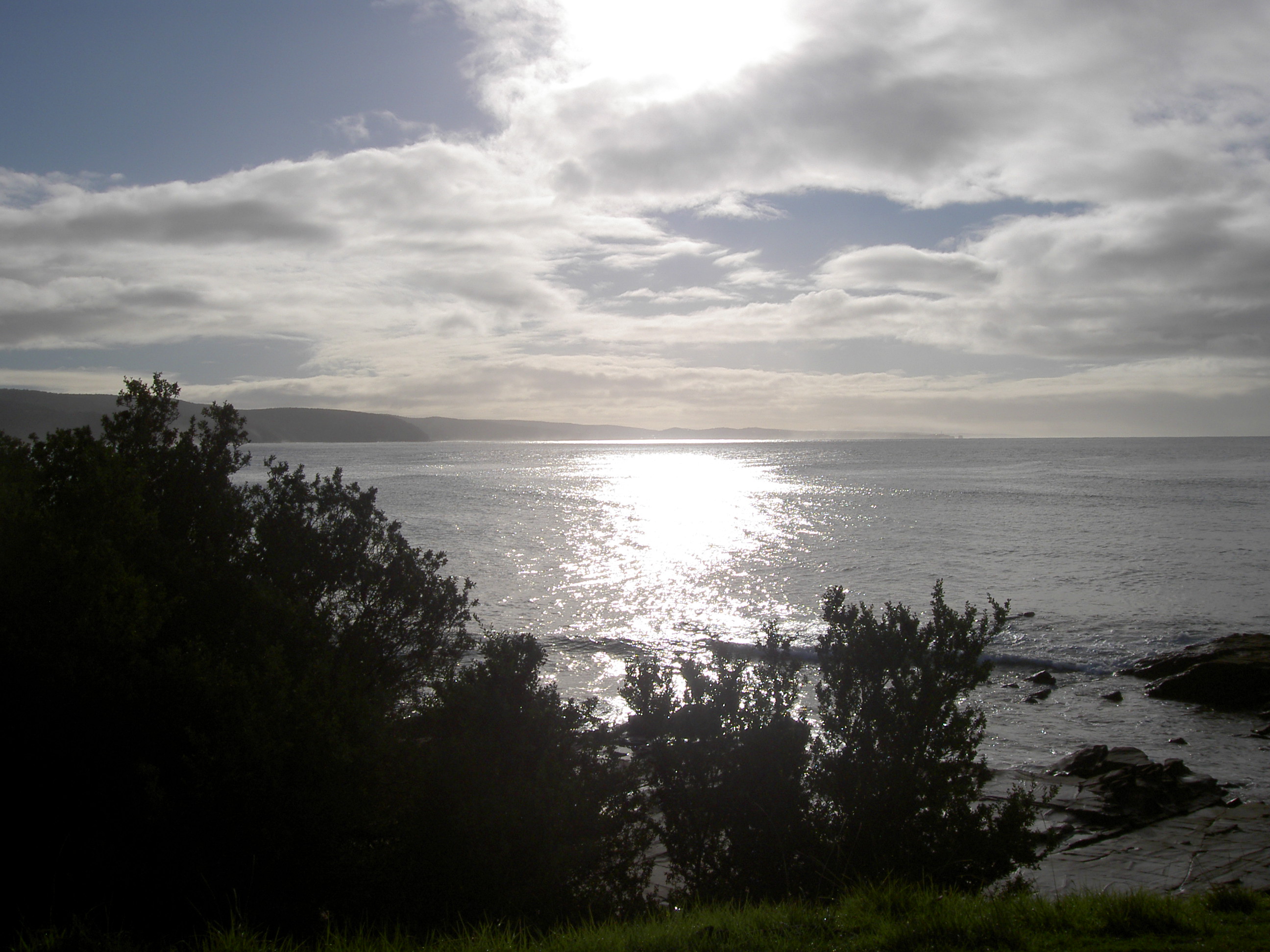
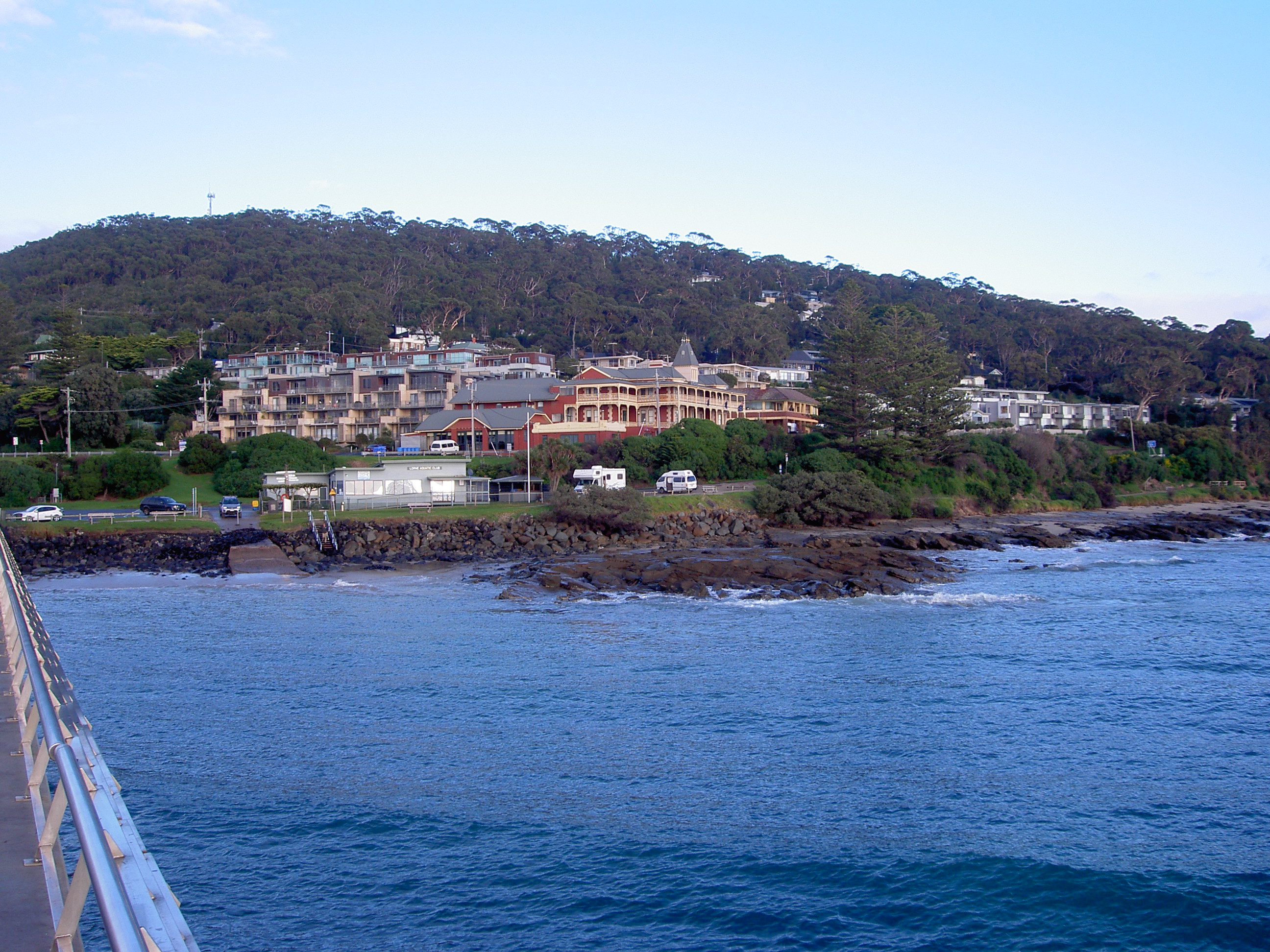
It is said of the sea that it is always changing but always the same, and as we walked along the pier, and then along the path toward the town, the sea changed from silver to bright blue depending on our point of view.

Silver Sea


Blue Sea, with Grand Pacific Hotel in background

The walk to town is about 20 minutes, and of course by the time we got there we needed a good coffee. From a previous visit to Lorne we remembered a very nice shop near the road bridge over the Erskine River, which sold good organic fruit and vegies, excellent artisanal smallgoods such as salami and ham, and also made good coffee. So we bent our steps in that direction, but found that it was now an Italian restaurant, and was not actually open so early in the morning. But not far away, we did find a very small café that fortunately did make excellent coffee. Fortified, we crossed the Erskine River to find where it entered the bay.

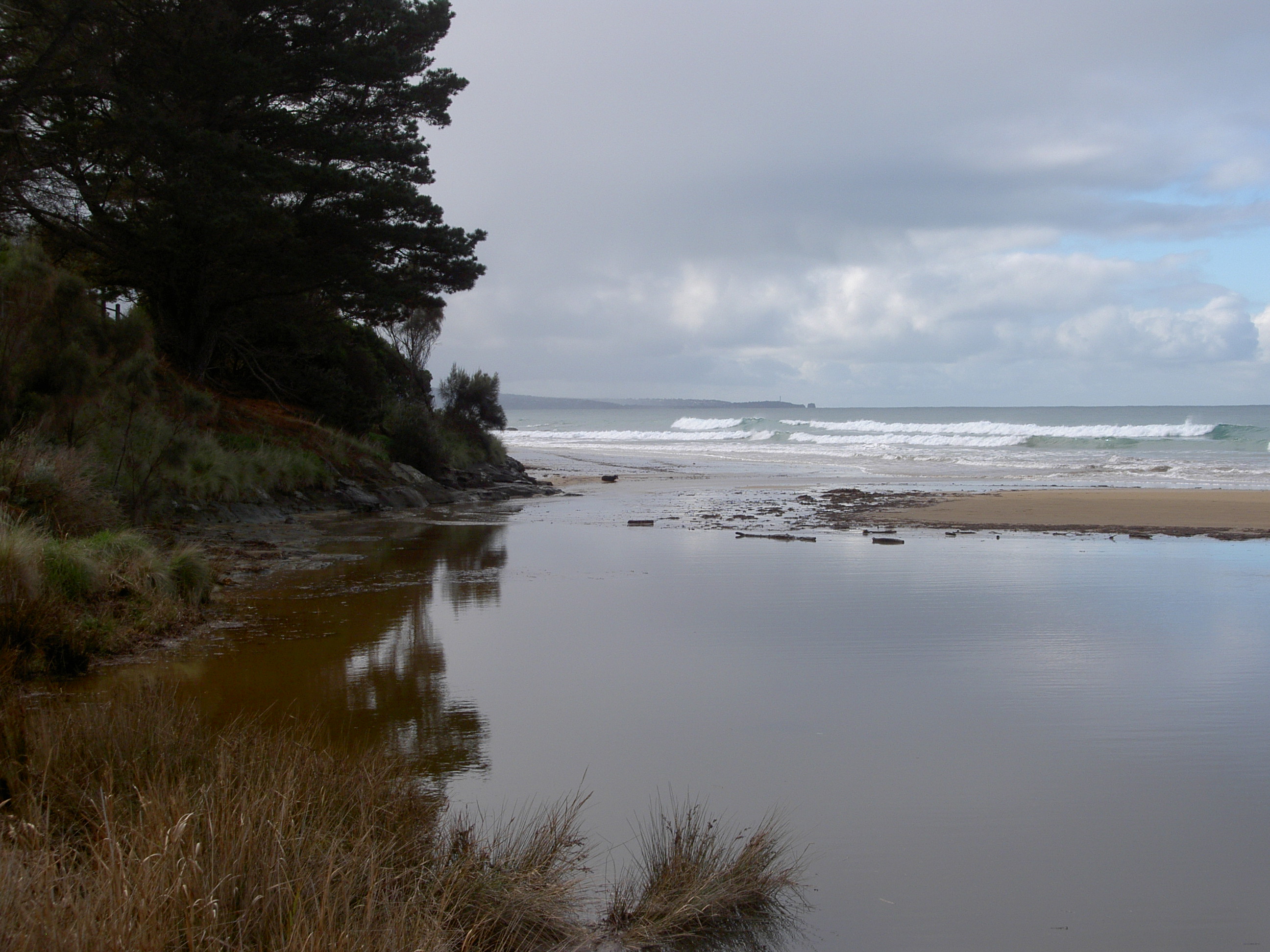
Erskine River, near the mouth

At the bridge, both upstream and downstream the river appears to be quite large. But it is mostly a very long thin lake, as the river barely has the strength to cross the sand and stagger into the ocean! As it happened, the tide was coming in, and we were amused to see a dog having a great deal of fun chasing the occasional ripple that did actually make its way over the sandbar and get a metre or two up the river before it petered out, leaving the very bewildered dog wondering where his plaything had gone.

Mouth of Erskine River

Between the path beside the river and the road, hidden in some straggly bushes and protected by metal railings, is a small grave. The tombstone reads:-

“In Memory of William Firth Lindsay, aged 8 years,

and Joseph Southwell Lindsay, aged 4 years,

drowned in River Erskine 28 Jan, 1850”.


There is an explanatory plaque which reads:-


“Two sons of a splitter whose hut stood on the hillside above – drowned in a quicksand while at play and buried here next day”


Of course in those days the population was next to nothing, and there would have been no-one around to hear their desperate screams as they panicked and struggled to escape from the quicksand while the tide came in and drowned them. Their father, William Lindsay, was the first European settler in the area, arriving here in 1849, only a year before this tragic accident and 21 years before the place even got a name! Subdivision did not start until 1869; the place was named Lorne in 1871; and a post office was opened in 1874. Overland access was a very rough track from the north, via Winchelsea, a distance of nearly 40k, and taking several days. Accordingly, most of the supplies were brought in by coastal vessels, which also took away the timber on which the growing population depended. But there was no safe harbour, so the vessels were simply beached on the falling tide, unloaded their goods, and re-floated on the next high tide. However, some, like the ketch Henry misjudged the rise and fall, and got stuck. In Henry’s case, the mistake proved fatal, as a violent storm blew in the following day and reduced the boat to matchsticks. Fortunately nobody was injured. The coastal shipping ended when the road, now known as The Great Ocean Road, arrived at Lorne in 1922. Whilst some tourism had been going on since the late 1800s, the coming of the road gave a huge boost to what has become a major tourist industry for the whole of Victoria’s west coast.

Today the resident population of Lorne is just over 1000, rising to something of the order of 13,000 over the summer, especially at New Year’s Eve when the Falls Festival takes place. And on the first weekend of January each year, more than 20,000 people come to watch the annual Pier to Pub Swim, listed in the Guinness Book of Records as “The largest organised ocean swim in the world”. The actual number of swimmers is now capped at 4,000, which to me seems an awful lot! The same weekend hosts the annual 8km Mountain to Surf Run, and the Lorne Surf Boat Race. So there is plenty on for the holiday makers in the summer. To accommodate the great influx of holiday makers, of course there have been massive developments of apartments and the like, one of which we are currently staying in. But it does mean that for about 75% of the year, about 75% of the total accommodation is unoccupied.


But what about winter? Well, we found that there are plenty of cafés and bakeries all doing a good trade. Even the ice cream shop was doing pretty well as we walked past despite the fact that the temperature was only about 100C. There is a surf shop or two, a hardware shop that also sells fishing gear, a pharmacy, an op-shop and a filling station. Apart from the small supermarket, there is nowhere to buy meat, fruit and vegies or small goods. There used to be a very good second-hand bookshop, where, on a previous visit I purchased a first edition set of bound volumes of Charles Dickens’s Master Humphrey’s Clock. Unfortunately that shop is no longer there. The shop itself is, but it is now a vacant shell.  However, nearby there is a shop that sells wine, but into which I have not ventured given my current abstemious approach to alcohol. But in the window of said shop was a notice advertising “Bach to the Bush”—a programme of works for solo cello by J S Bach. Now as most of my friends well know, I am not a member of the Universal Bach Fan Club, but as it was to be held that very afternoon, at the Qdos Art Gallery, “tickets on the web or at the door $25.00 concession”, we decided to pop along! The cellist was a young man, Anthony Albrecht, who completed his undergraduate music studies at Newcastle (NSW) University, followed by postgraduate studies at Juilliard School in New York, and now based in London. He had put his whole tour together specifically to bring his cello and his music to smaller towns across the whole of Australia, as well as the major centres. Having already been to Mt Gambier, Port Fairy and several other places well west of Melbourne, he was following the Lorne gig by heading to Canberra, then to Healesville, Olinda, Warranwood, Melbourne, Girgarre, Beechworth, and many other places I had not even heard of, before ending up with a recital in Cairns in August. A very punishing schedule! Qdos Art Gallery is a lovely place for a recital. It is newish, intimate, and an interesting building some 3 k from the centre of Lorne, very much out in the bush. And as for the recital?  It was played brilliantly—but it was still Bach.


Qdos Art Gallery also has a nice licensed café, but signs warning one to take care of one’s lunch as meals stolen by kookaburras would not be replaced, indicated just how dangerous the bush can be.

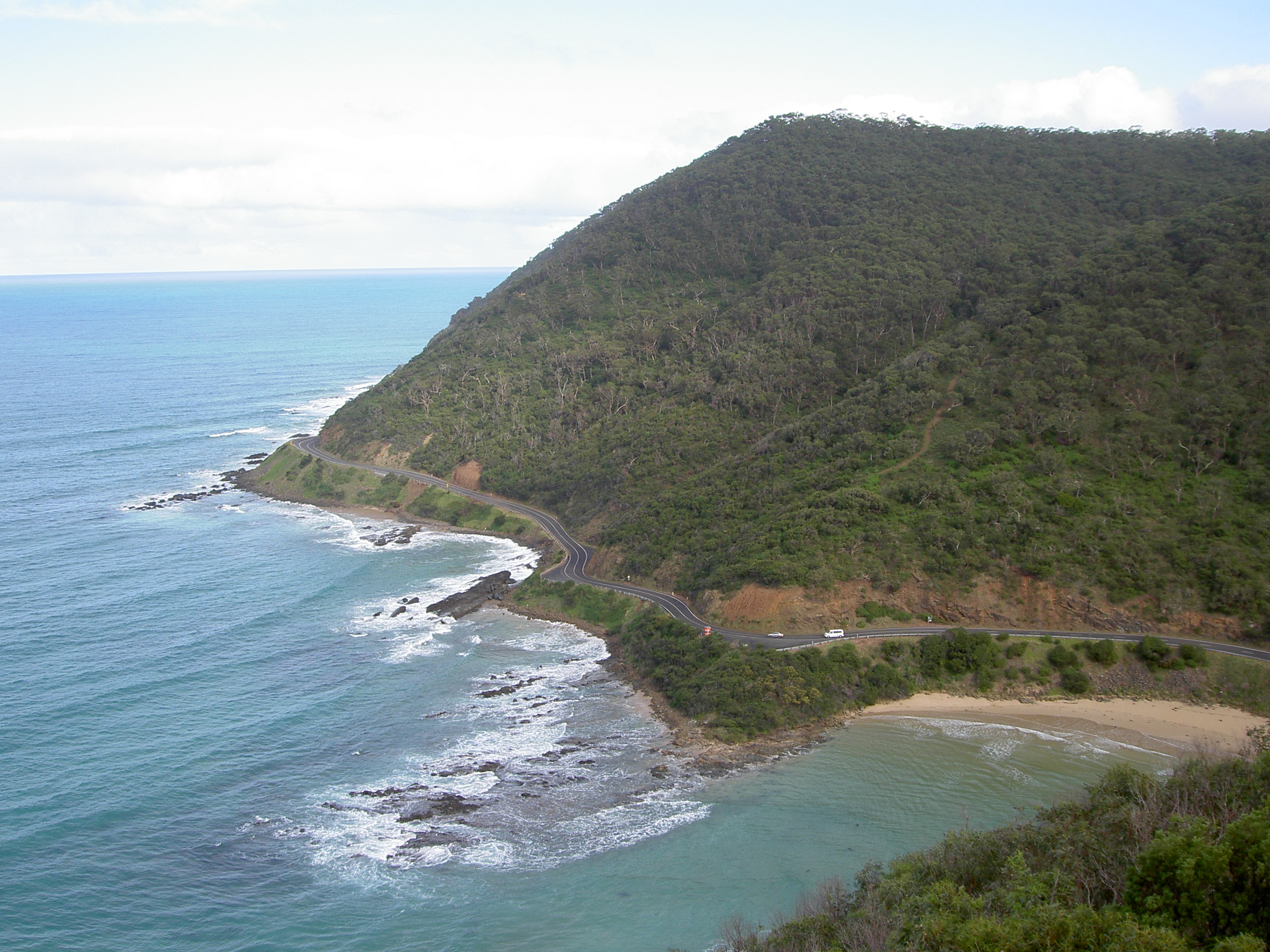
From Teddy’s Lookout

Before we arrived at the gallery, we went, for no reason other than we took a wrong turn, to Teddy’s Lookout. From here one can look down at the Great Ocean Road from a great height, and get some lovely views of the ocean and of the hinterland. I had hoped that maybe it looked down over Lorne itself, but unfortunately it was just a bit too far away for that—-but worth the detour nevertheless.


The next edition of the blog will be about the trip along the Great Ocean Road to Apollo Bay and beyond.


Sketches of Lorne


We had talked about, and had thought about, going to Port Douglas in far north Queensland for a couple of weeks in late June and early July to escape the Melbourne winter weather. But we talked too much, and thought too long, and as the last week of June approached, we realized we were not going to make it! Maybe it was our procrastinating natures, or maybe just the thought of making bookings for accommodation, arranging air flights, stuffing around getting to the airport and the hassles of checking in the baggage etc, that eventually led to us putting it all in the too hard basket, and settling for a week at Lorne, on the south western coast of Victoria. So instead of going as far north as we could, we ended up going just about as far south as we could without actually leaving the mainland. In part we felt justified, as the weather over the last two or three weeks had been really lovely.

So we set off on the morning of Saturday June 24 2017. It was a bright sunny morning, and we stopped at Anglesea for an excellent coffee at a place called, I think, The General Store and Café.

Anglesea

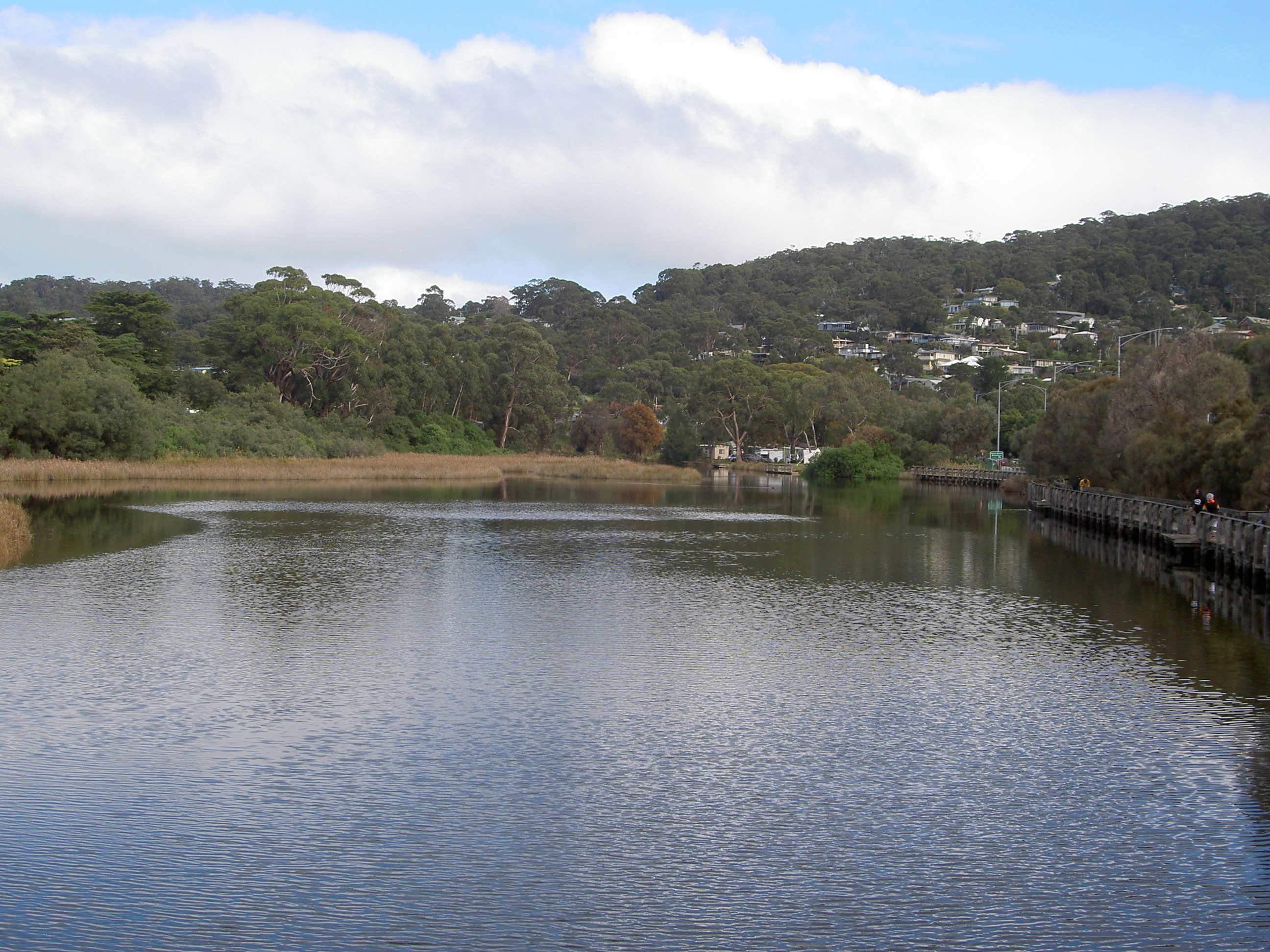
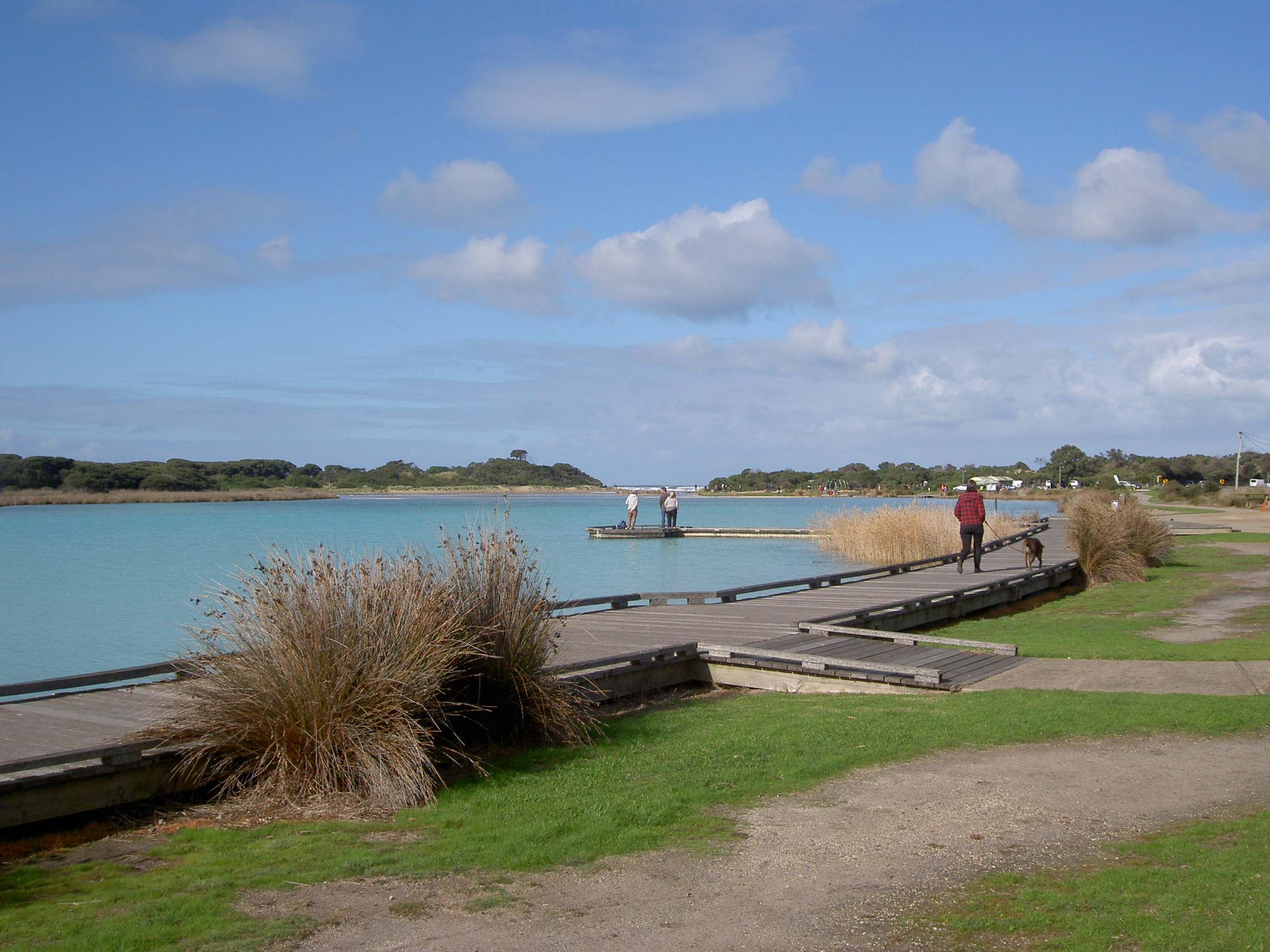
Blue sky, bright sunshine, no wind, the water in the inlet like a mirror. Who needs to go to far north Queensland?

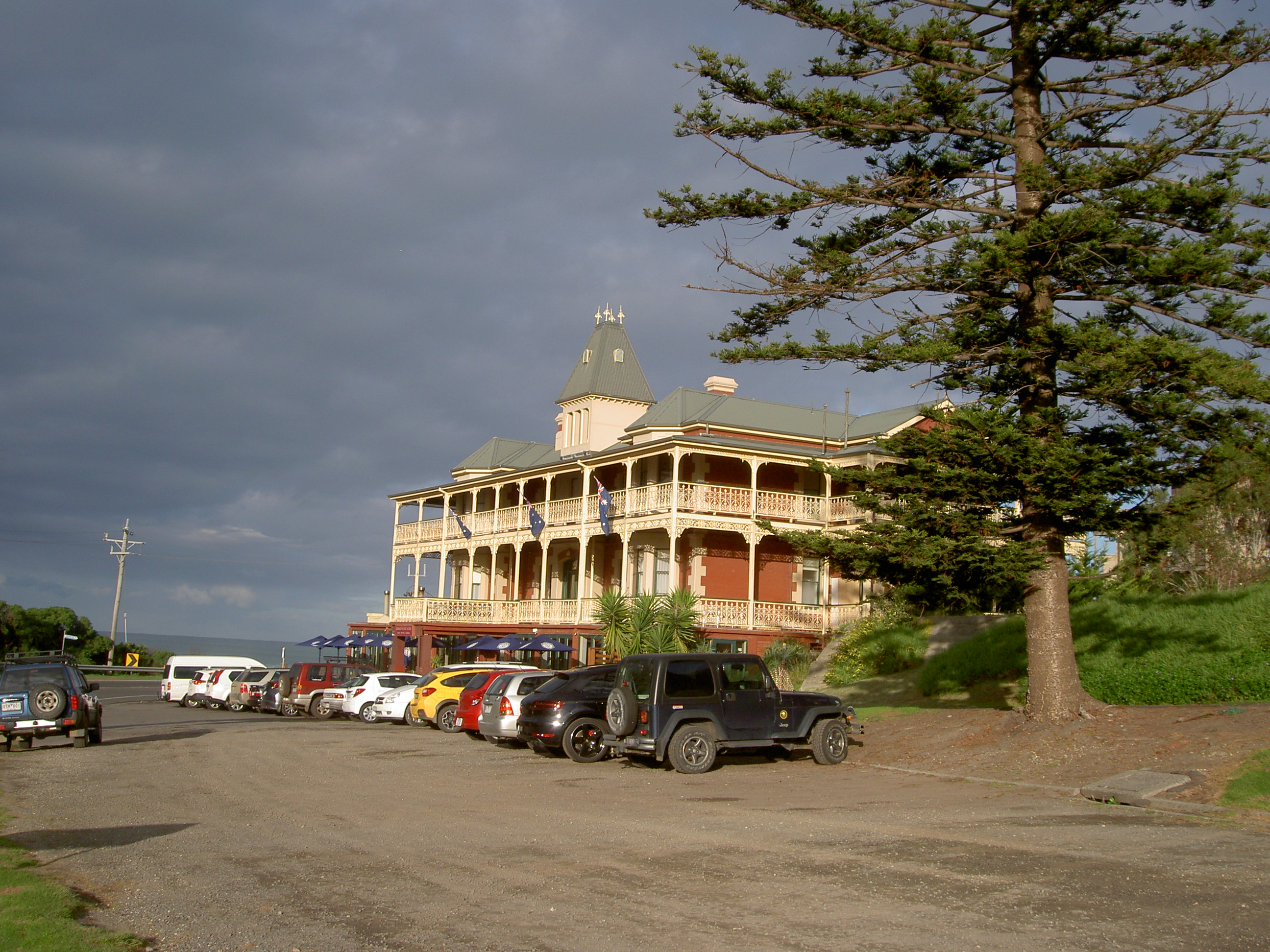
Anyway, we had booked a room, with a balcony, at the historic Grand Pacific Hotel at Lorne. Built in 1875 this hotel has wonderful balconies, decorated with some splendid wrought iron lace work, and it overlooks the bay fairly close to the Lorne Pier.

Grand Pacific Hotel, Lorne


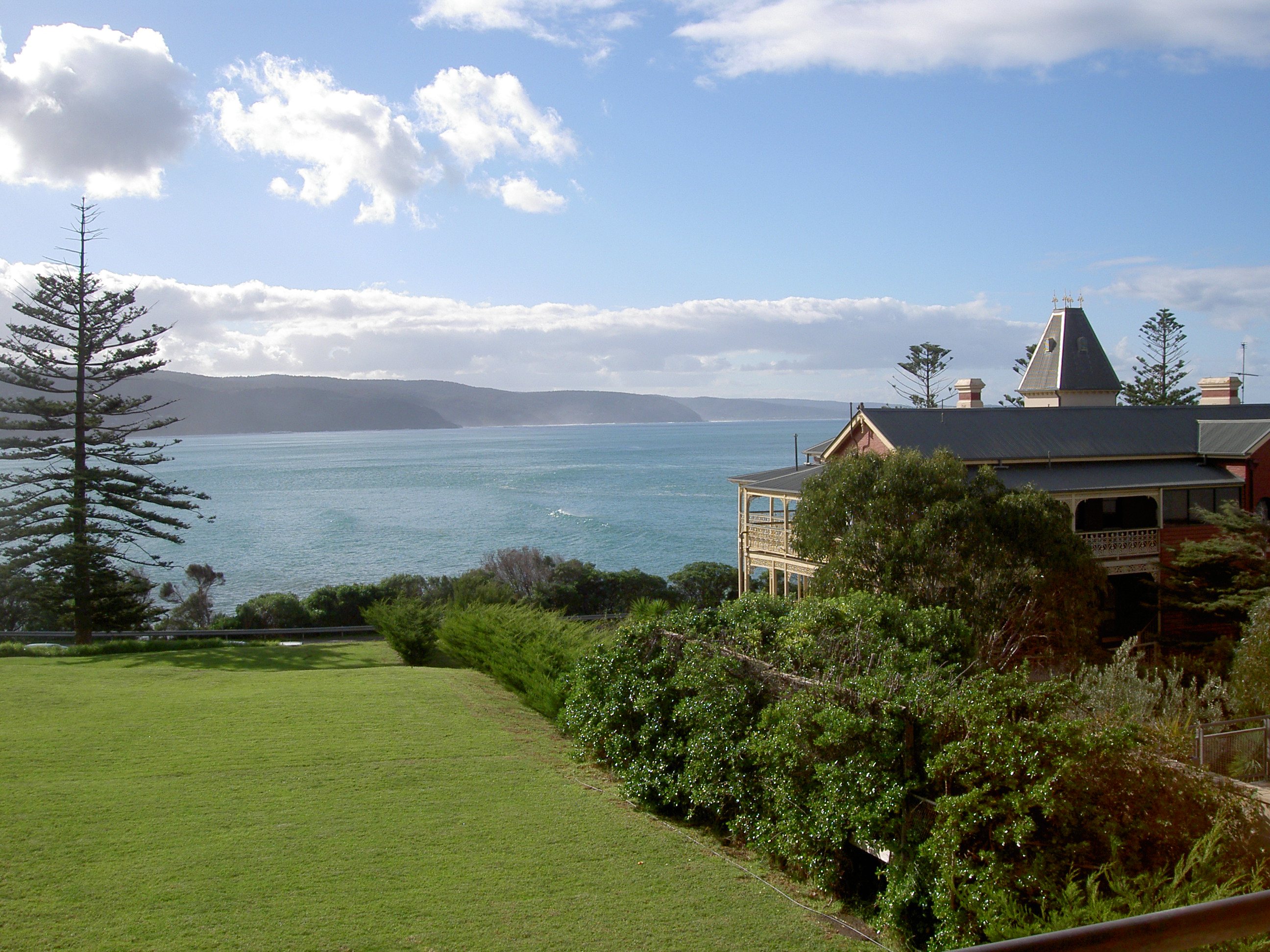
Arrived at the hotel we were met by a very pleasant young lady who told us all about the accommodation and it facilities. Here we found that our room had only a double bed, and given our age, and the need for technology-assisted sleeping, we decided that twin beds would be infinitely preferable. However, there were no twin rooms available, but the young lady could offer us an apartment which had two bedrooms. So we parted with a few more dollars and ‘upgraded’. As it happened, the apartment had a balcony with ocean views, whereas the balcony on the original room looked inland—so we were doubly happy with the change. The young lady presented us with a key, and a map to show us the way to the carpark and the apartment—-which was just behind, and to one side of, the main hotel building, a distance of the order of 50 meters. It hardly needed a map, especially as I had Satnav anyway!  The view from the apartment was just as we imagined it would be—very spectacular.

View from apartment balcony

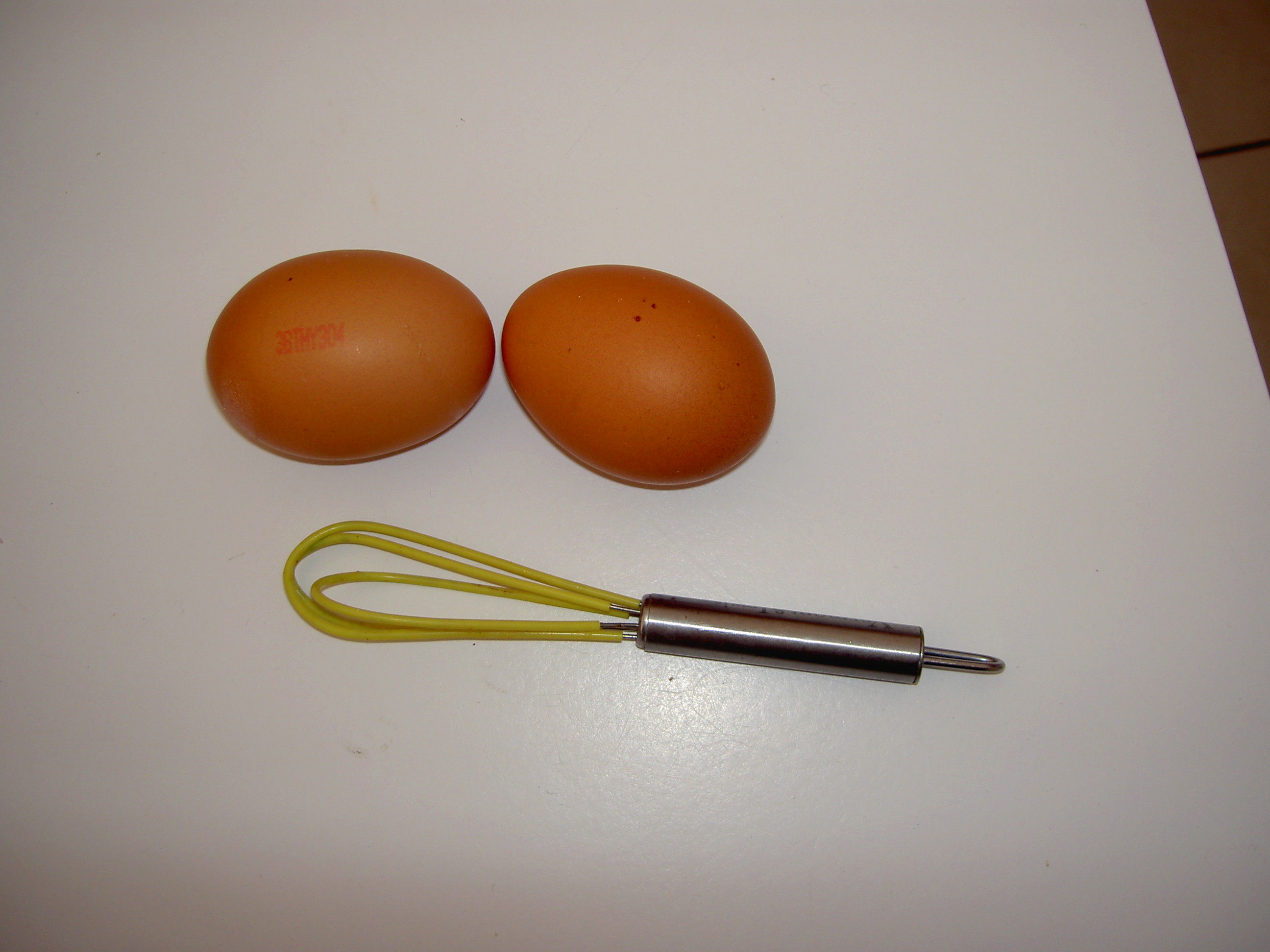
 The apartment itself was very well appointed, but it could do with a second comfortable reclining chair; and I must say that the balloon whisk left a lot to be desired! I had planned on cooking omelettes for tea, but quickly realised that the whisk would have been no match for a couple of robust Otway free-range eggs! So we went to one of the many local bakery shops in town and bought a couple of pies.

Balloon whisk!

It also took quite a long time to work out the machinations of the electric oven and its associated hobs—the controls for which were all the direct opposite of our stove at home.

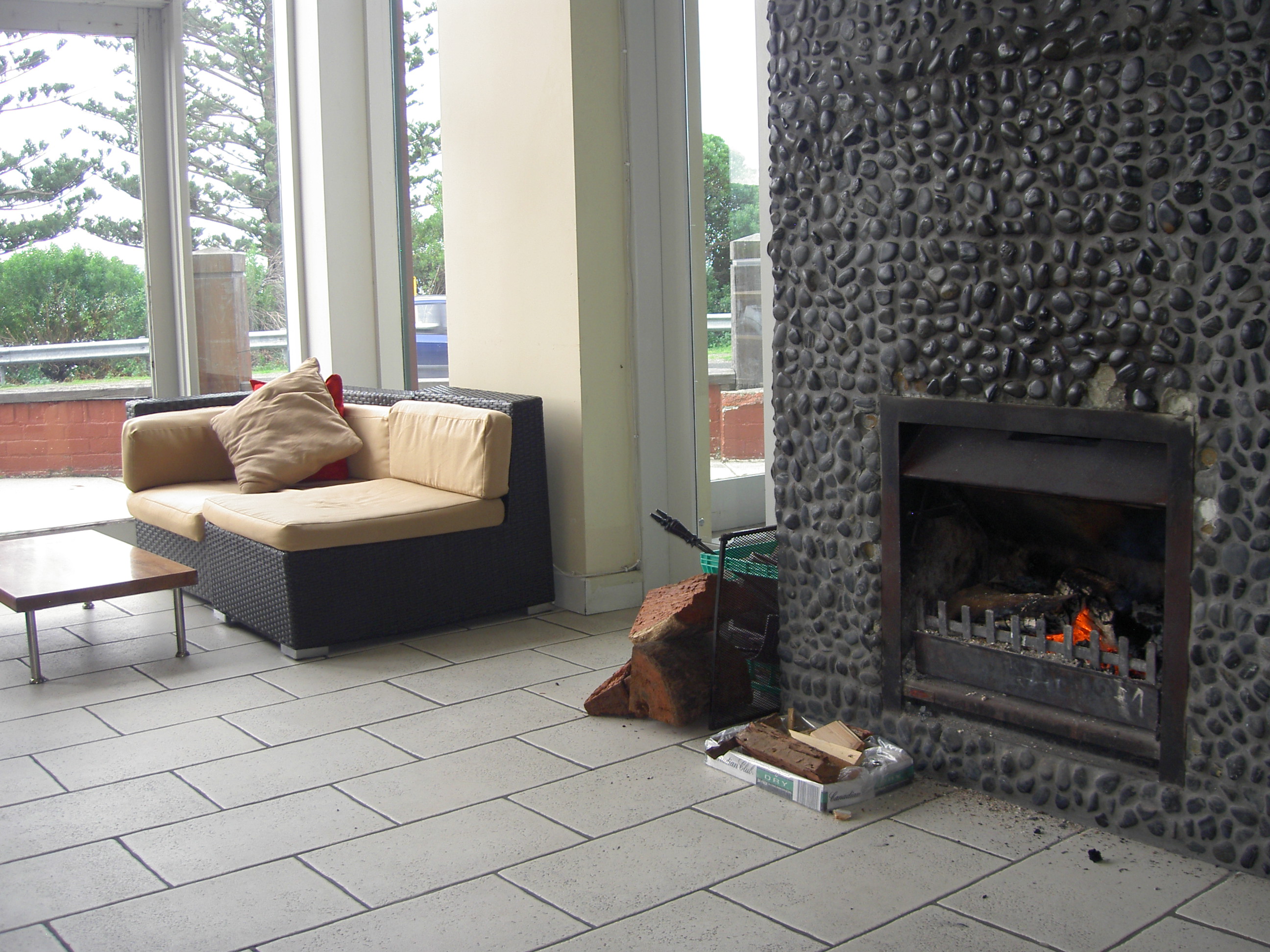
We had a very pleasant 30 minute stroll into the town, stopping now and then to scan the bay for the presence of whales and to admire the skills of the many surfers out in the waves. To me, they (that is the surfers, not the whales, of which there were none) all seemed a bit too close to the rocks, but as far as we could tell, no one ended up with a cracked skull. On our return to the hotel, ‘Happy Hour’ was about to start! Having installed Ann in the chimney corner by an open log fire, I ordered a pot of tea to be taken to her whilst I took the shopping up to the apartment. Whilst I was there, Ann sent a text message with the bad news that the television in the chimney corner had been switched on! When I got back to the little lounge, I found only one other couple ensconced there, and thankfully they indicated that they would also prefer the television off! So at the bar, as well as ordering my cheap ‘happy hour beer’, I requested the television be turned off. The young man behind the bar seemed to have some difficulty understanding what I thought was a pretty simply request, so he had to refer it to a young lady, perhaps one having more authority than he. She too appeared to have some difficulty understanding why on earth anyone would want the television turned off. However, I persevered, and our request was eventually granted. I have never understood why bars and cafés have these monstrous television sets going all the time, when no-one watches them anyway. But asking to have them turned off always seems to be greeted with disbelief, if not outright hostility, on the part of the staff. Anyway, it was turned off and it was quite pleasant in the little nook—-but it really could have done with some more comfortable furniture. From the exterior, the hotel promises something quite grand—as its name implies—but inside, it is much like every other pub! When we were in France a few years ago, we always stopped at 2-star shabby-genteel hotels, which were clean, comfortable and full of character, and could only have been in France. Here we have a 4-star hotel that could so easily have been made so much more interesting and charming, but which disappointingly fell at the last hurdle. Whilst the dining room, labelled ‘The Bistro’, was rather pleasant and not out of character, the little lounge was furnished with some modern square seats which were not particularly comfortable, and some peculiar modern tables, which were easily mistaken for additional seating. And the log fire was more like a gas-fired imitation log fire, that actually being a real log fire!

Small lounge

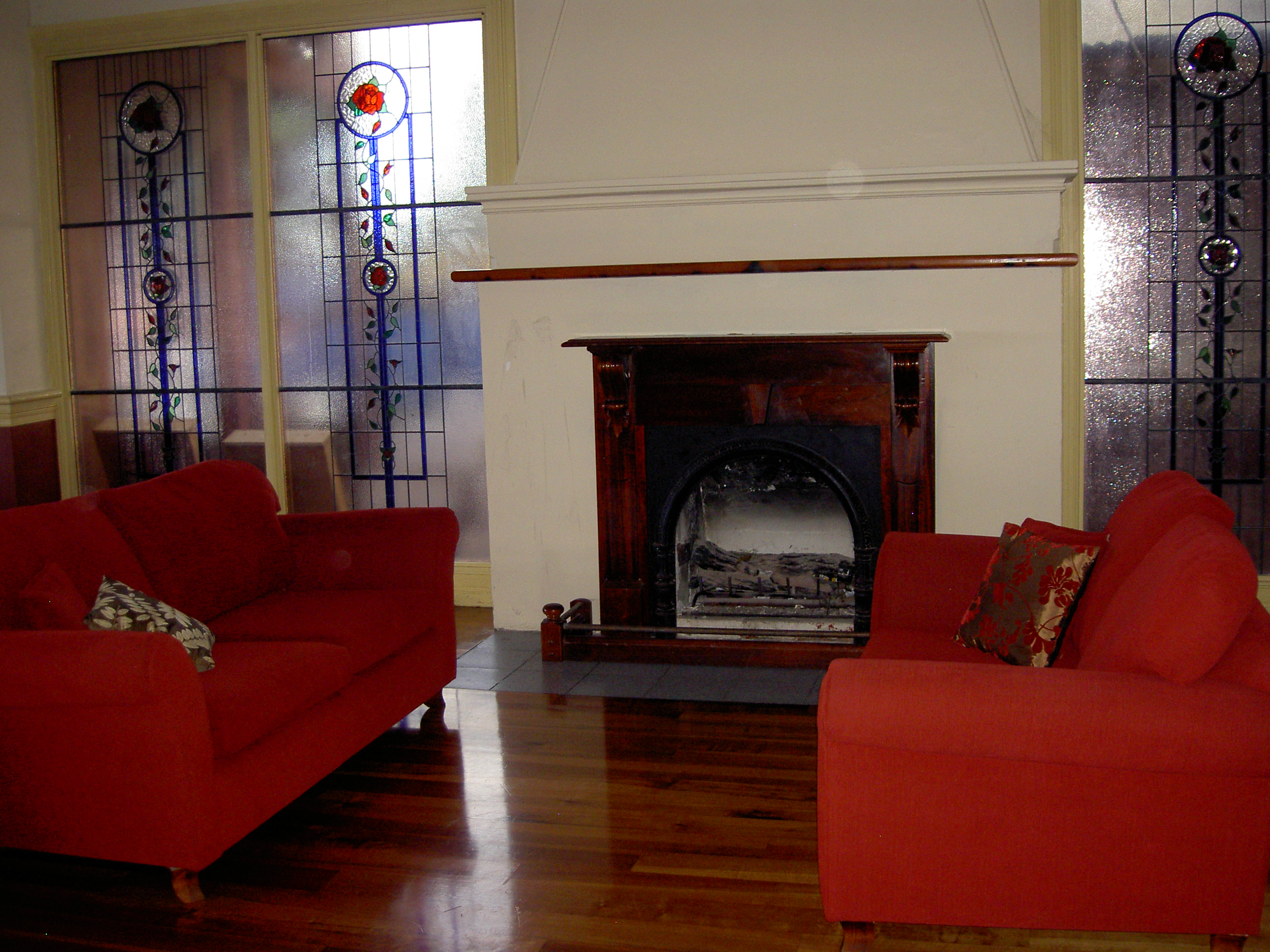
In another, much larger room currently not being used, there was some charming stained glass paneling, a real old-fashioned open log fire, and a few shabby, but comfortable arm chairs—–much more to our taste, and well and truly in the ‘shabby genteel’ style!

Large Loungeroom

It is a great pity that the small lounge had been ‘modernised’ and is now completely out of character compared to the rest of the building.

But the beds in the apartment were very comfortable, and we both enjoyed a good night’s sleep. Waking in the morning, it was overcast, but by 9.00 the clouds had gone, and the sun, like Mr Pickwick, had also risen and was once again there in all his glory. However, the Bureau of Meteorology site advised that the current temperature was 7.7, but felt like 3.8 —-maybe we should have gone north!

Well, that, I think, is more than enough about the accommodation. The next blog will be a bit more about Lorne and its attractions.